

Motorhome Layouts Guide
Buying advice
Motorhome layouts guide
The layout is the easiest aspect to get wrong if you’re new to motorhomes, so don’t rush in. Ever wondered why you see almost-new ’vans traded in with a handful of miles?
Those buyers probably bought the wrong layout for their needs – and may have paid dearly when part-exchanging for something more suitable.
Whatever size or price of motorhome you want, choosing the perfect layout for your motorhome is possibly the most vital decision you'll make.
Our guide will help you choose the right motorhome layout that best suits your lifestyle and needs.

Rachel Scholes Content Editor: Motorhomes
Rachel Scholes Content Editor: Motorhomes
Watch our essential guide to motorhome layouts


Layout is the most important thing
The layout (otherwise called the floorplan) of any motorhome is probably the main reason why you’ll want to buy it, or not.
It’s far more important than décor, or details like the upholstery, and much more crucial than any discount being offered, however tempting.
It’s so easy to think you need to make a quick decision before you miss out. But tread carefully – those one-owner, ultra-low mileage motorhomes you see on dealer forecourts are usually there because someone chose the wrong layout.
And, although motorhomes are known to retain a strong residual value, the biggest loss is always immediately after registering a brand-new 'van. You don’t want to be asking about part-exchange prices when your motorhome still has that new vehicle smell.
Island bed motorhome layouts
So, you want a permanent double bed in your motorhome, but you can’t live with the access issues posed by a French bed or transverse double layout (see below)? This is the answer. Easily accessible from both sides.


French bed motorhome layouts
A French bed refers to a fixed double bed arranged lengthways against a side wall of the motorhome, either offside or nearside.
The design is most commonly seen installed inside low-profile motorhomes.
Transverse bed motorhome layouts
A transverse bed motorhome layout is as much about the storage below the bed as the bed itself.
Usually found in compact low-profile motorhomes, where they will often boast some of the most spacious garage storage.


Single bed motorhome layouts
If you’re planning to motorhome in hot places then single beds might be more appealing than a double.
Or you want flexibility for use of your motorhome by different family members or friends. If so, then this may be your answer.
Bunk bed motorhome layouts
If you’re looking for a family motorhome, especially for travelling with younger kids, bunk bed layouts are streets ahead of any other layout.
These offering private sleeping spaces in a compact yet comfortable format. Look at storage in the bunk bed area and consider lounging carefully...
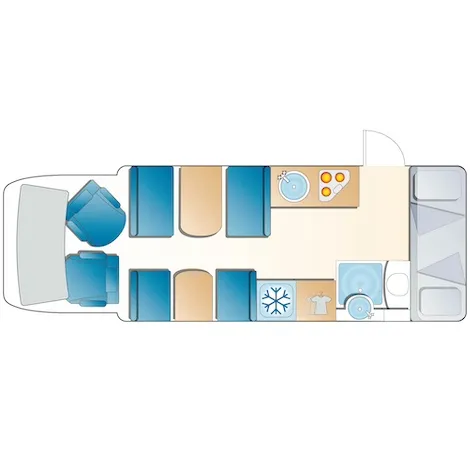

Front lounge motorhome layouts
These motorhome layouts are without a fixed bed, so you’ll need to convert seats to beds at night, unless the main bed is a drop-down type.
Drop-down beds, however, have transformed this sector, proving extremely popular on the continent.
This means that there is now a much greater choice in compact motorhomes...
Rear lounge motorhome layouts
Rear lounge motorhome designs usually major on plenty of relaxation space and great views out through big windows on three sides.
If you’re a former caravanner, this format may look appealingly familiar, providing great space.


Twin lounge motorhome layouts
If you’ve been tempted by a rear lounge motorhome, but need more than two travel seats, here’s a solution.
The twin lounge motorhome has been around for decades, so there’s plenty of choice for all budgets. Ideal for families or you just want more room to sprawl.
Motorhome layout FAQs
-
Fixed bed or not fixed bed?
You can find fixed beds in a number of compact coachbuilts, some only 6m long. However, as you move into larger coachbuilts of 7.5m or more, it becomes harder to find layouts that don’t have a fixed bed.
In motorhome layouts without a fixed bed, there is commonly extra living space (especially in bad weather), but having a permanent bed offers better sleeping comfort – and not having to rearrange cushions every night and morning.
In longer motorhomes the bedroom feels less of a dominating feature. If you’re really not sure which way to go on this topic, why not hire a ’van first?
A possible compromise, if you’re unsure, is a motorhome with a drop-down bed. If this is the main bed, it won’t take up any space during the day, but it will still give you a proper bed with a flat, one-piece mattress at night.
It still won’t feel like a separate bedroom, though, and you’ll usually lose your lounge with the bed down (except in an A-class motorhome, where the bed drops down into the cab area).
-
How much storage and living space do you want?
Fans of traditionally British layouts without a fixed bed will point to the extra living space on offer and extra space for entertaining friends and family, but a fixed bed also results in a large storage area beneath the mattress (right up to a full-sized garage for your bikes).
Always think about whether you need to get your cycles inside and where you’re going to keep other bulky gear, such as outdoor chairs, barbecue, etc. Some layouts without fixed beds still manage to offer a reasonable amount of external storage, but many fall down in this area.
Remember, too, that bedding will usually live in situ with a fixed or drop-down bed, but will need storing separately in models where seats become beds at night.
-
How many travel seats do you need?
There are pros and cons for any layout – there’s no such thing as the perfect motorhome – so it’s important to decide what’s essential for you (as well as things you’d like, but might not be deal-breakers).
Think carefully about how many travel seats you need and, where sofas convert into forward-facing passenger seats, see how easy that conversion process is.
If you're travelling with children, look for models with Isofix for child seats – while relatively rare in older models, this feature is becoming a more common option on new models, and is standard in some motorhomes for sale today.
-
How many berths do you need?
You may plan on just being a twosome for most motorhome trips, but think about whether other family members might need to be accommodated from time to time.
Unlike travel seats, though, there are alternatives here to catering for extra sleepers on your motorhome adventures without needing to change vehicles – an awning, tent, or Cabbunk system could be a better alternative than a different model of motorhome, especially if the additional beds are only going to be required on rare occasions.
-
How big a vehicle do you want?
Think, too, about the size of vehicle you want – not just in terms of length but width, too. The latter can become important on country lanes, although there are a growing range of slimline coachbuilts that are not much broader than a campervan.
Typical coachbuilts are often 2.3m wide and 7m to 7.5m long. A smaller vehicle means less living space but also a motorhome that’s easier to drive, less hassle to manoeuvre – and, perhaps, a better fit on your drive at home.
Bigger motorhomes also weigh more, thus reducing the payload, unless you go for a heavier chassis (with implications for driving licences, as well as speed limits and tolls, especially on the Continent).
Latest motorhome articles

Explore our magazines
Enjoy expert tech help, travel and campsite inspiration, buying advice, reviews, and more with our best-selling magazines and guides.

Buying Your Perfect Motorhome
Buying Your Perfect Motorhome is the ultimate guide to turn your motorhome adventure into reality. From models starting at £20k to luxury options, layouts, finance, insurance, and a dealer directory, it has everything you need to find your dream motorhome.

MMM magazine
MMM is the UK’s best-selling motorhome magazine and your key to unforgettable trips, both in the UK and overseas. Packed with expert reviews, advice and maintenance tips to help you make the best choices and keep your motorhome roadworthy.


