
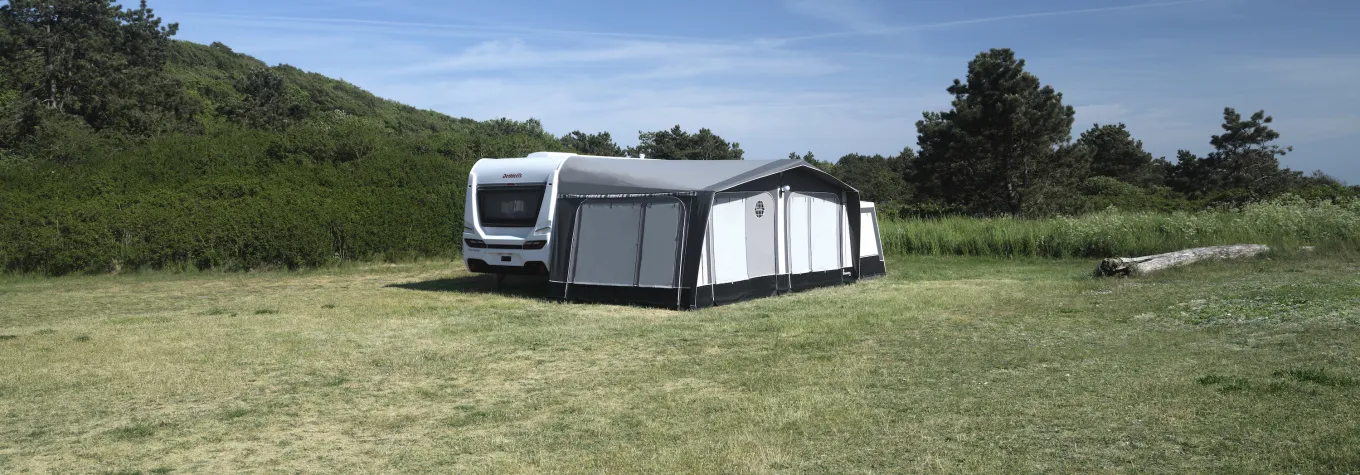
Best Caravan Awnings For 2026
Technical advice
Caravan Awnings: A Buyers' Guide
Caravan awnings are a fantastic addition to any caravan as they are one of the simplest, quickest and most cost-effective ways of adding extra space when your caravan is pitched up on a campsite.

Daniel Attwood Head of Content
Daniel Attwood Head of Content
Join the Out & About Live family
Get the latest news and exclusive offers direct to your inbox
Discover your inner outdoors with Out & About Live. For over 20 years we have provided the very best advice to motorhomers, campervanners, caravanners and campers – whether you are looking for travel advice, the very best campsites, help with choosing a new caravan, news, shows, what’s on and much more – it’s all on Out & About Live.
We would love to welcome you to the family so sign up to our FREE email newsletters so you don’t miss out any longer.
Caravan awning product reviews
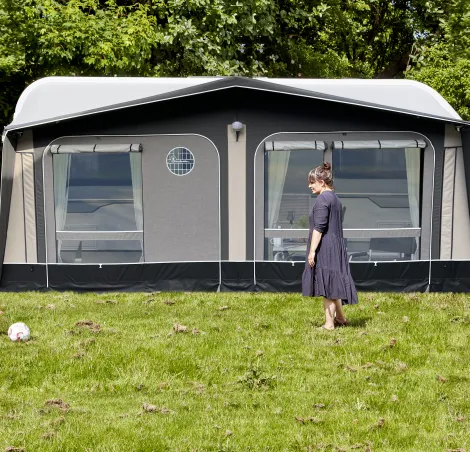
Isabella Nordic
Price: Prices range from £2,800 to over £5,300, depending on the size
If you tour regularly and want an awning that feels like an extension of your caravan, the Nordic makes an immediate impression. This is a true premium all-season awning, built with a heavy-duty frame and a solid PVC roof that manages changing weather without a fuss. It feels reassuringly upheld from the moment it’s pitched and that sense of lasting solidity carries through the entire design.
The Scandinavian influence is clear in both the look and the materials. The Isacryl side panels are not only durable, but also breathable, which helps keep the interior feeling fresh over longer stays. It is the kind of awning that works just as well on a bright summer pitch as it does during a windy autumn weekend.
Well considered practical touches are where the Nordic lifestyle design really earns its status. Window flaps add privacy and protect the interior when you are off site, while the extra-wide doors make access easy, even when you are carrying plenty of gear. Ventilation is also well handled, with multiple options that allow you to manage airflow depending on the conditions.
Everything about it feels thought through. From covered zips that resist damp to the option of extending the space with an annexe or sun canopy, this is an awning designed for people who spend serious time touring and want something that can keep up.
Isabella Ventura Air Nova
Price: Prices range from £2,199 and £2,399, depending on the size
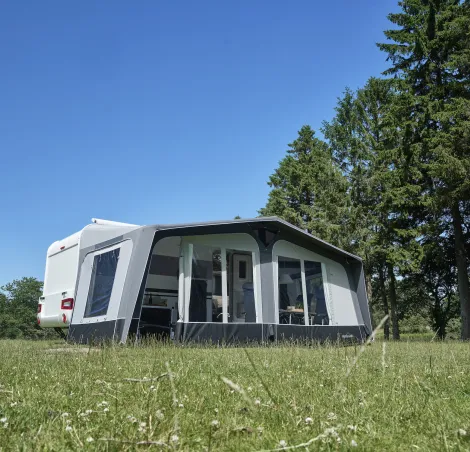
If you are looking for a more intimate feel, the Ventura AIR Nova offers a premium, high-performance design. This is a full awning designed to run the length of your caravan, creating a substantial living area that genuinely changes how you use your pitch.
Despite its size, set-up remains surprisingly manageable thanks to the single-point inflation system. Being able to bring the whole structure up from one valve makes a noticeable difference, especially when dealing with a larger footprint. Once inflated, the Nova feels secure and well balanced, which is exactly what you want from a full awning.
Space is where it really stands out. With multiple size options available, you can match it closely to your caravan and create additional room rather than just a sheltered area. The ability to remove or roll back panels adds flexibility, allowing you to switch between an enclosed space and a more open canopy depending on the weather.
Details are also enhanced; for instance, the improved ventilation, mosquito nets and optional inner roof ensure a comfortable environment for longer stays or cooler weather. Plus, with all essential accessories included, you’re fully equipped and ready to go from day one.
In use, the Nova feels like an extension of the caravan – rather than an add-on – and is a strong option for longer trips, seasonal pitches or anyone who values space and comfort as much as the caravan itself.
Isabella Ventura Air Aura
Price: Prices range from £1,648 and £1,999, depending on the size
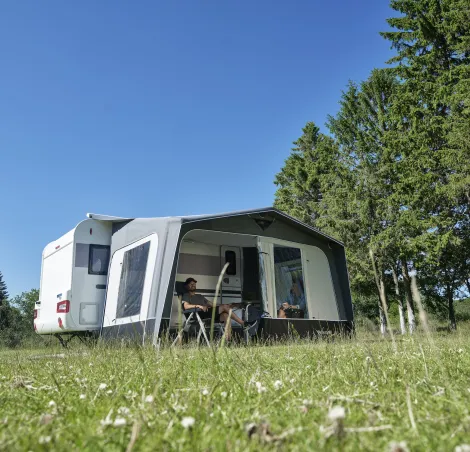
For those who prefer a quicker, more flexible set-up, the Ventura AIR Aura strikes an excellent balance between space and simplicity. It is a porch awning that feels generous without becoming overcomplicated, making it a strong choice for weekend trips or shorter stays. The standout feature is its air system. All the tubes are connected, which means you can inflate the entire structure from a single point. In practice, this takes much of the effort out of pitching and reduces the chance of uneven tension or air loss. Once up, it feels stable – even if the weather shifts.
Inside, the Aura is bright and adaptable. The front and side panels can be fully removed or simply rolled back, which allows you to open the space up on warmer days or close it down when the rain arrives. This flexibility makes it easy to adapt your set-up to the weather, rather than the other way around.
Ventilation is well handled, with front vents and mesh panels in the sides helping to keep air moving. It is also well equipped straight out of the bag, with a pump, curtains and essential accessories included, so you are not immediately looking at extras.
Overall, this is a reliable awning that keeps things straightforward. It gives you usable space, quick pitching and enough flexibility to suit most touring styles – without overcomplicating the experience.
What is a caravan awning?
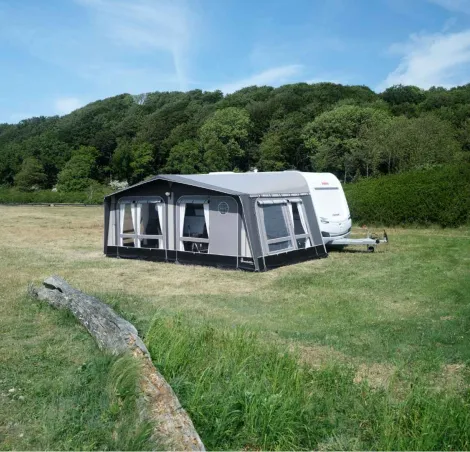
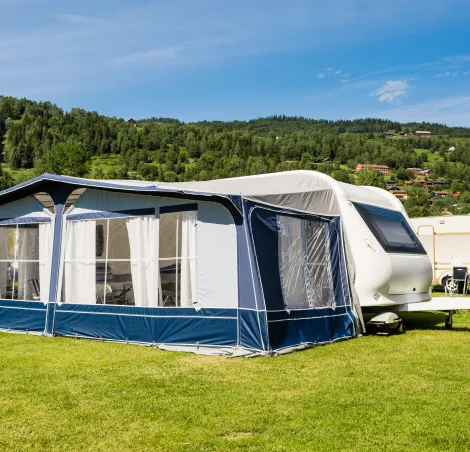
Awnings are a valuable addition to any caravan, offering an extension to living space, and can be used for a variety of purposes – they are basically a tent-like structure that is attached to the side of your caravan, providing extra relaxing, dining, sleeping and storage space once you’re pitched up on a campsite.
In fact, some awnings can more than double your undercover space so they really are worth considering, especially if you tour as a family and/or have kit such as bikes, water sports gear or even just want somewhere undercover for your wet dog and walking gear to dry out.
Indeed, the extra space caravan awnings provide can even offer an extra bedroom or two, a dining area, a food preparation zone and a relaxation area or a combination of all of these things.
Whether you are a seasoned caravan enthusiast or a newcomer to the lifestyle, understanding the basics of caravan awnings can help you choose the right one for your needs. The size of your awning will depend on the size of your caravan, as well as your personal requirements.
Weight is also an important consideration when buying a caravan awning, as you will need to transport your new awning to and from your destination.
Lightweight materials are ideal for this, as they are easy to handle and transport but there are pros and cons with all of these aspects and that’s where we can help make that all-important decision.
Ease of use is also a factor, as you will want to be able to erect your caravan awning quickly and easily, especially if the weather is less than perfect.
Luckily, today’s caravan awnings are designed to be easy to assemble, with clear instructions, which should equal less drama when you’re assembling it.
Caravan awnings and porches are designed for use in different conditions. For example, some are extremely lightweight and speedy to erect, so could be ideal for weekends away or for caravanners who move from campsite to campsite every few days.
Others are made to withstand severe weather and can take longer to erect but will remain a solid structure for weeks or even months; some can even be pitched for an entire season.
Whatever model you choose, look for additional features such as heat-reflective roofs and movable pegs that can be clipped onto the awning and moved on a rail so, should you hammer into a rock, you can simply slide the peg along a little until it is above softer ground.
Types of caravan awnings
Full caravan awnings
These give you maximum space, so they’re ideal for holidays where you are pitched up at the same campsite for more than just a few days, as well as for permanent pitches.
They take longer to construct than porches, but that’s worthwhile when you’re staying for a week or more. These awnings fit the full length of a caravan from bottom front to bottom rear and are available in many different lengths to accommodate all lengths of caravan. The measurement of full awnings is expressed in centimetres, and what you need depends on the length of your caravan.
Some awning manufacturers have size guides on their websites – just type in the make, model and year of your caravan and up comes the size you need. This can be much easier than trying to figure it all out yourself.
Depending on the model, full-sized awnings can be heavy to handle and transport, which will affect your payload and therefore what else you can carry. If you want to tow with the awning in your caravan, its weight must be subtracted from your payload.
Some seasonal full awnings can weigh 50kg but weights have dropped and now you can get full-sized touring awnings weighing less than half of this.
An example of a high-quality full caravan awning is Isabella’s new Nordic range, which is equipped with Isabella’s heavy-duty MegaFrame, which, together with the solid PVC roof, makes this a great all-season awning.
The fronts and sides are made of breathable and easy-to-clean Isacryl, while neat touches include flaps for all windows that give extra privacy and protect belongings from the sun's rays. It also has extra-wide entrance doors, which are particularly useful if you have a pram or wheelchair.
It has interchangeable fronts and sides, as well as covered zips that provide protection against damp and UV light.
Caravan porch awnings
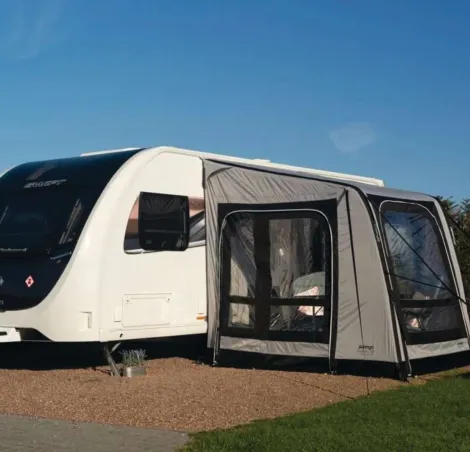
Porches are quicker to construct and lighter to transport. A generalisation would be that porches are normally smaller than the full awnings, although some porches can be nearly as large as full awnings.
Porch awnings create a smaller porch area; they are available in fewer sizes but are more universally fitting as they do not cover the full length of the caravan.
The downside is that you don’t have as much space as with a full awning but they suit many caravanners well and the space deficit is outweighed by their lightweight structure, ease of installing and disassembling and their lower cost.
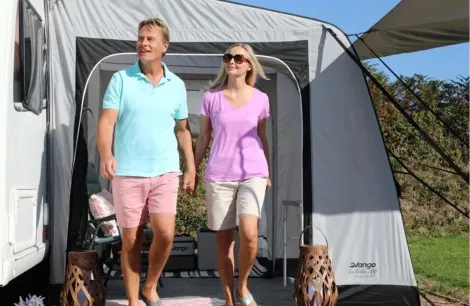
There are longer versions available; Vango’s range of porch awnings, for example, offers 2m models right up to 5m models if your keder channel or awning rail is long enough.
Caravan canopies
Canopies are easy and quick to erect, can stretch the full width of your caravan and can also be permanently fitted so it is just a question of unwinding it for instant cover from the sun or rain.
The downsides are they have no sides so offer no wind protection or privacy and, talking of wind, they can be damaged by strong winds so need to be wound back in should the weather turn too bad. Some canopies can have sides attached to them, making them similar to a full-sized awning.
Caravan air awnings
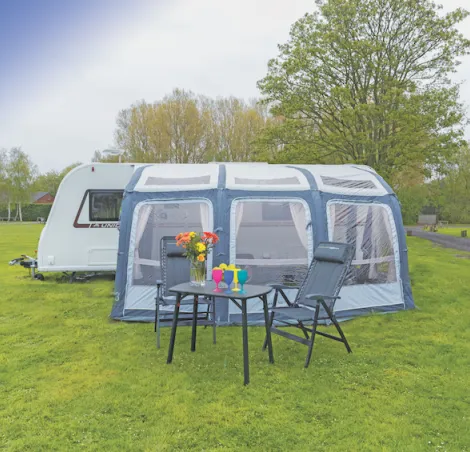
The invention of air technology in awning construction has revolutionised the market and has provided buyers with a new breed of awning that is speedy and easy to construct. The principle behind air awnings is a system of pipework, which you inflate using an upright pump. It’s easy and very quick.
If you’d rather let battery power do the inflation for you, just buy a 12V pump. Air awnings are perfect for those who want an easy-to-pitch awning that is lighter in weight than rigid-poled models.
Vango, more commonly known for its tents, has made significant inroads into the awning market recently, applying its AirBeam technology to a range of full and porch-style awnings. For ease of use, this system has single-point inflation; isolation valves mean the air flows into the beams but not back out.
There’s also valves for each beam, which then allow the beams to be topped up when needed and also, when all of these are opened, very quick deflation.
Vango also uses what it calls SuperBeams, which are wider in diameter and improve the stability of the awning. Inflation via the company’s Turbo Pump is recommended, with time ranging from two minutes for the smaller two-metre Baletto porches to six minutes for a four-metre Tuscany version.
Another example of a new breed of awnings is Bradcot’s Modul-Air range. It can be used as a porch or a full awning – just zip on or zip off the extra segment/s as your requirements change.
Sizing an awning for a caravan
There is some confusion about how you measure for a caravan awning. The simple answer is you measure from the ground up to the start of your awning rail, which will be on the side of the caravan (the same side as the door) at the front corner and then measure all the way around the awning rail to the back corner and then down to the ground again.
It is important not to forget measuring that critical bit from the ground up to the start of the awning rail and back to the ground when you get to the other end.
Vango says to make sure the ground is level and that the caravan is level, too, when it comes to height. It adds that while you can measure alone, it’s much easier with someone to help.
Check out this handy guide here.
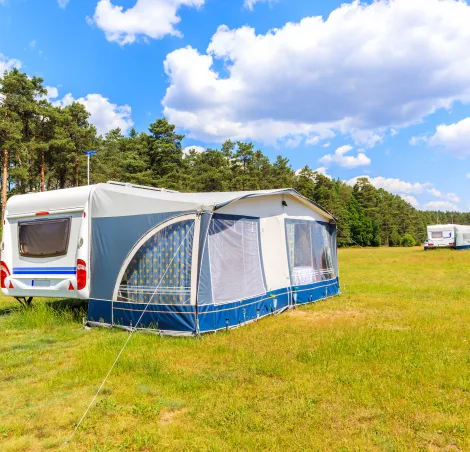
How to put up a caravan awning
Awnings are supported on one side by the caravan itself and then by either poles or inflatable air supports. Awning frames come in four types: steel, aluminium, fibreglass and air.
With many awnings on the market you get the option to choose your preferred frame material to suit the use to which you’ll be putting your awning or porch.
Steel-framed caravan awnings
This is a good option if you are planning to leave your awning up for a lengthy period of time, in varying weather conditions. For example, if your caravan is sited for a whole season on the same pitch then go for a poled awning made from quality fabric like TenCate.
Weight isn’t usually a consideration when you’re only transporting your awning to and from a campsite at the start and end of a season. Sometimes you may need additional steel poles for year-round pitching so it remains stable in poor weather when you are not there.
Aluminium and fibreglass-framed caravan awnings
Both of these are lighter-weight options, suitable for touring, when the weight of your awning is a more important consideration in relation to your payload.
When it comes to erecting the awning, both aluminium and fibreglass frames are easier to handle, because each pole is lighter than steel. Aluminium and fibreglass also weather better.
Pitching your caravan awning
Before buying, be aware of just how heavy and easy or difficult an awning is to erect, especially on a gusty day or if you have no helpers.
Erecting and dismantling an awning is perhaps one of the most daunting aspects of caravanning for a first-timer. This is where air awnings come into their own, especially the latest single-point inflation models.
For more pitching tips, check out this handy step-by-step guide from Caravan Guard.
Caravan awning accessories
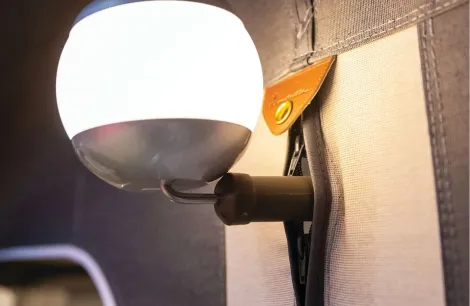
- Lighting: Go for LED lights
- Carpets, flooring and groundsheets: These all add more comfort, warmth and practicality to the inside of the awning
- Heating: If you’re a year-round caravanner or even like to pitch up out of season, a safe awning heater can be a great investment for you. Check out our guide to caravan heating systems here
- Inner tents, privacy rooms and annexes: These are available to make the space inside your awning work better for you
- Pump for inflatable air awnings: An essential and there are both manual pumps and electric pumps available today
- Roof liners: Can add extra insulating properties as well as extra protection
- Additional tent pegs: Pegs, particularly pegs designed for hard ground, are an essential for many, especially if you are not sure of the type of pitch you’re getting
- Storm straps: Straps are essential for seasonal awnings that are left up for long periods and preferable for those who pitch up when the weather is not on your side
- Cleaners: These will keep your awning in the best condition for years to come
Caravan awning warranties
Most good suppliers will offer a one to two-year warranty for a new caravan awning.
Vango, for example, has a two-year warranty, which can be extended by an extra year if you register online within six months of purchase.
Some manufacturers offer much more and British manufacturer, Bradcot, offers a five-year warranty that covers UV damage.
Bradcot says one of the key questions everyone should ask is whether the warranty will cover UV degradation, as some manufacturers do not offer any cover or guarantee against UV degradation.
Bradcot’s Andy Riley explains,
If you arrive late and it’s raining, you can just put up the porch and then add the rest the next morning.
Likewise, when you come to leave, you can take the extensions down the previous day and then the porch on the day you leave. Or, if you’re on a short trip, then just pop up the porch.
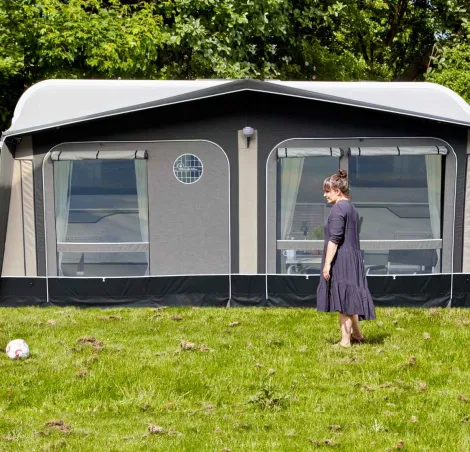
Choosing a caravan awning
Awnings are not an everyday purchase – they can be a significant and costly investment. If your awning is going to be permanently sited with your caravan for an entire season or if it is used almost every week through the season, then invest in a top-quality model.
If you go for a luxury full awning, for example, you’d be looking at £2,500, depending on the length of your caravan. However, an excellent awning can be found for around £1,500.
At the opposite end of the price spectrum, you can find lightweight, simple porches for as little as £150 for a basic sun canopy. In between those prices is a vast choice and you’ll soon discover there’s an awning or porch to suit every budget and every requirement.
Vango has an augmented reality function you can use to view its awnings in 3D; you can even step inside to gauge the space available. Check it out on your mobile device.
Tips when buying an awning
Caravan awning fabrics
Awning fabrics are a critical factor when buying. You want something that dries quickly after rain, that is protected against damaging effects of UV light, that is tough enough to withstand strong winds, and that is both breathable and provides a degree of insulation. It also needs to be lightweight and compact enough to be manageable to carry and transport and then to erect.
The fabrics will vary from lightweight, thin polyester to quality, solution-dyed acrylic and on to the more advanced TenCate fabrics. They can be enormously different in weight, look, feel and quality. And the fabric choice depends on how you’ll use the awning.
Frequent users should invest in a better, more-expensive awning which, typically, will be built to last and is likely to be constructed with TenCate that has a microporous coating, which makes it breathable. Occasional users may struggle to justify such a major expense.
Lightweight polyester has some advantages. It’s quick to dry after rain and light in weight to handle when you’re constructing and packing it away. They’re less expensive than acrylic options but they do not have any breathability or UV protection qualities.
Within this sector, there’s a considerable variation regarding thickness and density of weave, tautness and weight. Expensive, high-quality awnings are made to last many years. They look more taut and rigid than lighter-weight fabrics.
In the acrylic sector, there’s an interesting fabric: fibre-dyed material, also called solution-dyed. In the manufacturing process, the fibres that make up the fabric are dyed before being woven. This fabric is more resistant to the effects of UV light than fabric that has been dyed after it has been made into yarn.
Now, we have TenCate, which is used by the likes of Bradcot and Isabella. TenCate has many advantages and sits at the premium end as it offers extra protection against rain, UV damage and, because it is coated, it allows the fabric to breathe so condensation is virtually eliminated.
Whatever the fabric, it best to follow the right steps when packing an awning away.
Latest caravan articles
Explore our magazines
Enjoy expert tech help, travel and campsite inspiration, buying advice, reviews, and more with our best-selling magazines and guides.

Buying Your Perfect Caravan
Buying Your Perfect Caravan is the ultimate guide to finding your ideal caravan. From layouts and storage to finance, insurance, and essential kits, it has everything you need to make your dream caravan adventure a reality.

Caravan magazine
Caravan magazine is perfect for caravan enthusiasts. Make the most of your caravan lifestyle with expert advice, unforgettable road trips, must-see attractions and top maintenance tips to keep your ‘van adventure ready.


