

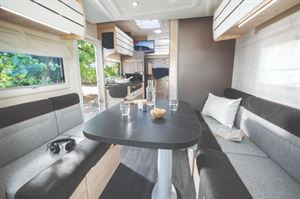
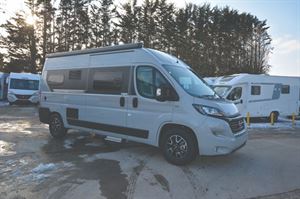

(photo by Warners Group Publications)
The oldest of all fixed bed layouts, but today perhaps one of the least commonly seen in coachbuilts.
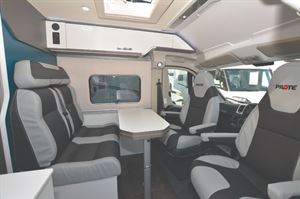
However, in larger van conversions (Fiat Ducato, Peugeot Boxer and other similarly sized panel vans), this design has become a best seller on the Continent, with a strong following here, too.
Be sure to watch our complete guide to motorhome layouts.
Words by Rachel Scholes and Peter Vaughan
The Transverse bed layout

(photo by Warners Group Publications)
You’ll find this format in van conversions from almost all of the major European brands (Adria, Hobby, Hymer, Knaus, Rapido, etc), as well as specialist campervan makers like Dreamer, Globecar and Westfalia.
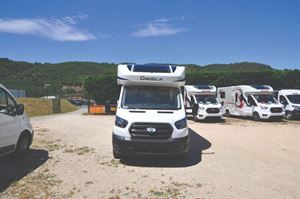
Transverse beds are also seen in a number of continental compact low-profiles, where this design lends itself to the shorter body lengths involved.
Often these models are narrower than the coachbuilt norm, at around 2.10m, as well as being only six metres in length, so they can be considered as an alternative to a campervan.
The layout is as much about the storage below the bed as the bed itself. These models will often be shorter than fixed single bed or island bed layouts but they will sometimes boast the most spacious garage storage.
Check weight limits in the garage, though (dictated by chassis extensions and rear axle limits), if you want to carry lots of stuff, or something really heavy, like a small motorbike. It’s not unusual for a coachbuilt’s garage to be limited to a maximum of 150kg.
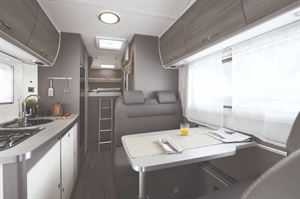
Bed length, too, is a factor: where lengthways beds can sometimes be short, these widthways berths – occupying the full breadth of the vehicle – are habitually more than two metres long in coachbuilts.
But don’t forget that the person sleeping against the end wall will have to clamber over their partner for a night-time loo visit. They may have to negotiate a ladder, too.
Beds in high-top campervans are shorter, because the vehicles themselves are narrower, but still usually achieve lengths of at least six feet.
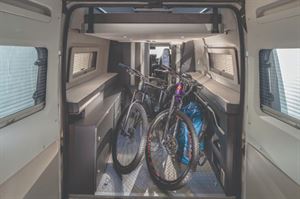
Van conversions, however, have the advantage of rear doors that open wide to receive your gear in their under-bed load areas.
Beds then often split and fold, too (or sometimes rise all of a piece electrically), thus allowing the loading of taller items, such as bikes.
If this aspect is important to your buying decision then check out how each manufacturer has developed the storage area, as they differ markedly in practicality.
If you’re in the market for something that’s compact but offers maximum stowage, or if you want a van conversion with the comfort of a fixed bed, this could be the layout for you.
Or, if you want a family ’van with masses of storage for sports gear, you’ll also find some larger (seven-metre) overcab coachbuilts that offer the ultimate in load-carrying potential.


