
Campervan Conversions: A Complete Guide
Technical advice
Taking you through the steps of converting our Volkswagen Crafter to a campervan, from base vehicle choice to bespoke layout and systems, showing how careful planning shapes a practical, liveable campervan.
Words and photos by Grant Wyness
Choosing your base vehicle
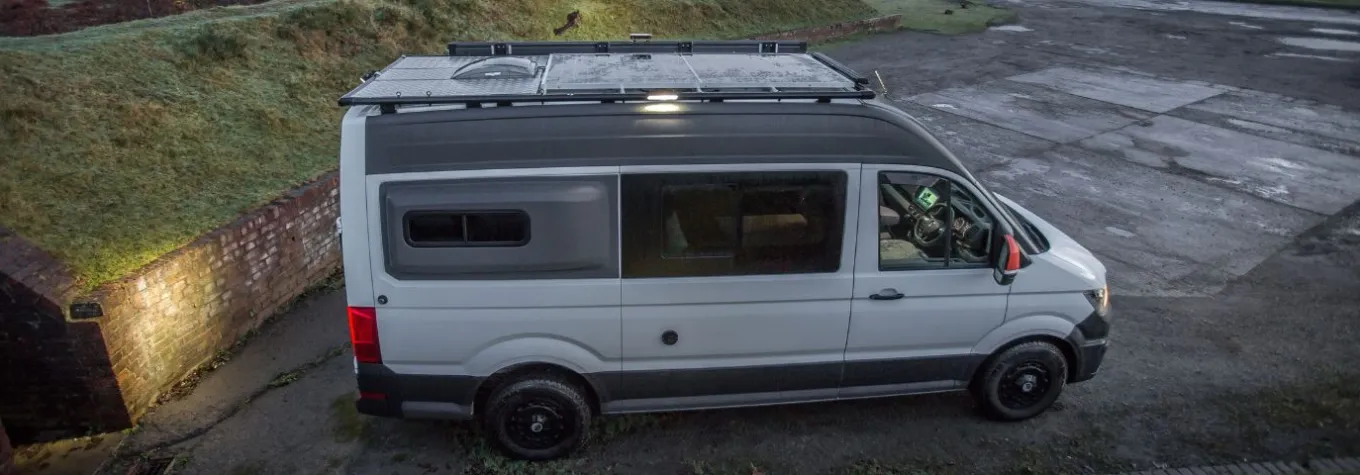
Choosing the base vehicle is a simple case of working out what you value most, though there are plenty of options on the market. The Volkswagen Crafter remains one of the few large vans that offers real interior volume without making you feel as if you are piloting a truck.
Ours is a 2021 medium wheelbase, high-roof, 140hp, six-speed model, and even fully camper-loaded it returns between 24 and 32 miles per gallon in everyday use.
With VB air suspension and Michelin Agilis CrossClimate tyres fitted, it sits on the road with a calm that borders on disconcerting. The suspension smooths the ride and keeps the body under control, but it is the tyres, the only part of the vehicle touching the real world, that give you that sense of grip and stability.
Weight limits and payload
Another important factor is weight. Fully built and loaded, the campervan comes in at around 3,200kg to 3,250kg, which still leaves a useful margin to the 3.5-tonne limit – the point at which you would need a different licence.
Join the Out & About Live family
Get the latest news and exclusive offers direct to your inbox
Discover your inner outdoors with Out & About Live. For over 20 years we have provided the very best advice to motorhomers, campervanners, caravanners and campers – whether you are looking for travel advice, the very best campsites, help with choosing a new campervan, news, shows, what’s on and much more – it’s all on Out & About Live.
We would love to welcome you to the family so sign up to our FREE email newsletters so you don’t miss out any longer.
Should you buy new or used?
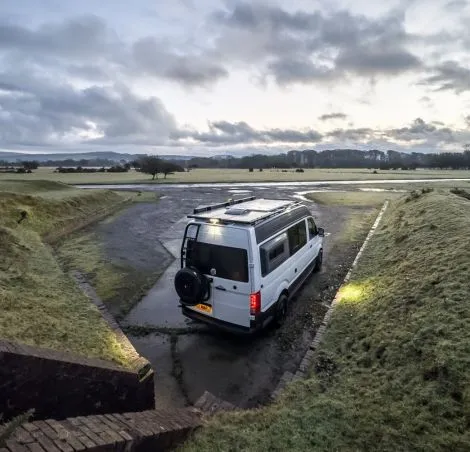
We bought used. The post-Covid economics of commercial vehicles make little sense for a private campervan conversion, so we chose to put our money into the systems and interior rather than initial depreciation.
Buying new was considered, but quickly dismissed. That made finding the right used van an important early step.
Secondhand commercial vehicles can be a gamble, but we were clear about what we wanted: a local, main-dealer example with a clean history. In the end, we found one in Cornwall through Yeomans at Indian Queens.
Minor cosmetic marks aside, it had clearly been well looked after, and a few small details in the cab suggested its previous owner worked to a decent standard. It felt like the right starting point, so we bought it.
Finding a space to convert your van
Before any of the interior work could begin, there was a more basic problem to solve. You need a large indoor space to carry out a campervan conversion properly.
We dropped a 20-foot shipping container onto our land and turned it into a fabrication space. It was clad, insulated, fitted with proper lighting, infrared heating and 40A power, along with the tooling needed to work at scale.
Even then, it was a tight fit. I ended up building special benches to handle full sheets of ply and manage more awkward assemblies in a confined space.
Choosing your perfect layout
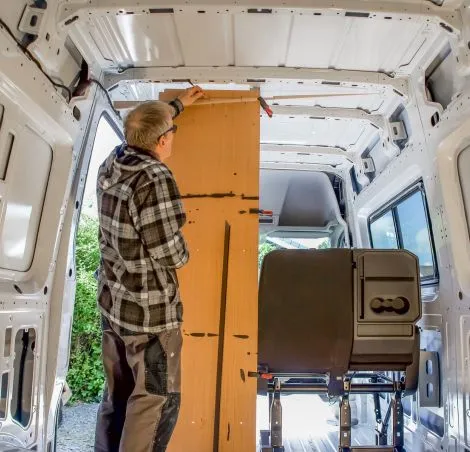
The first challenge is creating a layout. The interior of a van is neither flat nor straight, and nothing offers obvious datum points. Those curves can make fixing anything a challenge.
From the outset, I decided everything in this campervan would be made specifically for it, more like individual pieces of furniture than off-the-shelf units.
Our starting point was the rear seats. I found a brand-new double seat removed from another Crafter and bought it for a fraction of its retail cost. It is a common approach, many parts can be sourced secondhand if you are prepared to look.
Positioning it precisely is critical. The layout needs to be tightly packed to make the most of the space. The Truma D 6 E diesel heater and hot water system sit beneath it, and once that relationship was fixed, the windows, table, shower and overall flow of the interior began to fall into place around it.
Deciding on plumbing and heating
While it's very much a hidden aspect, you should consider your campervan tanks and plumbing systems carefully.
Grant Wyness, DIY converter
I chose Wyedale Tanks for its consistently good products, and a company that actually thinks in solutions as well as its ability to offer customisation. The fresh water tank was 63 litres, with 20 litres waste.
An electric pressure pump (quiet in normal use), services a pull-out kitchen mixer tap with extending hose (ceramic valve), twin hot-and-cold ceramic shower valves and an under-sink filtration system.
For winterisation, I have an automatic Truma frost-protection dump valve. Filling and dumping is direct, thanks to an easily accessible fill point and waste outlet.
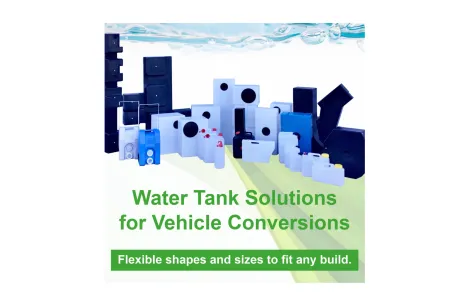
Interested in water tanks for your own conversion?
Grassroutes Leisure stocks a wide range of water tank configurations designed to overcome even the most challenging layout restrictions. From compact, space-saving tanks to fully portable options, it can supply the ideal solution for your project whatever space you’re working with.
Speak to the Grassroutes Support Team today to find the perfect tank solution for your needs.
Call now: 01963 824792
Fixing furniture in a campervan
How you fix furniture in a campervan is often overlooked, but it has a huge impact on how the vehicle feels on the road. Movement, vibration and long-term wear can quickly expose weaker fixing methods, leading to rattles, flex and general fatigue in the structure.
Many builds rely on battens or mechanical fixings, but bonding systems are increasingly used to create a more integrated, rigid interior. When done properly, they spread loads more evenly and remove a lot of the small movements that cause noise over time.
In this case, we chose to bond cabinets directly to the van carcass, avoiding wood battens or screw fixings. This was done using a polyurethane bonding system with primers, backed up by aluminium battens.
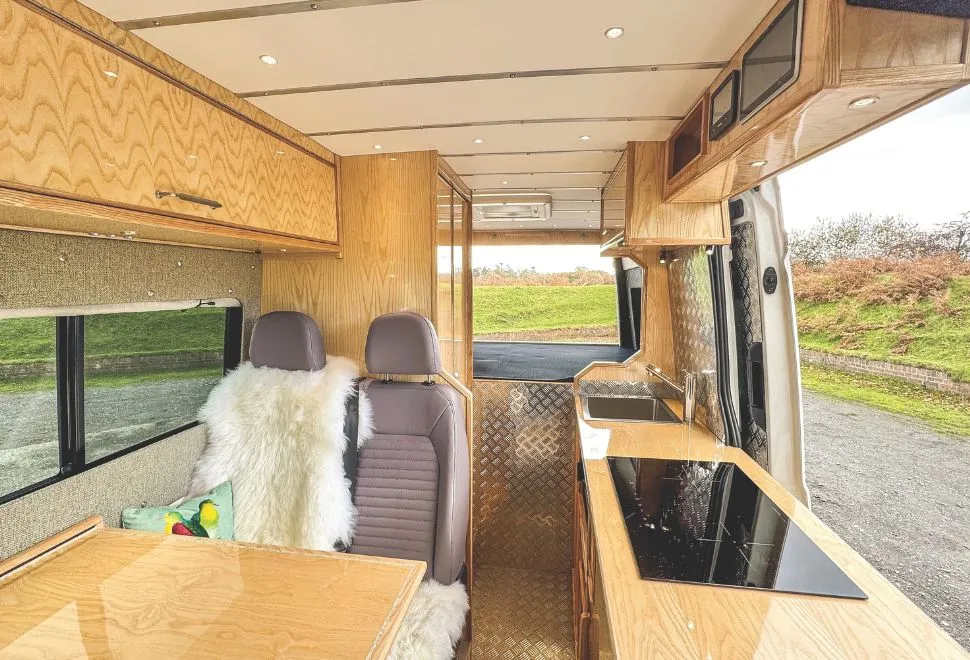
The main joinery is ash veneer on a lightweight poplar core, made specially for the project by Premier Forest Products, with solid ash edges from locally sourced, field-grown timber. The open grain was filled and finished with multiple coats of epoxy and a high-solids lacquer.
Designing a campervan kitchen
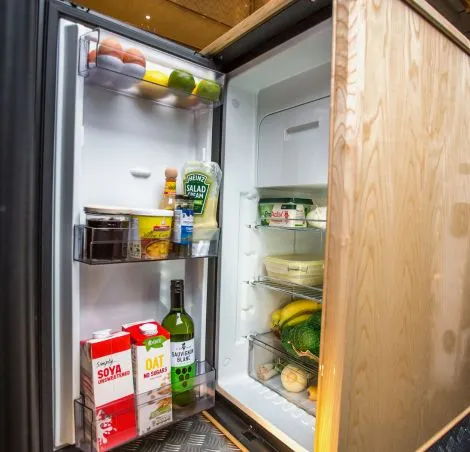
Our kitchen grew out of a single decision: I wanted a 90-litre Dometic fridge-freezer because of its double-hinged door. It can open from both sides which, in a campervan, where inside and outside cooking constantly overlap – is far more useful than it first sounds.
That one feature dictated where the fridge sat, and everything else, the induction hob, the Ninja cooker and the ventilation – was arranged around it.
On battery alone, with 608Ah of lithium and 500W of solar, we can cook, boil kettles, run the fridge and charge devices all day, and still end the evening with over 90% remaining, even in poor weather.
Creating a bedroom
A good sleeping set-up is one of the most important parts of any campervan conversion. Managing condensation, maintaining airflow and getting the right level of support all play a role in how liveable the space feels.
Ventilation is key. Without it, moisture builds quickly overnight, leading to damp bedding and long-term wear on the interior. Just as important is the bed base itself, allowing air to circulate beneath the mattress to prevent condensation from forming underneath.
In this build, we opted for a fixed double bed, with a ventilated base, a woven nylon moisture-wicking layer, and a custom foam and memory foam mattress. A Maxxair fan sits directly above. There is no condensation, even in harsh winter conditions, which after decades of camping still feels slightly unreal. Bedding stays dry, and that alone makes a noticeable difference to how you feel in the morning.
How to maximise storage
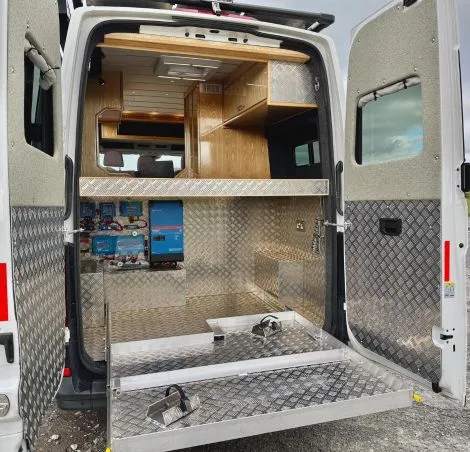
In the garage we use a slide-out tray to store bikes. It makes loading and unloading quick and avoids having to wrestle with awkward, wet kit.
A roof rack was another must-have. It adds a second layer of storage for bulkier items that never sit neatly anywhere – inflatable boats, wet gear and bags you would rather keep separate from more valuable equipment.
Access is via a rear ladder from Mule, whose fabrication quality I could not better myself.
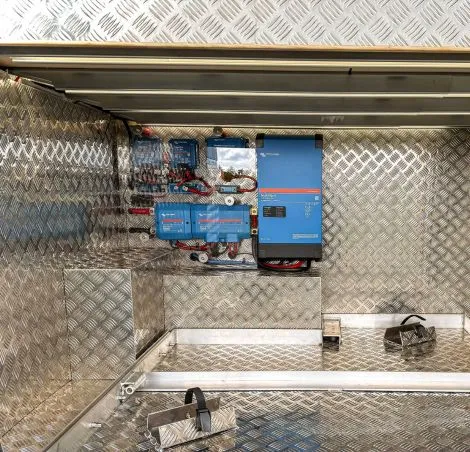
Campervan electrical installation
The electrical installation, in our case, was built entirely around Victron components, though this is to suit my own caution. The aim was to create a campervan electrical system that is reliable, visible and easy to manage when living off-grid.
The wiring is kept continuous and unbroken, with generously sized cables throughout. The larger the cable, the more electrical current it can carry, while also minimising resistance and excess heat build-up.
DVLA rules: adding windows and reclassifying a campervan
Adding windows is one of the first visible steps in a campervan conversion, but it also feeds into how the Driver and Vehicle Licensing Agency classifies the vehicle.
In the UK, simply fitting windows is not enough to have a van reclassified as a motor caravan. The DVLA looks at a combination of internal features, such as a fixed bed, cooking facilities and storage, alongside external appearance.
Even then, reclassification is not guaranteed. Many self-builds remain registered as vans with windows, which can affect insurance, speed limits and access to certain areas.
-
How much does it cost to convert a van to a campervan DIY?
This project used high-end specification but with most of the labour being DIY. The total spent was around £65k – the van itself cost £28,995 and the materials used here were £34,005. The DIY converter here reckons an equivalent professional conversion would cost well over £100,000.
-
Is it cheaper to convert or buy a campervan?
It all depends. If you have very specific requirements, then it may be cheaper to convert than buy a ready-made conversion and get it modified. Building a design around specific needs may be easier in the long run that the level of work needed to adapt a model. Be wary of buying secondhand self-builds as they won't be tailored and make sure you take an expert along to check the electrical and gas systems at the very least.
-
Do I need to tell the DVLA if I convert a van?
You don't have to, but you can inform the DVLA if you convert a van to a campervan. There is no body type classification for campervan.To meet the requirements for a 'motor caravan' the DVLA has a set of guidelines that some campervans currently do not conform to. This will result in a body type of 'van with windows'.
-
Is it legal to sleep in a layby in the UK?
Sleeping in laybys in the UK can be tolerated as long as there are no restrictions or you obstruct traffic. You are also allowed to park up and sleep in side streets as long as there are no signs to the contrary. To ensure you don't get moved on, carry out parking behaviour not camping. You can park up on privately owned land with the prior permission of the landowner. If you are not at all sure, then its best to move on or only stay for one night.
-
What is the best budget van for camper conversion?
We would seriously recommend as low a mileage as possible and looking for a van that has been looked after. The less premium brands are good places to start - Renault, Citroën, etc.
VW has just moved to a new Transporter after a significant gap between this and the T6.1 stopping production. This basically means that demand for the T6.1 was high and so prices of used models also stayed high. It's not on the budget list.
In larger vans, Fiat (and Citroën and Peugeot) have good numbers available and Ford Transits have become more popular, so these are the brands to look for. VW, MAN and Mercedes will sit at the higher end and you may have to look for higher-mileage models to find one on a lower budget.
Latest campervan articles
Explore our magazines
Enjoy expert tech help, travel and campsite inspiration, buying advice, reviews, and more with our best-selling magazines and guides.

Buying Your Perfect Motorhome
Buying Your Perfect Motorhome is the ultimate guide to turn your campervan adventure into reality. From models starting at £20k to luxury options, layouts, finance, insurance, and a dealer directory, it has everything you need to find your dream campervan.

Campervan magazine
Campervan magazine is the ultimate guide to maximise your ‘van experience, including unforgettable road trips, and must-see attractions, expert advice and reviews. Plus, essential maintenance tips to keep your ‘van in top condition.


