Seatbelts and the law
Motorhome advice
Motorhome seatbelt law and safety
Travelling in a motorhome or campervan should be fun and safe for all the family to enjoy. Here, we explain the law on wearing a seatbelt when travelling in a motorhome or campervan, and why it's so important.
While newish motorhomes will often have four or more seatbelts, if you have (or are buying) an older campervan or motorhome, you may have to consider adding additional belts in the rear (not always easy and often impractical).
Some motorhomes may also have more berths (for sleeping) than seatbelts for passengers. This is often because the seats are side-facing and so cannot have seatbelts, but the seats may still convert into beds. This might be useful if, say, grandchildren join you to stay (but travel separately), or if you like to each have the extra space of a double bed.
Other models may have more seatbelts than berths, which may be useful if you carry passengers who are not sleeping in the motorhome or campervan, or if others join you for day trips.
If, for example, you need six people to travel in a motorhome, make sure your motorhome has six seatbelts, too. The more seatbelts you need, the fewer vehicles will meet your requirements and you’ll never see more than six, or possibly (in a very rare case) seven, seatbelts in a factory-produced motorhome.

Rachel Scholes Content Editor: Motorhomes
Rachel Scholes Content Editor: Motorhomes
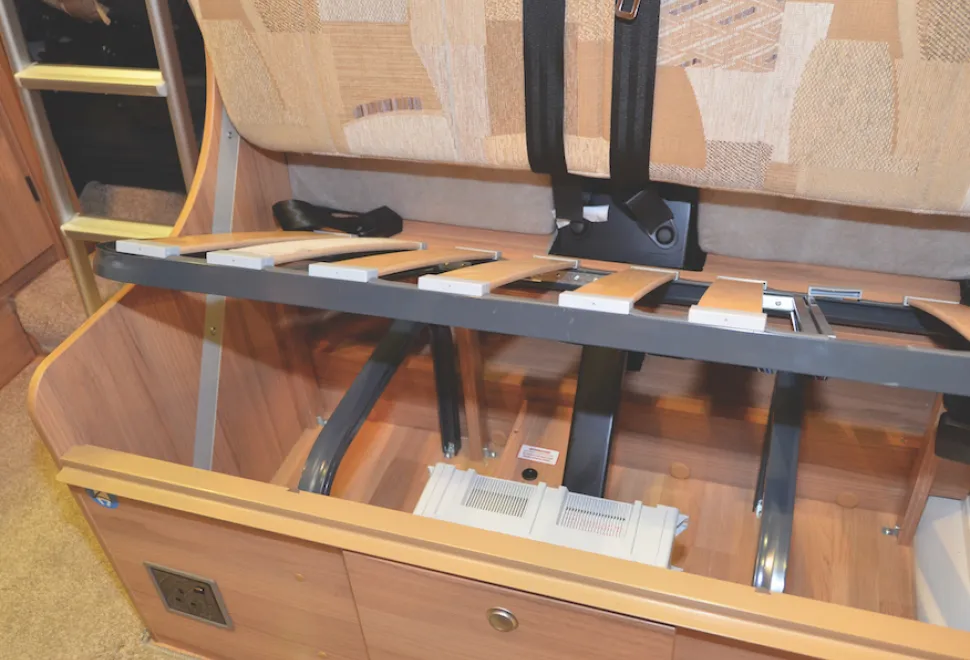
Motorhome seatbelt law
In 1966, legislation made it compulsory for all new passenger cars to be fitted with front seatbelts – but it wasn’t until 1983 that it became compulsory to wear them.
As public acceptance of seatbelts increased, so further legislation has been introduced, covering a wider range of vehicles and applications, including specific requirements for children. This piecemeal introduction of legislation, while necessary to take the public along with stiffer measures, has resulted in some motorhome owners still asking questions about the law regarding the carrying of passengers without seatbelts and the so-called ‘grey areas’ of the law.
While looking at the different aspects of the law, it cannot be emphasised too strongly how evidence indicates that, in a collision, lives are saved with the use of seatbelts.
Seatbelt legislation comes under the Road Vehicles (Construction and Use) Regulations (C&U Regs). With regard to motorhomes, this originally stated, ‘motor caravans first used on or after 1 April, 1982 shall be equipped with anchorage points for the driver’s seat and specified passenger seat’.
This was subsequently amended in the 1986 Regulations to require anchorage points for the driver’s seat and any forward-facing seat in motorhomes from 1 October, 1988.
It wasn’t until legislation in 2007 that manufacturers and motorhomers started to seriously consider seatbelts as an essential piece of kit for passengers in the habitation area. From 20 October, 2007, new motorhomes were required to have seatbelts fitted on all seats except those seats intended solely for when the vehicle is stationary. This situation exists to the present day where manufacturers fit belts to seats that are designated as travelling seats.
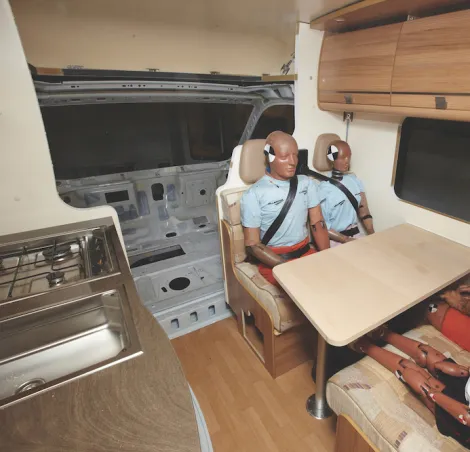
What is different about motorhome seatbelts?
No legislation has been brought in that expressly forbids the use of seats without belts when travelling, either in newer motorhomes with designated travel seats or earlier motorhomes with no belted seats in the accommodation area. What legislators have relied upon to regulate the use of non-belted seats in motorhomes is long-standing legislation, namely Regulation 100 of C&U Regs 1986 that requires, 'the manner in which any passengers are carried in or on such vehicle… shall at all times be such, that no danger is caused or is likely to be caused to any person in or on the vehicle or trailer or on a road.'
Clearly an unrestrained passenger is likely to present such a danger in the event of a collision.
Reinforcing Regulation 100 is Section 40a of the Road Traffic Act 1988, which says a person is guilty of an offence if he uses a vehicle on the road when the number of passengers carried or the manner in which they are carried is such that the use of the motor vehicle involves danger of injury to any person.
It’s also worth noting that, if you have a motorhome with designated travel seats, there is a good chance your motorhome will be overloaded if you carry passengers in excess of the number of travelling seats.
What is explicit in the regulations is, if a seatbelt is available, it must be used. In addition, regulations clearly detail how children aged 12 and under must travel in appropriate restraints.
The driver is responsible for ensuring a child under the age of 14 is in the correct car seat or wearing a seatbelt. The penalty for non-compliance is a fine of up to £500. There are a few exemptions, including a driver when reversing and if the driver has a medical certificate of exemption.
Motorhomes that were built before legislation required the designation of travel seats can sometimes be found with seatbelts fitted to side-facing seats. Under the 2007 legislation designated travel seats can only be forward or rearward-facing.
In the event of a crash, side-facing seatbelts may help prevent the wearer being thrown around the motorhome or ejected, but in a frontal crash these belts can increase injury by subjecting vulnerable parts of the body to higher loads than if the belt were located a front-facing seat.
This doesn’t make sideways-fitted seatbelts fitted to motorhomes built before the legislation illegal, but their use is not recommended.
From an insurance perspective it would probably be deemed difficult to impose limitations on the carrying of passengers in older motorhomes.
However, for motorhomes under the 2007 legislation with designated travel seats, it’s possible insurers could repudiate liability or limit damages through contributary negligence where passengers were not in designated travel seats.
Seatbelts in motorhomes for children and dogs
Legislation regarding seatbelts for carrying children in vehicles was introduced in September 2006 and was updated by 2017 legislation, ECE R129.
Essentially, children must use a child car seat or booster seat with a normal seatbelt until they are 12 years old or more than 135cm tall, whichever comes first. There are a few exceptions, and, in most cases, a child under three must always be in a child seat. Child restraints cannot be fitted to side-facing seats.
The choice of child seat is based on the child’s height and/or weight. It is mandatory for new child seats to meet European safety standard ECE R44/04 or R129, which run in parallel, so look for the E mark on the seat.
The selection of i-Size/R129 seats is based on height rather than weight. One of the changes with i-Size seats is they are designed to keep children rearward facing until they are 15 months old. Other changes include only approving high-backed booster seats, which provide greater protection than booster cushions.
You must only use a child seat if your motorhome seatbelt has a diagonal strap, unless the seat is designed for use with a lap belt or it has Isofix anchor points. Some child seats require additional support such as a support leg to the floor or top straps. You should always check with your supplier to confirm a child seat is suitable for your motorhome seating. Many coachbuilts can only take one child seat (next to the wall).
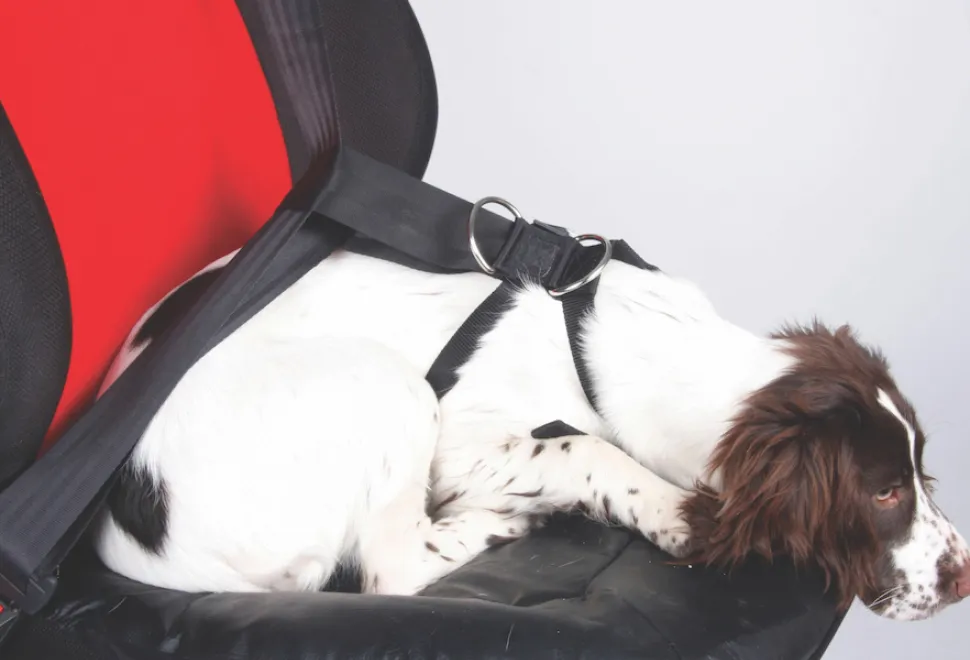
While dogs are not referred to in the regulations, the same potential for harm to the animal and danger to others in the motorhome in the event of a collision is there. Hence Regulation 100 could also apply for unsecured animals.
The Highway Code Rule 57 states, 'when in a vehicle, make sure dogs and other animals are suitably restrained so they cannot distract you while driving or injure you, or themselves, if you stop quickly.' You can buy a dog harness for fitting to a standard vehicle seatbelt and Isofix versions are also available. Do ensure any harness you buy is designed for travel and not a standard walking harness.
Child restraints vary with the age of the child and need to be changed as they grow. Incorrectly installed seats are a major contributor to child injuries. In 1997 Isofix was introduced, which is now the global standard way of anchoring child seats.
The Isofix system allows quick and easy installation and removal of child seats. Fitting of this system has been a legal requirement in passenger cars since 2007, but is still not required for motorhomes.
You will find some motorhome and campervan models come with Isofix. The number of motorhomes offered with Isofix as an option is slowly increasing and a few offer it as standard. Isofix is also more widely seen in campervans, especially OEM models such as the VW California and Ford Nugget. Some RIB and Reimo seats, as used in smaller campervans, come with Isofix.
Travelling in a motorhome with a wheelchair
Government advice from the Medicines & Healthcare products Regulatory Agency (MHRA) is, 'ideally, wheelchair users should transfer to vehicle seats wherever possible and the wheelchair stowed as an item of luggage.' If this is not possible you will need a specialist wheelchair strong enough for use as a seat in transport and arrange for an appropriate wheelchair tie-down and occupant-restraint system.
Wheelchair instructions for use should make it clear if it is suitable for occupied use in a vehicle, and, if so, how to do it safely. Normally, wheelchair restraints are proprietary designs with crash test certification.
Installing a suitable restraint system calls for considerable expertise and the best advice is to contact a specialist installer. Coachbuilt GB is one such specialist.
Is adding seatbelts to your motorhome a good idea?
Seatbelts can sometimes be retrofitted in the rear of older motorhomes. This can be problematic; older vehicles may not have the structure or anchorage points needed to withstand the forces involved in an accident. If you are considering adding seatbelts to a motorhome, seek professional advice and do not add belts to side-facing seats.
When buying secondhand, it is essential to check if a qualified fitter installed any retrofitted seatbelts to forward-facing seats.
The importance of proper seating was revealed when Bailey undertook crash testing in the development of its first motorhomes. It showed, in a frontal collision, travel seats need to be reinforced to prevent collapse. The testing also highlighted several other areas of concern, which were shared with the industry.