
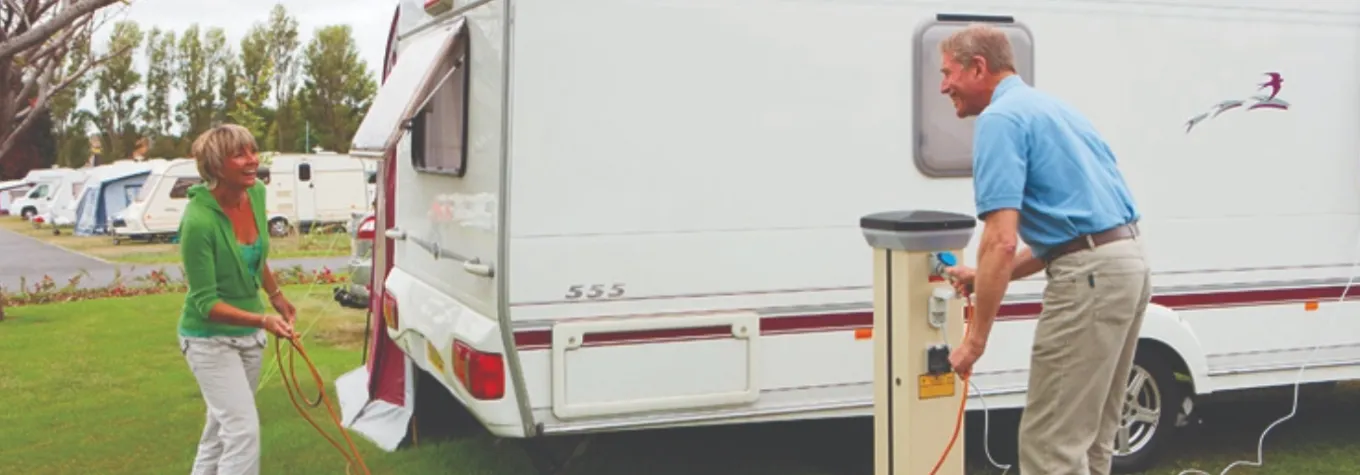
Avoid tripping out the 230V electric supply to your caravan
Technical advice
Caravan electrics: avoid tripping out
Have you ever tripped out your mains electricity supply on site? Most people have at one time or another.
There is no doubt that mains hook-up can add much to our caravanning comfort but the campsite's supply can deliver only a fraction of the power we use in our houses. If we use too much – CLICK – off it goes, and we're left to sort out the mess.
Tripping the supply can make you unpopular on a campsite, especially if you have to go and get a member of the campsite's staff to put the supply back on again. Worse still, you may even have tripped the supply to neighbouring pitches.
Understanding caravan electrics and avoiding tripping out
There are two ways in which you might trip the supply. The first, and most common, is through overload. In other words, taking more power than the supply can handle.
The second is through an earth fault, which may be caused by a faulty appliance or cable.
In this article we'll look at both and what you can do to avoid falling victim.
How do caravan electrics work?
The typical supply to a modern house is rated at 80 or 100A but the best you'll see on a campsite is just 16A. Older campsites, and many continental ones, may have only 10A or even six.
With limited power to play with, we need to think carefully before switching something on. We need to have some idea how much power it will consume. As a rule, items that produce heat use a lot more power than those that don't.
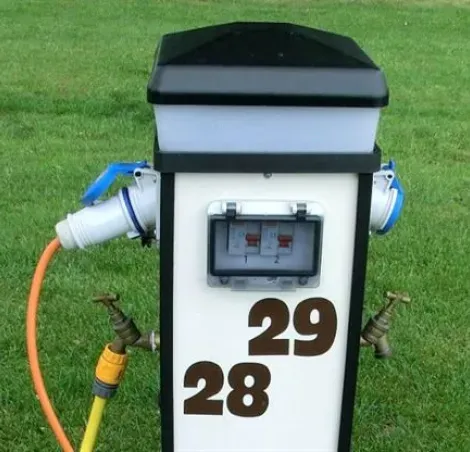
Which electrical items can I use?
As a guide, the amps available on the campsite multiplied by the voltage equals the wattage that can be used. For example, a 10A pitch x 230 (volts) = 2300W.
If, for example, you’d switched on the 2kW heater and then attempted to make a cup of tea with a 750W kettle, the bollard will trip.
How do electrical systems work in a caravan?
First thing to note is that in most caravans there are two electrical systems; 230V mains electric and a 12V battery system.
Overload trips are controlled by miniature circuit breakers or MCBs for short. These are the modern-day replacement for fuses. Just like a fuse, they will tolerate a small overload for a short period but will trip immediately with a large overload, including what may occur with a short.
Overload trips may take a minute or more to activate, depending on how much overload there is. This means that, if you accidentally switch something on, you may have time to switch it off again before power is lost.
Earth fault trips are instantaneous. They have to be, because an earth fault could result in electrocution. In normal operation the current in the live and neutral wires should be identical. All the current that flows down one wire should return via the other, having done its job in powering the kettle, the heater or another appliance.
When an earth fault occurs, some of that current leaks away to earth and creates an imbalance. It's that imbalance, sensed by something called a residual current device (RCD), which then trips the supply.
The amount of imbalance needed for a trip is small, just 30 thousandths of an amp (or ampere, to quote the full name). This is designed to prevent death through electrocution as might otherwise happen if you touched something that had become live.
Types of caravan power
Caravan electric hook-ups
All caravans with a mains installation have to have an RCD by law. The campsite supply also must have such a device but it may be shared by more than one hook-up point so, if you trip it, your neighbours could be affected, too. It is good practice to operate the test button on your RCD each time you hook up.
One of the most common causes of earth faults on a caravan is electric kettles. If your supply RCD trips the instant you switch the kettle on, the chances are the kettle is faulty and should be replaced.
If you can't positively identify and isolate the cause of an earth fault, do not continue to try to use the caravan's hook-up. The most important piece of advice here is to get your caravan electrics looked at by a qualified electrician.
Leisure Batteries
A caravan leisure battery is an essential component, powering your lights, appliances and other critical equipment. Unlike car batteries, which deliver short bursts of power to start engines, leisure batteries provide a steady energy supply over extended periods.
Click here, to read more about caravan leisure batteries.
Solar panels
Caravan solar panels are increasingly popular with caravanners looking for more independence. They are now regarded as pretty much essential kit for off-grid caravanning.
They allow you to power your caravan’s water pump and lights without relying on electric hook-ups. This means you can save money on pitch fees, by choosing pitches without electric hook-ups. And this also increases your choice of more remote locations.
Whether you’re planning to head off-grid, or simply want to keep your battery topped up between trips, solar power are a smart and sustainable solution.
Click here, to read more about caravan solar panels.
How to safely use your caravan electrics
Top tips:
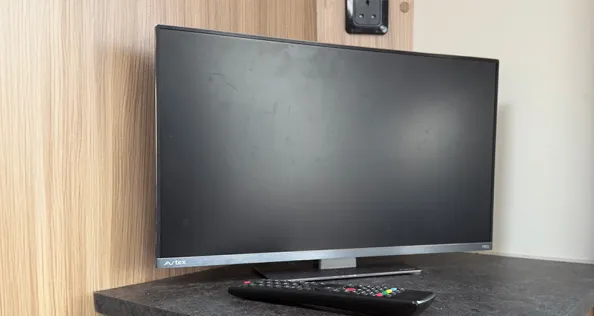
- If you have a TV, make sure it will run off 12V and power it that way. Then, if the mains trips during your favourite soap, you can carry on watching courtesy of the leisure battery
- If your supply is just 6A, never switch on more than one item at once; if 10A, two items and, if 16A, three items. It won't prevent all trips but it will help
How to measure electricity use in caravan
When you are used to having a stable and constant supply of electricity at home, it may come as a shock to learn which appliances are the most power hungry. A hair dryer rated at 1,600W will consume 70 times the power of an 18.5in LED TV rated at 23W.
Microwave ovens can use more power than you might think, too. The reason is their rated power is an indication of what goes into the food rather than what is taken from the mains, which can be nearly twice as much.
With all these things to bear in mind, it can be difficult to know just how much current you may be drawing at any one time.
A rough guide
1,000W equates to just over four amps at 230V.
Common electrical problems
Troubleshooting electrics in a caravan can be caused by:
Overloading circuits, failing to fully unwind electric hook-up cables, using damaged cables or faulty appliances, neglecting battery maintenance like checking voltage and terminals and not performing regular safety checks on the system
When there is a problem with your 12V electric suply, the following steps will help you identify it:
1. Inspect battery connections
- Examine cables for cleanliness and tight connectors
- Ensure cables don't disconnect with a gentle tug
- Look out for corrosion around battery terminals
2. Check voltage
- Use a multimeter to measure leisure battery voltage
- A reading above 12.6V when fully charged is ideal
- Voltage below 12.6V indicates the need for charging
- If charging is ineffective, consider replacing a battery over five years old
3. Identify power-draining appliances
- Confirm battery capability to hold a charge
- Check for unintended power consumption by appliances
- Use the caravan switch to cut power to appliances via the fusebox
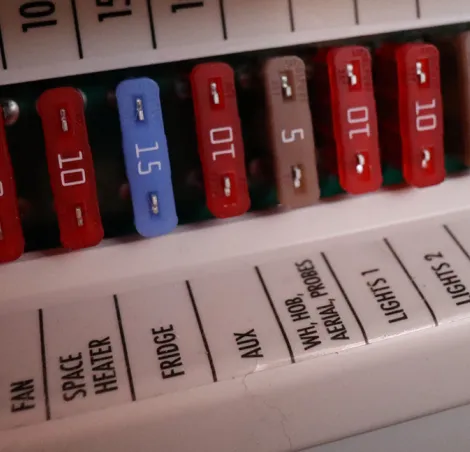
4. Inspect the fusebox
- Connect the battery to a multimeter
- Document your fusebox configuration
- Remove and reinsert fuses one by one to find the problematic circuit
- Sandpaper old fuses if needed; replace if they're faulty
How to monitor electrics in a caravan
Load monitoring devices: It is possible to buy load-monitoring devices that measure the current at the supply point and relay the information by wireless to a small display panel. Primarily designed for home use to tell you the cost of electricity being drawn, you can also set them to show you the loading in kilowatts (kW).
Once fitted, you can easily see how much power your caravan is using and adjust it to stay within your limit. The only thing to bear in mind is that there may be a short delay in the information being displayed. This is because, to save battery life, transmissions are not continuous but made every few seconds.
Owl monitor
The Owl monitor we tried transmitted every six seconds but could be set to transmit every 60 seconds. It also had an auto power save mode that ensured it transmitted every six seconds only if the power changed, otherwise it transmitted every 60 seconds.
Load-controlling devices
The Alde load monitor is a good device to help master your caravan electrics (if you have Alde heating). This consists of a sensing coil threaded through the live wire feeding the caravan. Installation should be by a qualified electrician. It senses the current and sends the reading down a wire to the digital control panel where you can see it.
You can then select the current rating of your supply in the range of five to 17A. If the set level is exceeded, the boiler is powered down in stages to prevent tripping of the supply. Of course, it's still perfectly possible to overload and trip the supply but the Alde boiler will not be to blame.
Off-grid caravanning tips
Going off-grid will not be for everyone, but even a small solar panel will keep your caravan powered up and provide other benefits, including keeping your battery charged when the van is in storage.
Final thoughts
Getting to know your way around the caravan electrical system is one of the first things you should do. Once you know how to test for faults and do a little investigation on your own, it will be easier to identify whether you can make fixes yourself, or whether the caravan needs a professional to fix it.
Being mindful of the appliances you are using is another good tip when it comes to not overloading the electrical system.

Join the Out & About Live family
Get the latest news and exclusive offers direct to your inbox
Discover your inner outdoors with Out & About Live. For over 20 years we have provided the very best advice to motorhomers, campervanners, caravanners and campers – whether you are looking for travel advice, the very best campsites, help with choosing a new caravan, news, shows, what’s on and much more – it’s all on Out & About Live.
We would love to welcome you to the family so sign up to our FREE email newsletters so you don’t miss out any longer.
Latest caravan articles

Explore our magazines
Enjoy expert tech help, travel and campsite inspiration, buying advice, reviews, and more with our best-selling magazines and guides.

Buying Your Perfect Caravan
Buying Your Perfect Caravan is the ultimate guide to finding your ideal caravan. From layouts and storage to finance, insurance, and essential kits, it has everything you need to make your dream caravan adventure a reality.

Caravan magazine
Caravan magazine is perfect for caravan enthusiasts. Make the most of your caravan lifestyle with expert advice, unforgettable road trips, must-see attractions and top maintenance tips to keep your ‘van adventure ready.


