
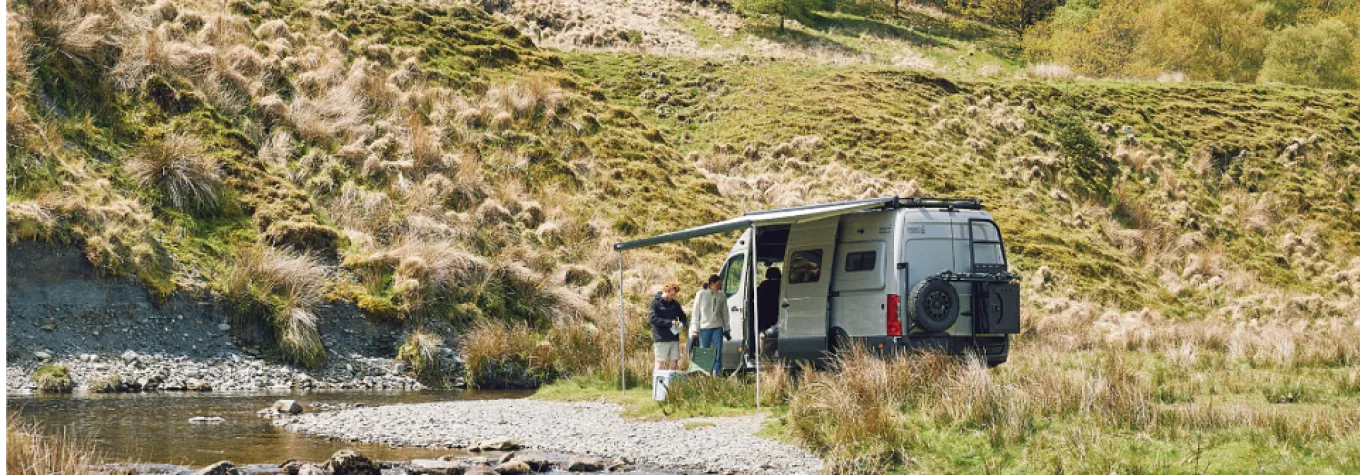
The ultimate guide to off-grid campervanning
Technical advice
Ditching electric hook-up and wild camping in your campervan is a great, low-cost way to enjoy the outdoors away from the crowds on busy campsites.
But, going off-grid and staying overnight in a remote location can be a daunting thought.
Our guide will explain what you’ll need to be self-sufficient and how to make sure your off-grid campervan trips go without a hitch.

Iain Duff Content Editor: Campervan/Camping
Iain Duff Content Editor: Campervan/Camping
What is off-grid camping in a campervan?
First of all, it’s important to understand what wild camping actually means – for backpackers and hikers, wild camping is hiking to a remote spot on a hillside, pitching a tiny tent and setting off again the next morning.
But in the context of campervans, it has several definitions, from park-ups on quiet country lanes to pub car parks. It can even mean staying on a traditional campsite without plugging into the mains, or using smaller sites that don’t offer all the facilities.
With the right set-up, you can still cook meals, heat and light your campervan, connect to the internet and even watch TV if you wish.
Why go camping off-grid?
For many people, off-grid campervan trips are the essence of vanlife. It is all about the freedom of being able to go wherever you fancy.
Also known as wild camping, it conjures up images of finding an idyllic rural spot, parking up your campervan and spending a night in the wilderness. The next morning you wake up to a beautiful view, before moving on to the next remote stopover.
But there are other reasons to camp off-grid. You might want to take advantage of the network of low-cost certificated sites and locations around the UK, where facilities can be extremely basic. Or perhaps you plan to travel across Europe, stopping at aires where there are no mains hook-ups or toilets available. You might even fancy a spot of ‘stealth camping’, where you park up for free in an urban area for the night.
Whatever your reason for wild camping, there are some things you’ll need to ensure your self-sufficiency goes smoothly.
Essentials for off-grid campervans
If you are not planning to stay on campsites during your campervant adventures, there are some essentials you will need to consider to ensure you can spend as much time on the road as possible, including power, heating, keeping food fresh and water and waste.
# Power
A good leisure battery, solar panels to keep it charged and an inverter that lets you use 230V appliances are essential when camping without electric hook-up.
Leisure batteries
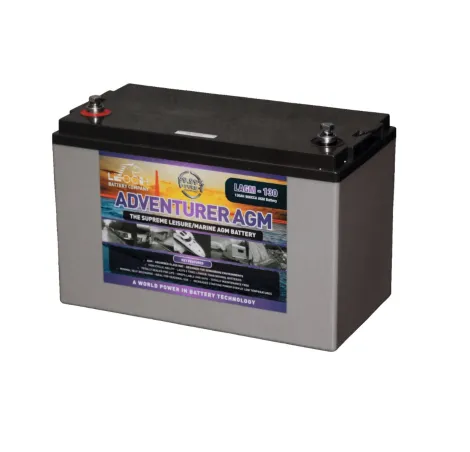
Not to be confused with the vehicle’s starter battery, leisure batteries store the energy that you use to power the campervan’s electrical system. There are two types available, traditional lead acid or modern lithium-ion.
Lead acid batteries are available in a few different varieties; the flooded lead acid type has a liquid electrolyte, while gel and AGM batteries keep the electrolyte in a more solid state. AGM batteries have been the most common used in campervans but their weight makes them less practical.
Although they are much more expensive, lithium iron phosphate batteries (LiFePO4) batteries are growing in popularity for campers because they are smaller, lighter, more powerful and last longer than AGM batteries.
A battery between 100Ah and 150Ah should be enough for three or four days off-grid on a UK campsite, at a festival or a show. In sunnier climes, it will last longer.
To maximise its cycle life, it is important not to let a lead acid battery discharge below 50% of its capacity. Driving will recharge the leisure battery, but if you’re staying in the same place for a while, a B2B charger is a good idea.
Solar panels
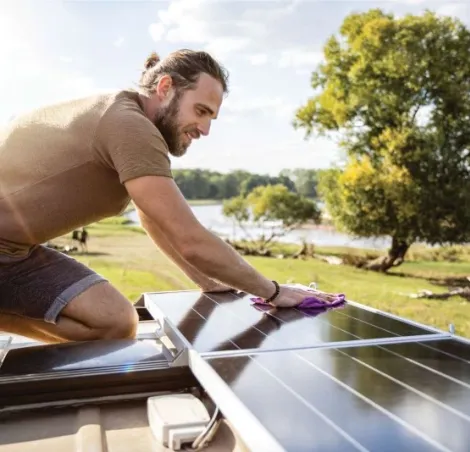
Solar panels will keep the leisure battery topped up and are a completely renewable energy source, but, of course, they depend on a good amount of sunshine to operate at their best. That’s all very well if you’re travelling through southern Europe, or even the UK during the summer, but if you’re pitching up in the UK in January they obviously won’t work as efficiently.
The more panels you have installed on your campervan, the longer you will be able to survive off-grid and the more electrical appliances you will be able to use. You can start with a minimum of an 80W panel, but preferably you should go for 100W or more.
Running LED lights and watching TV won’t eat up too much power, but if you add a refrigerator, oven or water pump into the mix, your consumption will be considerably higher.
Inverters
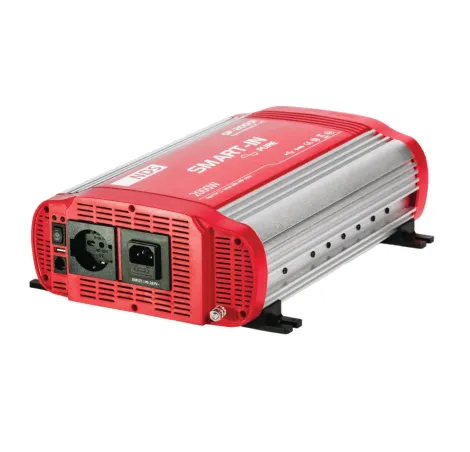
You will also need an inverter, preferably a pure sine wave output inverter, to convert 12V from a battery into 230V to run mains equipment. A 400W inverter will be enough to let you charge phones, cameras, speakers and laptops and run low-energy items like LEDs, small fans and portable coolers.
For larger appliances like low-wattage electric kettles, hair dryers or space heaters, then consider a 1,500W inverter. Microwaves typically consume around 700-1,200W, so you may need to ensure you have enough power available for short bursts of use.
You should also consider the starting surge that some appliances require when first turned on, which can often far exceed their rated running wattage.
# Heating
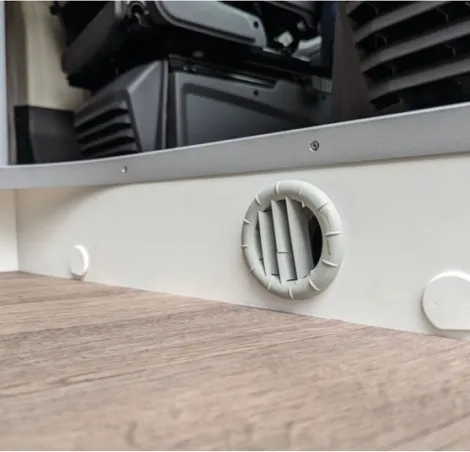
There are three main options for heating a campervan off-grid: diesel, gas and electricity. As the name would suggest, diesel heaters operate by burning diesel to heat up a heat exchanger. Air is warmed as it passes through, then the hot air is blown into the living space.
The diesel is usually taken from the vehicle’s fuel tank. Gas air heaters work in a similar way, but instead burn LPG to heat the heat exchanger. Electric heaters are really only an option if you’ve got access to a mains hook-up – the energy needed to power them would make it unrealistic to use your leisure battery.
Diesel is cheaper to run compared to gas – and easier to obtain. For off-grid camping, the ideal scenario might be to use diesel for heating and gas for cooking. You’ll also need a reasonable gas supply if you want to run a three-way fridge off-grid, rather than a compressor.
# Fridges
There are two types of campervan fridge: compressor and three-way. A compressor fridge is typically twice as efficient as a three-way fridge. A compressor fridge will take about 60W of power when running but switches on and off via its thermostat (45W is average).
A three-way absorption-type fridge will take at least double this power, typically 120W when running. The major difference here is that, when you are parked, the absorption fridge runs from your gas cylinder or mains hook-up. A single 6kg gas bottle holds as much energy as 63 fully charged 110Ah batteries.
# Water and waste
If you are planning to camp somewhere that doesn’t have toilet and shower amenities, then your off-grid campervan will need its own on-board facilities.
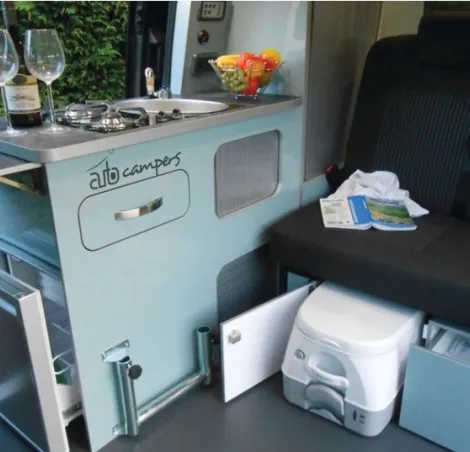
Even if you don’t have a full washroom, a portable toilet is something you won’t be able to do without. Remember, a cassette toilet could be full within a couple of days and you won’t have easy access to a chemical disposal point, so you will need to think about how to responsibly dispose of your waste. Whatever you do, DO NOT empty it in the wild. An alternative option for off-grid campervan journeys is a composting toilet.
A plentiful supply of fresh water on board your campervan is essential for off-grid camping – a larger campervan will have a tank with a capacity of around 100 litres, which should be enough to last a weekend, depending on how many people are using it and what it’s being used for.
Remember, you’re going to need water for cooking, dishwashing and cleaning, as well as showering and using the toilet. If you’ve got a smaller campervan, your water carrier will be small, too; although, without a washroom on board, you won’t use as much.
On longer trips, you will have to plan ahead to establish where you will be able to refill your water supply.
Where to stay in your off-grid camper
Remember, in the UK, wild camping in your campervan is not a right and landowners can ask you to move on at any time. However, generally, if you are discreet and respectful, take all your rubbish away and don’t cause a nuisance, you are likely to be fine.
You should only stay in the same place for one or two nights and make sure there are no specific restrictions on overnight parking or other local byelaws that would prevent you from staying there. Some car parks ban overnight camping and you could be fined if you ignore their rules.
Don’t block driveways or entrances to fields with your campervan, stay away from buildings and keep out of view as much as possible. The key is not drawing attention to yourself, so try to avoid residential streets, always keep noise to a minimum and do not set up camping chairs and awnings outside your campervan. Generally, the more remote the location the better it is for wild camping in a campervan.
Scotland, Wales and the Lake District are very popular for off-grid and wild camping; however, that has created some resentment in local communities because of the irresponsible actions of some thoughtless campers.
If you do want to wild camp in these beautiful locations, then it’s essential that you are considerate and don’t behave in a way that will upset the people who live in the area.
For your own safety and security, consider the surroundings. Does the area feel safe? If not, move on to somewhere else. If you are solo camping, always make sure someone knows where you are. Lock your doors and cover your windows so no one can see inside.
Unlike much of continental Europe, where aires and their equivalent are widespread, the UK does not have an extensive network of free or low-cost overnight stopping places. However, there are a growing number of spots where you are welcome to spend the night. Brit Stops is a directory of locations, such as pubs, farms, shops and other businesses where you can stay overnight for free – with the hope that you’ll take advantage of the services and products on offer.
The Camping and Caravaning Club and the Caravan and Motorhome Club both have a network of privately owned affiliated campsites where the facilities are minimal. These small Certificated Locations and Certificated Sites charge a small fee to Club members.
The best campervans for off-grid camping
The first thing to consider for off-grid camping is the campervan you will need. If your biggest priority is getting off the beaten track and accessing more remote rural locations, then a small, nimble campervan, such as a VW Transporter or similar, is your best bet.
This will almost certainly mean compromising on the facilities you have inside the vehicle, though, and in a small campervan that’s likely to mean no dedicated washroom/toilet. At best they will have a portable toilet and perhaps an external shower point, so you’ll need to decide if that will be enough for your needs, especially if you only plan to be wild camping for a couple of nights.
If you are planning longer off-grid campervan trips, more space – and, crucially, an on-board shower and toilet – will be important. In this case, you should go for something a little bigger for your off-grid adventures, such as a six-metre campervan with a washroom and kitchen. What you lose in agility you will more than make up for in comfort and convenience.
If you expect to do a lot of stealth camping in built-up areas, then you should consider a vehicle that looks less obviously like a campervan and in that way you’ll draw less attention to yourself if you’re parked in a street.
Malibu Genius 4x4 Performance
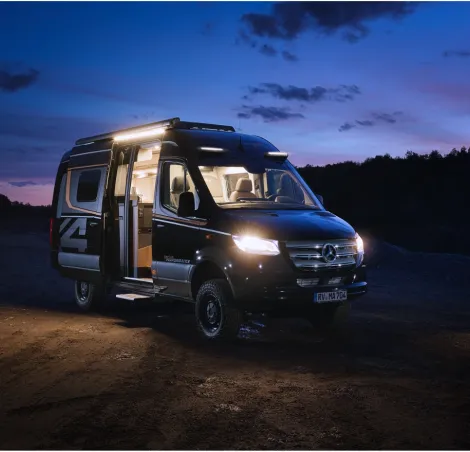
Mercedes-based, this 4x4 model has an innovative GRP extension on the back. While it may not sound much, that extra 40cm of space inside, compared to the standard 6m-long short wheelbase van, allows for proper single beds without too much compromise on the rest of the interior.
Plus, it’s a much more manageable size than the 7m Sprinter-based conversions, especially when it comes to parking and low-key overnighting.
That extra space has been used wisely with a good sized kitchen, compact lounge and clever washroom (the toilet slides away under the beds to create a proper shower area as well as those excellent domestic quality single beds.
It's truly unique...
Price from £128,040
Length 6.41m
FAQ
-
How long does a leisure battery last?
A battery between 100Ah and 150Ah should be enough for three or four days off-grid on a UK campsite, at a festival or a show. In sunnier climes, it will last longer.
To maximise its cycle life, it is important not to let a lead acid battery discharge below 50% of its capacity.
Although they are much more expensive, lithium iron phosphate batteries (LiFePO4) batteries are growing in popularity for campers because they are smaller, lighter, more powerful and last longer than AGM batteries.
-
Is it illegal to sleep in your campervan in the UK?
No, it's not illegal to sleep in your campervan but you should always be responsible.
Don’t block gateways or access and treat property with respect, leaving it as you found it, and don’t park in passing places, even if that’s temporarily to take a holiday snap,
Leave no trace is a principle to stick by – this includes any rubbish, particularly if any supplied bins are full.
Be discreet – don’t set up camp with awnings and outdoor chairs and make sure noise is kept to a minimum and don’t set up a campfire.
-
Can you camp off-grid in the UK?
Yes, many people camp off-grid in the UK. While wild camping in the UK is generally not a right, it is tolerated in certain circumstances and locations. Technically you cannot park on private land without permission from the landowner and if you are asked to move you should do so immediately.
In Scotland, you should be able to park in designated parking areas, unless there are bylaws and signs stating otherwise.
Even in Europe, where this is more commonly accepted, communities and governments are cracking down on overnighting, creating regulations or laws that preclude this in certain areas or non-designated sites.
That doesn’t mean you are limited to campsites, but it does mean you won’t be able to park up for the night absolutely anywhere.
Final thoughts
Off-grid campervanning offers an escape into nature, away from the constraints of traditional campsites. Whether you seek remote wilderness or tranquil certificated sites, preparation is key.
With the right set-up – efficient power sources, heating, water management, and mindful etiquette – your off-grid adventures will be unforgettable and responsibly enjoyed.
Join the Out & About Live family
Get the latest news and exclusive offers direct to your inbox
Discover your inner outdoors with Out & About Live. For over 20 years we have provided the very best advice to motorhomers, campervanners, caravanners and campers – whether you are looking for travel advice, the very best campsites, help with choosing a new campervan, news, shows, what’s on and much more – it’s all on Out & About Live.
We would love to welcome you to the family so sign up to our FREE email newsletters so you don’t miss out any longer.
Latest campervan articles
Explore our magazines
Enjoy expert tech help, travel and campsite inspiration, buying advice, reviews, and more with our best-selling magazines and guides.

Buying Your Perfect Motorhome
Buying Your Perfect Motorhome is the ultimate guide to turn your campervan adventure into reality. From models starting at £20k to luxury options, layouts, finance, insurance, and a dealer directory, it has everything you need to find your dream campervan.

Campervan magazine
Campervan magazine is the ultimate guide to maximise your ‘van experience, including unforgettable road trips, and must-see attractions, expert advice and reviews. Plus, essential maintenance tips to keep your ‘van in top condition.


