
Tips for travelling with dogs in a caravan
Inspiration
Caravanning with dogs: all you need to know
Caravan holidays with dogs are a joy for lots of reasons. The ability to take our pet with us on our travels is one of the reasons many of us choose to buy a caravan.
Read on for advice on travelling safely, making dogs more comfortable when travelling with the caravan, taking a pet to Europe and more.
This article is sponsored by Tavo, which makes the Maeve pet protection system, plus the Crispin travel crate and the Hendrick crate.
An introduction to caravanning with dogs
Firstly, many people choose to buy a caravan specifically because they have a dog – or more than one dog – and want to take the dog on holiday. After all, we all get pets because we want to spend time with them – and what better time than holiday time, whether that be your main holidays or weekend breaks?
Secondly, if you already have a caravan and are thinking of taking your dog with you on holiday, maybe for the first time, you can be sure that having your dog with you will enrich your holiday – making it more fun. So, any which way you approach the idea of caravanning holidays with dogs, it’s a win-win.
Caravanning with a dog – or more than one dog – is just so easy. An awning helps, of course – especially in providing somewhere to towel your dog’s fur after a rain-soaked walk, and to wipe muddy paws.
The presence of a dog in the family may influence the layout of caravan you choose. Enough floor space is key. And that strongly depends on the size of the dog.
Again, awnings are an advantage and, the smaller your caravan, the more you will appreciate the extra space an awning provides for your dog to eat, possibly even sleep (in a dog crate so that he can’t get out of the awning).
From a dog’s perspective, they love being with people – and in a caravan they’re closer to the family than in a house. And they love going for walks, of course. It's easy to build walking into your holiday route.
Planning your travel
The first thing to consider when planning caravanning travel with a dog is keeping the dog happy in the car – and safe. In terms of happy, we mean keeping the car well ventilated so that the dog doesn’t feel too hot, and giving him his own bed so that he is comfortable.
Safety is a much greater consideration, though; that’s about making sure that the dog is confined to one area of the car, either the back seat, or the luggage area in an estate car or hatchback. Being confined to one area will prevent the dog from entering the driver’s space (essential!). It also means that, in the event of heavy braking or a collision, the dog can’t be thrown forward into the front seat area, or into the back seat if he is in the luggage area.
Dog seatbelts are available; these attach to the car’s seatbelt system. There are also dog crates on the market; most fold when not in use. These originated for transporting show dogs and are now in common use by pet owners.
For caravan owners, dog crates have a double use, for they can be used to confine your dog within an awning, to make sure he can’t get out without his lead and run around the campsite.
What to bring with you on a journey
Water is essential; plus, of course, a bowl. Depending on the length of the journey, you may wish to pack some dried dog food.
Kitchen paper is a good idea, to wipe muddy paws after you have stopped to give your dog a chance to 'go to the loo'.
Why bring your dog in your caravan?
As we know, the use of caravans, motorhomes and campervans provides a variety of benefits, not least an element of freedom.
One of the best plus points is that you can bring along your canine companions. Including your dog in your adventures benefits your physical and mental health while away, and can elevate the whole experience, as you’re with all family members.
With your own accommodation on wheels, you don’t have to worry about any pet rules that come with renting a hotel room or B&B. Taking your dog to the loo is also a far more convenient process, as are its other requirements, such as feeding and walks. Bringing your dog along is also more cost-effective than using kennels.
In the UK, the average price of an overnight stay in a kennel is £20. Therefore, a getaway can quickly add up to a sum better spent elsewhere. But, most importantly, sharing a break with your dog makes it more fun and is healthier for you and your four-legged companion.
Things to consider in relation to travel safety with your dog
The Highway code states "When in a vehicle, make sure dogs or other animals are suitably restrained, so they cannot distract you while you are driving, or injure you, or themselves, if you stop quickly. A seatbelt harness, pet carrier, dog cage or dog guard are ways of restraining animals in cars.”
You can restrain or contain your dog in various ways:
- Dog guards/barriers placed behind front or rear seats can block off a section of the vehicle
- With a wide variety of shapes and materials, a small or medium dog crate (or travelling kennel) may fit on the back seat of most towcars. You may need to adjust seats to fit a larger crate in. Crates should be large enough to allow your dog to stand up, lie down, and comfortably turn around
- Car harnesses should be manufactured to withstand the impact of a car accident; the tether attaching it to the seatbelts should be as short as possible to reduce the distance a dog is thrown during an accident
Whatever the distance of the journey, you will need to consider the frequency of stops that you will need to make to keep your dog happy.
That’s not just about ‘toilet’ stops, it’s about making sure the dog doesn’t get bored – because bored dogs can get restless and may bark – and that can distract the driver.
Tavo Hendrick Pet Car Seat Carrier
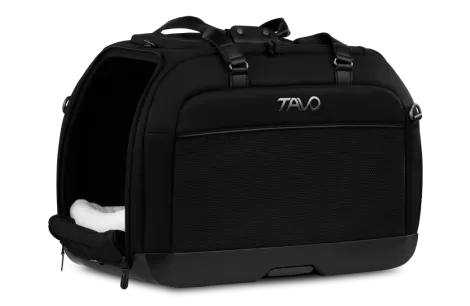
If your pets prefer a secure, enclosed travelling environment, take a look at the new Hendrick from Tavo, priced at £300. It has Isofix latching points that can be quickly released at the push of a button. A structured base prevents sagging and mesh panels provide ventilation and viewing windows. This crash-tested carrier also has memory foam side impact protection.
Caravanning with dogs travel checklist
Ensuring your dogs travel securely is easy, but here are our top tips for travelling safely with dogs in a caravan:
- Research your travel system – look for a system that’s been crash tested
- A distressed dog who is restrained can still be a major distraction – build up training, beginning with just sitting in the car and giving your dog treats. Step by step you can move to closing doors, starting the engine, and then short journeys
- Check your breakdown cover will permit dogs to travel with them in the event of your vehicle needing to be recovered
- Never allow your dog to put their head out of the window – it may look fun but, as well as the obvious risks, dust and dirt particles can hurt your dog’s eyes
- Don’t travel with your dog sat next to an airbag
- On longer journeys, give your dog plenty of breaks
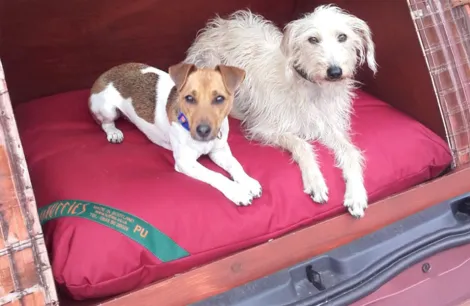
Save on Tuffies Tailor-made service
Tuffies was voted Best Dog Bed 2025 by the readers of Your Dog magazine and one of those reasons is its bespoke service that allows you to find the exact fit for the space available, meaning it won’t slide around on the road.
Use the code TOUR75 to save 7.5%

Zeus Nitro dog toys
Get ready to experience Zeus Nitro…
Unleash the inner athlete in yourself and your dog with Zeus Nitro dog toys, designed for intense, energetic play! Made to be extra-strong yet highly flexible, these toys promote safe fetch and play, with the optimal weight for maximum performance – on land and in water!
Travelling with dogs
If your dog is not a good passenger, it’s not something you (or your dog) need to learn to live with. It’s time to put in place an action plan!
The first port of call is your vet. Any health issues could be causing your dog to be in pain or extra anxious when being driven.
Once your dog has a clean bill of health, then you can begin to work on their travelling environment.
If your dog doesn’t enjoy travelling then they may already have negative associations with it. You can begin to rebuild their confidence with some travel training.
Take it slowly and break it down into stages. Start with the car stationary and use treats or toys, whatever motivates your dog, to build positive associations.
Keep sessions short – don’t allow your dog to get to a stage where they can’t cope. This training will include getting your dog used to his safety devices, such as a seatbelt or crate.
Once your dog is happy in the car, you can then start to build up to doing short journeys.
Top eight tips
Helping dogs travel more comfortably in a car
As your dog learns to relax on the drive, you can help keep trips comfortable with the following tips:
- Feed a light and easily digested meal three to four hours before setting off
- Plan longer journeys to schedule stops at least every two hours
- Drive carefully – a smooth drive will help
- Keep calm – if you get angry when driving, your dog can think there is something to worry about
- Provide ventilation
- Place shades on side windows to reduce heat and glare
- Make sure your dog is comfortable – there should be enough room to stand up, turn around, and lie down comfortably
- Never let your dog put their head out of the window – it’s not safe and can make them feel worse
Just like us humans, dog can suffer from motion sickness when travelling. Or the anxiety might be fuelling their sickness.
There are a range of calming products to reduce anxiety, as well as anti-sickness supplements and even medication. Talk to your vet who should be able to recommend useful products and advise on any that you source yourself.
Finding a dog-friendly caravan park
The vast majority of campsites parks accept dogs. Those that don’t are usually those that have their own beaches. Check when booking anyway.
Many dog-friendly caravan parks have dog walking areas; some have small fields that are fenced, where you are permitted to let your pet run free of his lead.
Almost all campsites that allow dogs have a rule that says ‘dog on leads at all times’. That means not just when out for a walk, but when the dog is outside around your caravan. You can buy spiral dog securing points that go into the ground and have a loop at the top to which you can secure a lead or longer tether.
Windbreaks can be useful to show your dog where the pitch boundaries are – and some windbreak systems can be bought complete with ‘gates’. Our advice, though, is not to rely on a windbreak to confine your dog – they can easily ‘break out’. That goes for awnings, too. And, as the vast majority of campsites do not allow dogs to run loose, you need to make sure your dog doesn’t escape.
Some campsites have dog showers – these are fantastic for getting your dog clean after a muddy walk.
Our own Campsite Finder lists dog-friendly sites in many parts of Britain.
Wherever you choose, it’s worth remembering that late night and early morning barking – and lots of barking at any time – is not considered good campsite etiquette! It’s also worth remembering that, while many people absolutely love dogs (not only their own), there are some people who really don’t like dogs!
Dog accessories for caravanning
Having all the gear you need makes life so much easier. Prepare a doggy ‘suitcase’ with all the essentials, such as food, treats, toys, bed, crate, leads, collars, brush, drying towel, medication, and anything else you might need. You can buy items that have been forgotten, but it’s better being prepared. Write a list, as there is often much more than you realise!
For starters, don't forget the basics:
- A towel ‘bag’. These are like very close-fitting dog coats; you put the dog inside the towel bag and rub his fur dry
- Collapsible bowls. These save space in caravan lockers and are also great for taking out on day trips
- A ground-screw dog tether – position it where the dog has access to shade
- If you allow your dog to go on the seating in your caravan, invest in some covers to protect your caravan’s upholstery
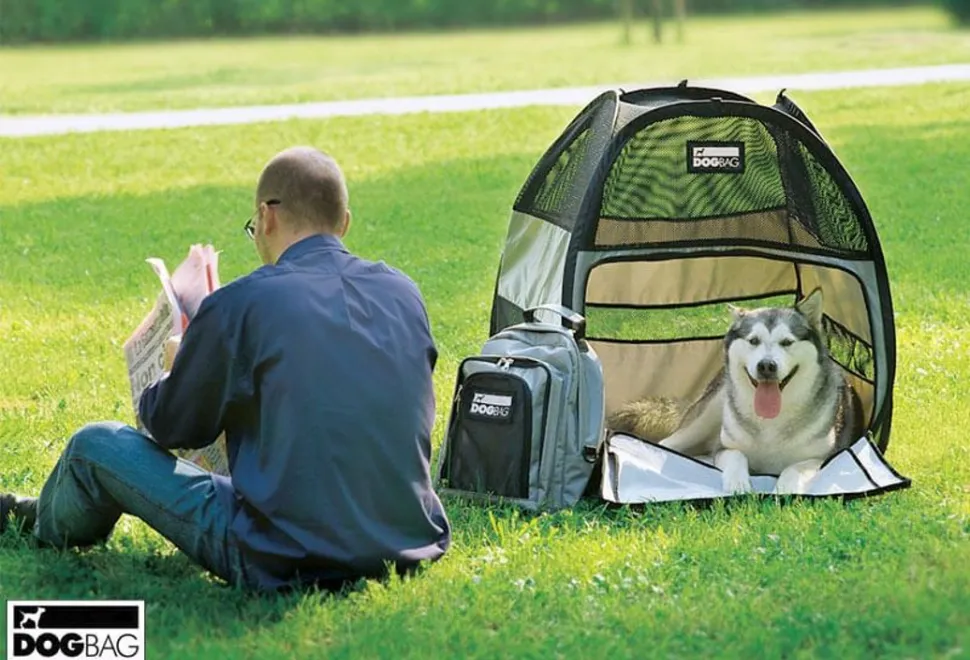
- A folding kennel for your awning, to confine your dog; these are made of fabric and have mesh areas. They're a great alternative if you don’t use a dog create. Check out the Dog Bag listed below
After that, there are a few other things to consider, starting with toys! Whatever his favourite toy, it will help his happiness in the car. A bed is a good idea, whether inside a crate, or on the back seat if the dog is anchored by a lead to the safety harness.
Another good option is the Dog Bag, which is a pop-up kennel built from mesh fabric that filters out UV rays and keeps your dog cool in hot weather. It's easy to keep clean and can be used in the car, too.
Water, as we mentioned earlier, plus dried food (if your travel includes a time that he would normally eat a meal) – and ‘bribery’ in the form of dog treats.
Make sure you pack a lead, collar and harness, as many places in the UK that you might visit on holiday – like the Lake District, for example – require you to keep dogs on the lead. One of our favourite options is the Dogmatic head collar, which has a unique design that enables you to control your pooch without causing them distress. It will allow you to explore further with your best friend in comfort and control.
Travelling in Europe
You will need to obtain an animal health certificate (AHC) from your pet's vet for each individual trip you wish to take your dog to a country in Europe, including Northern Ireland. And, of course, you will need to check when you book a campsite abroad that dogs are allowed at that campsite.
Many dog owners choose to cross the Channel via the Channel Tunnel, to avoid the potential hassles of travelling on a ferry with them.
In order to obtain an animal health certificate, you will need to make sure the dog is microchipped and has had a rabies vaccination. Some countries, notably Malta, Norway, Finland, Northern Ireland and Ireland, also insist that the dog has had tapeworm treatment.
You need to obtain an animal heath certificate in the 10 days before you enter the EU from Britain. Animal health certificates are obtained through your vet. Rules for countries outside the EU differ; check the requirements for each country you may be visiting well before your departure date from Britain.
-
How do I keep my dog cool in my caravan?
You can have an air-conditioning unit fitted. If you don’t want to do that, you can keep the caravan ventilated by opening the rooflights and windows on the first latch, so creating airflow. Do not leave windows open unless you are in the caravan because your dog may escape.
And don’t be tempted to leave the top half of your caravan door (assuming you have a stable door) open for ventilation – a large dog can jump out of it. In hot weather, even though you may open the windows and roof vents, standard advice is not to leave dogs alone in a caravan, because it may become too hot for them.
-
Can you travel with dogs in the caravan?
Definitely not. Dogs must be in your towcar.
-
What are the rules for travelling with dogs?
The Highway Code states that dogs must be restrained so that they cannot distract the driver or injure you or themselves if you stop quickly.
-
How much does an animal health certificate cost?
Prices vary hugely. From £99 for one dog to £250 and more. Our research shows an average cost of around £150.
Final thoughts
Enjoy holidaying with your canine companion! Caravan holidays with dogs, whether you are a family with children, a couple, or on your own, can be great fun.
Plan ahead, choose the right campsites for your dog, make sure he’s comfortable and happy while you tow the caravan, and invest in a dog crate for use in your car and in your awning. And don’t forget to pack enough of his favourite food, just in case it’s not available near to where you are staying.
Join the Out & About Live family
Get the latest news and exclusive offers direct to your inbox
Discover your inner outdoors with Out & About Live. For over 20 years we have provided the very best advice to motorhomers, campervanners, caravanners and campers – whether you are looking for travel advice, the very best campsites, help with choosing a new ‘van, news, shows, what’s on and much more – it’s all on Out & About Live.
We would love to welcome you to the family so sign up to our FREE email newsletters so you don’t miss out any longer.
Latest caravan articles

Explore our magazines
Enjoy expert tech help, travel and campsite inspiration, buying advice, reviews, and more with our best-selling magazines and guides.

Buying Your Perfect Caravan
Buying Your Perfect Caravan is the ultimate guide to finding your ideal caravan. From layouts and storage to finance, insurance, and essential kits, it has everything you need to make your dream caravan adventure a reality.

Caravan magazine
Caravan magazine is perfect for caravan enthusiasts. Make the most of your caravan lifestyle with expert advice, unforgettable road trips, must-see attractions and top maintenance tips to keep your ‘van adventure ready.


