
McLouis Fusion 379 low-profile motorhome



Description
The McLouis Fusion motorhome range was introduced in 2019; for 2025 it gets a new look inside and out
Key Features
Full Review
Words and photos: Peter Vaughan
The McLouis brand was originally the brainchild of the late Pier Luigi Alinari who masterminded numerous southern European motorhome makers in his time.
Following its launch in 1999, it soon arrived in the UK and, while the moniker might sound slightly Scottish, this all-Italian marque, based in Tuscany, actually merged the names of two airport restaurants (McDonalds and Louis’) that Pier Luigi had spotted on his travels just prior to its debut!
After a period away from the UK market, McLouis motorhomes returned to Britain in 2019 with an all-new range under the Fusion name, marketed by Auto-Sleepers as both marques had now become part of the Trigano Group (McLouis having joined in 2013).
Six years later, with an expanding network of dealers behind it, this is the first major revamp of the Fusion range and our test vehicle is a prototype for the 2025 line-up.
Next season, the UK will get four models – 330 (rear lounge), 360 (transverse double bed over a garage), 373 (fixed single beds) and this 379 (island bed).
The spec
All will be built on the Series 10 version of the Fiat Ducato, featuring a heavily restyled front bumper/grille, rather than the outgoing Series 9 cab seen here. As a prototype, there may be slight differences between our test motorhome and the ones you can buy.
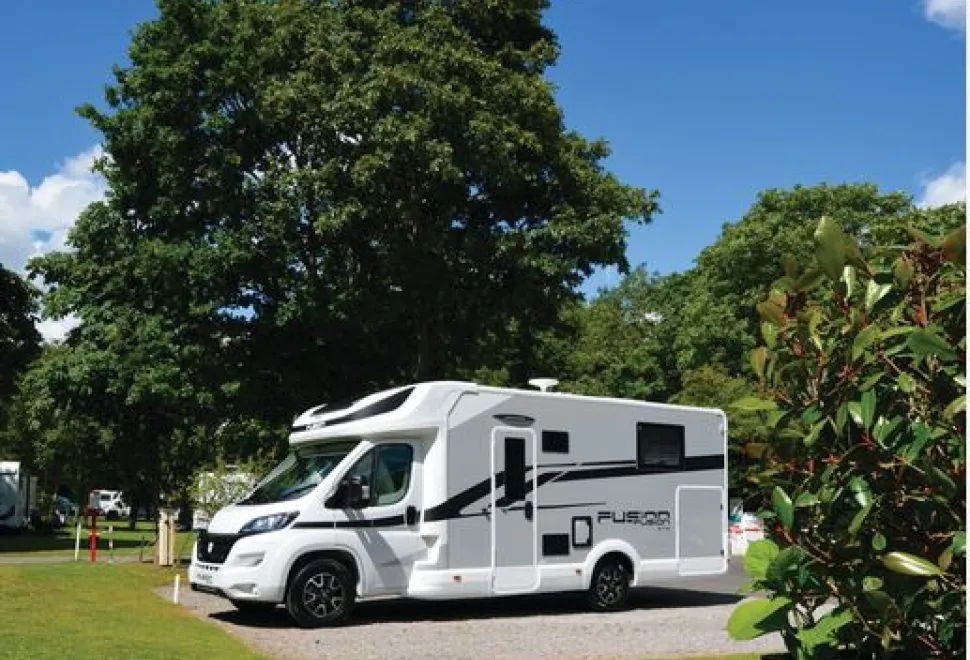
The big news on the outside, however, is a switch from a grey cab and white body to a white cab and, well, you’ve looked at the photo…
Complete with brand-new graphics, as well as carry-over features like the framed habitation windows and 16in alloy wheels, the 2025-season model looks a lot more modern.
Unlike many of its imported rivals, it also continues to have a fully UK-handed layout with the habitation door (featuring a window, bin, flyscreen, central locking, twin internal steps – no outside step) on our nearside.
The bodywork uses the company’s WPS construction system, which is completely wood-free (plastic resins replacing the timber frame) and has polyester inner and outer skins for the walls, a hail-resistant roof that you can walk on, a glass-fibre skin underneath the motorhome and 7cm of insulation in the floor.
A new feature is the addition of the VIN Chip vehicle identification system.
The specification is completed by a 120W solar panel and generous (115-litre fresh, 135-litre waste) water tanks (the latter with a T-handle for quick emptying), but there are no external shower or barbecue points.
The garage
The key feature externally, of course, is the garage, with full-sized loading doors on either side.
Inside this area, lighting is sparse and the lashing points are fixed ones in each corner but a 230V socket has now been added.
More importantly, the headroom in the garage can be raised from 97cm to 1.17m at the press of a button, although the bed must be in its low position for sleeping.
The garage can carry up to 300kg, but a total payload for the new model has yet to be declared; however, we wouldn’t expect it to be much different to the 428kg of the 2024-season motorhome in manual, 3,500kg form (a 3,650kg chassis upgrade is also offered).
Likewise, you’ll probably have to wait until the NEC before prices are confirmed but last year’s 379 was £77,995, so something around £80k seems probable, with an automatic gearbox likely to add quite a substantial premium.
The Ducato base
The Fiat Ducato got its still-current wedge profile back in 2007 and, although the Ford Transit is now eating into its dominance, it retains a market-leading position in motorhomes.
Since its debut (when most thought it very ugly, although we’ve since got used to it) it has evolved mostly through new engine and gearbox options.
The Series 9s are smoother, easier to drive and quieter than earlier Ducatos but the feel from behind the wheel, with positive steering, a firm ride and excellent stability, is similar.
The new Series 10 is, perhaps, the most controversial-looking Ducato yet with its random slots for a grille but, as before, we’ll probably get accustomed to its new face, even if the ugly duckling never becomes truly swan-like.
The cab
Inside, the cab still has cheap, hard plastics but there are some new features. Most interesting will be the swap from nine to eight speeds for the automatic transmission – that, we can’t wait to try.
In the meantime, we can tell you that the McLouis sticks with a 140hp motor and a manual gearbox as standard.
It cruised along the M4, lightly laden, in perfectly acceptable fashion but with far too many rattles once we diverted onto Berkshire’s rural roads.
And we should point out the extra features that will come on production models – the electric parking brake, the front fog lamps and automatic air-conditioning.
The Pioneer 9in multimedia unit seen here is also standard; it includes the reversing camera, Android Auto and Apple CarPlay, with built-in sat-nav available as an optional extra.
One final driver’s note concerns the lack of a nearside window behind the cab, making some angled junctions quite awkward for a solo driver.
The décor
Inside, the 2025 Fusion is very different to the 2024 model, even though the layout is carried over.
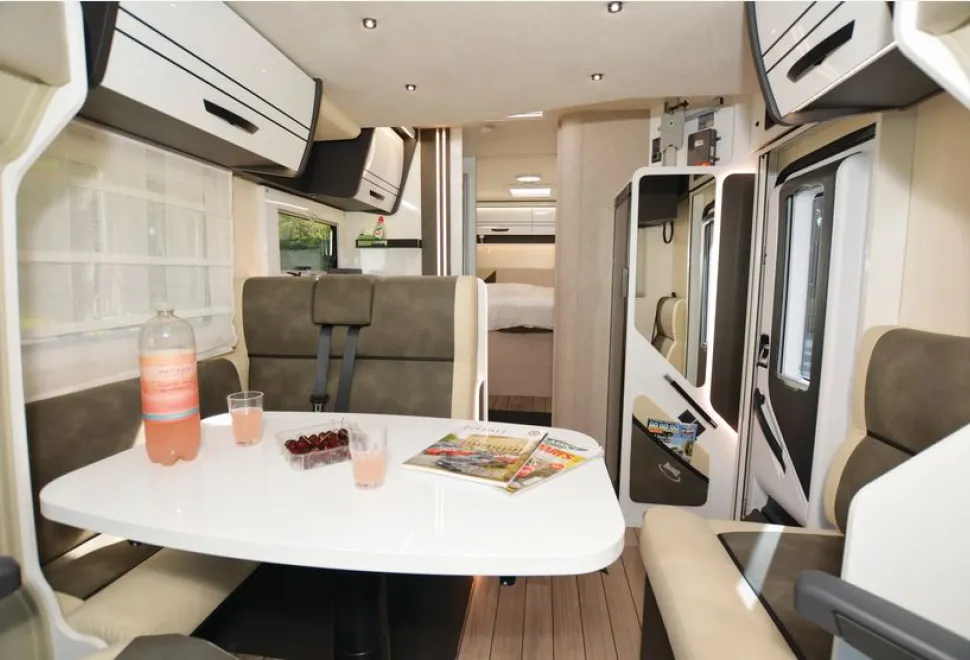
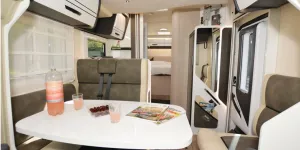
Gone is all the light wood, replaced by bright gloss white with contrasting dark grey handles, frames and seat bases.
There’s a new mid-grey textured finish to the washroom walls and the bed base, plus a new corduroy-style trim under the drop-down bed; removable carpets will still be included, although they weren’t fitted to our test motorhome.
In fact, the fabrics, flooring, furniture and lighting have all changed, creating a far more contemporary vibe.
If you like the new look, it’ll be a key reason to choose the McLouis because this is a crowded sector with plenty of rival brands competing for your custom.
The layout
Whilst there are countless low-profile island bed models in the 7.5m class, many have moved away from the classic continental half-dinette in favour of side settees.
McLouis, however, has stayed faithful to the former, with a single side seat on the nearside making seating room for five on site (this prototype also featured a fifth seatbelt and berth but these will not be available in the UK for the 2025 season).
This format is better suited to those regularly carrying rear passengers as there’s no reconfiguring from on-site to travel seating.
The lounge
It’s not a particularly large lounge and it favours upright sitting, rather than recumbent relaxing.
There’s plenty of daylight from the huge opening overcab sunroof and artificial light from the downlights in the drop-down bed base.
The table is a good size and sturdy for dining but doesn’t twist (only sliding fore/aft and side to side) and feels quite large in the space, especially if you’re occupying the rear bench for travel.
Isofix is fitted here but the table’s size may stop some child seats from fitting. Another aspect to note is that the cab chairs and floor are both higher than their neighbours and the table is more in tune with the Fiat seats than the settee.
You’ll want to sit in the front seats to watch the TV, too – the bracket is high up over the fridge (an aerial and sockets are fitted but not the screen).
The kitchen
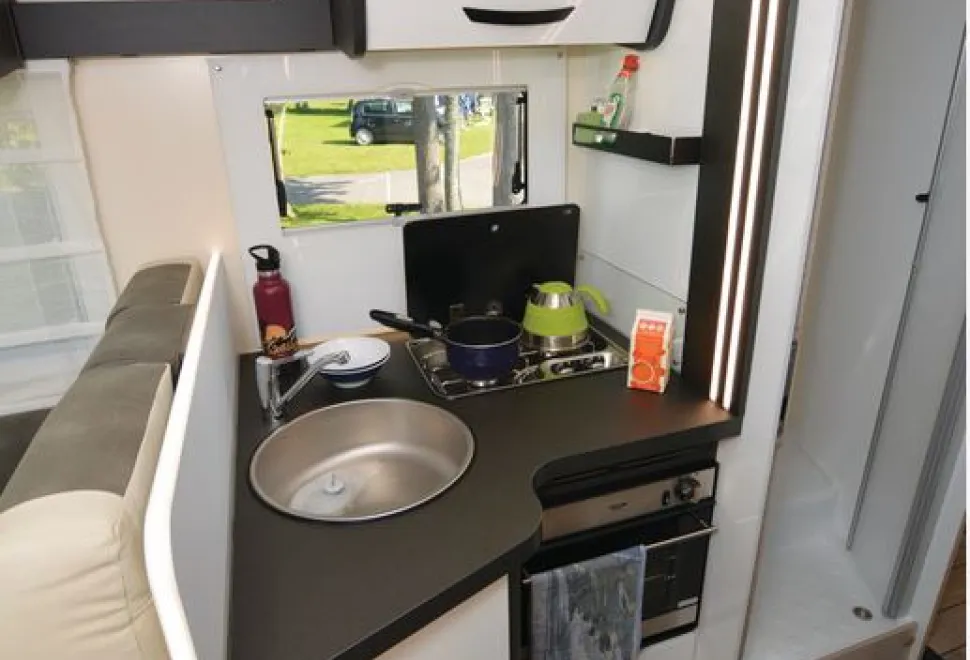
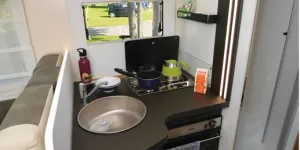
If you’re planning on rustling up some chicken wonton tacos or Mexican ravioli, then the changes to the kitchen may be more important to you than the injection of designer pizzazz to the décor. It’s here in the galley that the 379 has changed most.
Firstly – cue the fanfare! – the oven has moved from above the fridge and is no longer behind you as you stand at the hob; it’s now where it belongs, under the counter in the main L-shaped kitchen unit.
That, in turn, means there’s a new fridge – a tall, slimline 142-litre Thetford model with automatic energy selection and a big bottle drawer for your prosecco.
Less in tune with UK tastes, perhaps, is the switch from a three-burner hob to two, although McLouis is not alone in believing that few owners really use more than a pair of gas rings at once. It does at least create a bit more worktop space.
Storage is in one largish top locker and a deep cupboard under the sink. This hides the cutlery drawer as well as a shelf that stretches 80cm to the wall – you’ll need the arms of Mr Tickle to reach the pepper grinder if it’s slid all the way to the back!
There’s just one mains socket in the galley (underneath the top cupboard) and the extractor hood appears to have been dropped from the spec, although there’s still a roof vent nearby.
The washroom
Beyond the galley, there are steps up into the shower, toilet and bedroom (all of slightly different heights).
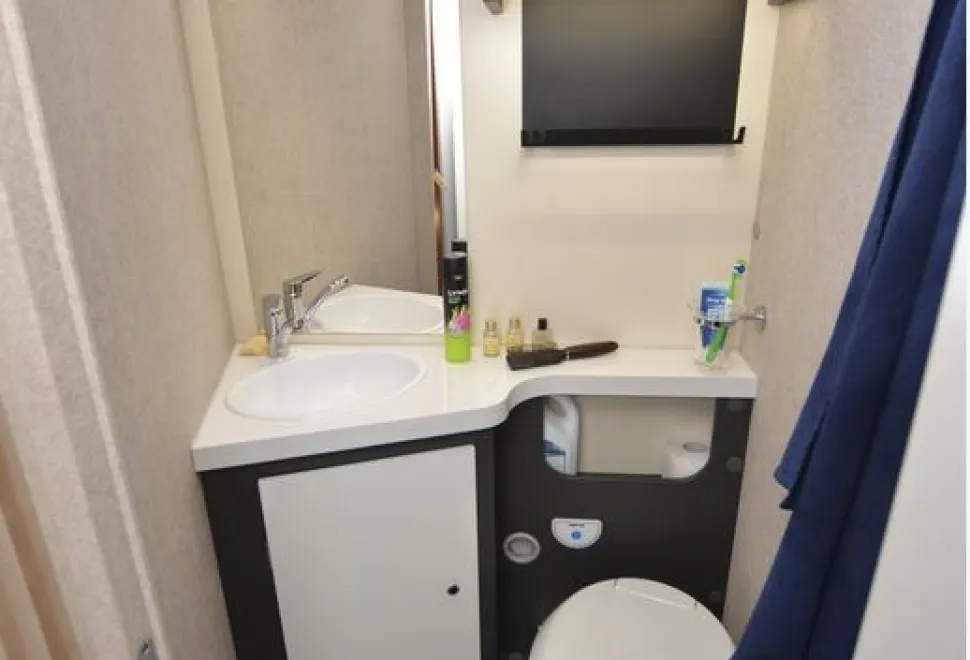
The format is the usual one, with separate loo and shower areas that can be combined into an en suite with the toilet door closing off the back of the motorhome.
Here, there’s also a concertina screen for privacy in the bedroom and, while at first this seems inferior to a proper door, it does give as you shuffle around the end of the bed, so it’s actually as much a plus as a minus.
The shower has gained a drying rail and also has proper doors, twin drains, somewhere for your gel and decent water pressure. The downside is the large step in the tray, which could be really awkward if you have large feet.
Opposite, the toilet area has lost its opening window, but still has a small roof vent.
The Thetford swivel cassette loo is on a slight plinth (check that out if you have short legs) and there’s adequate room to use it with the door closed (which isn’t always the case in this layout).
The basin has a good area of worktop adjacent, while a loo roll holder is hidden in the cupboard below and a robe hook and towel rail are also fitted.
The bedroom
Aft of the ablutions, the bedroom has the typical his and hers wardrobes, a roof vent and reading lights with built-in USBs. Unusually, the headboard has magazine pockets, while importantly there’s enough room to sit up with your latest MMM.
The mattress is rather firm, which may not suit everyone, and the foot of the bed is curved to ease access and give more undressing space.
Extra storage is found by lifting the end of the bed and this space will be perfect for clothes as the Truma Combi boiler is directly below (it’s a 6 E gas/electric model).
There’s even a little bit of extra cupboard space in the steps at each side of the bed.
The drop-down bed
Of course, this Fusion is also a true four-berth with its second double bed lowering electrically over the lounge, with no need to move any seats or the table and without losing the use of the galley.
The mattress here narrows towards the nearside to ease access through the door, which is possible without too much of a limbo.
You’ll need the ladder to reach the front bed and headroom up there is a modest 53cm but that leaves just enough room for one person to sit underneath.
Two reading lights and wall pockets are practical additions for those sleeping up front.
Motorhome supplied by McLouis UK
Tel: 01386 853338
mclouisfusion.co.uk
Insurance: £746.29
Tel: 0800 975 1307
shieldtotalinsurance.co.uk
For quote details: motorhome.ma/QuoteInfo
Our Verdict
The Fusion goes into 2025 with a new look that feels far more up to date.
It appears well-finished (rattles aside) and has a mostly comprehensive spec, which includes being a proper four-berth as standard (the drop-down bed is much better than a lounge bed).
Key pluses are the UK-handed layout, height-adjustable garage and new, low-mounted oven – take these into account when comparing with its many rivals.


