
Auto-Trail Excel 620S low-profile motorhome



Description
Auto-Trail is adding a pure two-berth layout to its compact, narrow-bodied Excel range for 2025
Key Features
Full Review
Words and photos: Peter Vaughan
The Auto-Trail Excel 620S
Auto-Trail debuted its Excel range a year ago – watch our video at motorhome.ma/autotrail24 – with four models based on the Ford Transit, all featuring a slimline low-profile body designed to appeal to those trading up from a campervan for more living space and more storage.
Each of this quartet has an overall width 11cm less than the company’s other coachbuilts, while layouts (rather continental in style) all have four belted travel seats.
Now there’s a fifth model in the line-up, which will be shown for the first time at the October NEC – and it’s a little different to its stablemates.
So, to bring you the full story, we collected the prototype from Edwards Leisure in Worcester to carry out this live-in road test.
The additional model is the 620S, which shares its 6.20m overall length with the existing 620G. However, there’s a shorter wheelbase here (because of the position of the habitation door) and no garage or fixed bed. If the 620G is a bit Germanic in its floorplan, the 620S is as British as the village cricket green.
It’s purely a two-berth (no rear travel seats) and brings back a design that was once hugely popular in the form of the Tracker EKS. Here, though, it has the Ford cab and the Excel’s contemporary design.
With no current equivalent motorhome available from either Bailey or Swift, the new Auto-Trail also slots neatly between two long-running models (the Elddis Autoquest 115 and Auto-Sleeper Nuevo) on price, while also being unique in combining this design with the Transit chassis.
The Ford cab
Our test vehicle was based on a 2024-season Ford cab, while production models will all be built on the latest Transit.
Unlike next season’s Stellantis vans (Fiat, Peugeot, Citroën), there’s little to mark out the change visually but there is a new eight-speed automatic transmission for the Ford, and the Xzent head unit seen in our photos will be replaced by the Blue Oval’s own, larger (12in) SYNC 4 display.
What doesn’t change is the Ford’s more car-like driving position than the Fiat/Peugeot vans, with plenty of adjustment at the helm via a reach and rake-adjustable wheel.
The chairs have twin armrests and lumbar support and go down nice and low, too.
What surprised me here, though, was just how well the 130hp motor performed – no need to pay £1,200 to upgrade to the 165hp motor then!
The ride quality is comfortable but there were still some rattles and the longer rear overhang means that the 620S isn’t quite as surefooted as its longer wheelbase stablemates.
Auto-Trail will continue to offer a range of cab colours at no extra cost – Agate Black, Magnetic Grey, Moondust, Grey Matter or this very attractive Chrome Blue. Of course, it’s a 3.5-tonne motorhome to suit any licence and it comes with the sort of payload that means you’ll never have to trouble the weighbridge – a whopping 745kg.
The options
By today’s standards, the Excel is also keenly priced, although the £64k list figure isn’t the full story. You’ll definitely want the Drivers Pack (£1,975) and Lux Pack (£1,578) and it seems highly unlikely that any will ever be built without these ‘options’.
The Drivers Pack adds electric/heated mirrors, automatic lights and wipers, front fog lamps, a heated windscreen, the Trend dashboard, cornering lights, collision mitigation system, lane assist, speed sign recognition, front parking sensors and tyre pressure monitoring.
Then the Lux Pack gives you the 12in touchscreen with Apple CarPlay and DAB radio, a lithium habitation battery, TV aerial, 200W solar panel, Omnivent, upgraded habitation door with flyscreen, removable carpets, reversing camera and external barbecue point.
On top of the packs, our test vehicle had the black alloy wheels (£995), 21.5in Avtex TV (£420), cab blinds (£680) and an automatic gearbox (£1,860), bringing the total to £71,610.
To be fair, there’s not much else to add, although you could have a 3.5m roll-out awning (£1,095), an additional leisure battery (£595), a towbar (£795) and Motorhome WiFi (£425).
The spec
However you spec your Excel, this is a much more modern-looking motorhome than the company’s traditional Expedition and Imala ranges. From the large, opening overcab sunroof to the rear panel with its roof spoiler, circular tail lights and pre-fitted bike rack mountings, it looks ready for 2025.
You’ll find pleasing details, too, such as the external hatches into the under-seat lockers on either side and an entrance that needs no pop-out step.
There’s an outside shower (cold water only) as well as the barbecue point and, although both water tanks (90 litres fresh, 80 litres waste) are underslung, the grey tank does at least come with a simple T-handle and large bore outlet for quick and convenient emptying.
Whilst looking underneath, though, you’ll spot the very inaccessible spare wheel, buried forward of the fresh water tank.
The interior
Whatever your views on the spec, it’s the space inside that will sell you this motorhome as it simply serves to give a couple maximum living space in a compact motorhome – one that’s shorter than an extra-long Fiat/Peugeot panel van but feels much, much bigger inside.
Of course that’s partly down to the flat sides of a coachbuilt motorhome and, although the Excel is slim, it’s still wider than a campervan.
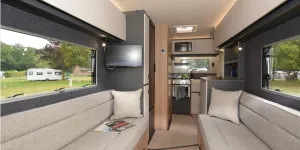
But just look at the size of the lounge, with swivel cab seats, long sofas down each side (1.83m on the nearside, 1.51m on the offside) and no fixed table.
Add in the large side windows, big overcab sunroof and MPK rooflight and you can hardly believe that you’re in such a petite motorhome.
Even when I arrived at the Caravan and Motorhome Club’s Malvern Hills site on a murky grey afternoon (in August!), the interior felt light and welcoming.
It’s comfortable, too, with settee heights that are well judged – although it might have been tempting to try to keep the overall length below 6m, that would have compromised this lovely lounge too much.
It also has a good range of artificial lighting, including ambient lights above the top lockers and directional reading lamps with USB ports above the aft end of each sofa. Pity there are no reading lights in the cab, though.
Décor-wise, we seem to be moving away from wood, which only appears on the washroom wall and on the seat bases – elsewhere it’s a mix of greys.
The table matches the mottled finish of the kitchen counter and, as it’s a free-standing unit, it can be used outside or in. It slides away in its own compartment near the door when not required and it’s not too heavy, but indoors it works best if you sit side by side as it’s rather too slim to cater for both settees at once.
The lounge storage
With the water tanks underslung, there’s lots of space in the under-seat lockers. In fact, the nearside bed base was only half-filled by two pillows and a pair of single duvets.
Its opposite number is shorter and accommodates the habitation electrics, Whale boiler (which seemed to dump its water on a whim) and lithium leisure battery but still offers plenty more room for your gear.
You’ll need to remove the base cushions when raising the seat bases for access but the backrests can stay put – drop-front doors would make reaching your stuff easier from inside the motorhome.
Up above, there are capacious top lockers along each side, all with concealed latches, although some of these were not securing their doors properly. At the sides of the cab roof are open shelves that need the addition of luggage nets or deeper lips.
The Whale heating controls are above the habitation door, along with Auto-Trail’s simple touchscreen for water level, battery condition, dimming the lights, etc.
Sadly, the Whale controls can’t match this intuitive design and, unlike Truma’s system, you can’t dial in a desired temperature.
The beds
A long settee on the nearside means a good-length and near-instant single bed. You can simply remove the backrest or, better, slide out the base a tad and let the back cushion drop down behind.
On the offside, the sofa does the same but it’ll only be long enough if you are particularly petite. The answer is that feet go onto the swivelled cab seat, with an infill cushion to level it up.
That makes for a 1.93m-long bed, while using a similar infill on the nearside stretches the bed to 2.23m!
If you prefer a double, it’s simple to slide out the bed bases all the way to the middle and hinge down their support legs.
There are no extra cushions required and you can sleep lengthways (although pillows will not be side by side) or across the motorhome in another generously sized and flat bed.
The double bed works best if you want to watch TV as the screen is at the wrong end for watching from the singles. But, whichever way round you sleep, it’s easy to access the washroom in the rear corner.
The washroom
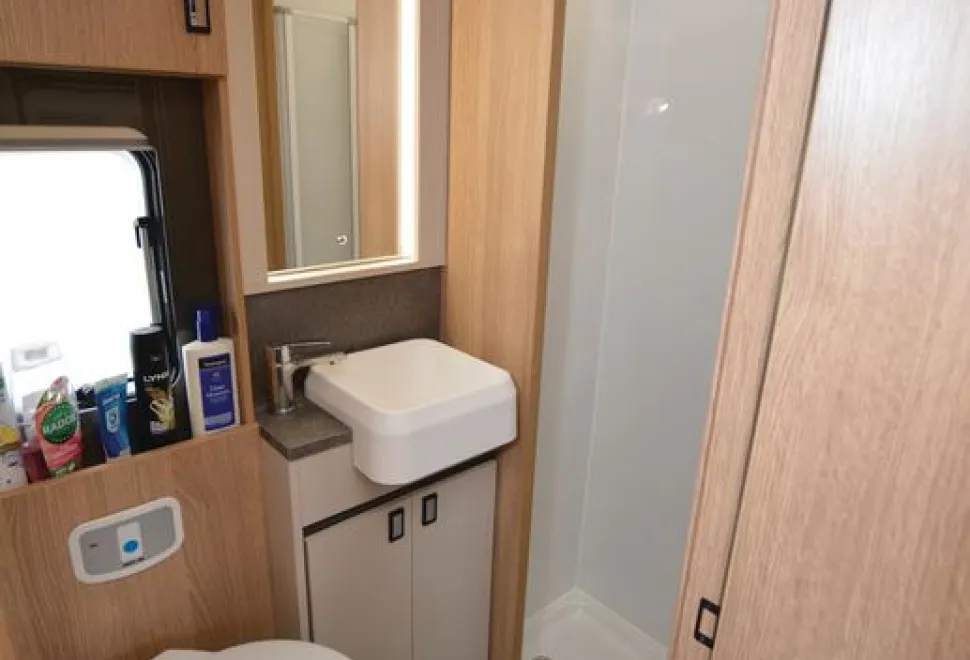
There’s a step up into the space but the winning feature is the separate shower. With plenty of room and headroom, the shower benefits from decent water pressure, too, so it’s a joy to use.
Afterwards, a single outlet restricts water flowing away but our main gripe here is the lack of anywhere to place your shower gel (except on the floor).
Note, too, that the only washroom ventilation is an opening window behind the loo.
There’s space to comfortably use the swivel cassette toilet and, despite it being on a plinth, that wasn’t really a problem with my averagely long legs.
There’s also a reasonable amount of storage here and the usual accessories – towel ring on the door, loo roll holder and robe hooks.
The kitchen
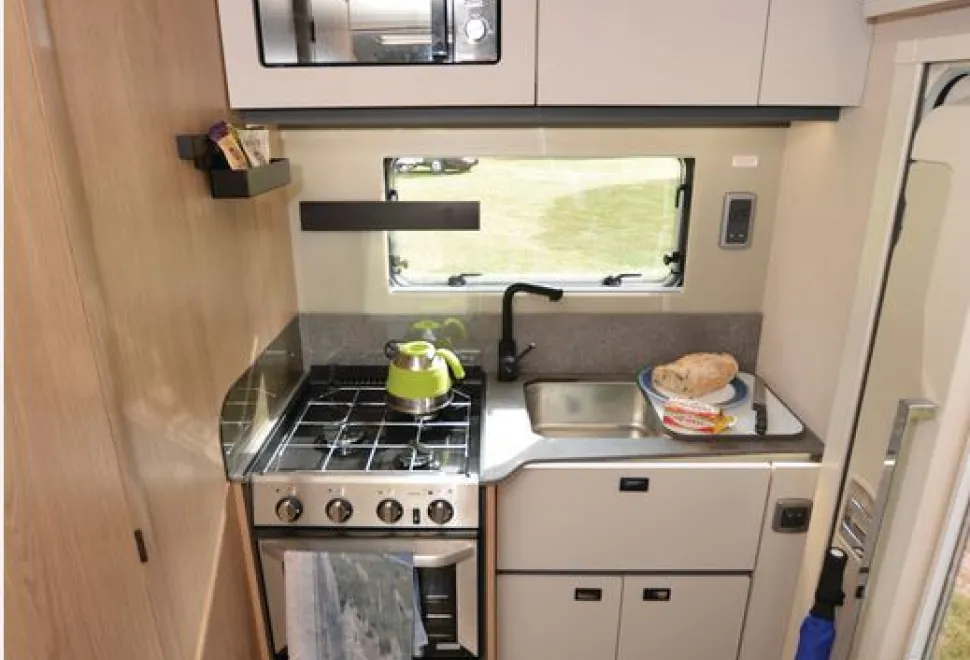
A lot of British motorhomers seem to love a microwave, so Auto-Trail has added one as standard for all Excel models (including the 620S) for 2025.
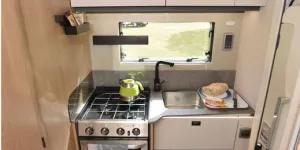
Below that is a three-burner gas hob and a combined oven and grill, so you’ll not be short of culinary options.
You shouldn’t be short of storage, either, although much of it does require you to get down on your knees as the only drawer (incorporating a cutlery section) is under the sink.
That comes with a flush-fitting cover to enhance preparation space and the only 230V socket in the whole motorhome (!) is adjacent.
At the very least, the Excel needs a three-pin power point by the additional counter that’s forward of the entrance. This is higher than the main galley but still gives the chef more room to work.
Below is more storage, although this is only shallow as the gas locker is behind here (accessed from outside and quite high off the ground).
At the back are shelves with elasticated straps but only small items will fit as the straps don’t stretch much.
What certainly isn’t compromised is the fridge size. Between the washroom and the rather tiny wardrobe on the offside is a tall Thetford cooler boasting 149.5-litre capacity. It’s a compressor model, as is becoming the trend.
As with any layout of this ilk, remember that the cook may not be best pleased by comings and goings through the habitation door while they rustle up tasty cuisine.
Motorhome supplied by Auto-Trail VR Ltd
Tel: 01472 571000
auto-trail.co.uk
Insurance: £584.80
Tel: 0800 975 1307
shieldtotalinsurance.co.uk
For quote details: motorhome.ma/QuoteInfo
Our Verdict
Here’s a classically British two-berth layout with a contemporary feel, compact width and competitive price.
It feels super-spacious for a motorhome that’s just 6.20m long but cannot cater for more than two travellers on the road.
Bed sizes, fridge size and the separate shower all impress but we’d like more mains sockets and winterisation for the water tanks.
Disadvantages


