
Bailey Endeavour B62 high-top campervan


Description
Bailey shows that it’s possible to fit a spacious two-berth layout into the compact dimensions of a six-metre Ford Transit
Key Features
Full Review
Words and photos: Peter Vaughan
The Bailey Endeavour B62
This is no ordinary motorhome launch. In fact, I drove a prototype of the long-awaited Bailey campervan back in March, months before its NEC unveiling this October. But our test is not in the environs of Bristol, nor even Britain.
This test took place as part of Bailey’s Sahara Challenge 2 – a 19-day, 2,735-mile odyssey to Morocco and back. And MMM was the only magazine there.
So it was that I stepped off a flight to Marrakech and battled through a melee of suicidal pedestrians and crazy mopeds to arrive at Ourika-Camp, where I met my home from home for four nights for the very first time – and in very unfamiliar surroundings.
All I knew in advance was that Bailey’s first-ever campervan would be based on Ford’s Transit – this far ahead of its October debut, even the vehicle’s inclusion in the Sahara Challenge was a closely guarded secret.
It feels like history repeating itself. For years prior to Bailey’s first motorhome in 2011, there were constant rumours that this leading caravan brand was to enter the motorised market. Now, in 2023, it feels like there’s been the same anticipation regarding the campervan.
But no more. In fading light, I’m standing in front of the very first prototype Bailey Endeavour. This is the B62 – a six-metre, rear lounge, two-berth model, while a B64 with front lounge and four berths (thanks to a pop-top) is also coming.
First impressions are good. It ticks the boxes externally with its black alloy wheels, metallic blue paint (the only colour on offer), and an overcab sunroof (which will be a flush-fitting glass unit instead of plastic and with a slightly larger aperture in production).
Internally, too, I may be jaded and weary from travel but that only seems to enhance the attraction of those long rear sofas in a layout of classic appeal. I can’t wait to put my feet up.
The Ford Transit
The selection of rear lounge campervans in the UK is already almost as bewildering as the confectionary choice in your local filling station – big brands such as Auto-Sleepers, Auto-Trail and Swift all offer a choice of models, before you include the campervan specialists such as Consort, IH and Vantage. But Sevel vans (Fiats and Peugeots) rule the category.
Bailey has gone its own way, using the Ford Transit. That created its own challenges, not least because of reduced interior width and wheelarch positions, but it gives the Endeavour a USP. It also builds on the strong relationship the company started with its Adamo low-profiles, becoming the only UK coachbuilt motorhomes with Ford’s top-tier QVM approval.
Hopefully, it also avoids the horrendous chassis availability problems that have been associated with the Stellantis marques.
The spec
The Bristol brand has also turned the Transit’s challenges into positives. Raising the seats to maximise bed dimensions meant raising the floor, too, so the Endeavour benefits from a flat floor throughout the living area and one that is 90mm thick in the centre aisle, encompassing plumbing and allowing heater ducts to run beneath the shower, as well as including over 70mm of Styrofoam insulation.
Even more significantly, the higher floor required the higher roof of an H3 (the tallest) Ford Transit, so the interior headroom is almost 2m (close to 6ft 6in).
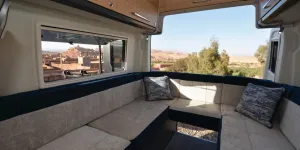
Comfort has not been compromised, however. This rear lounge is a good one, with all the features you’d expect – top-opening windows on three sides and a large Heki sunroof (plus a small vent, too) in the roof above.
Blinds are the posh pleated type (with a non-patterned finish for production) and the walls and barn doors are covered with clean, practical, automotive-style trim panels. There’s also a wide variety of interior lighting, including downlights, LED ambient strips over the top lockers and swivel reading lamps (with built-in USBs).
The lounge
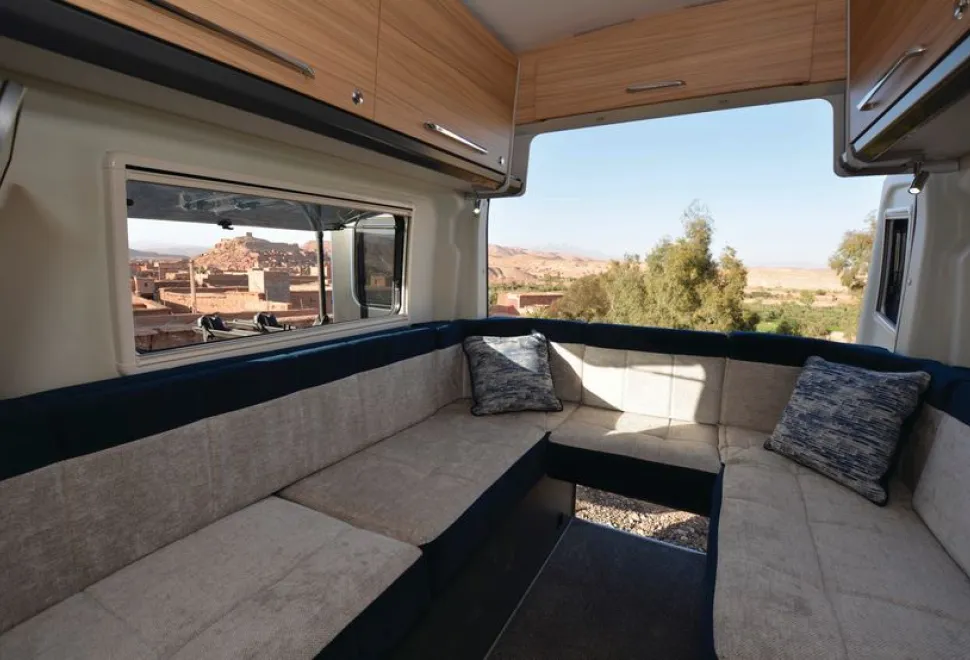
Where the Endeavour, err, endeavours to be different from its mass-produced rivals is in having a U-shaped lounge. Except that, if you prefer straight settees, so you can load a paddleboard inside or simply have an alternative entrance, you can arrange that, too. Just remove the central cushions and a board that acts as the base, and the lounge layout changes. A rear bumper/step makes access easy this way, too.
You’ll also be able to reach into both bed bases via the rear doors, so tube-like folding chairs, levelling wedges, etc, can be popped in here.
And, although the Truma Combi boiler (a diesel unit in production) lives under the forward end of the offside settee, there’s still plenty of under-seat storage here, too. It’s super-deep space – up to 510mm high – and a drop-front door is being added on the offside, while the slatted bed frames also have sprung hinges to ease access. Then, up above, the eye-level cupboards also take advantage of the taller Transit – there are shelved and unshelved cupboards with over 400mm internal height.
A pale wood finish is used for the flat, positively locked doors, but Bailey has avoided excessive woodgrain – the seat bases are silver and there’s enough white to brighten the décor without it feeling stark.
The table, too, eschews wood and, despite the thickness of the tabletop, it’s surprisingly light to carry from its home (which is now under the offside rear sofa). The sequoia leg – on which it is tolerably stable – is also being moved to the inside of the settee’s drop-front door.
The beds
Also under the settees (on the nearside) is the folding, vented board that fills the aisle to make the double bed. It’s not as easy to use as some slide-out supports but neither is it especially awkward once you’ve done it a couple of times. With that in place, the two long backrests slot in on top, after the removal of a section that’s attached with Velcro.
The result is a bed that’s big enough to sleep lengthways or across the campervan – the mattress might only measure 1.72m in the latter direction but this is where Bailey has shaped the plastic trim panels to the contours of the Ford, so usable space is 1.84m ( fractionally over 6ft).
Of course, as in other similar models, you can also use the sofas as single beds, just by removing the backrests. Here, the actual mattress width looks a mite meagre but, again, the usable room is greater, at around 630mm (over 2ft).
Another serious challenge for the Bailey design team was the pinch point towards the front of the layout where the aisle width between the washroom and kitchen could have required WeightWatchers membership as part of the purchasing package.
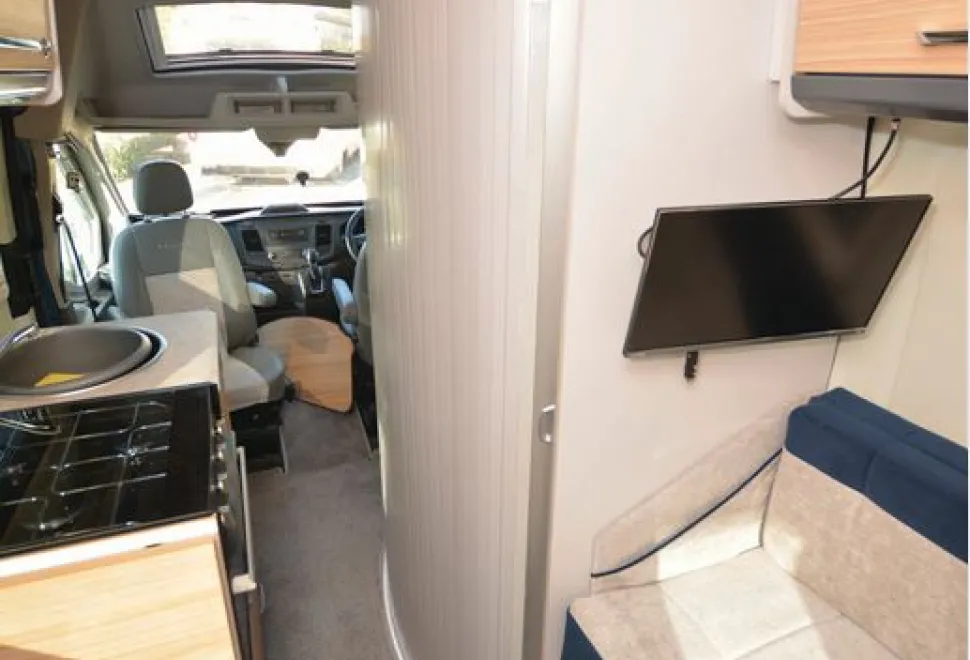
Rather more ingeniously, the Endeavour adopts a rotating tambour door that allows a wide gangway for the majority of the time but a generous ablutions zone when it’s actually occupied.
The washroom
That the gap between the tambour door and the oven is as little as 340mm in the latter mode, shows that some cunning was indeed necessary, but don’t think that you can’t go for a tinkle while your better half is cooking – it’s just better if you don’t have to coincide the activities!
When the washroom is in hiding, the aisle is up to 760mm wide, which makes a massive difference to the feeling of space. In the prototype, I had to lift a floor panel before sliding the washroom door, but that is being changed in production while still retaining the carpet that helps to blend the two areas.
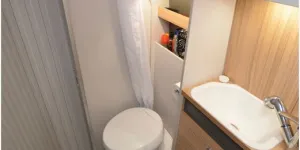
What really impresses is the amount of room inside the washroom. For a campervan, this is a much less claustrophobic space than you’d expect.
Headroom is up to 1.95m and there’s plenty of room to shower, with the basin’s tap extending to become the showerhead and a curtain just protecting the furniture, not wrapping all around you. Soapy suds even flow away well, thanks to twin drains.
There’s a decent amount of storage, too, and a roof vent will be added in production vehicles. That leaves the only real downside being the height of the loo, which requires very long legs for sitting comfortably.
However, it’s worth noting that the small (41-litre) grey tank will require regular emptying and water pressure isn’t torrential. You may also wake your partner if they’re a light sleeper and that tambour door clatters open in the early hours.
The kitchen
The width of the aisle might, alternatively, have been solved by a less well-equipped galley but Bailey hasn’t compromised on fitting the Thetford Triplex cooker that includes a Brit-pleasing oven and grill, in addition to three burners. Gas is only used for cooking, so the single 6kg cylinder isn’t a problem.
The galley also features a good-sized sink with removable draining board (usable with the hob’s glass lid closed) and a useful folding worktop extension. The latter, however, is not fitted by the doorway, where it can impede access, but over the sofa, which seems more practical. Pity then that there’s no mains socket adjacent (there is one at the other end of the galley but that’s not ideal with no lid for the sink onto which appliances could have been placed).
Kitchen storage is good, including practical pockets on the forward end of the unit, but the only drawer (for cutlery) is inside a cupboard.
Opposite the main galley area, the fridge (a tall compressor unit) sits under the small wardrobe (hanging height 740mm). The shape of the Ford precludes clothes and cold food swapping places, but this isn’t much of an issue.
The drive
Where the Transit really wins, of course, is on the road – and on this test, what a road. The title RN9 doesn’t do it justice, as this thoroughfare twists and turns through the spectacular Atlas Mountains to a height of 2,260m. On the good surfaces on the northern side of the summit, we’re in a hurry, using all the Ford’s 155bhp and even slotting the six-speed auto’ transmission into manual mode. It’s smooth, refined and quick.
The southern descent is different with surfaces more akin to your expectations of north Africa and conversion noise rises accordingly, though commendably it’s mainly from the blinds. Adopting a forced slower pace shows just how easy this Endeavour is to drive – good visibility, compact dimensions and a much more compliant ride than a Ducato or Boxer all scores brownie points.
Production models will also add Ford’s central display, rather than the basic radio seen here. That, in turn, can be linked to a reversing camera – the only thing that Bailey seems to have left off the spec.
Cab blinds, an 80W solar panel and a TV aerial (but not the telly) are also standard fare – along with the aforementioned alloy wheels, metallic paint, automatic gearbox and top-spec motor. They’ve also addressed the seat adjustment for taller folk by moving the table which, on the prototype, stored behind the driver’s seat.
Motorhome supplied by Bailey of Bristol
Tel: 01173 135385
baileyofbristol.co.uk
Insurance: £603.08
Tel: 0800 975 1307
shieldtotalinsurance.co.uk
For quote details: motorhome.ma/QuoteInfo
Our Verdict
<p>Taking a proven and popular two-berth layout and adding the USP of the Ford Transit might have been enough to ensure the Endeavour’s success. But Bailey has done so much more than that, adding all the spec you’d want as standard, pricing it right and ensuring that storage, washroom space and lounge comfort are all competitive with the best of the mainstream Fiat/Peugeot opposition.</p>
Disadvantages


