
Panama P12 rising roof campervan
Description
Can this new brand of campervan from Spain knock others into a cocked (Panama) hat?
Key Features
Full Review
Words and photos: Peter Vaughan
The Panama P12
It’s much rarer these days for us to discover a major new campervan or motorhome brand arriving on our shores – most are already here!
However, Marquis Leisure has just launched two new pop-top campers from Panama for the 2025 season.
It’s another Trigano Group marque that was established in 2020 following the conversion of a 15,000 square metre, former static caravan factory to campervan production.
Being Trigano, this isn’t a small enterprise building a few dozen campervans – 4,000 vehicles a year roll out of this site in, no, not Latin America, but Peñíscola, Spain.
Panama’s debut in Britain coincides with the arrival of Ford’s all-new mid-sized van, so both models available from Marquis are based on the Ford Tourneo Custom (the people-carrier version of the Transit Custom).
The P12 is the short-wheelbase model with the typical side kitchen layout, while the P57 is a long-wheelbase camper with a rear L-shaped kitchen and corner shower/toilet compartment.
Both are offered in just a single spec, with no factory options list, to keep things simple, but also to keep the pricing ultra-competitive.
With components, chassis, fuel and staff costs having risen dramatically since Covid, small campervans like this often now have a price starting with a seven, or an eight if they have all the toys. But here is a price tag starting with a five, if only just!
The Ford equipment
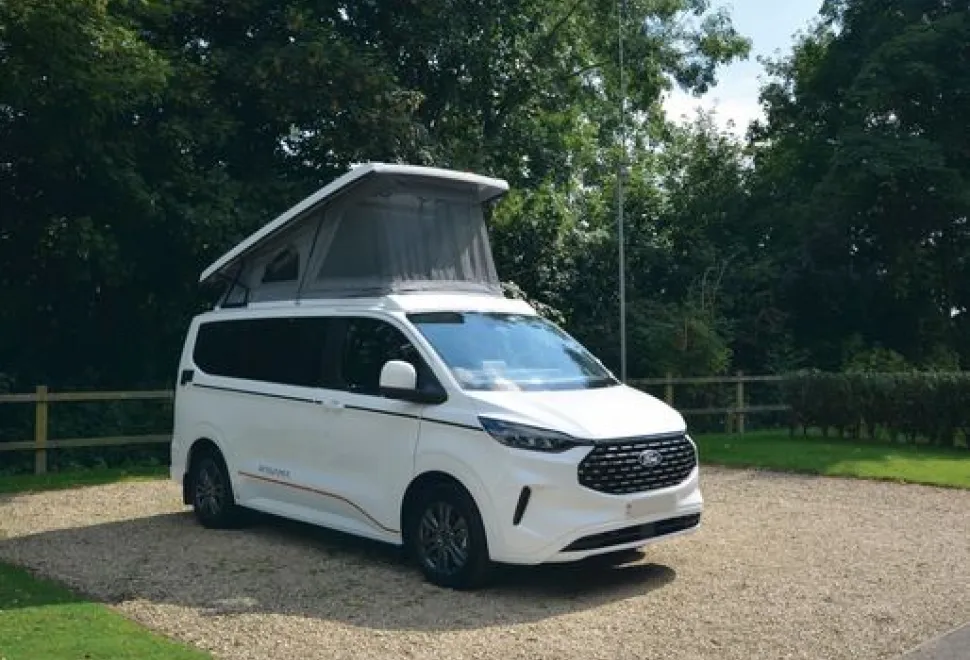
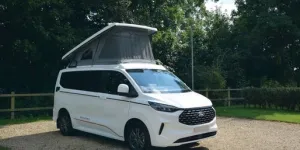
Despite the £59,995 list price, though, the P12 doesn’t look like a back-to-basics vehicle – you just have to like white. It comes with 17in alloy wheels, there are flush privacy glass windows (more on those later) and the bumpers and mirrors are colour-coded.
And the new Ford is quite an eye-catching vehicle with its bold grille and LED headlights.
Nor has the spec been pared to the bone. Under the bonnet, the 2-litre EcoBlue diesel engine churns out 136hp and it’s linked to an eight-speed automatic transmission.
And you get all the latest safety gismos – front and rear parking sensors, Pre-Collision Assist, Torque Vectoring Control, Lane Keeping Alert, Driver Alert, Speed Sign Recognition, Side Wind Stabilisation, Traction Control, Emergency Brake Assist, Electronic Stability Control (ESC), Wrong Way Alert, Trailer Sway Control and Hill Start Assist.
The cab
In the cab, it’s not immediately obvious that the upholstery doesn’t match the rear (they’re both dark grey) – perhaps because your eyes go straight to the new digital dashboard and the 13in central display.
It’s all very up-to-the-minute and the huge touchscreen includes DAB radio, Bluetooth, Apple CarPlay, Android Auto and reversing camera.
You can also adjust some of the assistance systems here and set the ’van to Normal, Eco, Sport, Slippery or Tow/Haul mode.
The heating and air-conditioning controls (including the heated cab seats – I didn’t expect those at this price) are in a row at the bottom of the screen but I’d still find rotary knobs easier to use safely while the campervan is moving.
The actual driving is pretty simple. Engage drive on a stalk to the right of the wheel and flick the central switch for the parking brake (which also makes for very easy rotating of the cab seats) and you’re off.
All-round visibility is good with twin-lens door mirrors, although the view through the vehicle is rather dark.
The wheel is leather-bound and carries controls for the radio, phone and cruise control, but its squared-off shape is a bit odd – fortunately, the alloys are still round!
The cab chairs are supportive and come with twin armrests, lumbar support and plenty of height adjustment. Even more pleasing is the amount of variation on the steering column, so the perfect driving position should be possible for all sizes of driver, especially as the seat slides a long way back before touching the galley behind.
The ride
Out on the road you have to get used to the various bongs – if you stray 1mph over the speed limit or the limit changes (some of these can be switched off).
But you’ll soon find the Tourneo easy and relaxing to pilot with adequate performance from this entry-level power unit (the 150hp and 170hp motors are not offered here).
The ride is firm but not harsh and it would be easy to live with this vehicle day to day, going to the office, the supermarket, doing the school run, etc. It will even nip under the 2.10m height barriers that we came across in the Cotswolds, although (like many of its ilk) overall height is just over 2m.
Seven seats
Talking of the school run, if you need a true people-carrier during the week, then the P12 can be ordered with extra seats.
Individual reclining chairs with armrests slot into the floor rails to form a third (central) row, either forward or rearward-facing, and turn your campervan into a minibus. Each extra seat costs £950 and has Isofix.
It’s not a transformation you’ll want to carry out too often, because the seats weigh 36kg each; you could envisage popping them in for the week and unbolting them at the weekend.
What’s impressive is that there’s genuinely room to get seven adults on board.
Fortunately, there’s enough payload to do that legally, too. The maximum gross weight of the Tourneo is 3,175kg, giving a payload of 617kg.
The roof
A potentially even more important transformation is when you lift the pop-top, because of course this gives you full standing room (as well as an extra bedroom).
Again, Panama hasn’t scrimped and turned to some unheard-of supplier of cheap roofs; it’s used a pop-top from renowned German specialist, SCA.
Inside the cab, a trim panel keeps things tidy when the roof is lowered and the twin catches on either side adopt a reassuring belt ‘n’ braces approach to keeping it down. Then, once up, it offers up to nearly 2.40m of headroom.
This is also one of those en vogue ‘panoramic’ roofs, so the whole canvas can be unzipped or, more practically, a large area on three sides at the front can be uncovered while retaining a mesh to keep out the little flying biters and stingers.
That lets in lots of daylight and was great on the first day of our test when the thermometer touched 24 degrees.
Imagine less clement weather, though, and you’ll want to keep it zipped shut, leaving just a small window on the offside to let light in at roof level.
That would be less of an issue if the glazing in the body of the vehicle wasn’t so heavily tinted. On a sunny day with the sliding door open, you won’t notice it, but, when it’s gloomy outside, it can feel a bit gloomy inside, too.
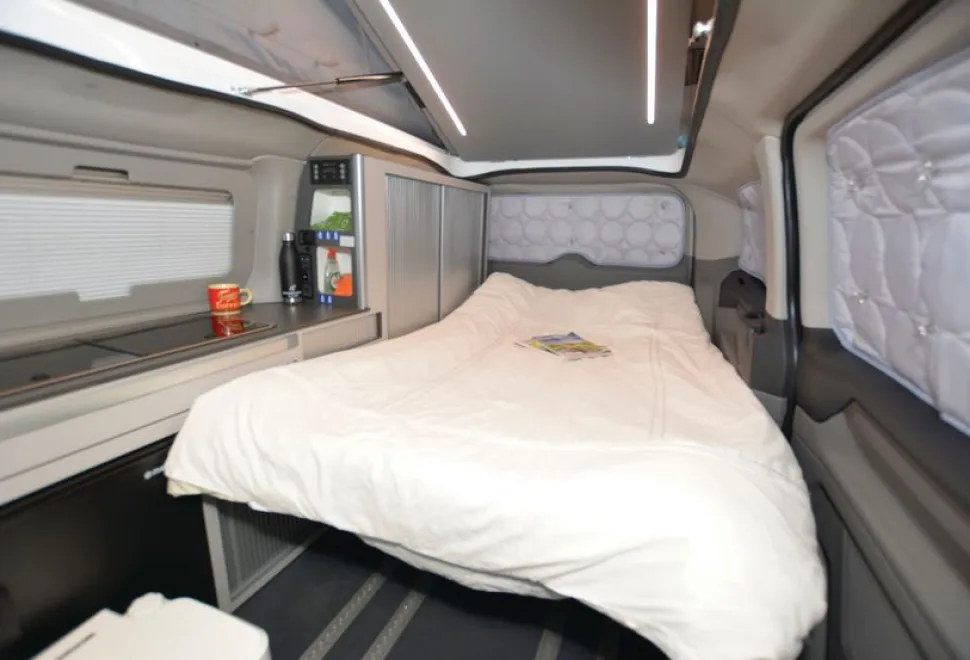
The only answer is to switch on those long LED strips set into the base of the roof bed which, it has to be said, do a great job of lighting up the whole of the interior.
While we’re on the subject of windows, note too that there are opening sections behind the kitchen and in the sliding door but these are hinged, not sliding, so they provide only very limited ventilation.
The seating
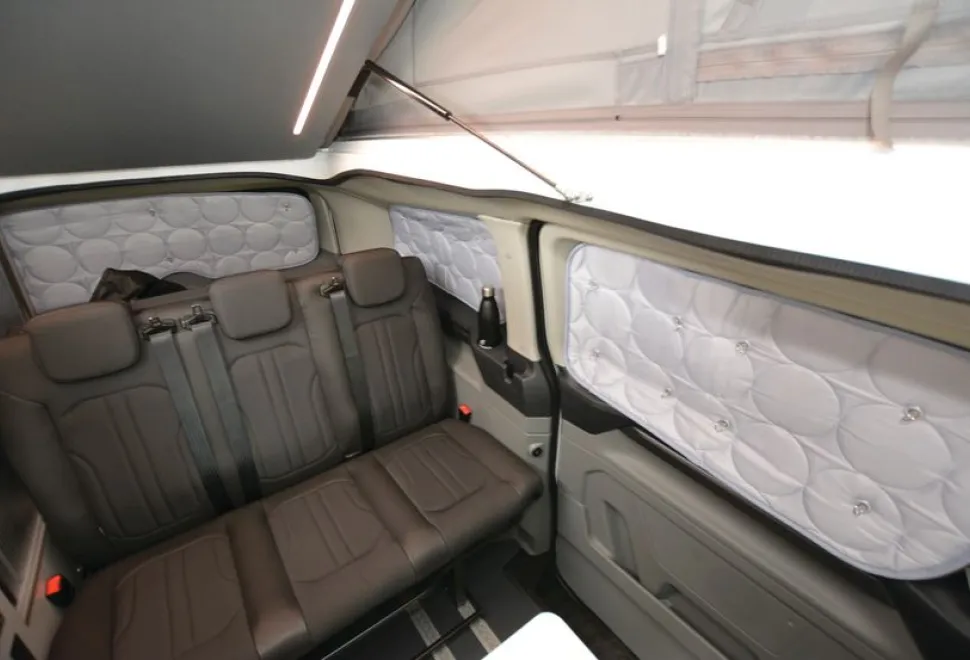
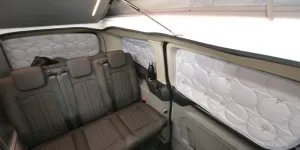
Even if you don’t purchase the extra seats, you still benefit from the sliding rear bench from Mobiframe. This is super-simple to use with a bar to lift at the front and then push down to secure it anywhere along its track.
The rear seat has a comfortable height (no dangling feet here), three seatbelts and two Isofix positions and can be moved close to the cab to bring little ones nearer to their parents, or to make a van-like space (around one-and-a-half metres long) in the back for those trips to Ikea.
The rear section of bed (behind the seat) can also be tipped vertically to increase boot space or laid flat when camping as a convenient area to store bedding, etc.
Underneath, there’s useful open space extending forward under the bench but there’s nothing to stop items stowed here from sliding forward into the living area under heavy braking.
The table also stores in the boot, although you might want to keep it somewhere more accessible in wet weather and its plastic retaining catches looked flimsy.
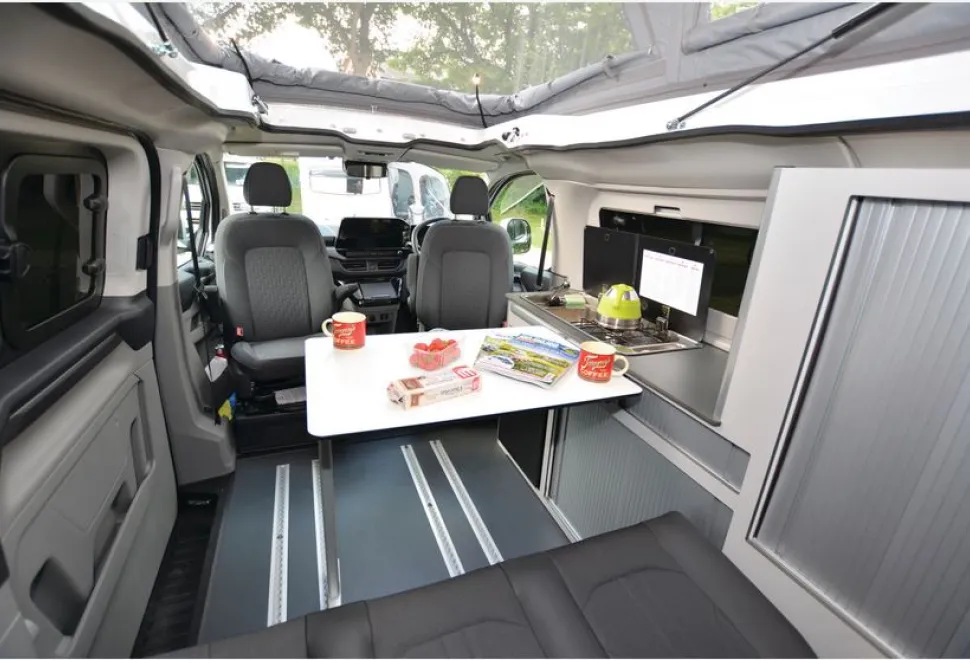
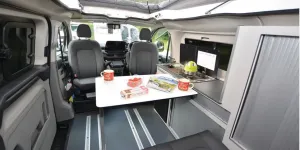
At 80cm by 54cm, it’s a good size, and it simply attaches to a rail on the kitchen unit where it is sturdy and adjustable.
Here, again, the sliding seat pays dividends as you can bring it forward, so that the cab chairs are also within reach – now four can sit around for dinner. Even better, the table can also be used outside, thanks to a pair of extra folding legs.
The beds
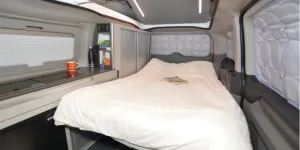
It’s easy to convert the seat into a bed. First, slide the squab cushion forward, then flip it over.
Next, fold the backrest flat (it’s quite heavy to lift back up) and fold over a mattress topper for the foot of the bed.
At 1.18m wide, it’s broader than many campervan beds and it’s also firm, flat and completely ridge-free with a chaise longue position for lazy mornings.
With bedding stowed in the boot, you can simply unfurl it into place, so it was a pity there was no light over the head of the bed (that’s to be added following this review).
Up top, the roof bed is both longer and a fraction wider and, for comfort, its mattress sits on Caraflex plastic springs.
Unusually, there’s a ladder provided for access, although I’d leave it at home as it steals almost all of the wardrobe when stored – my kids are well-practised at climbing without one and would be more impressed by the twin reading lights with built-in USBs.
The spec
Night-time blackout is one area where the cost-cutting seems to have struck, with insulated screens for every window bar the kitchen (which has a cassette blind and flyscreen).
Or maybe that is not so much about saving pennies as keeping the automotive look inside? There’s no dated carpet trim here, just smart plastic trims as you’d expect in an MPV.
At the rear offside, there is even a cupholder, USBs, a recess for your phone and a rear speaker.
There are more power points (12V, 230V and USBs) at either end of the galley and the spec includes an inverter (so you can use a mains appliance without hook-up).
The kitchen
As for the kitchen kit, it’s the predictable two-burner gas hob and cold-water-only sink combination unit ( from Can), plus a front-loading 42-litre compressor fridge from Mestic (not a name I’ve come across before).
All the galley’s storage is behind tambour doors, so you can access it irrespective of the rear seat’s position, unlike in a number of rivals.
Alongside the cooler is a cupboard for a Porta Potti, with a slim shelf above (just room for some crockery) and then a cutlery drawer above that.
To the rear is a cubbyhole for mugs, etc, and beneath is a larger cupboard for your pans and non-perishable food.
The unit is completed with two tall lockers at the back, but one of these is almost filled by the ladder.
Summary
Compared with some of its rivals, the P12 seems to be a tad light on storage (there’s no upper shelf or cupboards, for example), but both the fresh and waste water tanks are inboard (where they won’t freeze) and you could gain space if you didn’t need to carry the loo.
Motorhome supplied by Marquis Leisure
Tel: 08000 267777
marquisleisure.co.uk
Insurance: £529.20
Tel: 0800 975 1307
shieldtotalinsurance.co.uk
For quote details: motorhome.ma/QuoteInfo
Our Verdict
<p>The cheapest Tourneo Custom Bus nine-seater on Ford’s configurator is almost £55k, which makes the price of this Panama campervan all the more remarkable, especially as it has a sliding seat system, top-quality pop-top, Webasto heating and an automatic gearbox. </p>
<p>I’d have liked more daylight inside and blinds all round but, at this price, you have to expect a few compromises. Value for money here is king.</p>
Disadvantages


