
Dormobile Ballintrae high-top rising roof campervan

Description
Dating back to the 1950s, Dormobile was one of the very first campervan brands. Now it’s back with a brand-new flagship…
Key Features
Full Review
Words and photos: Peter Vaughan
The Dormobile Ballintrae
The Dormobile name is even older than MMM, having first been coined in 1952. Its factory in Folkestone churned out conversions on numerous base vehicles, but, perhaps most notably, VW Type 2s, Bedfords (CAs and CFs) and, more unusually, Land Rovers. The brand was so well-known that when my parents bought their first campervan in 1979, friends referred to it as a ‘Dormobile’ even though it came from a rival marque.
Despite its success in the 60s and 70s, and coachbuilt motorhomes joining the range, Dormobile’s Tile Kiln Lane plant sadly closed its doors in 1994. And that could have been the end of the story, had it not been for the links with Land Rover, as Dormobile conversions of the pre-2016 Defender have continued since 1997.
Land Rover campers were always going to be a bit niche but, since moving to a new site (a former Vauxhall car dealership) in Lyndhurst in the New Forest, Dormobile has been quietly reinventing itself.
In 2020 (the year of the move), it built 40 type-approved Ford Transit Custom conversions for rental, following that with 50 Peugeot Boxers.
Now it has a range of models for retail buyers, based on the VW Transporter and MAN TGE, as well as the aforementioned vans. It celebrates the past with three classic 1972 Dormobiles in its showroom, but has up to 20 new and (more recent) used campervans in stock and looks to a future making 150 to 200 campervans a year.
Except that Dormobile doesn’t manufacture the conversions inhouse, it develops them and then subcontracts the work to selected partner companies around the UK that meet its standards.
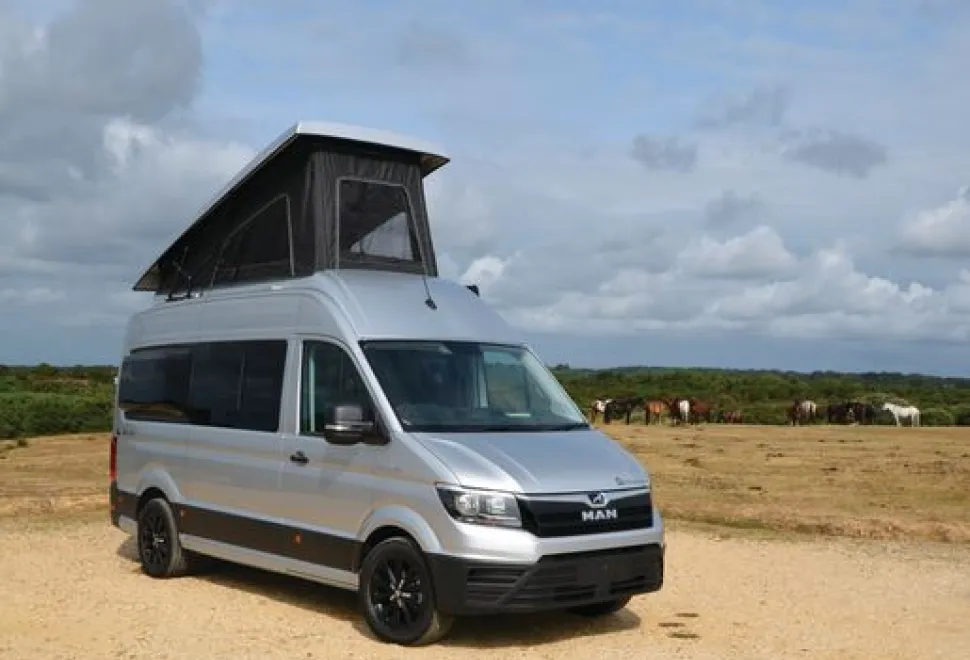
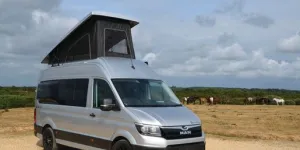
The latest addition to its line-up is the flagship, the Ballintrae (named after a seaside village near the Giant’s Causeway), based on a MAN van.
The MAN van
Dormobile had already launched (at Campervan Campout) its Ohana on the MAN base, but that model lacks a washroom. The Ballintrae is a more upmarket design with a fixed double bed and a pop-top, making it a four-berth campervan.
By choosing the MAN TGE (sister van to the VW Crafter), Dormobile has given the Ballintrae a huge head start. This is the best base vehicle in its class; it has the edge over the Sprinter and shames the ageing Ducato/Boxer.
On the road, the MAN has the feel of a bigger VW T6, but it’s not too big. This standard-wheelbase van is still a whisker under 6m long and the double lens door mirrors and rear view camera ensure that manoeuvring is a doddle.
Of course, the eight-speed torque converter transmission (not a DSG as in the Transporter) fitted here helps, too, and it is super-smooth on the open road. Our test campervan had the standard 140bhp motor, which seemed more than adequate, but a 177bhp model is also available for an extra £2,538.
The spec
With a price tag starting at £99,000, it comes fully equipped with features such as a 3m Dometic awning, leather upholstery, a reversing camera and metallic paint.
Alloy wheels are standard, too, although the ones fitted here are an upgrade. The only other extra-cost items were the automatic gearbox and LED headlamps.
In the cab, the ergonomics and build quality score highly, with top marks for the 8in screen and its wireless connection to Apple CarPlay or Android Auto. The front seats are another plus, with a tilting squab and adjustable lumbar support for the driver. Only the plastic steering wheel lets down the premium feel, but you can have it trimmed in leather (and heated) for £708.
The exterior
Externally, Dormobile has gone for a clean, automotive appearance. The habitation windows are tinted, single-glazed glass (sliders each side up front), and the pop-top blends in so well with the TGE’s lines that you wouldn’t know it was there until you lift it.
The sliding door’s electric step pops outs automatically on opening, while the mains hook-up and filler for the 25-litre LPG tank are hidden below the bodywork at the rear.
In summer you might bemoan the lack of flyscreens on either of the windows or the side door, while the water tanks (65 litres fresh, 40 litres waste) are underslung, perhaps limiting serious winter camping.
The garage
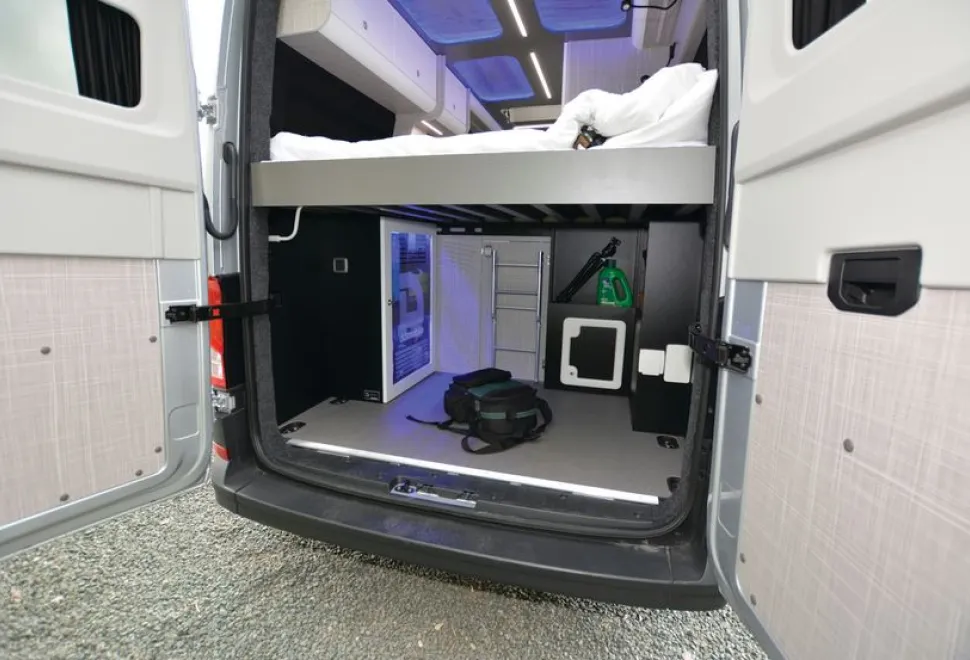
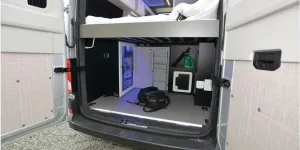
Putting the tanks underneath, however, increases space in the rear garage, which must be one of the biggest in this class of campervan. Open the rear barn doors and you’ll find a space that, at its most generous, is 1.71m wide, 1.29m deep and 93cm high.
The fresh water filler and external shower points are mounted here (on the offside), but there are no 12V or 230V sockets and you’ll need to bear in mind when packing that servicing of the cassette loo is done through the garage.
There’s plenty of room to stow outdoor furniture but, if you want the neatest solution, Dormobile offers a table and chairs that store in pods on the back doors (£1,194 for the set).
This supersized space is also accessible from the living area and, on the nearside, you’ll discover the vehicle electrics, behind a Dormobile-branded glazed door. No expense has been spared here, with a 105Ah lithium battery and 1,200W inverter fitted as standard, while a 200W solar panel on the roof is linked to a Victron MPPT charge controller.
The roof
That roof, from Spanish maker, Atek, is easy to raise (requiring more muscles to lower, as is often the case). You’ll have to stand on the rear seat to operate it but the security catches for travel (one each side) are delightfully simple to use.
Of course, full standing room (1.90m) is already in situ, so this pop-top is just there to provide an extra bedroom – or perhaps a grandstand view when the canvas sides are zipped completely open in its scenic mode!
A ladder should make for easy access and the bed itself is both extra long (2.04m) and extra comfy, thanks to its 90mm-thick mattress. There are three opening flyscreened panels (one each side, plus one at the front), two reading lights (with USBs), and even a shelf at the front of the roof where you can store pillows with the top lowered; a safety net was missing from this prototype but will be added.
The rear bed
Were it not for the sliding door being on the UK side, you might be fooled into thinking that the Ballintrae was from a continental brand. Its rear garage layout, the pop-top roof and clean, contemporary aesthetics all feel quite European.
Above the garage, the rear bed will be a key reason to buy. It uses flares on the outside to extend the width inside and achieve a decent bed length of 1.88m. Just as importantly, the mattress sits on Froli springs so it is oh-so-comfy at night. And, in the morning, when you want to sit up with a cuppa and read your new issue of MMM, you can – for once there are no cupboards overhead, just sensibly placed reading lights.
The blue mood lights in the ceiling and a dimmable LED strip allow a restful ambience to be created and the curtains on the rear doors do a respectable job of blackout. Curtains, not blinds, are used up front, too, with one piece of fabric stretching around the cab, held in place by press studs. You can upgrade to Remis cab blinds for £780.
A short ladder caters for the climb up to the back bed (1.06m off the floor) and stores on the reverse side of the door into the garage. How neat would it be if this door could incorporate fold-out steps instead?
More pressing, though, is the need for ventilation in the bedroom (a roof vent isn’t possible and the only windows, in the back doors, are fixed).
The interior
Up front, the continental theme continues, with a lounge that incorporates swivel front seats, a half-dinette with wall-mounted table and full-height walk-through into the cab. This is no ordinary half-dinette bench, though. Instead, Dormobile uses the same type of seat as you might see as a double passenger seat in the cab. That means it’s properly tested and properly shaped for comfort.
As usual, it’s a bit tight in width (88cm) for two adults but, both for passenger carrying and relaxing on site, it is so superior to the flat, upright benches seen in some rivals.
Not so great is the table, which is a tad small (75cm by 40cm), slightly wobbly and lacks a swing-out leaf to enable the occupant of the swivel passenger chair to reach it, although the power points (12V, 230V and USB) here are very useful.
Under the rear seat is some shallow storage, above the gas/230V Whale boiler (space heating is blown-air but gas only).
The kitchen
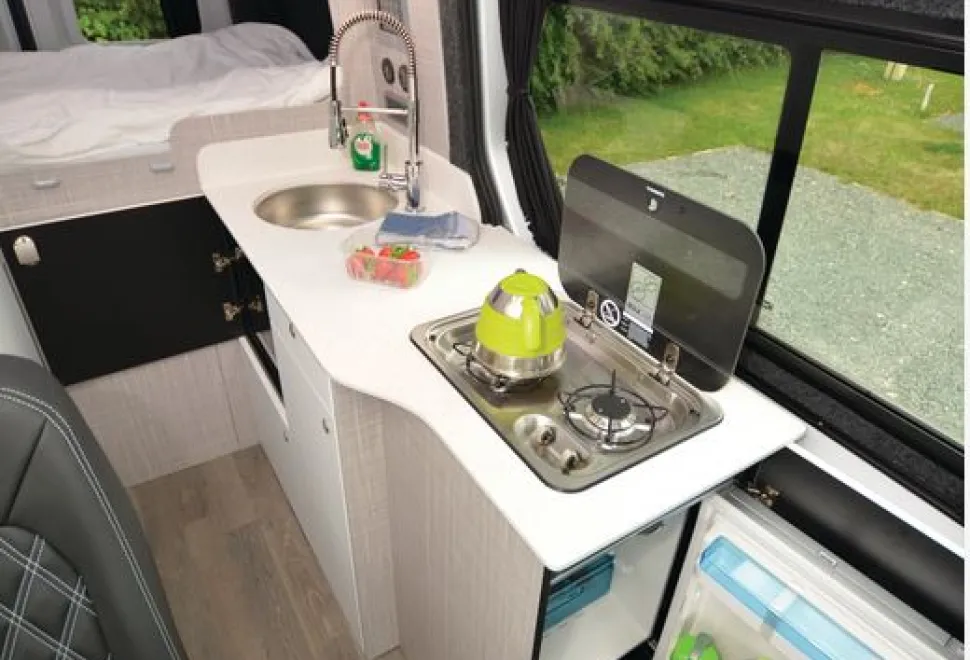
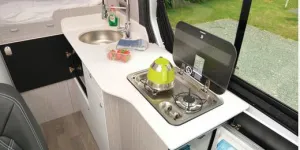
If you’re wrestling with your choice of this type of layout, then maybe Dormobile has come to the rescue. Where many floorplans of this ilk offer minimal worktop space, the Ballintrae has seemingly acres of usable Corian surface and, while often the only cooking kit is a two-burner hob, here the newcomer serves up a Dometic plateless 700W microwave (or, alternatively, a gas oven – you choose).
Hidden in a cupboard, the microwave doesn’t spoil the clean lines of simple white locker doors and the fridge is similarly concealed at the end of the galley, facing forwards. Here, though, the 47-litre compressor cooler’s second door stops you leaning in from outside to grab another beer.
Under the fridge is a useful drawer (deleted if you go for the optional, larger 80-litre fridge) and the kitchen also has a cutlery drawer, but most of the galley’s storage is in less-convenient cupboards. There’s no shortage of room to store all your culinary gear, however, and there are two 230V sockets for your appliances.
Star of the show, though, is the super-swish, hose-style tap with both jet and spray functions!
The washroom
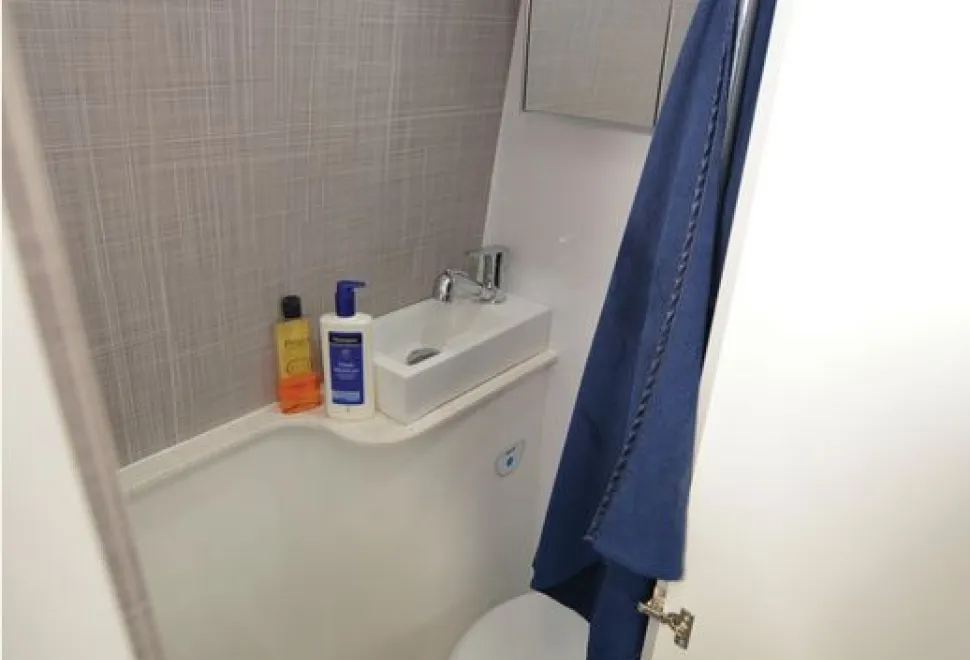
Throughout this conversion, everything feels durable and well finished and that’s true, too, in the washroom, which takes up its position opposite the galley. Inside this small room, everything is wipe clean and, while the basin is rather tiny, it sits on another Corian counter.
The washbasin’s tap pulls out to become the showerhead and, with no clingy curtain to envelop you, there’s plenty of room to enjoy a good hose down. A wooden duckboard is fitted and the central drain in the tray works well; what doesn’t pass the MMM test is the door, which needs a seal or lip at the bottom to stop shower water seeping out into the aisle.
You may also want to try the loo for size; of course, it’s the standard Thetford cassette but shoulder room when enthroned is tight (42cm from wall to worktop), unless you lean forward or sit at an angle.
Above, the only washroom storage is in a small mirror-fronted cabinet; there’s no towel rail or ring, nor a holder for toilet paper. The issue that really needs addressing, though, is the lack of ventilation – as with the bedroom, the pop-top stops a roof vent being fitted and there’s no window here.
The Ballintrae also lacks a wardrobe, but a hanging rail will be added in the washroom in production models. If you need to hang a couple of best outfits, it would be easy enough to also add a rail in the garage.
Motorhome supplied by Dormobile Ltd
Tel: 02382 544050
dormobile.co.uk
Insurance: £831.60
Tel: 0800 975 1307
shieldtotalinsurance.co.uk
For quote details: motorhome.ma/QuoteInfo
Our Verdict
<p>From the MAN base vehicle to the Corian worktops, the Froli bed springs to the electrical kit, there’s a premium feel to this new flagship from a historic brand that is reinventing itself. In many ways, the Ballintrae is close to being a winner, it just needs attention to a few details (which we’ve been promised will be addressed) to rival the best in its class.</p>
Disadvantages


