
Adria Twin Max SLB high-top campervan

Description
Shown as a concept a year ago, Adria’s first MAN-based campervan goes on sale here at the October NEC show
Key Features
Full Review
Words and photos: Peter Vaughan
The Adria Twin Max SLB
Adria’s Twin can be regarded as royalty amongst fixed bed campervans; the origin of the species, it has evolved consistently to remain a market leader. And now it has a bigger brother, the Twin Max, which was first shown as a design study at last September’s Caravan Salon Düsseldorf.
The Max is Adria’s first-ever conversion on a MAN base vehicle (so the 2024 range includes Fiat, Mercedes, MAN and Renault chassis) and arrives with a choice of two layouts in the Long (6.84m) panel van, with a Standard wheelbase (5.99m) model expected to follow. At launch, the 680 SLB (tested) and 680 SGX differ only in their rear bedroom/garage arrangements.
They go on sale here at the NEC show in October, but we were able to road test the left-hand drive prototype for a few days while it was in Britain for the company’s trade show. It should be pointed out at the outset, then, that our test vehicle is not to UK spec, which had still not been finalised at the time of writing.
As for pricing, it is anticipated that the Max will be around £12k more expensive than an equivalent Fiat-based Twin Supreme 640 and it is hoped that a fully loaded Max with the 175bhp (177PS) engine and automatic gearbox will retail for under £100,000.
The spec
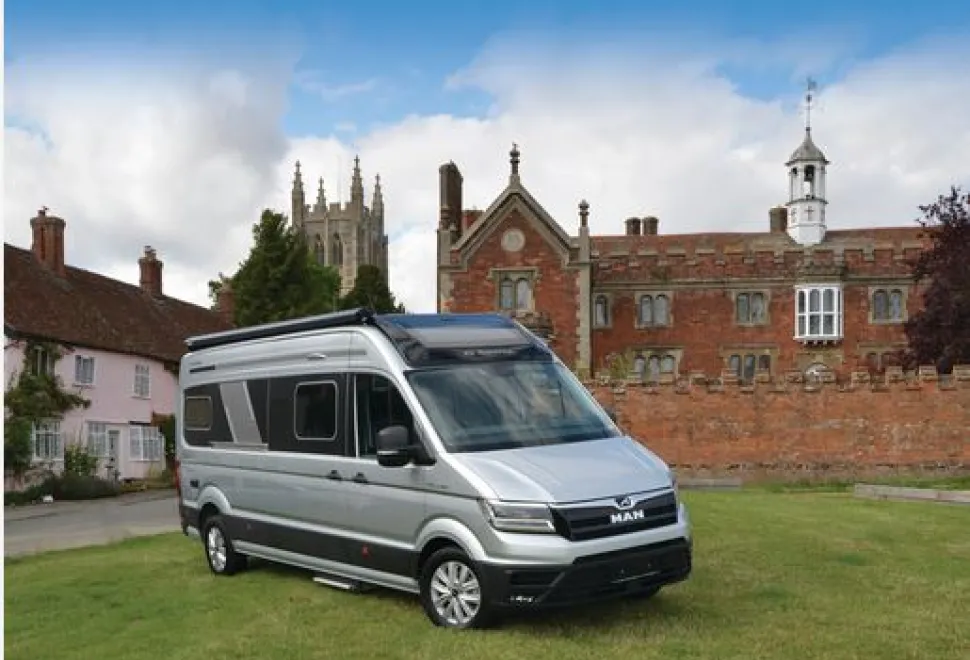
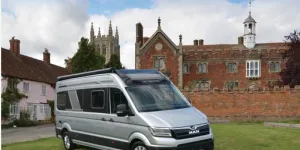
In a campervan beauty contest, the Max would go home wearing a sash. It comes with 17in alloy wheels and a choice of Indium Grey or Reflex Silver metallic paint, and the contemporary design of the MAN van (basically the same vehicle as a Volkswagen Crafter), is complimented by Adria’s subtle, geometric graphics. With chromed Adria badging, flush-fitting, framed windows and a neatly integrated overcab sunroof, the Max looks every inch the 21st century leisure vehicle.
In right-hand drive form, the MAN will retain its offside sliding door, which is fitted with an electric step (with warning buzzer and auto-retraction) and a flyscreen. The Dometic awning above will be included in UK spec, as will a solar panel.
Our test vehicle also had an external barbecue point and a mains water connection for use on fully serviced campsite pitches, but it’s not yet clear whether the latter will be offered in the UK.
We will get a base vehicle with all the toys, though, and it will be uprated as standard to a 4,000kg maximum gross weight, thus requiring a C1 licence but also endowing the Max with over 700kg of payload in UK trim.
Other features to be included for our market include a heated, leather-trimmed, multifunction steering wheel, heated windscreen, LED headlamps, Dynamic Road Sign Display, DAB+ radio, Climatronic air-conditioning, the Driver Assist System Pack (including lane departure assistance, for example), Lights & Vision Pack, Media Van Nav Pack with four speakers, and adaptive cruise control with emergency braking ( for speeds up to 99mph!).
Needless to say, I didn’t find out whether the MAN would reach such velocities, nor whether it would apply the anchors if I was daydreaming, but yet again the TGE proved itself to be leagues ahead of the ageing Ducato/Boxer vans in terms of driver appeal and cabin ambience, as well as the quality of fit and finish.
Anyone with experience of a modern VW will feel instantly at home with all the controls and the ergonomics seeming spot on, from the seat with tilting squab and electric lumbar adjustment to the variable reach and rake on the steering column.
The twin-lens door mirrors give a good view aft, backed up by a reversing camera that uses the same neatly integrated display as the radio and navigation. On the latter front, my phone paired wirelessly via Android Auto to get me to the Camping and Caravanning Club’s welcoming site on the outskirts of Cambridge.
The drive there revealed the strong performance of MAN’s top power unit and the smoothness of the torque converter transmission. It’s a very refined vehicle, albeit with a few rattles from the living area (remember, this was a prototype).
It’s also long for a campervan, with a substantial wheelbase (4.49m). That results in superb stability but, when I popped into a Tesco car park, I was very aware of the length of this campervan – and very grateful for parking sensors not just front and rear but at the sides, too (let’s hope they’re included in the standard spec).
The garage
A key reason to buy a Twin Max will be its loadspace at the rear. Like other continental-style fixed bed campervans, there’s a huge area here for outdoor gear and the Max really maximises this. Even with the beds in situ, this space measures 1.76m deep, 1.04m wide and 58cm high. What really impresses, however, is how easily this can be converted into a full-height garage.
The SLB layout features twin beds and these simply hinge up to the sides, where they are held in place with seatbelt-style straps; that’s all there is to it. You can then remove the crossbars that support the beds and even unscrew the step at the front of the bedroom area to allow long loads to be carried.
Not only are there rails in the floor to secure heavy loads, but similar lashing points are fitted in the side cabinets. These also include a couple of cupboards, the small gas locker (heating is diesel-fired), the inboard 100-litre fresh water tank and, in the test campervan, a built-in inverter (that’s likely to be an extra-cost option but the Max does come with two 100Ah leisure batteries). Just inside the rear barn doors you’ll find a mains socket on the UK offside and an external shower attachment on the nearside.
Our test vehicle also sported some interesting accessories. On the back doors were a pair of soft bags that simply unclip and have carrying handles. The whole rear opening was also covered by a zipped-in flyscreen, while, on the alternative SGX model, we’ve seen fabric covers that unfurl to protect the furniture in the garage area from damage by bikes, etc.
The beds
For sleeping, the SGX sports a double bed (which rises electrically to the ceiling), while the SLB has the aforementioned twin beds. As the mattresses meet in the middle, it may depend on who you are sharing with whether these are sufficiently ‘single’, but they have easy access (without disturbing your partner) via a step at the end.
They offer extremely spacious and comfortable sleeping, too, with each bed measuring 0.86m wide and the longer offside mattress being up to 1.95m long. As you sleep lengthways, the overhead cupboards don’t impede you sitting up with a morning cuppa and there are reading lights on either side (as well as USBs and LED strips).
With opening windows on both sides and in each of the rear doors, plus a small roof vent above, you’ll never be short of ventilation.
The lighting
Up front, it’s daylight that’s maximised. Not only is there a large glass sunroof above the cab but a further huge (80cm by 63cm) wind-up rooflight over the lounge. Combined, they make this a lighter, brighter space, one that feels bigger than in rival models.
It’s well-lit after sundown, too, with LED strips above and below the top lockers (the upper ones dimmable), as well as neat mini spotlamps for reading (including the cab chairs).
The layout
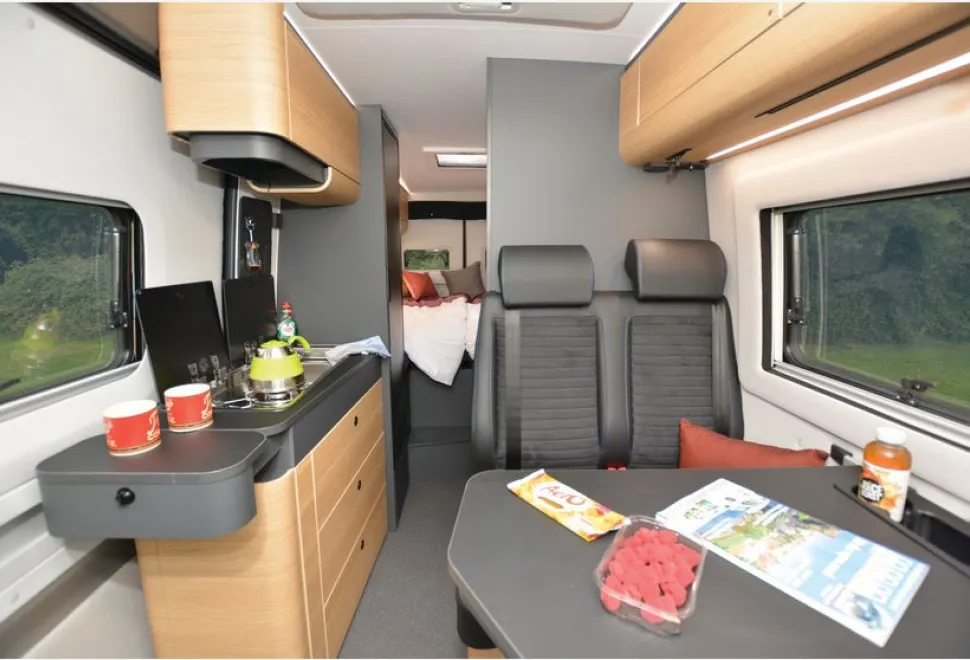
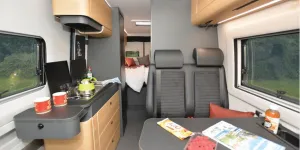
The layout is predictable – a half-dinette, swivel front seats (which turn easily, thanks to a drop-down handbrake) and a wall-mounted table – but the execution exhibits superior detailing.
For a start, it all looks very contemporary. The grey table matches the kitchen counter and fridge area, while the light wood of the rest of the furniture exhibits lots of curves, as well as clean lines due to the lack of any handles.
Leather upholstery will be standard and the padded fabric finish around the dinette window and the full plastic trim on the sliding door complete a premium-quality appearance. It’s not just about the looks, though.
The cab seats are as supportive on site as they are for driving, while the rear bench might be the very best in its class for comfort, although the position closest to the wall is best suited to a child.
The table also includes a couple of cup holders (good to avoid spillages) and has a (very sturdy) swing-out extension leaf to cater for what will be the driver’s seat in RHD models.
The kitchen
For extra worktop in the galley, Adria has eschewed the usual folding flap and, instead, added a slide-out section at the end of the unit, onto which a panel slots in. It feels very substantial but you’ll have to store that piece of worktop somewhere.
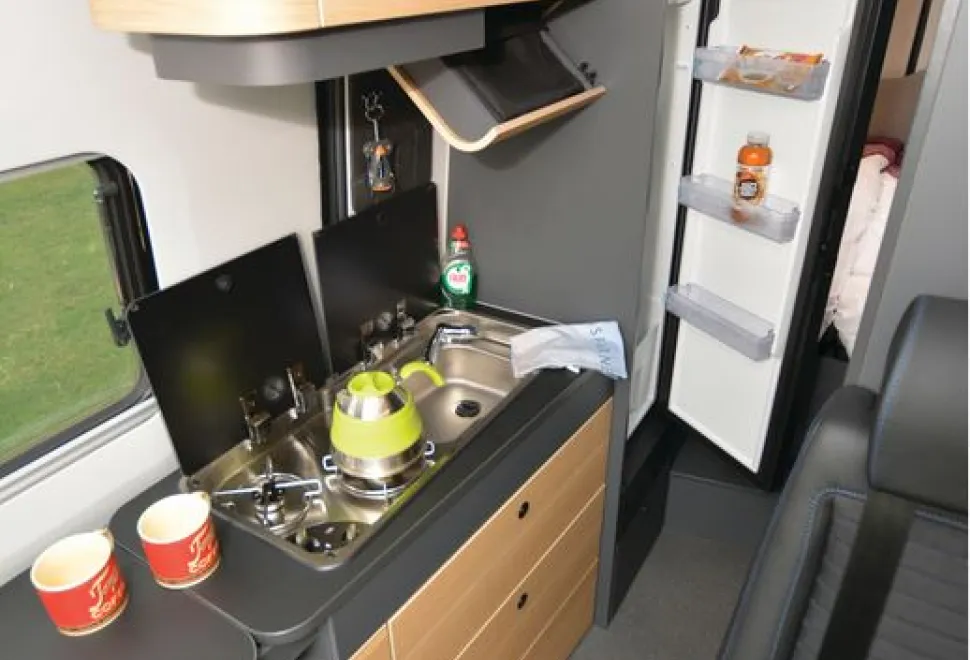
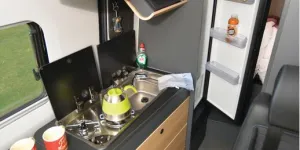
The rest of the kitchen holds few surprises. The curves and clean lines are repeated here and storage includes three supersized soft-closing drawers. Some of this storage will be lost if an oven is fitted, which is how we’re expecting UK vehicles to be delivered.
In the meantime, cooking is simply on a two-burner stove that’s integral with the stainless-steel sink. If you want to use a toaster or coffee machine, there’s a 230V socket above but this will require the sink lid to be closed, which isn’t ideal. There’s another socket (and USBs) on the front of the half-dinette, so appliances could go on the table, and power and aerial sockets (and more USBs) are fitted above the rear seat for a TV.
Back in the galley, there’s an unusual drop-down locker above the sink that incorporates a holder for spices, etc. There’s a wall-mounted set of pockets for some utensils, too.
Completing the kitchen is a tall compressor fridge. This 137.6-litre Thetford unit is an optional upgrade (an 84-litre fridge is standard). We haven’t seen whether the smaller fridge allows for a wardrobe to be incorporated, but it’s worth noting that in this model there was no hanging space at all (apart from a drying rail in the washroom).
The washroom
When you slide back its black tambour door, first impressions of the ‘little room’ are good, too. A large, angled mirror and frosted window give an enhanced feeling of space inside and the black tap and black outside/white inside washbasin look stylish. There are neat details, too, like the clothes drying rail and top cupboard with deep lip to keep everything safely in situ.
In use, though, the space doesn’t live up to initial expectations. The cassette loo is rather too high, unless you have long legs, and you’ll need to be sitting there to get your face over the basin; there just isn’t much standing room in here.
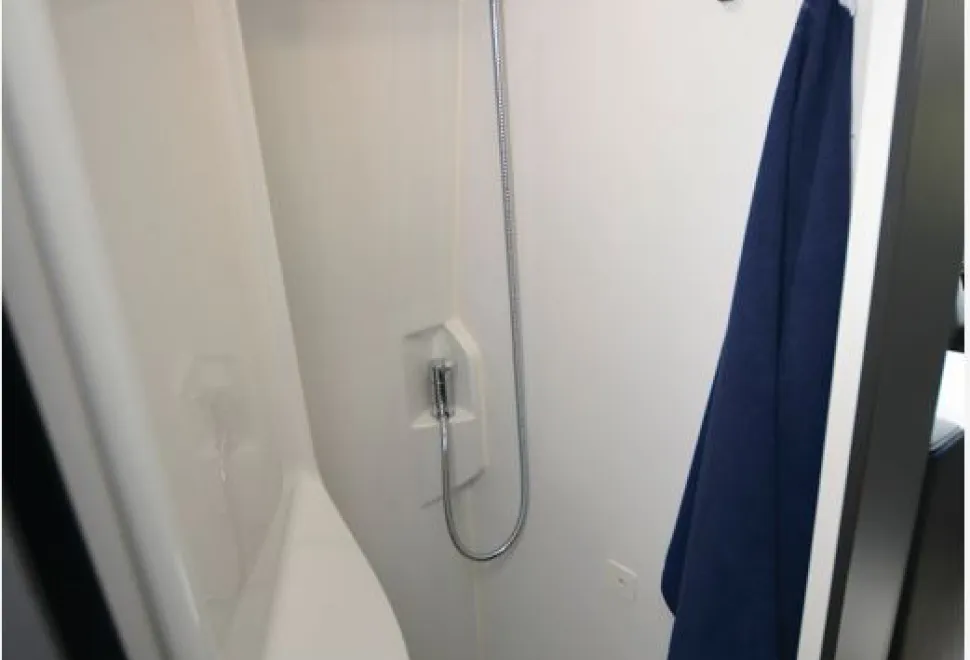
Things are better when it’s time for a shower, thanks to a simple-to-operate swing wall where the washbasin rotates over the toilet. It’s all done in characteristically Adria sturdy style, but you’ll need to try the shower for size because it’s quite a compact space. At least you don’t need a curtain, and there are two drains in the shower tray.
Waste water should flow away easily enough, therefore, into the 70-litre underslung tank, which is both heated and insulated and has a large bore outlet with an electric dump valve.
Motorhome supplied by Adria Concessionaires
adria.co.uk
Insurance: £714.73
Tel: 0800 975 1307
shieldtotalinsurance.co.uk
For quote details: motorhome.ma/QuoteInfo
Our Verdict
The MAN is unbeatable as a base vehicle, especially in 175bhp automatic form, but 6.84m is long for a campervan. Adria uses that extra space to provide a superb bedroom that quickly turns into a huge garage. The front lounge isn’t big but the daylight and seating comfort are superb, and Adria’s design and build quality throughout are top-notch. If there’s a weak point, it’s the compact washroom.
Disadvantages


