
Adria Active Duo pop-top campervan

Description
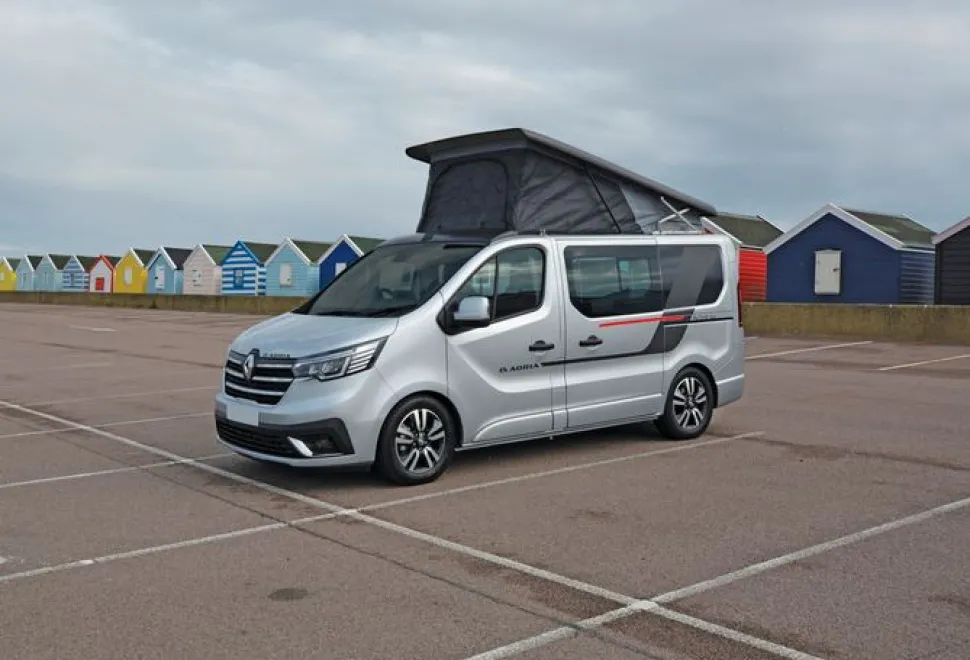
Based on the latest Renault, this new Adria fills a niche between basic campers and more fully equipped pop-top models
Key Features
Full Review
Words and photos: Peter Vaughan
The Adria Active Duo
You can get a much bigger coachbuilt motorhome for less money – that’s the retort from some readers whenever we test a pop-top model like this new Adria. Often that’s true, but the Active Duo now looks a lot more competitive, thanks to a revision of its UK pricing. In fact, with a new starting price (announced in December 2023) of only £52,990 (a near £10k reduction), it suddenly looks very keenly priced indeed.
And campers like this aren’t just about affordability anyway. As well as having the advantage of being small enough to squeeze down those Cornish lanes where grass is growing between your wheels, a campervan like this must be able to act as a daily driver – popping to the supermarket or the office, parking in town centres and taking the kids to school. You won’t be doing any of that in your tag-axle A-class.
Cutting down on the number of vehicles in your fleet and running a camper day-to-day also has benefits in terms of insurance, servicing and MoT costs, of course, but the campervan in question must be good at both leisure and the more mundane roles. So, how does the Active Duo fare against its many established rivals?
Well, its choice of base vehicle is an interesting one. The Renault Trafic has been around in its various forms since 1980 and, in its first iteration, was a trendsetter in its move to front-wheel drive. Today, though, it faces stiff opposition in the camper market from the far more frequently converted Ford Transit Custom and VW Transporter T6.1.
However, an all-new version of the former has recently been shown and we’d expect it to reach UK buyers, as a campervan, next spring at the earliest. You’ll wait longer (perhaps another 12 months) to get a new-generation Volkswagen camper and it’s no secret that the T6.1’s successor will be a very close relative of the new Transit Custom.
The point is, if you buy a Ford or VW right now, it’ll very soon be an obsolete model. The Trafic, on the other hand, has just been under the surgeon’s knife for a comprehensive facelift and is not due to change again until 2027.
The base vehicle
The ‘new’ Renault is not a completely fresh design but the latest update to a model that first appeared as the Trafic III in 2014. In this guise it gets a totally new front end, with a bolder, more aggressive face, chromed grille and LED headlamps (said to enhance visibility by 20%), plus C-shaped daytime running lights. Bigger door mirrors are another development to ease the driver’s life.
I’ve always enjoyed driving the Trafic and, when the third-generation model was launched to the press almost a decade ago, it seemed like a real advance over its opposition, feeling instantly more like a car, less like a van.
Rivals have caught up, of course, but the new dashboard design that I’m sampling here for the first time impresses with a look straight out of Renault’s passenger car line-up.
There are all the essential recesses for cups, phone, maps, etc, and the 8in Easylink touchscreen has piano-style switches below and separate rotary controls for the heating and air-con under those.
The cab seats are supportive and, although fitted with only a single armrest apiece, the door trims are designed to accommodate your other elbow.
Importantly, the driving position at the new leather-trimmed steering wheel feels more SUV than Routemaster bus, while the inclusion of Apple CarPlay and Android Auto keeps the tech up to date, even if you still need a wire to connect your smartphone.
Under the bonnet, Renault describes the 2-litre, Euro 6D-Full emissions compliant engines as ‘new and improved’. Kicking off the range of Blue dCi diesel motors is a 110bhp unit with 300Nm of torque, which is the standard spec for the Active Duo, along with a six-speed manual gearbox. Here, though, we have the far more tempting 150bhp/350Nm engine with an EDC automatic transmission.
Like VW’s DSG, this is a twin-clutch system that’s smooth and utterly faultless in operation. Performance from the Renault surprised, too – with similar power and just 10Nm of extra torque, it felt noticeably livelier than my own VW.
The more I drove this Trafic, the more I liked it. Fuel economy of around 40mpg was better than my T6, too.
The options
It’s not just the base price of the Active Duo that’s been revised but the options costs, too. The Highland Grey paint is now £435 extra (it was a whopping £1,040), while the 150bhp motor and automatic gearbox add £3,780 to your bill (previously £4,975).
If you go for the ‘full monte’ with Comfort Pack, Renault’s PCV36 and PCV18 Packs, EasyLink infotainment, and alloy wheels (in a spare), the total cost of your camper is now down by £13,250 to a total of £63,490. That makes the Adria look much more attractive.
The layout
As an everyday vehicle, the Active Duo has a trump card that few rivals (bar the California Beach and Ford Nugget) can match – twin sliding doors. These provide easy, safe access wherever you park and a further bonus is the Reimo sliding seat system, which includes Isofix for a pair of child seats.
Of course, you can also bring the little ones close to the cab by moving the bench forward, or put the ‘van’ into campervan by pulling the seat right forward, leaving a huge load area almost 1.50m long by 1.17m wide in the back.
Even with the seat in its ‘camping’ position, there’s still a generous boot for your shopping, and you shouldn’t be restricted on where you shop, as the 4.99m length fits into a standard bay and the 1.99m height (with the lowered suspension fitted here) slips beneath most barriers.
The pop-top roof
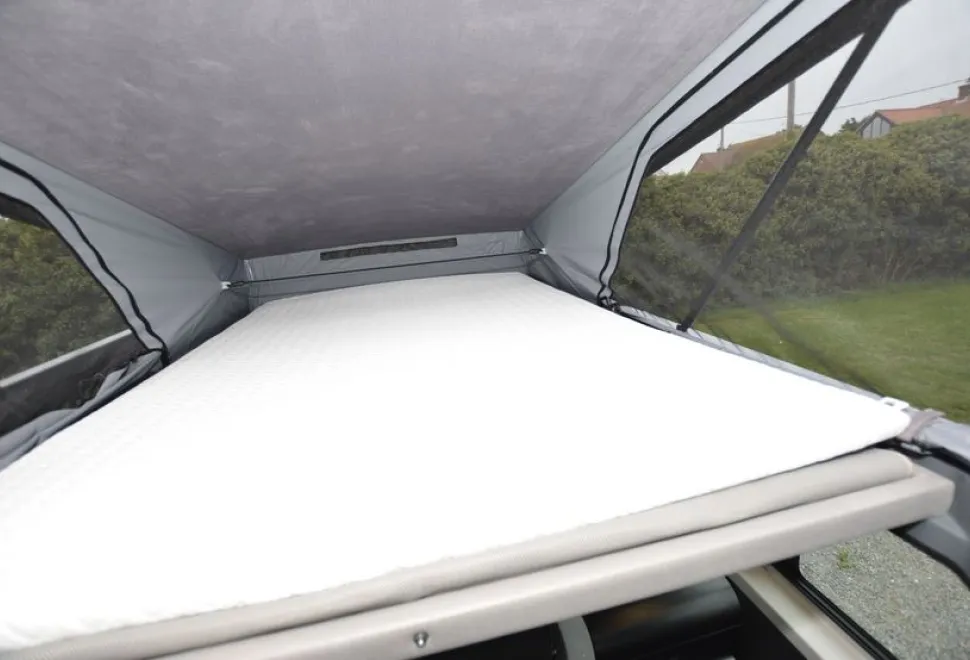
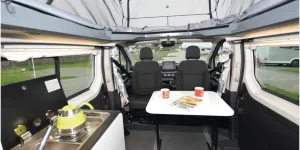
So, the Active Duo serves well as a car, but what about as a camper? Well, first job when you park up is to swivel the front seats and both turn easily. Then raise the pop-top and – electric versions aside – this must be one of the easiest roofs I’ve ever tried, both to raise and lower. It has catches at each side (plus a centre seatbelt clasp, belt and braces fashion), but the former lock automatically when you drop the lid down again.
Then, when it’s up, you can fully unzip the front three-quarters of the canvas, leaving a giant flyscreened area – great for letting in the sunshine and fresh air. However, when it’s chilly or soggy, the Adria roof is more limiting and it’s a pity there’s no way of letting in more daylight up top.
Uplighters in each front corner do at least provide some artificial illumination, though.
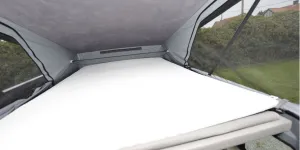
The roof also comes as standard with an upper bed and it’s a comfy one, thanks to its mattress sitting on plastic Froli springs.
However, the Sky Open roof, along with Webasto diesel-fired blown-air heating, cab carpet, a 100Ah leisure battery, awning and the special suspension are all packaged together in the Comfort Pack, priced at £2,905.
Storage
The awning is badged Thule and looks familiar but is not the usual wind-out type. Instead, you open the box and unfurl it manually, then attach the legs. It is definitely a two-person job and seems unnecessarily fiddly when the wind-out types work so well.
Another option (£580) is a rear tent that simply hangs over the tailgate. That is much easier to deploy but doesn’t seem to add a lot of space, while leaving your vehicle unlocked and unsecured from the back. Better to get an inflatable free-standing awning if you want more space.
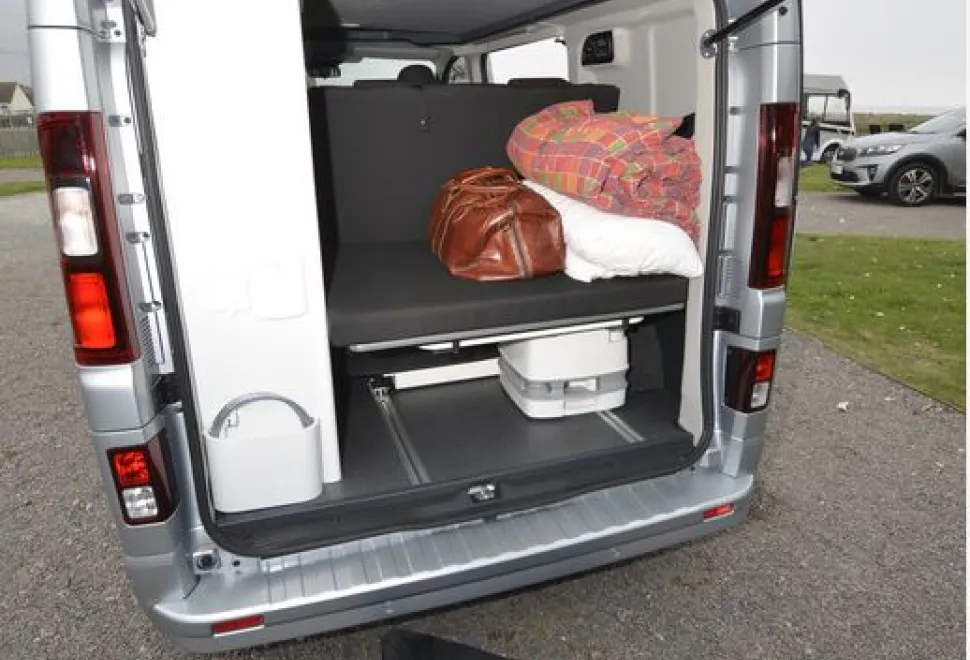
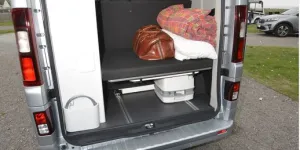
There’s no issue with storage at the rear of this camper, though, and the rear boot is such a vital aspect of this type of campervan if stays of more than one night away are going to be practical.
Above the mattress, there’s room for all your bedding, plus soft bags for extra clothes. Underneath, we had the rear tent and a Porta Potti (not included), but there was room for outdoor chairs and more. The table stores here and is a free-standing unit that works well inside or out.
Less accessible, but quite generous in capacity, is the space under the seat. This is reached from above and was big enough to house my cameras, laptop bag and coats.
The rear furniture also includes the gas locker (for one Campingaz cylinder) and the inboard fresh water tank (14 litres). Unlike many of its ilk, the Adria also has a fitted underslung waste tank (no doubt in order to meet NCC approval), and an added bonus is the outside shower, although this is, of course, cold water only (welly boots won’t complain, kids might!).
The kitchen
If you’re wondering how Adria has managed to offer twin sliding doors and yet retain the side kitchen layout that is so popular for campervans of this size, it’s simply in the dimensions of the galley. Here, it’s a much shorter kitchen unit that comes just partway across the nearside door.
A key advantage of the Active Duo’s design is the front-facing fridge, which is great when loading up with fresh food at the supermarket direct from your trolley and just as appealing when you’re sitting outside and want to grab a beer.
However, the design also has shortcomings directly attributable to its size – open the glass lid and you’ll see that there’s just a single-burner hob in a combination unit with a small sink. With the lid raised, there’s enough room for a couple of cups but not much else, although Adria’s excellent detail design includes a couple of useful wall pockets for washing-up liquid, etc.
Above the fridge, there’s also a cutlery drawer, but the rest of your kitchen kit will have to go in the tall, tambour-door locker alongside the seat. Actually, this works well, with plenty of room in this large, shelved space for crockery, pots and pans and non-perishable foods.
The lounge
The rear bench is also at a far more comfortable height for those with average-length legs than the RIB seat so often seen in small campervans, and rear passengers will be pleased to find large opening windows on either side of the camper.
Even better is the simple way the Reimo seat becomes a bed. First, the squab cushion lifts and hinges forward through 180 degrees, then the backrest folds down into the space left vacant by the squab. It takes only seconds and results in a mattress of three completely flat sections, totalling 1.96m in length.
At the foot of the bed, there’s room for a Porta Potti for night-time emergencies, while the fridge and hob remain accessible for an early morning cuppa.
After sundown, curtains cover the cab and tailgate windows while unusual pleated blinds are fitted on the side windows; it’s just a shame these aren’t a darker material to keep out more sunlight.
As for interior illumination, there are LED strips over each sliding door and over the head of the bed, plus a downlighter in the base of the roof bed (and the aforementioned uplighters in the front corners of the roof).
Motorhome supplied by Adria Concessionaires
adria.co.uk
Insurance: £558.45
Tel: 0800 975 1307
shieldtotalinsurance.co.uk
For quote details: motorhome.ma/QuoteInfo
Our Verdict
The Active Duo’s twin sliding doors are a real advantage, especially in combination with the versatile Reimo sliding seat.
Adria uses top-notch fittings and fit and finish is first-class, while this model finds a worthwhile niche between the kitchenless California Beach and fully equipped models like the Ocean.
Now, with its reduced pricing, it looks much more appealing. Even fully loaded with all the options, it comes in at under £65k.
Disadvantages


