
VW California Ocean eHybrid Campervan


Peter Vaughan Content Editor: Motorhomes
Peter Vaughan Content Editor: Motorhomes
Description
Petrol/electric power for the most car-like camper on the market
Key Features
Full Review
The previous-generation California was undoubtedly a huge success, with over 200,000 sold up to 2024. It changed little internally over T5, T6 and T6.1 generations from its launch in 2005, although cab and engine spec improved to match customer demands and environmental legislation.
It would have been easy, therefore, for VW to simply repeat the recipe in the new Transporter, the joint venture van produced at Ford’s factory in Turkey.
We first got a glimpse of the future of Volkswagen’s own in-house camper at the August 2023 Caravan Salon Düsseldorf, where the California Concept broke cover.
No longer would the campervan share anything with the Transporter, and nor would it adopt the all-electric retro-look ID Buzz as its base (as had been rumoured). Here instead was a California based on the Multivan people-carrier, an all-new car in 2022 using the MQB platform (shared with the Mk7 Golf, Audis, Seats, Škodas, etc).
The California (offered in Beach Camper, Coast and range-topping Ocean specs) is to date the only commercially available campervan based on the Multivan. The Cali always had spec and features that weren’t available on other VW campers but this takes the OEM leisure vehicle into a whole new sector. Having just spent a week and several hundred miles with one, I can attest to its superb road manners. This is more premium SUV than converted van.
Looks like an MPV
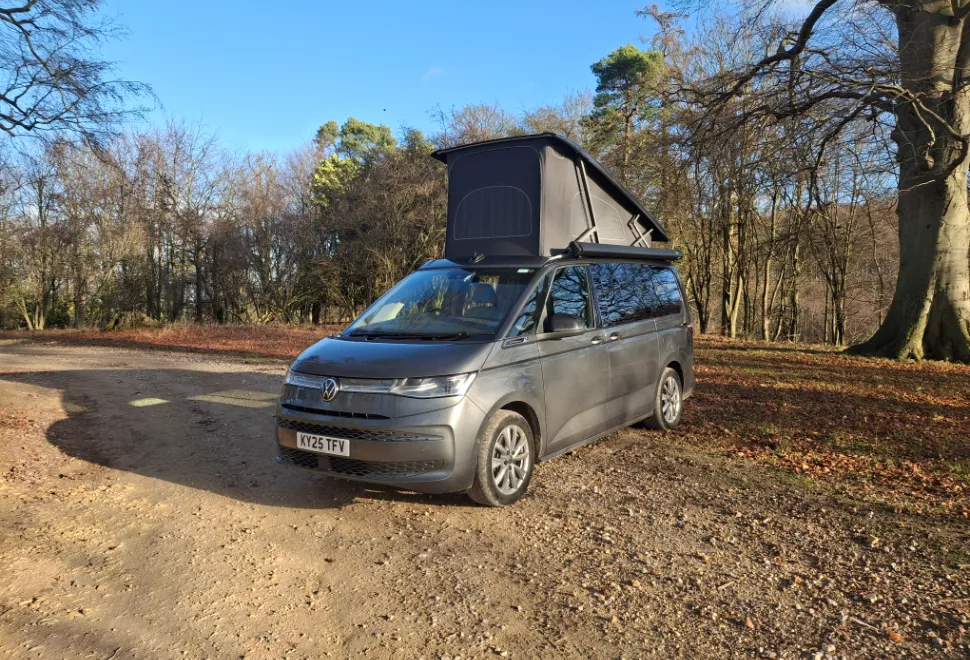
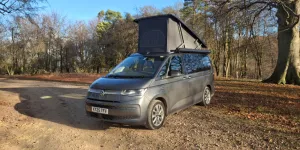
The looks, with distinct shovel nose and the (sometimes blind spot-causing) double A-pillars, don’t shout campervan. In fact, in the Indium Grey metallic of our test vehicle, the appearance doesn’t shout at all. Fortunately, there are bolder paints and duo-tone schemes that suit the California’s image better.
For the first time, the VW camper also comes not only with diesel power (2-litre, 150hp), but also a petrol (2-litre, 204hp), and, most interestingly, a 245hp eHybrid mixing petrol and electric power. The 1.5-litre TSI engine and 19.7kWh battery combination is what we have here, but it’s worth noting that this version has less payload than the diesel (287kg versus 413kg).
If you live in a major town or city and can charge from a domestic supply, the eHybrid is probably a no-brainer. Its 52-mile electric range is adequate for many commutes, shopping trips and school runs, while the 45-litre fuel tank caters for weekends and holidays in a way that is still not matched by pure EVs. In hybrid mode, 91mpg is claimed, and it’s possible to drive solely on battery power for city centres. Once the electric supply has been depleted, we were achieving around 35mpg – similar to what we’d expect from a diesel and better than a petrol California (official figure 30.4mpg).
A dream to drive
All the new Californias have a DSG automatic gearbox and, while the eHybrid has one fewer ratio (six, not seven), it feels little different behind the wheel.
Those used to hybrids and EVs will enjoy the almost one-pedal motoring, thanks to regenerative braking, but you are rarely conscious of the petrol engine cutting in and out. Refinement is top-notch until you press firmly on the right pedal to overtake and the TSI motor makes its presence felt in a way that the larger-capacity petrol or diesel versions would not.
Whichever power unit you choose, the driving environment is many grades higher than the new Transporter. This is a solely VW product, not a joint venture, and it has the Teutonic solidity of an £85k vehicle.
From the Discover Pro sat-nav and 10in touchscreen to the three-stage heated seats with twin armrests and eight-speaker stereo, you won’t hesitate to switch from a similarly priced car to drive this Volkswagen day to day.
It has everything you’d expect from a high-end car, from keyless entry and adaptive cruise control to superb IQ Light matrix LED headlights that make most campervan headlights seem like candles…
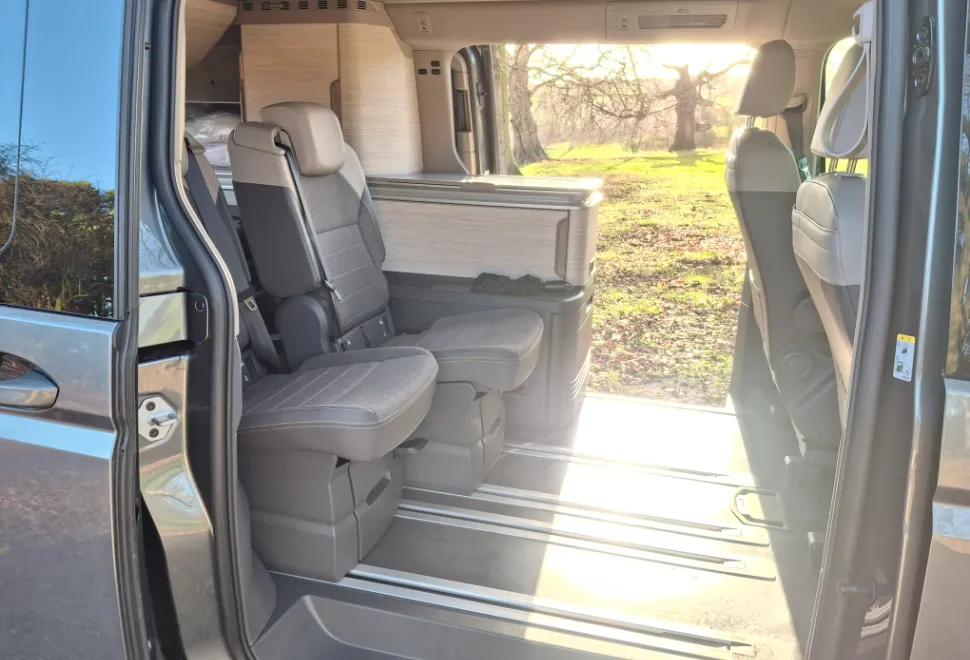
Another aspect, of course, that makes the new Ocean a better car is the twin sliding doors, while rear passengers (still just two in this model, three in the Beach Camper) now have individual sliding/reclining seats that are almost as good as those up front, and way better for long journeys than the old one-piece bench.
Detractors always pointed to the previous California’s offside sliding door – OK on the Continent but requiring extra care when on-street parking in the UK – now you have a door on the right side wherever you are.
Compromised for camping
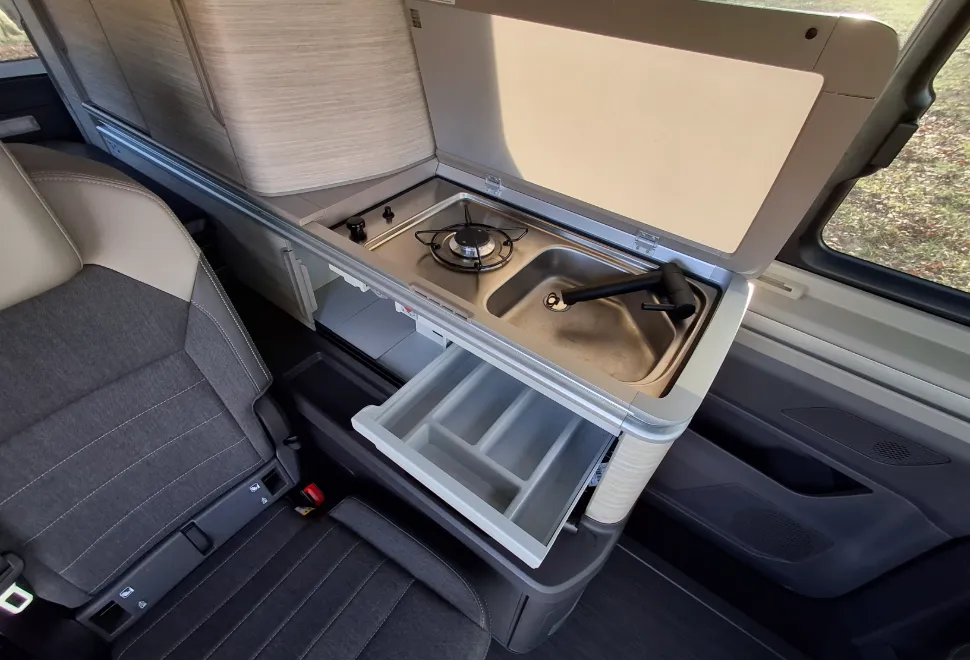
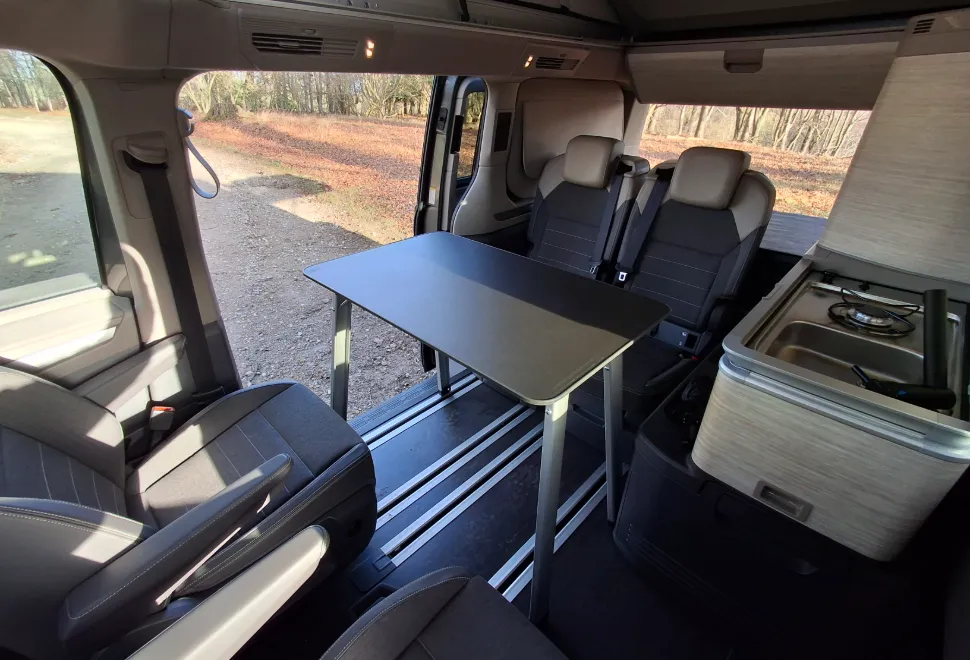
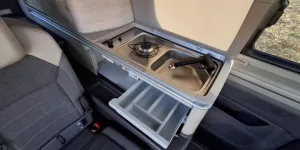
To achieve access from either side, the latest California has a much shorter kitchen than your typical VW camper. That means less storage (despite the full-height section with sliding doors towards the rear) and just a single-burner hob.
The sink, too, is quite small and shallow.
Another compromise concerns those rear seats, which, rather than having a large drawer beneath, just have a tiny storage bin each (room for your slippers or Crocs but that’s about it).
It’s not all bad news, because the drawer-style 37-litre fridge is a neat feature – grabbing a cold drink when eating outside or loading shopping straight from your trolley is ideal. And the Ocean still comes with all the kit, including the roll-out awning, an inboard fresh water tank and blown-air heating (petrol, not diesel, here).
Lighting (now dimmable) is improved, leisure batteries have been upgraded to twin 40Ah lithium units and the pouch that also acts as a blind on the rear offside window is useful for socks, underwear, etc. Everything feels nicely finished and should last for many seasons without becoming tatty.
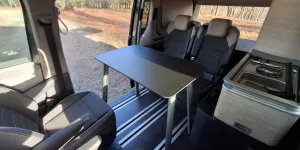
Another clever idea is the worktop flap that can be attached to the back of the galley when eating outside (with the nearside slider open) or on the end of the kitchen for a bit of preparation space. It can also be used as a table for one in conjunction with the rear seat nearest to the galley.
Not so practical is the main table, catering for four. You can use it outside but also have to go outside to get it from the boot and, when you erect it inside, you realise it’s just awkward and cumbersome. Outdoor chairs (kept in a pouch on the tailgate) still come as part of the standard equipment – it all feels as if the Ocean has been designed more for summers in Spain than winters in Walsall.
Storage in the boot
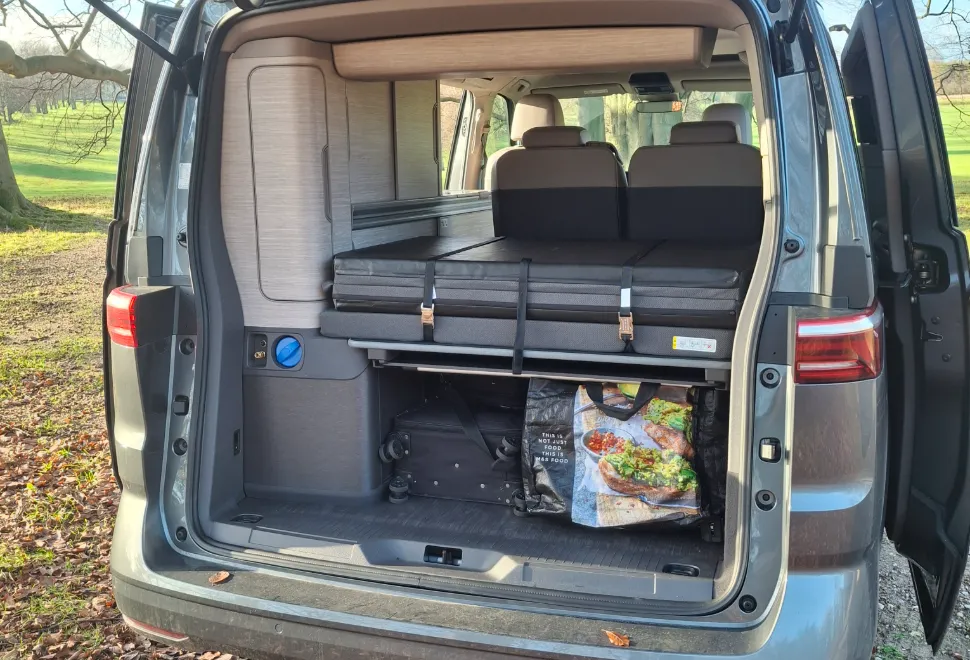
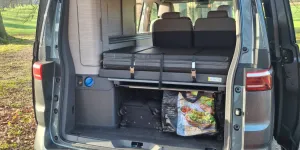
The big table slides away into the lower part of the boot, where there’s still a decent amount of stowage space – room for your mains lead, levelling wedges, etc, and even a Porta Potti.
You can increase the room by sliding either or both back seats forward or even removing one of them.
Above, though, there’s a lot less space than you might hope as there are three layers of mattress stacked here. After shutting the blinds (which don’t cut all the daylight out), these (rather firm) bed sections unfold over the rear seats once you’ve folded them flat.
The resultant bed is 1.99m long but a rather skinny 1.06m wide. Better, then, to sleep in the roof where the 2.05m by 1.22m mattress is on plastic springs.
The pop-top itself rises electrically – a slow but effortless party piece of Californias since the T5. Now controlled by a switch on the dashboard, the roof has flyscreened panels on three sides but no window to give daylight without fresh air.
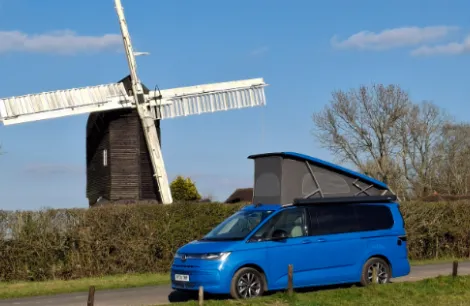
How does the new California compare with its T6.1 predecessor?
Read our in-depth comparison of the latest model with the previous California and watch our video review.
Our Verdict
This second test of the new California Ocean only reinforced the feeling that it is unmatched as a car that you can occasionally camp in. It has an OEM feel beyond even that of the Ford Nugget or Mercedes Marco Polo with many new features that make it stand out from the competition. However, limited storage and that narrow downstairs bed (with minimal floor space unless it’s in place) will count against it for those buying a campervan for more serious camping trips.
Disadvantages


