
VW California Ocean (T7 Multivan) Campervan

Peter Vaughan Content Editor: Motorhomes
Peter Vaughan Content Editor: Motorhomes
Description
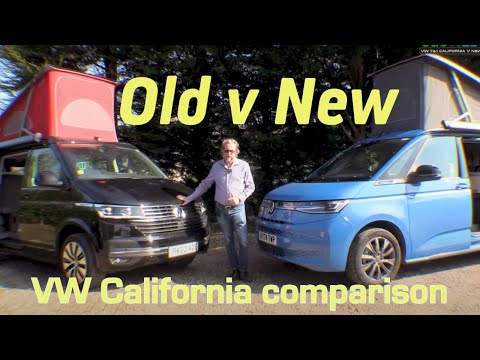
The new California Ocean is based on the Multivan people-carrier rather than a Transporter van, but how does it stack up in comparison with its T6.1 predecessor?
Key Features
Full Review
The Volkswagen California has been around since 1988, originally built by Westfalia on the T3 and then T4 generations of the Transporter. VW took both its design and build in-house in 2004 with the launch of the T5 Cali, the first one to come here as an official right-hand drive import. Later T6 and T6.1 versions required only the most minor updates to the habitation aspects as sales soared – the Cali has been a huge success story, with 200,000 vehicles sold in less than 20 years, making it the best-selling campervan in Europe.
With the end of T6.1 Transporter production, however, an all-new model was required. Rumours of an all-electric, retro-styled ID Buzz California have so far come to nought and, equally, VW shows no sign of converting the new (Ford-based) Transporter van into a camper.
Instead, the future direction of VW’s camper was unveiled at the 2023 Caravan Salon Düsseldorf with the California Concept, based on a Multivan people-carrier. Now the production model is here, albeit without the induction hob and portable barbecue of the concept.
In fact, the new California that you can buy comes in three flavours. The Beach Camper is a five-seater that has a simple slide-out galley in the boot. However, standing under the tailgate to make a cuppa may lose its appeal in Britain in the rain…
Next up is the California Coast, which has the same four-seater/side kitchen design as the top-spec Ocean that we’re testing here (note that all the names have been carried over from the T6.1, even if the designs are different). Key differences between Coast and Ocean are the latter’s electric (rather than manual) elevating roof, heated cab seats, Discover Pro sat-nav with 10in display plus streaming and internet, power latching for the sliding doors and tailgate, 18in Toshima alloys, ambient interior lighting, LED matrix headlights and some cosmetic details.
The new Multivan-based California Ocean also comes with a choice of three completely different powertrains, unlike the outgoing TDI-only model. Our test vehicle is the obvious choice – a 2-litre diesel with seven-speed DSG automatic gearbox. However, it comes solely with a 150hp power output, which may disappoint owners of the previous 204hp biturbo T6.1. If you want more performance now, you’ll have to swap from the black pump to the green one and order the 2-litre petrol model with 204hp. For budding boy racers, it knocks 2.6 seconds off the 0-62mph dash, reducing it to 10 seconds dead. But the combined fuel consumption figure is around 10mpg worse, at just over 30, and the petrol version is almost three grand dearer than the diesel.
Later this year, you’ll be able pick the third alternative, a petrol/electric plug-in hybrid with 245hp and 4Motion all-wheel drive. We’ll be very interested to test the real-world EV range of the eHybrid when it arrives.
Whichever California tempts you, it will come with the 5+ Promise – five services (and three MoTs), five years’ warranty and five years’ roadside assistance.
Still with diesel power
So, the new California is no longer based on a van. In fact, the Multivan uses Volkswagen’s MQB platform which has sired around 60 different models, from Polo to Passat and including Audis, Seats and Škodas. Using an MPV or people-carrier as its base should give the new model a real USP – and added sophistication. Other OEM campervans – Mercedes Marco Polo, Ford Nugget and Citroën Holidays – all have closer links to commercial vehicles.
The Cali has also grown bigger. Length is the most notable change, going from 4.90m to 5.17m. Width has expanded a tad, too, from 1.90m to 1.94m (excluding mirrors), but crucially this campervan remains untroubled by height barriers with an overall figure of 1.97m.
It’s also still a vehicle that you can drive on a standard Class B car licence, and its maximum gross weight has actually reduced from 3,080kg to 2,850kg. Payload has also dropped by around 100kg, so you’ll have to be aware of that if you ever travel with four adults on board.
When camping, though, it’s more likely to be just a couple of grown-ups or, perhaps, a two-plus-two family. In which case, the driver is in for a treat. The T6 and T6.1 were great vans but they were still vans. The new Cali moves things on by some margin simply because it isn’t a van.
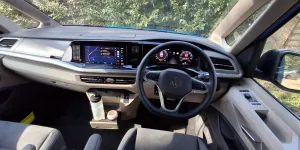
Of course, the new Cali is a real step forward when you’re using it as a car and one of the key strengths of a vehicle like this is that it can be used every day, taking the kids to school, going to the supermarket or popping to the office. From the moment you sit behind the fully adjustable wheel and adjust the seat, its armrests and electric lumbar support, you feel like you’re in a premium vehicle – more Audi than Škoda. Little details like the aluminium fillets on the doors and dash and the padded leatherette sections on the door tops make a difference.
Twenty-first century features
The instrumentation is fully digital and there’s a 10in screen for the radio and navigation, while Android Auto and Apple CarPlay link wirelessly. Cruise control (adaptive, of course) and radio controls are mounted on the steering wheel, which, like the seats, comes with three-stage heating. The stereo, meanwhile, has eight speakers and the subtle blue illumination around the cab for night-time driving turns to red if a door is opened, or green if you receive a phone call. My teenage daughter described that feature as “sick”, which apparently is a very good thing!
I was more taken with the IQ Light LED matrix headlights, which gave remarkable visibility and dipped only the necessary elements to avoid blinding oncoming traffic – clever and more likely to improve safety than all the electronic nannying.
You can’t avoid all the latest assistance gismos these days, so the California has Driver Alert, Front Assist, Dynamic Road Sign Display, Park Assist and Travel Assist. Mostly, they’re not too obtrusive, but they’re not infallible. The Cali was convinced that a local derestricted road had a 30mph limit and reprimanded me for speeding. Then, when reversing towards a speed bump, it jammed the brakes on hard, thinking I was going to crash. The design of touchscreen isn’t perfect, either, with it being far too easy to inadvertently alter the air-con temperature when fiddling with the radio. Please bring back physical switches.
There’s keyless entry and keyless starting – just keep the fob in your pocket and press the button marked ‘Engine’. No need for a conventional gear stick, either, just flick down the chunky switch between the two digital displays to engage drive, or push it up for reverse. And here’s where things get really interesting to campervanners because the T6.1’s floor-mounted parking brake (awkwardly in the way between the seats) has gone; now it’s an electric parking brake that releases automatically.
On the road, the new California is impressive. Smooth, quiet and comfortable, it’s everything you’d want it to be, whether you’re nipping out for milk or heading to the Côte d’Azur. The phrase “car-like” has been hugely overused in campervanland over the years but here it isn’t just car-like, it is a car. Even my gripe about a slightly tardy pick-up from stationary was soon eliminated by selecting sport mode. Sport mode in a campervan, whatever next?
Understandably, the motoring press has been very excited by the new model. Autocar magazine declared, “VW’s vast experience with campervans is very obvious and employed brilliantly”, while Top Gear said, “As expected, the California remains a brilliant campervan.” We’ve had to wait longer than them to get our hands on the new camper but we won’t be blinded by the fact that it’s nicer to drive, so we set off not only to camp in it but to park it side by side with its predecessor.
More doors, less kitchen
The biggest criticism of the old California, whether T5, T6 or T6.1, was that the door was on the “wrong” side. Of course, if you parked in the street in the UK, you’d have your rear passengers alighting into the middle of the road – not ideal, but you’d have the same issue taking your UK camper onto the Continent.
Well, wherever you are the new California solves that because it has sliding doors on both sides. Not only that but our test vehicle had electric sliding doors with Easy Open – a £1,200 option that allows you to remotely open either door from the key fob. My 11-year-old lad thought that was cool – “sick” doesn’t seem to be in his vocabulary yet.
It also means that the (standard) Thule sunshade awning is now on the nearside and that you could also use a free-standing awning on either side.
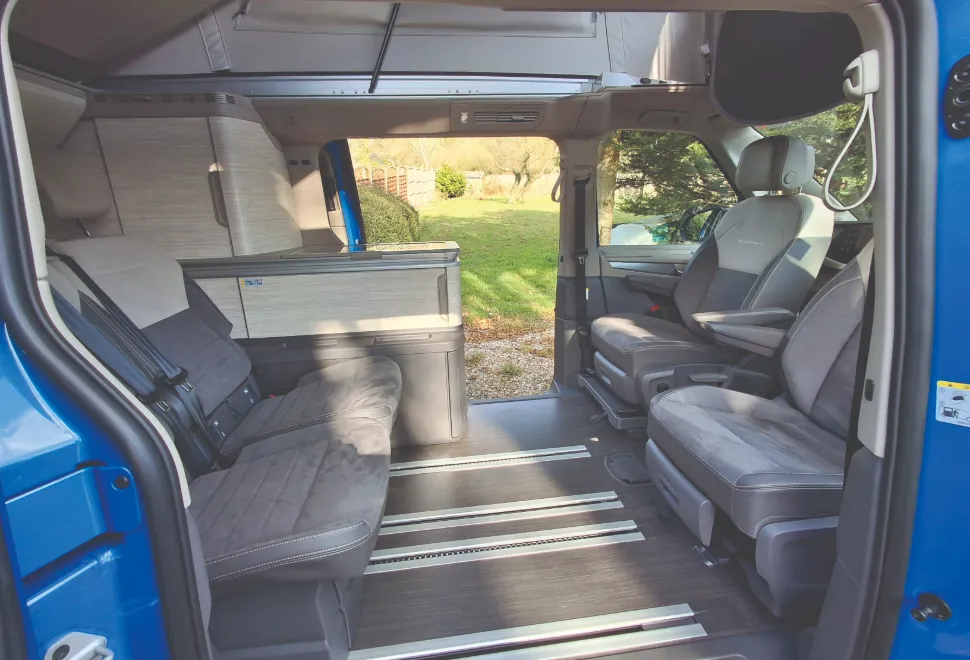
The California’s kitchen is still on our nearside but, to allow access through the door here, it has become considerably shorter. There are further pluses to that, though. The recline on the passenger cab chair is no longer restricted by
the galley behind, while the fridge (now a drawer-style unit in the end of the kitchen) can easily be reached from outside. It’s a slightly smaller cooler than before but imagine the convenience of parking your Tesco trolley alongside and loading the beer straight in.
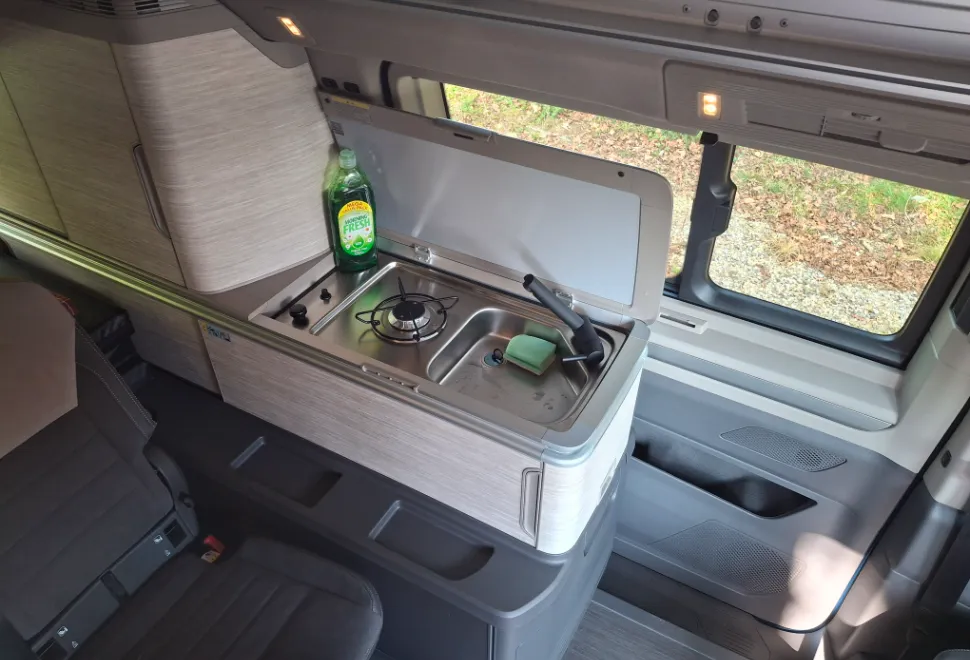
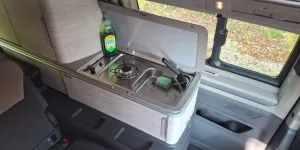
The Cali kitchen is still a smart-looking bit of kit but its glass worktop (now much more compact) reverts to a single lid. Lift it and you’ll be disappointed to find just one gas burner and a rather shallow sink.
More worrying is the considerable loss of storage space below. Sliding doors are retained for the furniture (easy to access wherever the seats are) but the one under the hob and sink reveals a large cutlery drawer and room (only just) for a couple of mugs, bowls, plates, a small kettle and the dolls’ house-sized VW-branded saucepan.
There is more stowage space towards the rear, where the furniture is taller, but the new Cali loses the old model’s wardrobe and vanity mirror. More importantly, the T6.1 had a large – and very useful – drawer under its rear bench seat, while the new one has just a tiny pull-out plastic cubby (enough for a pair of slippers, perhaps) under each individual rear seat.
Separate seats
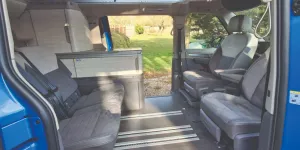
Of course, the back seats mark another significant change when comparing Multivan and T6.1 Californias – you could say they’re Oceans apart. The older camper had a bench seat for two that slid fore and aft on covered tracks in the floor. It was infinitely more comfortable than the RIB unit beloved of so many VW converters but it was still just a bench seat.
The new California puts passenger comfort to the fore with two separate rear seats that slide and recline individually. It’s another aspect that makes the new camper great as a car, although its open rails for the seats will need regular vacuuming out.
When you’re camping, both front seats in both campers rotate easily enough. Then, in the T6.1, you slide the table along the front of the kitchen and simply lift it to the horizontal and unfurl its leg – easy. In the new model, you have to go outside and retrieve the table from the boot and, as it’s a free-standing unit, it’s a bit too high and rather cumbersome inside the vehicle.
The T6.1 has another table (neatly stored on the inside of the sliding door) for eating al fresco, while both Californias store a pair of camping chairs on the inside of their tailgate. The new seats are a little more comfy than the old ones.
It’s another clear win for the T6.1 but the new model claws back points for its mini table that clips to the back of the galley with the nearside sliding door open. And this can also be used as a much-needed worktop extension on the end of the galley, but you have to open the door to get it.
Beds for four
Both Californias have an electric pop-top that’s effortless to use and each has a sprung roof bed as standard. In each case there are flyscreened ‘windows’ with covers at the front and on each side but there’s no way of getting daylight in either without fresh air, too. The newcomer claims the longer bed (a whopping 2.05m) but its mattress is also 4cm narrower.
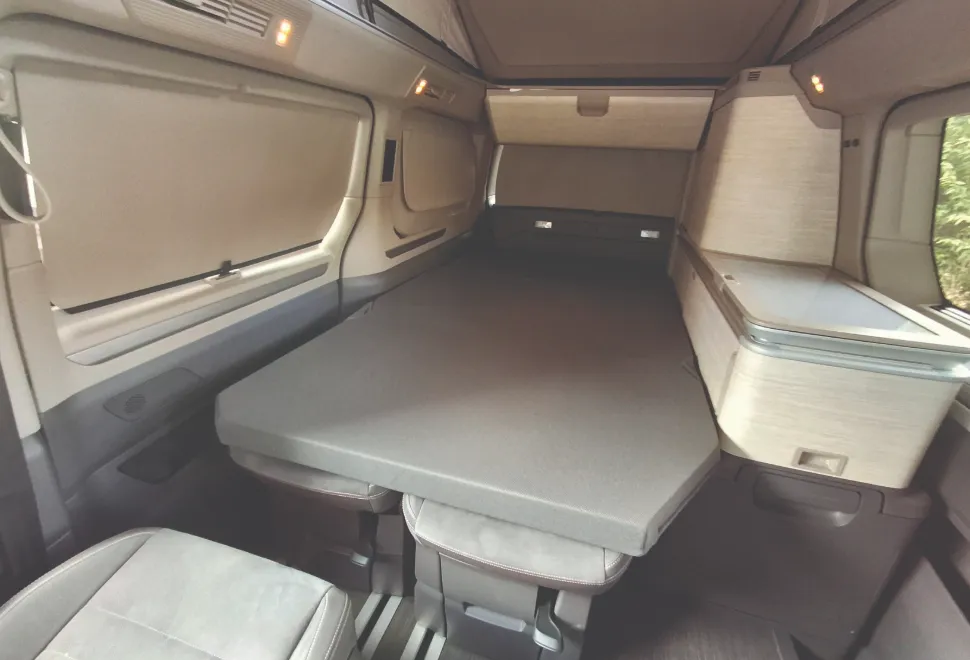
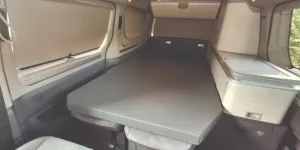
Down below, the T6.1’s rear seat slides forward and folds flat. It takes seconds and leaves plenty of floor space at the front to undress, or to park a loo. The new camper’s bed is more involved as you first slide each rear seat forward and flatten it, then unfold a three-section mattress over the top. Again, it’s a longer but narrower bed, as well as one that leaves very limited floor space – having a loo for night-time use is near impossible. Both Calis have firm beds but, while the T6.1 has plenty of room to stow a mattress topper, you don’t really have that luxury in the new one.
Where the latest California scores is with a good range of dimmable interior lighting, all controlled by the neat touchscreen mounted on the wall next to the rear seat. Like its predecessor, VW’s new camper has blinds for the side windows and tailgate. In the cab, side windows are covered by screens that attach with magnets – clever. The windscreen’s cover is a bit tent-like, with five slot-in poles but, although fiddly, it does an effective job of blackout.
The new touchscreen also allows easy monitoring of water and battery levels (now twin lithium batteries), as well as controlling the diesel heating and fridge.
Rear boot storage
The rear boot is a vital aspect in campervans like these as it’s where you’ll keep your bulkiest gear. It’s hard to fault the T6.1 in this area, with plenty of space above and below the rear mattress. In the Multivan, though, you see the impact of having to stow the three-piece mattress for the bed – it eats into your upper-level stowage, leaving room here for a duvet, but not much more.
Discover more VW campervan reviews
Explore a huge range of reviews here, including video reviews from our YouTube channel and those published in our best-selling magazine, Campervan Magazine.
Our Verdict
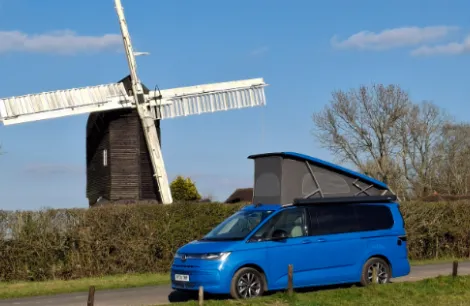
It wouldn’t be hard to fall for the new California’s looks (especially with the optional – expensive! – duo-tone paint) and you’ll be smitten if you take a test drive. Any thoughts of driving a builder’s van are suddenly banished to the history books, while the living area has the same integrated, automotive look as its forebear – just with perhaps even more sophistication.
And yet. The Multivan is bigger on the road but seems smaller on the inside. The twin sliding doors are great on a car but cause the kitchen to be too small, too lacking in facilities. The rear seats are fantastic when travelling but lose storage and make bed make-up less satisfactory.
Those seeking a day van, or contemplating just single-night stops en route to a holiday home will love the latest California and all of its added modernity. But we are campervanners and on longer trips away the new California’s dearth of storage will simply be a compromise too far.
Disadvantages


