
Panama P10E Hybrid campervan


Peter Vaughan Content Editor: Motorhomes
Peter Vaughan Content Editor: Motorhomes
Description
One of the first plug-in hybrid campervans in the UK comes from Spanish firm, Panama, through Marquis Leisure…
Full Review
Here’s a first. In over four decades of testing campervans and motorhomes, I’ve never had a hybrid-powered ’van for full review before – and that’s despite the Toyota Prius having gone on sale here 25 years ago.
But could this be the future of campervans? Volkswagen recently launched a hybrid version of its new Multivan-based California and the availability of Ford’s Tourneo Custom as a PHEV (plug-in hybrid electric vehicle) may result in a lot more petrol/electric campers coming onto the market.
The first of those to be widely publicised is this Panama P10E, imported by nationwide dealership, Marquis Leisure. Indeed, this Spanish campervan brand is also something of a newbie, having first appeared in the UK (and these pages) almost exactly a year ago when we tested the then new P12.
Like the P12, this new P10E is based on a short-wheelbase Ford Tourneo Custom with a side kitchen layout, a sliding seat system and a pop-top roof. So, you might think that you could just thumb through your back issues to see the habitation side of Panama’s latest creation. Not so. There are clear similarities in the design and fixtures and fittings but the P10E gets a higher spec and gas-free kitchen to go with its hybrid drivetrain. And, while the diesel-powered P12 still undercuts most rivals, despite a two-grand price rise for 2026, the P10E costs a whopping £18k more. That’s a big premium to justify.
Extra spec
The P10E does look like a more expensive campervan than its sister model. Whereas the P12 is all-white, the hybrid comes in metallic silver with a contrasting black roof. There are different (racier) alloy wheels, too, as part of the Active spec Tourneo base. With bold black and blue stripes, colour-coded bumpers and mirrors, privacy glass and off-road-style skirts, this is a vehicle that attracted plenty of very positive comments from onlookers.
It’s not short of kit, either. The sliding door has an electric soft-closing mechanism and the headlamps are full LED.
A reversing camera and front and rear parking sensors are almost de rigeur in this class of vehicle now, while the full gamut of assistance systems includes Lane-Keeping Alert with automatic centring, Speed Sign Recognition, Hill Start Assist and Side Wind Stabilisation.
New features (compared with the P12) are the latest Pre-Collision Assist, adaptive cruise control with Stop & Go and Blind Spot Assist.
A wireless phone charging station has also been added in the centre console and there’s keyless entry and starting, too.
More performance
The real difference, of course, is the powertrain, which is already proven in the Kuga SUV. It swaps the familiar 2-litre turbo-diesel for a 2.5-litre Atkinson cycle petrol motor and an 11.8kWh battery.
Unlike the (four-wheel drive) hybrid California, it remains front-wheel drive whether power is coming from fossil fuel or electricity.
And there’s plenty of power – with 232hp available, this is a good hand to hold in campervan Top Trumps. Three drive modes – Auto EV, EV Now and EV Later – allow you to choose when to use the battery power, or simply let the Ford decide for itself.
It always seems to pull away – in eery silence – as an electric vehicle, even when showing zero EV range on the fully digital dashboard. Then, when the engine cuts in, you are aware of the change but it’s not intrusive unless you’ve stamped on the accelerator – in which case, the rate of get up and go might surprise other drivers. This campervan is certainly not slow…
The clever bit is revealed by the almost hypnotic dial on the left of the display that swings clockwise (like a rev counter) when you’re summoning more performance and flicks anticlockwise (in green) every time you come off the accelerator or (more dramatically) when you brake. It almost becomes a competition to keep the dial green as much as possible, as this means you’re topping up the EV battery, gaining free miles.
The reality of this is that you’re driving on electric power more than you’d think. Setting off for home in Lincolnshire from the South West Motorhome & Campervan Show at Shepton Mallet, the Panama was showing a modest 15 miles of EV range and, yet, as I pulled onto my drive, it told a very different story – of the 199.8 miles of mostly A roads covered, 71.1 of those miles had been fuelled electrically.
Diving deeper into the trip computer also revealed an mpg figure of 43.2 – better than I’d have expected from a diesel model and using cheaper unleaded fuel.
Of course, the real beauty of this hybrid system will be when you can charge at home. From a domestic supply, sources at Ford suggest that a full battery can be achieved in five hours for less than a pound (on a cheap overnight electricity tariff). Pure EV range is claimed to be 32 miles, which seemed to be a realistic figure in mild September weather(it’ll be less in winter).
You can, of course, also plug in when you’re out and about, but that’s more expensive. Fully charging the empty EV battery at a Blink public charger in Wells, Somerset, cost £8.10, which seems rather dear for the electric mileage gained.
The key thing is that, unlike in a purely electric vehicle, there’s never any range anxiety – and never a requirement to search out a charging station if you don’t want to. You could do short commutes and errand runs, or school pick-ups, during the week, relying on the battery (charged at home), then have a range that’s comparable to a diesel campervan for holidays and weekends away, simply filling up with petrol as and when required. The petrol tank, at 63 litres, is a similar size to many diesel vehicles.
Driving the PHEV Tourneo is also a pleasure. The part-leather cab seats have lots of adjustment (including lumbar support) and twin armrests apiece, and they have three-stage bottom warmers. The leather steering might be a slightly odd squared-off shape but it’s comfortable to hold and, again, has plenty of adjustment.
You press a button to start – wait for some noise, then remember that none is coming – and the electric parking brake releases automatically. The SYNC 4 system’s 13in touchscreen displays the navigation clearly from your phone. This is driving made simple, the only fly in the ointment being the loud road noise – perhaps more noticeable because there’s so little else to make a din.
Five belted travel seats
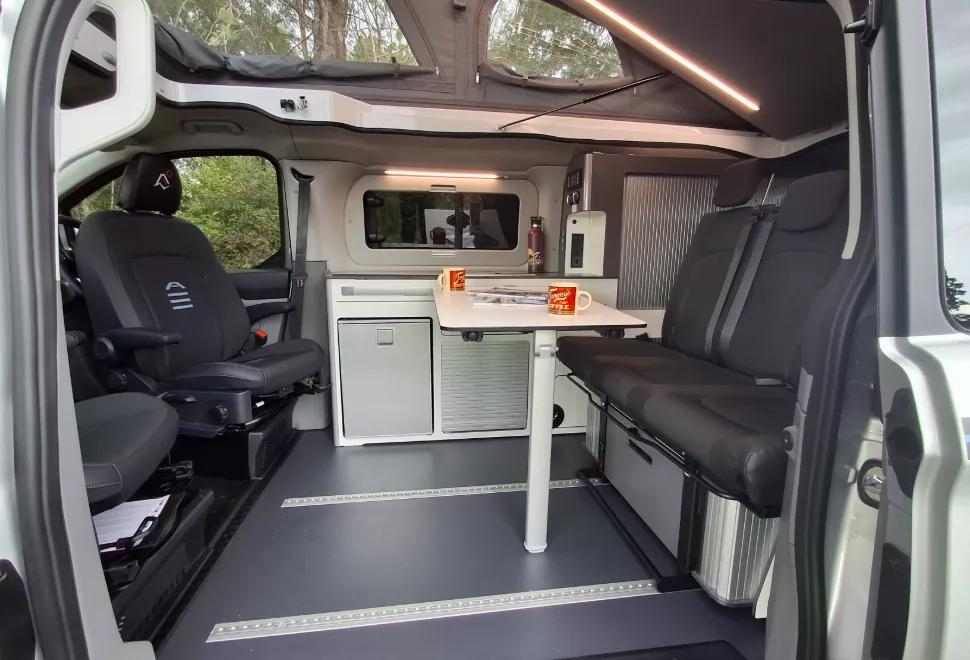
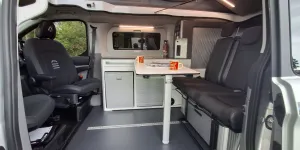
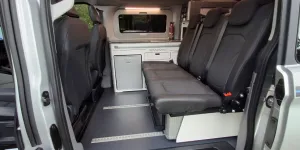
The P10E has the same Mobiframe sliding seat system as the P12, making this comfortably a five-seater campervan (with two Isofix points in the rear). Here, though, you can’t add extra seats as the reduced (465kg) payload is insufficient. What you can do is secure the seat in any position along its floor rails, simply by pushing down the locking bar with your foot. Moved forward, you can bring kiddies closer to parents, while trips to well-known Swedish flatpack furniture stores will be no problem with a load length of up to 1.45m behind the bench.
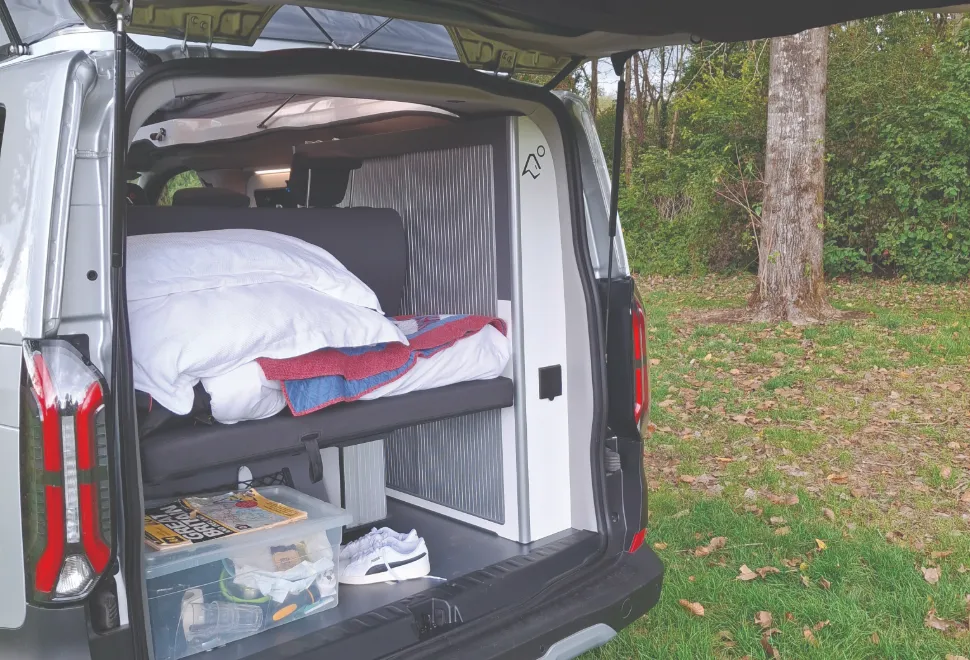
Panama has addressed one criticism of the P12, in which the under-seat space is open into the rear boot, so contents can slide forward unhindered. The new camper has a central drawer beneath the bench and a rather small tambour-doored compartment on each side. It’s definitely an improvement, although there’s still a gap on the offside and the drawer was almost filled by the ladder for the roof bed – we’d simply leave that at home.
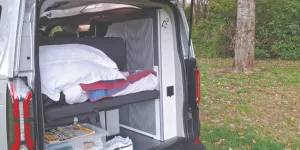
Even with the seat in its usual camping position, there’s still a large boot area with room for wellies, mains lead, etc, at floor level and bedding on the rear section of mattress. The table is now mounted in a zipped pocket on the inside of the tailgate, where there are also downlights and folding hanging rails. An external shower (cold only) is also fitted here.
The elevating roof – from German specialist, SCA – is also inherited from the original Panama model. It offers up to 2.25m of headroom and has a panoramic opening (but flyscreened) section at the front. However, as we’ve repeatedly noted with this pop-top, there’s very limited daylight up top when the weather’s not good enough to fully open it up. It appears better suited to the Costas than the Cotswolds.
Two double beds
Perhaps the best aspect of this rising roof is the upstairs bed, which has a 1.94m by 1.18m mattress mounted on Caraflex 20 plastic springs for comfort. Up top, there are also flexible wand reading lights (with built-in USBs) that can double up when you’re sitting in the swivelled cab chairs.
Down below, the Mobiframe seat is easy to convert into a bed that leaves room to access the fridge, get undressed or use the Porta Potti. It’s a slightly wider bed than in some rival campervans and you sleep on the reverse side to the seating, so it’s completely flat.
All just like the P12, although here you have cassette blinds at all the rear windows, rather than cost-cutting stick-on screens. Silver screens are still used in the cab and there’s still no light over the tailgate (despite previous promises), something sorely missed as you snuggle down with a good book (or MMM) at bedtime.
Ford's Pro Power Onboard
We’ve saved the Panama’s most unusual feature until last and that’s one it gets from the base vehicle – the Ford Pro Power Onboard. This taps into the vehicle’s EV battery via a 2.3kW inverter to give you mains power even when you’re not hooked up. To use it, the vehicle must first be switched on via the start button, the power supply must be selected on the SYNC 4 display and a three-pin socket has to be plugged in (found in a cupboard in the boot). As long as you have the vehicle’s petrol tank at least a quarter full, you can have 230V while camping off-grid.
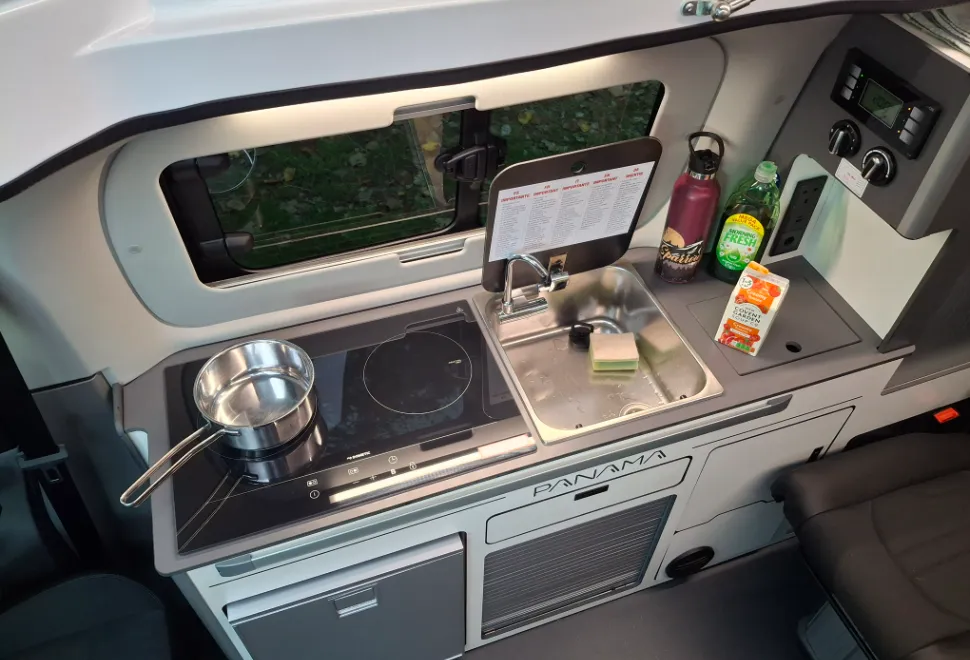
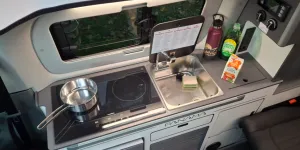
The Pro Power Onboard system is used to power the campervan’s only three-pin socket (in the galley), the induction hob and the 1kW blown-air heater. However, Panama warns against overloading the system and says the heating must be turned down to position one (of three) when you’re cooking. Of course, all these features are also available when hooked up to the mains and, if you arrive with limited (or zero) EV range, they will still function as the petrol engine will kick in to generate the necessary power.
The P10E also has a 100Ah leisure battery (surprisingly, not lithium) to run the compressor fridge, water pump, interior lights and USBs. You’d also expect a solar panel to be fitted as standard but that’s an £899 option (for 200W).
Going gas-free isn’t the only difference with this galley, versus the P12 – it might look similar at first glance but it actually differs in a number of ways. The fridge capacity (42 litres) is carried over and the sink is, once again, fed from an inboard tank. Likewise, there’s a bespoke cupboard for a Porta Potti 335 loo. What’s lacking here is storage for non-perishable food, pots and pans, crockery, etc.
A small drawer provided room for two bowls, two glasses and some cutlery. A tiny top-loading cupboard housed my coffee mugs, some bread rolls and Nespresso pods. That’s all the space there is in the kitchen.
Alongside the back seat is a wardrobe that has neither a hanging rail nor the shelves that it so badly needs. Beyond that, another tambour door (in the boot area) does reveal a tall shelved space (where I kept my pans) but it’s hardly convenient for the cook.

Browse motorhomes for sale
If you're in the market for a motorhome, you need to explore the huge range of motorhomes listed here on Out & About Live! Use the advanced search to filter by budget, berths, manufacturer and much more, then save your favourites to your profile.
Our Verdict
Ford’s plug-in hybrid Tourneo makes a great alternative to diesel campervans and could be cheap to run if you recharge at home, while Panama’s use of the vehicle battery for gas-free cooking and heating is innovative. Sadly, though, the ultra-keen pricing of the diesel-driven P12 is lost with the new hybrid P10E, which makes its lack of storage much harder to overlook.
Disadvantages


