
Rapido 710F (2003)
Image
Key Features
Model Year
2003
Product Class
Low Profile
Product Model Base
Fiat Ducato
Length (m)
5.77
Berths
4
Belted seats
2
Main Layout
Rear Lounge
Full Review
MMM teamster, Mark Brownrigg loved one secondhand ‘van he was testing so much that he bought it! So what is it about the Rapido 710F that was so appealing?
It’s something that comes to most of us as we get older, the feeling that we should maybe downsize to a motorhome that’s easier to drive. After running and loving three Hymer A-class motorhomes, warts and all (theirs, not mine!), I started to get uneasy about taking a biggie onto narrow roads.In fairness, more before the trip than during it, but since we do most of our touring out in wilderness areas, this unease was becoming an issue.
In the course of doing a Secondhand Choice piece for MMM, I stumbled onto exactly what I was looking for – a well-built compact ‘van in pristine condition. On returning home, I opened the door and shouted: “Get packed, we’re going down to see a ‘van,” then dragged the boss – kicking and screaming – the 150-plus miles back down south.
The little six-year-old Rapido 710F was still there, so I pushed her, still protesting, up into it. There was a silence, then she said: “I love this, let’s see if we can do a deal we can afford.” This personal anecdote touches a number of common issues.
First, it’s a huge step down from an A-class into a coachbuilt, which is broadly the size of a long wheelbase panel van; could we adjust to the loss of space? Secondly, the ‘van had done only 4,000 miles in six years and, from the MoTs, had lain idle for most of the last three years: engines are built to be used, would that idleness cause any engine orequipment problems? Thirdly, I was buying from a dealer many miles from home so any warranty work was going to involve a major cost in terms of fuel and inconvenience. Would the long treks be worth it? Only one way to find out...
BEAUTIFUL?
Sure, beauty is only skin deep, but there is an aesthetic element in our liking for any motorhome. It has to appeal to us instantly, giving us that wow factor when first we see it in the dealer’s yard, or when we climb up its step to look inside for the first time. Then it has to keep on appealing through years of ownership. How does the Rapido 710F measure up? Bottom line: it’s a head-turner. We’ve run many guided tours for strangers who knocked on our door.
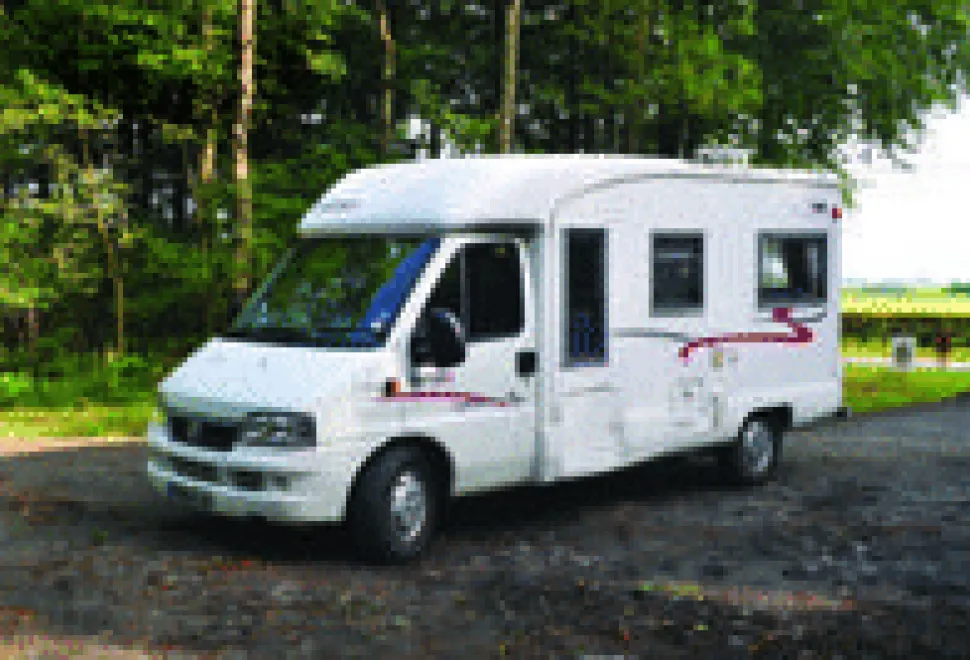
Outside, it is a classy compact ‘van, nice shape, interesting windows, low profile, simple graphics – sleek and feminine. Inside, one of the best-designed layouts you might ever see. It’s a rare beast – a European ‘van with a rear lounge and a forward space that provides a snack or coffee lounge for en route breaks. The front area also converts – providing two bunk beds.
Joinery is good quality, with a wraparound finish and no beading. There’s a neat – amidships – kitchen, while the lounge boasts a solid table, which lowers to help provide the base for a transverse double bed. As we use it, we keep discovering design features, which were years ahead of their time, such as controls that redirect engine heating into the rear lounge – warming it up as you approach a campsite.
It’s a ‘van designed to the very margin of development: all is squeezed into an 5.77m x 2.11m (18ft 11in x 6ft 11in) body. Finally, Rapido build quality is as excellent as the design. We’ve stepped down from Hymer’s A-class and don’t miss a thing.
A CLOSER LOOK
Fiat’s 2.8-litre engine is designed to pull heavier ‘vans than this small Rapido. Surely one of the best commercial vehicle engines Fiat ever made, it should travel many times round the world, and provides effortless power for any driving demands.
The cab seats are comfortable on the longest journey and both swivel round to help make the coffee lounge. Two side seats here (which convert into the bottom bunk with the help of the coffee table top), are equally comfortable. In fact, I often retreat to these – working on my laptop while the boss is watching TV in the lounge.
The offside-located kitchen is beautifully finished, with strip lighting and extractor fan above hob and sink. The 80-litre fridge has ‘elastic’ sides – seemingly swallowing everything we put into it. As a typical European ‘van, there’s no oven/grill: you are supposed, of course, to live and cook outside, which is seldom an option with our Scottish midges and weather. We carry a small portable electric oven, and it’s a simple task to sit it on the sink top and cook whatever we want when hooked up.
Opposite the kitchen, there’s a neat washroom and a fair-sized wardrobe. The little room has a corner washbasin, attractive yet spacious storage cupboards, an integral shower (which we never use) and a swivelbowl toilet. All of this in white and rich blue – oh, and there’s a blown-air heating outlet, which means she stays in there for hours...
The rear lounge is compact, but comfortable – the fixed table’s top sliding to either side to give ease of access. Even a big guy like me can pile the cushions against the end wall and get his feet up (at an angle) for a read or a snooze. We installed a flat screen TV on the nearside, which folds out of the way to let the smaller and more intelligent member of the team (or so she says) in and out.
This lounge converts easily into a comfortable double bed (dropping the table top onto wooden runners) then, equally easily, back into the lounge.
MAGGOTS IN THE APPLE?
Beware a ‘van which hasn’t been used – I was luckier than I deserved to be. The first problem, which flared up as we reawakened the big engine and put it to work, was that it appeared to overheat, and we were hundreds of miles from home. This proved to be only a thermostat, which was acting up and a simple Unipart replacement soon had us on the road again.
On the bodywork, we found that the sealant under and across the roof had either crackled or had gone black with mould. After a bit of persuasion, the dealer had a fitter scrape it out and reseal everything as good as new.
Over the winter, the fresh water pump refused to work: an airlock was diagnosed locally, and I was shown how to tap the end of the pump (located under the wardrobe floor) to get the water flowing again. Repeated failures took me south to have the problem properly diagnosed as a slack fitting inside the pump: two twists tighter and was running with enthusiasm again.
You inherit other people’s cunning plans: after eight weeks of frozen snow of the winter, we found both vehicle and leisure batteries completely dead. Replaced the vehicle battery, only to have the same thing almost happen again. The problem was finally diagnosed – a tracker device was discovered, and had been searching for a signal all winter thus draining the vehicle battery, then (through a link) the leisure battery.
It cost me an unnecessary £120 when five minutes’ work could have disconnected it. But it flagged up a related problem: there is a strange power equalisation link between leisure and vehicle batteries. If the leisure battery drains, then it can leave you without enough power to start. Constant monitoring and frequent winter runs are needed, it seems. All this is technology we could do without.
Our only ongoing problem has been with the fridge: it has a separate cooling fan which, when switched to automatic, keeps kicking in at all hours of the day and night, creating a din that made sleep impossible. The dealer replaced the thermostat, which made the problem even worse. Another friendly dealer oiled the bearings (reducing the din) and told us that there’s no need to use the fan unless we are in the summer heat of France. It was one of those issues where the instruction manual proved useless, and nobody in Rapido’s dealerships seemed to know for sure.
SPACE AND DISTANCE
No ‘van is perfect and you can spend a lot of money, discovering this simple truth. If you switch from a large ‘van to a smaller one, you lose a lot of living and storage space. It’s a simple equation. We have adjusted far more easily to the lesser space for humans than to the more limited room for kit. Although more patience is required (from me, she says), we actually like the smaller living space.
Storage-wise, we have to limit what we carry. There are fewer overhead lockers (all a decent size though) and limited underseat storage in the rear. So we have cut our cloth accordingly, and travel light. My main regret is
that there is no space for me to carry a folding cycle – a bulge in the rear panel would mean mounting a cycle rack so high up that I couldn’t lift my bike onto it, so no bike.
Buying miles away from home is always a risk. You need to trust the dealer, because it will cost a mint of money to travel there, only to be told that repairs have to be passed bythe warranty underwriter and it’s probably wear-and-tear, so they don’t give much for your chances. The guarantees that you buy on used ‘vans can be near worthless, because the things which are likely to go wrong are usually excluded. Often, nothing can be done until the ‘invisible’ underwriter agrees for the work to be done. You may have to go home and then travel back again.
We had problems, but by-and-large, the dealer has been helpful. It was the horrendous fuel cost of travelling back and forward (touching £100 a trip), which finally got to us. We chose to abandon our warranty cover, paying for any repairs ourselves at a local dealer. But beware: some dealers refuse to touch a ‘van they haven’t sold you. This is potentially a major problem.
CONCLUSION
We have been lucky. Because of my work as an MMM road tester, I stumbled onto a motorhome that’s proved to be as good as it looked, giving us a lovely compact motorhome, with many nice design features that must have
been ground-breaking in their day.
Our Rapido 710F has galloped out of retirement to start its new life: in just one year we have more than doubled the mileage we inherited, with only the few minor blips described above.
We have adjusted well to the smaller space, but it requires more tolerance from us – well, from me! And we were lucky with a supplying dealer who has – broadly – walked the walk as well as talking the talk. Some, of course, do not.
To read the full motorhome review in PDF format exactly as it appeared in the August 2011 issue of MMM, click here.
If you don't already have Adode Acrobat to be able to open a PDF, download it for free
It’s something that comes to most of us as we get older, the feeling that we should maybe downsize to a motorhome that’s easier to drive. After running and loving three Hymer A-class motorhomes, warts and all (theirs, not mine!), I started to get uneasy about taking a biggie onto narrow roads.In fairness, more before the trip than during it, but since we do most of our touring out in wilderness areas, this unease was becoming an issue.
In the course of doing a Secondhand Choice piece for MMM, I stumbled onto exactly what I was looking for – a well-built compact ‘van in pristine condition. On returning home, I opened the door and shouted: “Get packed, we’re going down to see a ‘van,” then dragged the boss – kicking and screaming – the 150-plus miles back down south.
The little six-year-old Rapido 710F was still there, so I pushed her, still protesting, up into it. There was a silence, then she said: “I love this, let’s see if we can do a deal we can afford.” This personal anecdote touches a number of common issues.
First, it’s a huge step down from an A-class into a coachbuilt, which is broadly the size of a long wheelbase panel van; could we adjust to the loss of space? Secondly, the ‘van had done only 4,000 miles in six years and, from the MoTs, had lain idle for most of the last three years: engines are built to be used, would that idleness cause any engine orequipment problems? Thirdly, I was buying from a dealer many miles from home so any warranty work was going to involve a major cost in terms of fuel and inconvenience. Would the long treks be worth it? Only one way to find out...
BEAUTIFUL?
Sure, beauty is only skin deep, but there is an aesthetic element in our liking for any motorhome. It has to appeal to us instantly, giving us that wow factor when first we see it in the dealer’s yard, or when we climb up its step to look inside for the first time. Then it has to keep on appealing through years of ownership. How does the Rapido 710F measure up? Bottom line: it’s a head-turner. We’ve run many guided tours for strangers who knocked on our door.
Outside, it is a classy compact ‘van, nice shape, interesting windows, low profile, simple graphics – sleek and feminine. Inside, one of the best-designed layouts you might ever see. It’s a rare beast – a European ‘van with a rear lounge and a forward space that provides a snack or coffee lounge for en route breaks. The front area also converts – providing two bunk beds.
Joinery is good quality, with a wraparound finish and no beading. There’s a neat – amidships – kitchen, while the lounge boasts a solid table, which lowers to help provide the base for a transverse double bed. As we use it, we keep discovering design features, which were years ahead of their time, such as controls that redirect engine heating into the rear lounge – warming it up as you approach a campsite.
It’s a ‘van designed to the very margin of development: all is squeezed into an 5.77m x 2.11m (18ft 11in x 6ft 11in) body. Finally, Rapido build quality is as excellent as the design. We’ve stepped down from Hymer’s A-class and don’t miss a thing.
A CLOSER LOOK
Fiat’s 2.8-litre engine is designed to pull heavier ‘vans than this small Rapido. Surely one of the best commercial vehicle engines Fiat ever made, it should travel many times round the world, and provides effortless power for any driving demands.
The cab seats are comfortable on the longest journey and both swivel round to help make the coffee lounge. Two side seats here (which convert into the bottom bunk with the help of the coffee table top), are equally comfortable. In fact, I often retreat to these – working on my laptop while the boss is watching TV in the lounge.
The offside-located kitchen is beautifully finished, with strip lighting and extractor fan above hob and sink. The 80-litre fridge has ‘elastic’ sides – seemingly swallowing everything we put into it. As a typical European ‘van, there’s no oven/grill: you are supposed, of course, to live and cook outside, which is seldom an option with our Scottish midges and weather. We carry a small portable electric oven, and it’s a simple task to sit it on the sink top and cook whatever we want when hooked up.
Opposite the kitchen, there’s a neat washroom and a fair-sized wardrobe. The little room has a corner washbasin, attractive yet spacious storage cupboards, an integral shower (which we never use) and a swivelbowl toilet. All of this in white and rich blue – oh, and there’s a blown-air heating outlet, which means she stays in there for hours...
The rear lounge is compact, but comfortable – the fixed table’s top sliding to either side to give ease of access. Even a big guy like me can pile the cushions against the end wall and get his feet up (at an angle) for a read or a snooze. We installed a flat screen TV on the nearside, which folds out of the way to let the smaller and more intelligent member of the team (or so she says) in and out.
This lounge converts easily into a comfortable double bed (dropping the table top onto wooden runners) then, equally easily, back into the lounge.
MAGGOTS IN THE APPLE?
Beware a ‘van which hasn’t been used – I was luckier than I deserved to be. The first problem, which flared up as we reawakened the big engine and put it to work, was that it appeared to overheat, and we were hundreds of miles from home. This proved to be only a thermostat, which was acting up and a simple Unipart replacement soon had us on the road again.
On the bodywork, we found that the sealant under and across the roof had either crackled or had gone black with mould. After a bit of persuasion, the dealer had a fitter scrape it out and reseal everything as good as new.
Over the winter, the fresh water pump refused to work: an airlock was diagnosed locally, and I was shown how to tap the end of the pump (located under the wardrobe floor) to get the water flowing again. Repeated failures took me south to have the problem properly diagnosed as a slack fitting inside the pump: two twists tighter and was running with enthusiasm again.
You inherit other people’s cunning plans: after eight weeks of frozen snow of the winter, we found both vehicle and leisure batteries completely dead. Replaced the vehicle battery, only to have the same thing almost happen again. The problem was finally diagnosed – a tracker device was discovered, and had been searching for a signal all winter thus draining the vehicle battery, then (through a link) the leisure battery.
It cost me an unnecessary £120 when five minutes’ work could have disconnected it. But it flagged up a related problem: there is a strange power equalisation link between leisure and vehicle batteries. If the leisure battery drains, then it can leave you without enough power to start. Constant monitoring and frequent winter runs are needed, it seems. All this is technology we could do without.
Our only ongoing problem has been with the fridge: it has a separate cooling fan which, when switched to automatic, keeps kicking in at all hours of the day and night, creating a din that made sleep impossible. The dealer replaced the thermostat, which made the problem even worse. Another friendly dealer oiled the bearings (reducing the din) and told us that there’s no need to use the fan unless we are in the summer heat of France. It was one of those issues where the instruction manual proved useless, and nobody in Rapido’s dealerships seemed to know for sure.
SPACE AND DISTANCE
No ‘van is perfect and you can spend a lot of money, discovering this simple truth. If you switch from a large ‘van to a smaller one, you lose a lot of living and storage space. It’s a simple equation. We have adjusted far more easily to the lesser space for humans than to the more limited room for kit. Although more patience is required (from me, she says), we actually like the smaller living space.
Storage-wise, we have to limit what we carry. There are fewer overhead lockers (all a decent size though) and limited underseat storage in the rear. So we have cut our cloth accordingly, and travel light. My main regret is
that there is no space for me to carry a folding cycle – a bulge in the rear panel would mean mounting a cycle rack so high up that I couldn’t lift my bike onto it, so no bike.
Buying miles away from home is always a risk. You need to trust the dealer, because it will cost a mint of money to travel there, only to be told that repairs have to be passed bythe warranty underwriter and it’s probably wear-and-tear, so they don’t give much for your chances. The guarantees that you buy on used ‘vans can be near worthless, because the things which are likely to go wrong are usually excluded. Often, nothing can be done until the ‘invisible’ underwriter agrees for the work to be done. You may have to go home and then travel back again.
We had problems, but by-and-large, the dealer has been helpful. It was the horrendous fuel cost of travelling back and forward (touching £100 a trip), which finally got to us. We chose to abandon our warranty cover, paying for any repairs ourselves at a local dealer. But beware: some dealers refuse to touch a ‘van they haven’t sold you. This is potentially a major problem.
CONCLUSION
We have been lucky. Because of my work as an MMM road tester, I stumbled onto a motorhome that’s proved to be as good as it looked, giving us a lovely compact motorhome, with many nice design features that must have
been ground-breaking in their day.
Our Rapido 710F has galloped out of retirement to start its new life: in just one year we have more than doubled the mileage we inherited, with only the few minor blips described above.
We have adjusted well to the smaller space, but it requires more tolerance from us – well, from me! And we were lucky with a supplying dealer who has – broadly – walked the walk as well as talking the talk. Some, of course, do not.
To read the full motorhome review in PDF format exactly as it appeared in the August 2011 issue of MMM, click here.
If you don't already have Adode Acrobat to be able to open a PDF, download it for free


