
Hobby Van Exclusive 60 KL
Image
Image
Image
Image
Image
Image
Image
Image
Image

Image








Description
Hobby Van Exclusive 60 KL 2012
Key Features
Model Year
2012
Product Class
Low Profile
Product Model Base
Fiat Ducato
Price from (£)
£57586
Length (m)
7.28
Berths
4
Belted seats
4
Main Layout
Bunk Beds
Full Review
With a concealed, fold-down bed and an innovative washroom wall that slides back to create a shower cubicle, this is a low-profile coachbuilt that transforms before your very eyes...
One of the biggest players in the European motorhome and caravan market, Hobby have been building vehicles
in northern Germany for over 40 years now and currently import a range of stylish low-profile and overcab coachbuilts through their extensive network of 25 UK dealers.
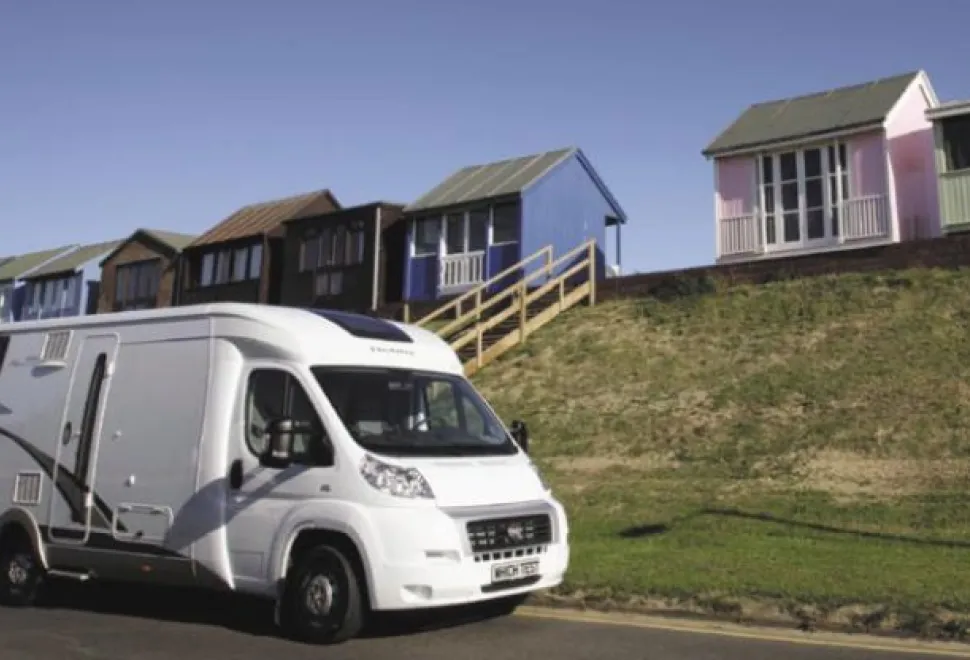
Customers can choose from Ford-based motorhomes – which start at £44,026 – or Fiat Ducato-based models which start at £57,586 for the model we are testing here, the newest addition to the slightly narrower than usual, curved sided, low-profile Van Exclusive range.
The Ford-based models are Hobby’s entry-level coachbuilts (including a rear lounge Siesta developed especially for the UK), with a more basic standard specification. The Fiat-based models come with a high level of standard equipment, including cab air-conditioning and a top-of-the-range Truma Combi 6E gas/electric unit for water
and space heating.
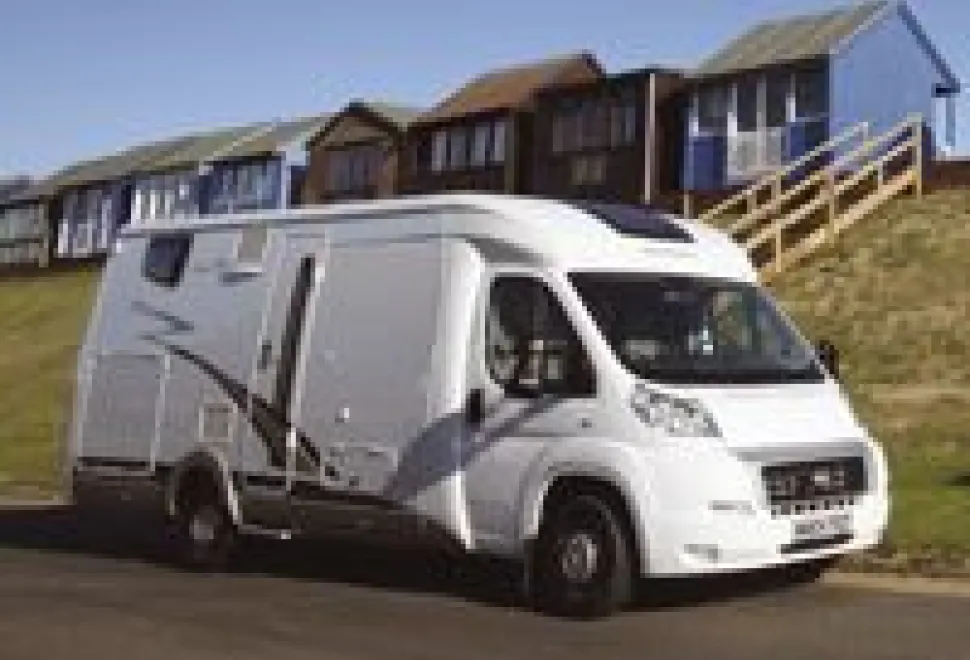
The brand-new 2012 Van Exclusive 60KL is a four-berth, low-profile with twin fixed bunks in the rear offside corner and an innovative double bed in the front, which folds down from the wall to cover the daytime seating area. There’s also a clever washroom in the rear nearside corner, with the washbasin mounted on a sliding wall that pushes forward over the toilet, so that a shower cubicle can be assembled in the space behind it.
BEHIND THE WHEEL
The Hobby’s Fiat Ducato base vehicle was fitted with the latest 2-litre 115bhp Euro V low-emissions motor. This engine – which was very smooth and quiet, with enough power and torque to make driving effortless – is only available with left-hand drive. The six-speed gearbox was also a delight to use, though I had to re-adjust to the left-hand drive layout of the press vehicle.
Rest assured, all of the official UK imports will be right-hand drive (unless you specify otherwise), though the layout in the living space behind the cab will still be the same as Continental examples, with an entrance door on the offside. The entry-level engine for the UK will be the Euro V 2.3-litre Multijet II with 130bhp.
The Hobby’s cab is a nice place to sit, with folding armrests for both driver and passenger seats, plus the ability to set an exact temperature, with a system that uses the standard air-conditioning in warmer months. Official UK imports will also come with a reversing camera and a built-in TomTom sat-nav as standard, so you don’t need to worry about paying for any extra-cost options on the base vehicle.
TAKE YOUR SEATS
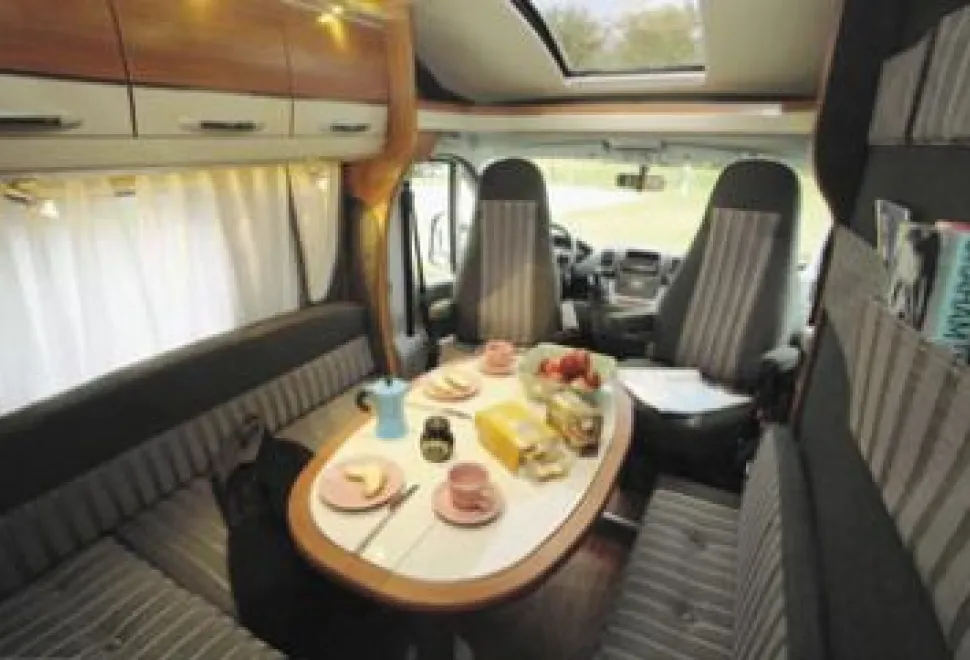
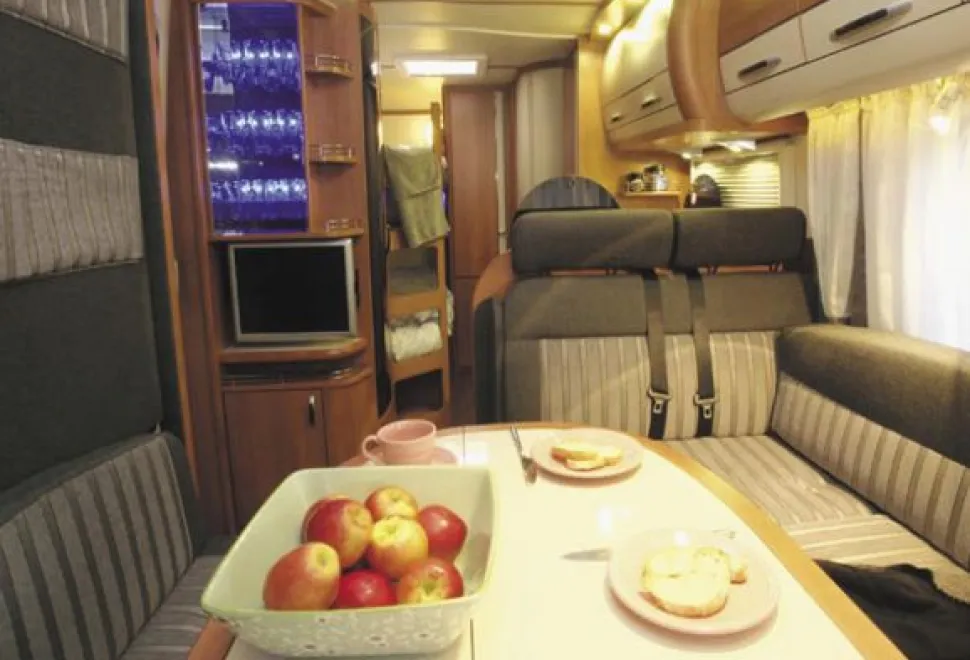
Once pitched-up there’s the option of putting down the standard rear corner steadies for extra stability if you want (I didn’t!), and it was time for me to fully explore the interior. The first thing to do, if you want to maximise the interior space, is swivel the cab seats to face the rear. Once done, you’ve got a lounge or dining area with seating totally surrounding the fixed table in the centre.
On the offside there’s a narrow, low-level bench seat which would be fine for children, or for visiting adults, but which isn’t comfortable for long periods of time. The reason for the low height of this seat will become clear later, when I describe the bed make-up procedure. However, this limited size doesn’t really matter because you’ve still got the swivelled cab seats, plus a large L-shape seating area on the nearside.
A pair of forward-facing seats, which form the smallest part of the ‘L’ in front of the central kitchen, both have three-point seatbelts, so a total of four people can travel in this vehicle, exactly matching its berth capacity (as many of you will know, this isn’t always the case!). When four people are travelling in the vehicle, the section of seating immediately in front of the forward- facing seats can be removed, by taking off the small seat squab and folding back the hinged panels that make up the seat base.
Once on site, it’s easy to put this section of seating back, to complete the L-shape around the table again.
Taking interior photographs for this test, I found myself constantly moving from front to back, wielding the heavy camera tripod, and I was glad that one side of the central table could be folded-down, to increase the passing space. The table is permanently fixed to the floor, so if it wasn’t for this hinged section it would be a real pain to move about. It’s also worth noting that there are a couple of heating outlets for the powerful gas/electric blown-air system in the lounge, so you’ll stay cosy when dining here in winter.
CONTINENTAL CUISINE
Next stop is the kitchen, which occupies the centre of the layout. On the offside there’s a large Dometic ‘Tower’ fridge with removable freezer compartment. On UK imports this will have a gas oven mounted on top of it, as the Germans know how much we like our pies over here! The oven in UK versions should make the kitchen more appealing for buyers over here, though it will be mounted quite high up, making it hard for short cooks to reach comfortably.
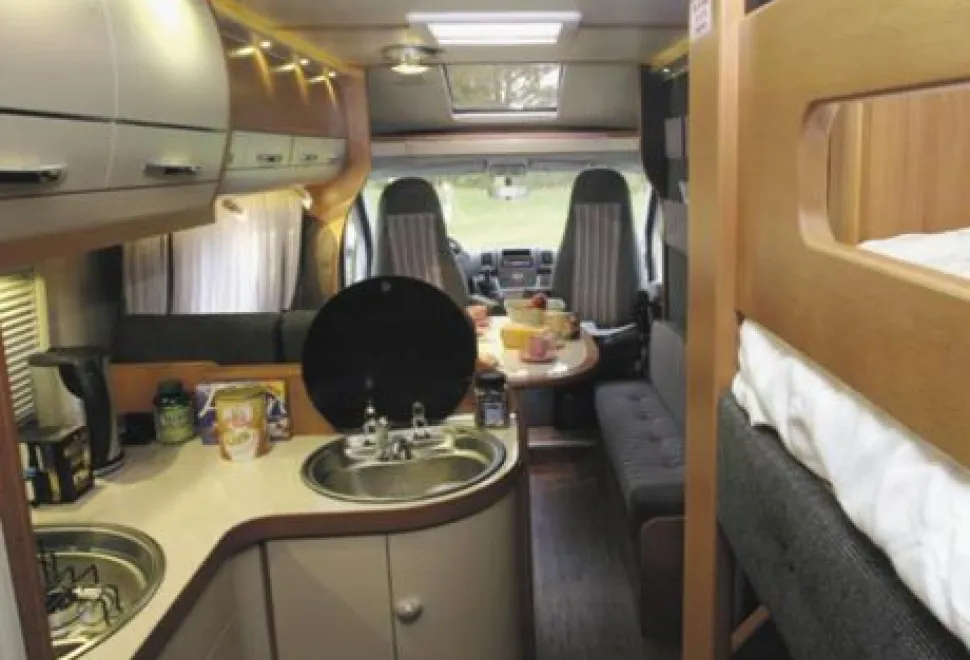
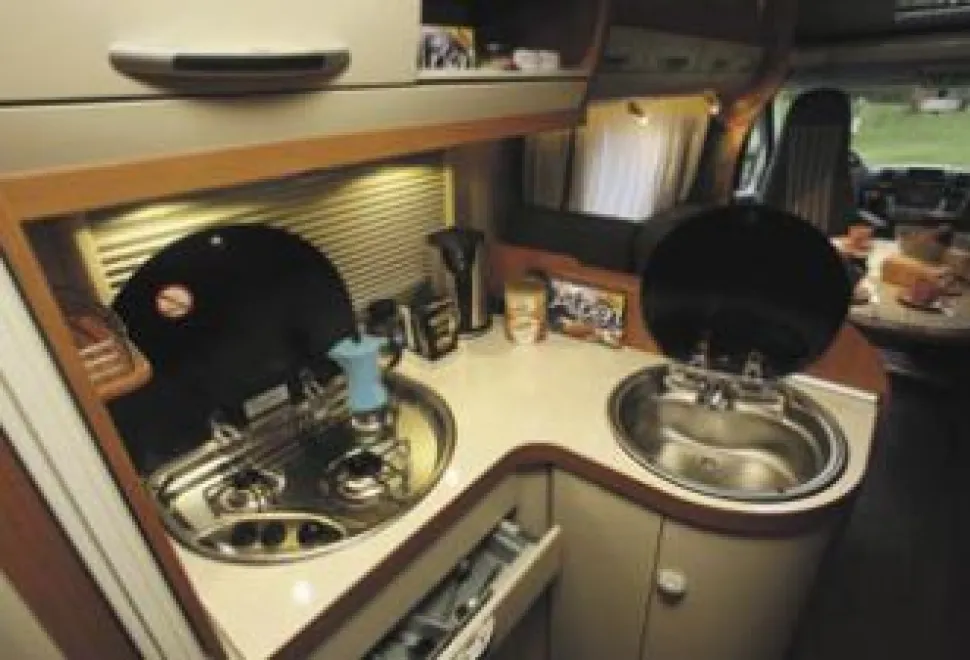
The main kitchen area forms an L-shape on the nearside, with a stainless-steel sink (no drainer) and the already mentioned three-burner gas hob. There’s also quite a lot of storage, in several cupboards and lockers, plus a set of drawers that usefully includes a domestic-sized cutlery drawer – at last! Task lighting is also very good, with a couple of spotlamps under the roof lockers, plus there are two mains sockets here, for your kettle and toaster.
WONDER WASHROOM
Washroom innovation is nothing new, and I remember looking at a classic 1960s Dormobile Debonair conversion on the Bedford CA, where the clever space-saving toilet cubicle folded out from the wall using a series of hinged panels. Of course, we’ve now got the equally clever swing-wall design in Auto-Sleepers’ coachbuilts, which makes the best use of a relatively limited space.
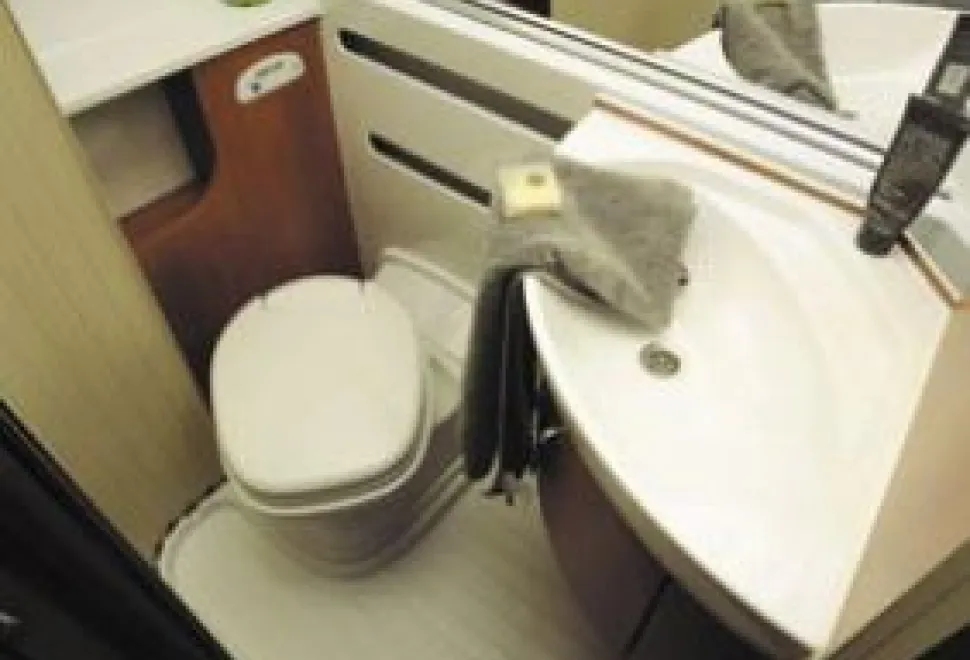
Hobby have invented their own unique solution to this space problem in the ‘smallest room’ and created a sliding-wall washroom, no less! The washbasin and a small cupboard are mounted on a sliding wall, which can be pushed back over the toilet when you want to have a shower. A bit of a shove is needed to start it moving, while holding up a small release lever, but soon you’ll be enjoying the Tarzan-like thrill of moving a whole wall with your bare hands!
With the wall moved out of the way, a series of hinged plastic panels fold out to cover the walls in the space behind it, forming a small shower cubicle. Small is the operative word here, as my wide 6ft 2in frame was tightly squeezed once inside. Apart from the limited space, which should be fine for people who are under 6ft, the shower cubicle looked good. A flexible pull-out hose formed the shower itself (doubling-up as the tap when the basin wall is pushed back into place), but there was nowhere on the wall to mount this at a high level. I would have preferred a simpler washroom design, with a larger permanent shower cubicle, but that would result in less wardrobe space, or design compromises elsewhere.
This is probably a good place to talk about the Hobby’s water system, which is worth a mention because there’s a 92-litre insulated and heated waste tank under the floor, with a large-bore drain pipe to the nearside. This is about as good as it gets on the waste front, so full marks here. The fresh water tank is a 100-litre unit, situated inboard under the dinette seating, so this again is suitable for all-year use.
STORAGE SOLUTIONS
Before talking about the Hobby’s star feature, its fold-down wall bed, it’s worth mentioning the storage options in this mid-sized coachbuilt. The star feature here is the large external locker door, which opens onto the rear bunk area. If you want to store large items, the lower bunk hinges up, to provide a tall ‘garage’. With the lower bunk left in place, there’s still good storage for items such as deckchairs.
The other storage areas are pretty good too. There are two wardrobes, one at the rear (with a series of shelves) and one next to the kitchen (with hanging space as well as a shelf). Add in plenty of roof lockers, plus an illuminated drinks cabinet that boasts an array of Hobby-branded glasses (yes, real glass!) and the total storage capacity is pretty good.
Incidentally, the payload limit is 373kg, which is probably about average for a coachbuilt of this size, but may be rather tight for family use. Investigate the 4-tonne chassis upgrade if your licence allows you to drive a vehicle of over 3500kg.
AND SO, TO BED
Time for the Hobby’s party trick, in the form of its unique fold-down double bed. Now, we’ve all seen motorhomes with lowering double beds, originally in A-class ‘vans, but more recently in a myriad of Bürstner-copying low-profiles. A fold-down wall bed is something of a novelty, though. One of the main problems to overcome is how to get such a bed to hinge down across the whole vehicle. For instance, if it was hinged half-way up the wall, then you’d only get half a bed. If it was hinged from the bottom of the wall, you’d get a bed that folded down to floor level, with no room for any other furniture.
So, what did Hobby do to get round these problems? Well, they’ve designed an electronically-controlled mechanism that slides the bed away from the wall, while it is still in the upright position. Once you have activated this, the next step is to manually lower it (because it has slid away from the wall slightly there’s a cantilever effect as the rear of the bed lifts up). Cleverly, while you are lowering the bed, the fixed table, which has a hydraulically-operated base, lowers down towards the floor at the same speed as the bed folding down from the wall.
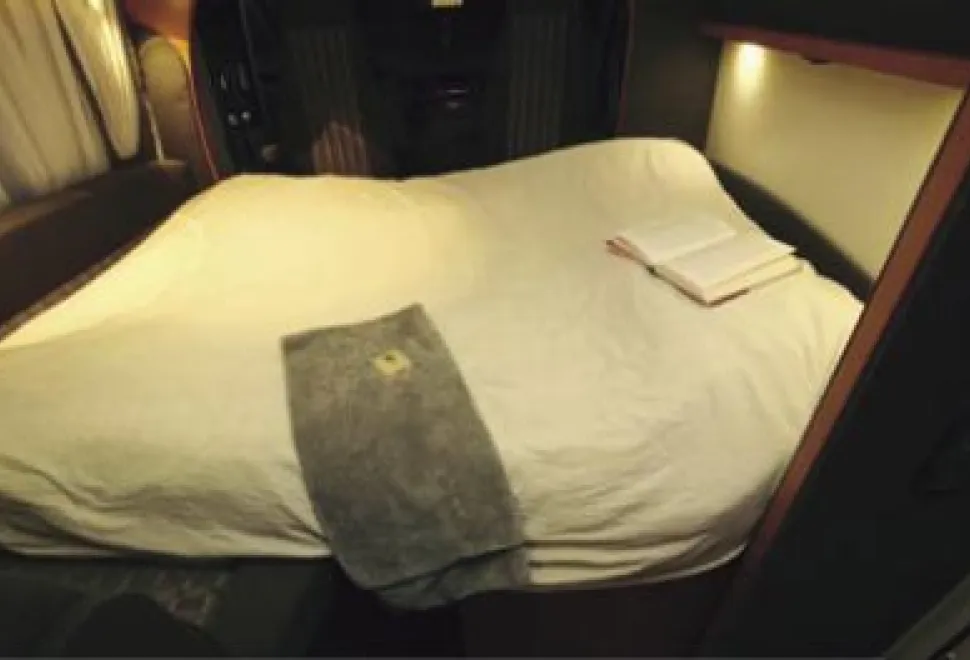
Still with me? The double bed base finally hits ‘land’ on the other side of the aisle, where it sits above the nearside settee squab. With an infill cushion put in place at the foot of the bed, you’ve got a large double that’s about two metres long. It’s a really comfortable bed and it only takes a few moments to set it up, so full marks to Hobby. It seems a bit complex, but it’s probably easier than a lowering roof bed, especially a manually operated one. And it is easier to access as it comes down nice and low.
You’ll also see why the offside settee has to be so low to the ground, because the bed lowers over the top of it. The back of the bed also has a magazine or book rack made out of cloth pockets, which creates a small library against the offside wall, when the bed is stowed. Keep the magazines or books in place when you lower the bed and you’ll literally go to bed with a book – a novel experience!
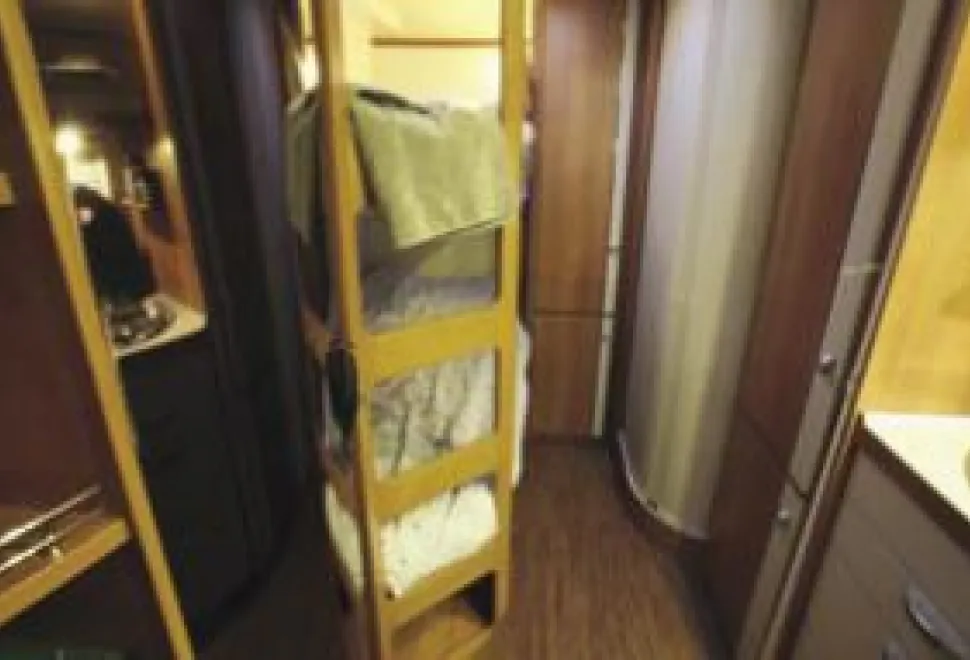
As well as this double bed, the Hobby boasts two bunks at the rear, both of which are large and very comfortable. In fact, all 6ft 2in of me slept in the lower bunk and had a great night’s sleep. Children would love it here, especially as they each get their own wall lamp with a teddy bear design on it!
ADDED VERSATILITY
I enjoyed my week with the Hobby. It has some interesting innovations which, by and large, work very well. The fold-down bed is a better idea than the sliding-wall washroom, since the shower cubicle is a bit too small.
The twin bunks mean that it’s targeted more at families than couples, but if you occasionally take the grandkids away with you, then you’ll love the flexibility offered by this layout. When the kids are not with you, you can fold up the lower bunk and have a garage instead.
To read the full motorhome review in PDF format exactly as it appeared in the December 2011 issue of Which Motorhome, click here.
If you don't already have Adode Acrobat to be able to open a PDF, download it for free
One of the biggest players in the European motorhome and caravan market, Hobby have been building vehicles
in northern Germany for over 40 years now and currently import a range of stylish low-profile and overcab coachbuilts through their extensive network of 25 UK dealers.
Customers can choose from Ford-based motorhomes – which start at £44,026 – or Fiat Ducato-based models which start at £57,586 for the model we are testing here, the newest addition to the slightly narrower than usual, curved sided, low-profile Van Exclusive range.
The Ford-based models are Hobby’s entry-level coachbuilts (including a rear lounge Siesta developed especially for the UK), with a more basic standard specification. The Fiat-based models come with a high level of standard equipment, including cab air-conditioning and a top-of-the-range Truma Combi 6E gas/electric unit for water
and space heating.
The brand-new 2012 Van Exclusive 60KL is a four-berth, low-profile with twin fixed bunks in the rear offside corner and an innovative double bed in the front, which folds down from the wall to cover the daytime seating area. There’s also a clever washroom in the rear nearside corner, with the washbasin mounted on a sliding wall that pushes forward over the toilet, so that a shower cubicle can be assembled in the space behind it.
BEHIND THE WHEEL
The Hobby’s Fiat Ducato base vehicle was fitted with the latest 2-litre 115bhp Euro V low-emissions motor. This engine – which was very smooth and quiet, with enough power and torque to make driving effortless – is only available with left-hand drive. The six-speed gearbox was also a delight to use, though I had to re-adjust to the left-hand drive layout of the press vehicle.
Rest assured, all of the official UK imports will be right-hand drive (unless you specify otherwise), though the layout in the living space behind the cab will still be the same as Continental examples, with an entrance door on the offside. The entry-level engine for the UK will be the Euro V 2.3-litre Multijet II with 130bhp.
The Hobby’s cab is a nice place to sit, with folding armrests for both driver and passenger seats, plus the ability to set an exact temperature, with a system that uses the standard air-conditioning in warmer months. Official UK imports will also come with a reversing camera and a built-in TomTom sat-nav as standard, so you don’t need to worry about paying for any extra-cost options on the base vehicle.
TAKE YOUR SEATS
Once pitched-up there’s the option of putting down the standard rear corner steadies for extra stability if you want (I didn’t!), and it was time for me to fully explore the interior. The first thing to do, if you want to maximise the interior space, is swivel the cab seats to face the rear. Once done, you’ve got a lounge or dining area with seating totally surrounding the fixed table in the centre.
On the offside there’s a narrow, low-level bench seat which would be fine for children, or for visiting adults, but which isn’t comfortable for long periods of time. The reason for the low height of this seat will become clear later, when I describe the bed make-up procedure. However, this limited size doesn’t really matter because you’ve still got the swivelled cab seats, plus a large L-shape seating area on the nearside.
A pair of forward-facing seats, which form the smallest part of the ‘L’ in front of the central kitchen, both have three-point seatbelts, so a total of four people can travel in this vehicle, exactly matching its berth capacity (as many of you will know, this isn’t always the case!). When four people are travelling in the vehicle, the section of seating immediately in front of the forward- facing seats can be removed, by taking off the small seat squab and folding back the hinged panels that make up the seat base.
Once on site, it’s easy to put this section of seating back, to complete the L-shape around the table again.
Taking interior photographs for this test, I found myself constantly moving from front to back, wielding the heavy camera tripod, and I was glad that one side of the central table could be folded-down, to increase the passing space. The table is permanently fixed to the floor, so if it wasn’t for this hinged section it would be a real pain to move about. It’s also worth noting that there are a couple of heating outlets for the powerful gas/electric blown-air system in the lounge, so you’ll stay cosy when dining here in winter.
CONTINENTAL CUISINE
Next stop is the kitchen, which occupies the centre of the layout. On the offside there’s a large Dometic ‘Tower’ fridge with removable freezer compartment. On UK imports this will have a gas oven mounted on top of it, as the Germans know how much we like our pies over here! The oven in UK versions should make the kitchen more appealing for buyers over here, though it will be mounted quite high up, making it hard for short cooks to reach comfortably.
The main kitchen area forms an L-shape on the nearside, with a stainless-steel sink (no drainer) and the already mentioned three-burner gas hob. There’s also quite a lot of storage, in several cupboards and lockers, plus a set of drawers that usefully includes a domestic-sized cutlery drawer – at last! Task lighting is also very good, with a couple of spotlamps under the roof lockers, plus there are two mains sockets here, for your kettle and toaster.
WONDER WASHROOM
Washroom innovation is nothing new, and I remember looking at a classic 1960s Dormobile Debonair conversion on the Bedford CA, where the clever space-saving toilet cubicle folded out from the wall using a series of hinged panels. Of course, we’ve now got the equally clever swing-wall design in Auto-Sleepers’ coachbuilts, which makes the best use of a relatively limited space.
Hobby have invented their own unique solution to this space problem in the ‘smallest room’ and created a sliding-wall washroom, no less! The washbasin and a small cupboard are mounted on a sliding wall, which can be pushed back over the toilet when you want to have a shower. A bit of a shove is needed to start it moving, while holding up a small release lever, but soon you’ll be enjoying the Tarzan-like thrill of moving a whole wall with your bare hands!
With the wall moved out of the way, a series of hinged plastic panels fold out to cover the walls in the space behind it, forming a small shower cubicle. Small is the operative word here, as my wide 6ft 2in frame was tightly squeezed once inside. Apart from the limited space, which should be fine for people who are under 6ft, the shower cubicle looked good. A flexible pull-out hose formed the shower itself (doubling-up as the tap when the basin wall is pushed back into place), but there was nowhere on the wall to mount this at a high level. I would have preferred a simpler washroom design, with a larger permanent shower cubicle, but that would result in less wardrobe space, or design compromises elsewhere.
This is probably a good place to talk about the Hobby’s water system, which is worth a mention because there’s a 92-litre insulated and heated waste tank under the floor, with a large-bore drain pipe to the nearside. This is about as good as it gets on the waste front, so full marks here. The fresh water tank is a 100-litre unit, situated inboard under the dinette seating, so this again is suitable for all-year use.
STORAGE SOLUTIONS
Before talking about the Hobby’s star feature, its fold-down wall bed, it’s worth mentioning the storage options in this mid-sized coachbuilt. The star feature here is the large external locker door, which opens onto the rear bunk area. If you want to store large items, the lower bunk hinges up, to provide a tall ‘garage’. With the lower bunk left in place, there’s still good storage for items such as deckchairs.
The other storage areas are pretty good too. There are two wardrobes, one at the rear (with a series of shelves) and one next to the kitchen (with hanging space as well as a shelf). Add in plenty of roof lockers, plus an illuminated drinks cabinet that boasts an array of Hobby-branded glasses (yes, real glass!) and the total storage capacity is pretty good.
Incidentally, the payload limit is 373kg, which is probably about average for a coachbuilt of this size, but may be rather tight for family use. Investigate the 4-tonne chassis upgrade if your licence allows you to drive a vehicle of over 3500kg.
AND SO, TO BED
Time for the Hobby’s party trick, in the form of its unique fold-down double bed. Now, we’ve all seen motorhomes with lowering double beds, originally in A-class ‘vans, but more recently in a myriad of Bürstner-copying low-profiles. A fold-down wall bed is something of a novelty, though. One of the main problems to overcome is how to get such a bed to hinge down across the whole vehicle. For instance, if it was hinged half-way up the wall, then you’d only get half a bed. If it was hinged from the bottom of the wall, you’d get a bed that folded down to floor level, with no room for any other furniture.
So, what did Hobby do to get round these problems? Well, they’ve designed an electronically-controlled mechanism that slides the bed away from the wall, while it is still in the upright position. Once you have activated this, the next step is to manually lower it (because it has slid away from the wall slightly there’s a cantilever effect as the rear of the bed lifts up). Cleverly, while you are lowering the bed, the fixed table, which has a hydraulically-operated base, lowers down towards the floor at the same speed as the bed folding down from the wall.
Still with me? The double bed base finally hits ‘land’ on the other side of the aisle, where it sits above the nearside settee squab. With an infill cushion put in place at the foot of the bed, you’ve got a large double that’s about two metres long. It’s a really comfortable bed and it only takes a few moments to set it up, so full marks to Hobby. It seems a bit complex, but it’s probably easier than a lowering roof bed, especially a manually operated one. And it is easier to access as it comes down nice and low.
You’ll also see why the offside settee has to be so low to the ground, because the bed lowers over the top of it. The back of the bed also has a magazine or book rack made out of cloth pockets, which creates a small library against the offside wall, when the bed is stowed. Keep the magazines or books in place when you lower the bed and you’ll literally go to bed with a book – a novel experience!
As well as this double bed, the Hobby boasts two bunks at the rear, both of which are large and very comfortable. In fact, all 6ft 2in of me slept in the lower bunk and had a great night’s sleep. Children would love it here, especially as they each get their own wall lamp with a teddy bear design on it!
ADDED VERSATILITY
I enjoyed my week with the Hobby. It has some interesting innovations which, by and large, work very well. The fold-down bed is a better idea than the sliding-wall washroom, since the shower cubicle is a bit too small.
The twin bunks mean that it’s targeted more at families than couples, but if you occasionally take the grandkids away with you, then you’ll love the flexibility offered by this layout. When the kids are not with you, you can fold up the lower bunk and have a garage instead.
To read the full motorhome review in PDF format exactly as it appeared in the December 2011 issue of Which Motorhome, click here.
If you don't already have Adode Acrobat to be able to open a PDF, download it for free
Our Verdict
Clever hinged double bed layout and innovative sliding washroom, but low payload may limit its appeal as a family motorhome.
Advantages
Novel hinged double bed works wells
Adult sized rear bunk beds
Standard-fit air-conditioning
Top-of-the-range Truma Combi 6E heating
Disadvantages
Payload is limited to 373kg without chassis upgrade
Sliding shower is a bit of a gimmick and too small


