
Bentley Cobalt (2011)
Image
Image
Image
Image
Image

Description
2011 Bentley Cobalt
Key Features
Model Year
2011
Product Class
Low Profile
Product Model Base
Renault Trafic
Price from (£)
£44165
Length (m)
6.20
Berths
2
Main Layout
Front Lounge
Full Review
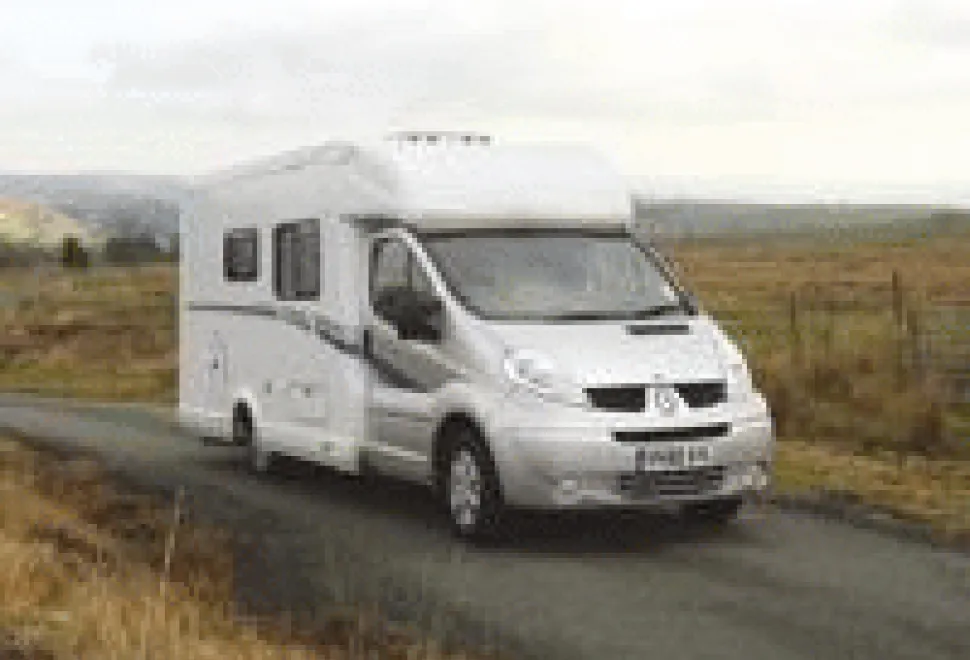
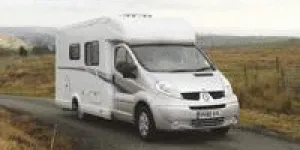
With the new Bentley Artisan range, Renault’s Trafic cab is mated to a low-profile coachbuilt body that’s narrower than most. Keen to see how well this combination works, we put the new Cobalt model through its paces in the Peak District.
Back in the December 2010 issue of Which Motorhome, we had a First Sight test of the new Bentley Ochre prototype, a narrow-bodied coachbuilt based on the Renault Trafic. This model is part of a three-vehicle range introduced by this new company; the other two are the Indigo and Cobalt.
This month we’ve finally – and exclusively! – got our hands on a production vehicle, in the form of the Bentley Cobalt, giving us a chance to really put this new range, and manufacturer, to the test.
The people behind the new Bentley Motorhomes company will be well known to owners of older Autocruise motorhomes, since father and son team Gordon and Richard Bentley used to work for Autocruise, before the Swift Group took over this South Yorkshire-based firm. Gordon and Richard set up Bentley Motorhomes with some financial backing from John Cockburn, who worked with them at Autocruise, so between them they’ve certainly got enough experience of building motorhomes.
I picked up the Cobalt from the company’s factory in Swinton, near Sheffield, and was given a detailed handover and tour of the factory by Richard. He gave me some background on the new models, explaining, "We called the new range Artisan because it has been crafted by our experienced master-craftsmen. Our main focus with these new Renault Trafic-based models is to provide all the quality and luxury of a coachbuilt motorhome, but within a bodyshell that’s practically the same size as many large van conversions. This makes them easy to manoeuvre and park, with a more car-like driving experience than some larger coachbuilts."
JOINING THE TRAFIC
My destination for a week-long test of the Cobalt was the Derbyshire Peak District, so having driven through the outskirts of Sheffield, I was soon motoring in some of the country’s most beautiful scenery. With twisty, hilly, and often poorly surfaced roads, the Peak District is a good test of any motorhome chassis. The Trafic’s cab has you sitting slightly lower than in a Peugeot Boxer or Fiat Ducato, so it’s slightly easier to get in and out of. Like the Peugeot and Fiat, it has an easy-to-reach dash-mounted gearlever, with precise gearchanges.
The engine is a 115bhp, 2-litre dCi and this provided plenty of power, with only the steepest of Peak District hills forcing me to change down to third gear, on the six-speed gearbox. At all speeds, the engine noise in the cab is fairly subdued, adding to the car- like feel of driving this vehicle. You feel like you’re driving a large MPV, rather than a coachbuilt motorhome.
The Cobalt is based on a platform-cab Trafic, not a chassis-cab like most other coachbuilts. This means that the steel floor panel remains above the chassis members at the rear, so in effect it’s like a panel van with the steel walls and roof removed. Bentley Motorhomes also strengthen this platform with some extra steel along the sill areas. The end result is a very solid chassis and I noticed very little flex or creaking in the coachbuilt bodywork when driving along the challenging Derbyshire lanes.
Richard explained that it’s harder to build a coachbuilt on a platform chassis, since holes have to be drilled through the steel floor for fitting wiring and pipework. However, it’s probably worth the extra effort if it makes for a more rigid motorhome.
Standard specification includes built-in TomTom sat-nav, Bluetooth for mobile phone connection, and both driver and passenger airbags. I used the sat-nav system a lot during my test period and found it easy to work with, though I never worked out how to turn it off while still having the radio on, so I got used to Ken Bruce being interrupted by a nagging voice urging me to ‘turn around when possible!’ The company also markets an Elite Pack (for an extra £1224), which adds cab air-conditioning, a colour-coded front bumper,front foglights, plus electric windows and door mirrors. This was fitted to our test vehicle, though the air-con didn’t see much use during November in the Peak District!
One final point on the cab – the door mirrors look like standard Trafic panel van mirrors and not the extended mirrors fitted to most coachbuilt motorhomes. While it’s true that the Cobalt’s coachbuilt body isn’t much wider than the cab, those few inches still reduce rear visibility somewhat, so extended mirrors would have been a useful upgrade. However, speaking to Gordon Bentley back in the factory after the test, he told me that they will be extending the length of these existing Renault mirrors on future models, so rear view vision should then be improved.
PITCHING UP
The campsite I chose for the week wasn’t actually in Derbyshire, but was the Caravan Club’s Blackshaw Moor site near Leek in Staffordshire, just on the south-western edge of the Peak District. Having chatted to the friendly wardens, I found a vacant pitch and set about hooking-up to electrics and activating all the appliances.
One of the innovations that the team at Bentley are most proud of is their new ‘EOS’ energy management system. The company’s unique electrical control panel by the entrance door is used to activate the electrics once you’re hooked up, including the lighting circuits and water pump.
Its star feature, however, is the ability to tell you exactly how much battery time you have left. This is so precise that you can turn off one of the lights, or another electrical component, then watch the ‘time left’ figure increase on the digital display. This would be a great bonus if you’re ‘wild camping’ but, once hooked-up on site, the display is happy to inform you that you’ve got enough power ‘forever’!
Other features of this system include the ability to switch power sources for engine starting, if the engine battery is flat, plus a warning system if your electrical polarity on hook-up is the wrong way round. My only niggle with the control panel is that it isn’t very well lit, with the nearest light being opposite, in the kitchen area. At night, it is quite hard to see which button to press. When I returned the ’van I spoke to the company about this and they are going to look into a way of sorting out this issue.
While on the subject of electrics, Bentley Motorhomes have fitted a modern 12V electrical system which doesn’t use fuses. Instead, the system will cut-out, then automatically re-start, when you have fitted the new light, or whatever else caused it to trip. This clever box of tricks is fitted at the base of a small storage box behind the passenger cab seat.
The mains RCD unit is fitted under the driver’s seat, which you have to slide forward to gain access to it. I guess this is easier than unloading everything out of an under-seat locker to gain access to it, but it’s still not the most accessible of positions. Just behind the seat, another storage box houses the 115Ah leisure battery, which is a sealed-for-life unit.
TIME FOR A CUPPA
Is it just me, or is that first cup of tea also the main priority for other people once hooked-up on site? Getting the kettle on, be it electric or gas-powered, is the sign that everything’s ship-shape... the gas is turned on and the hook-up is properly connected!
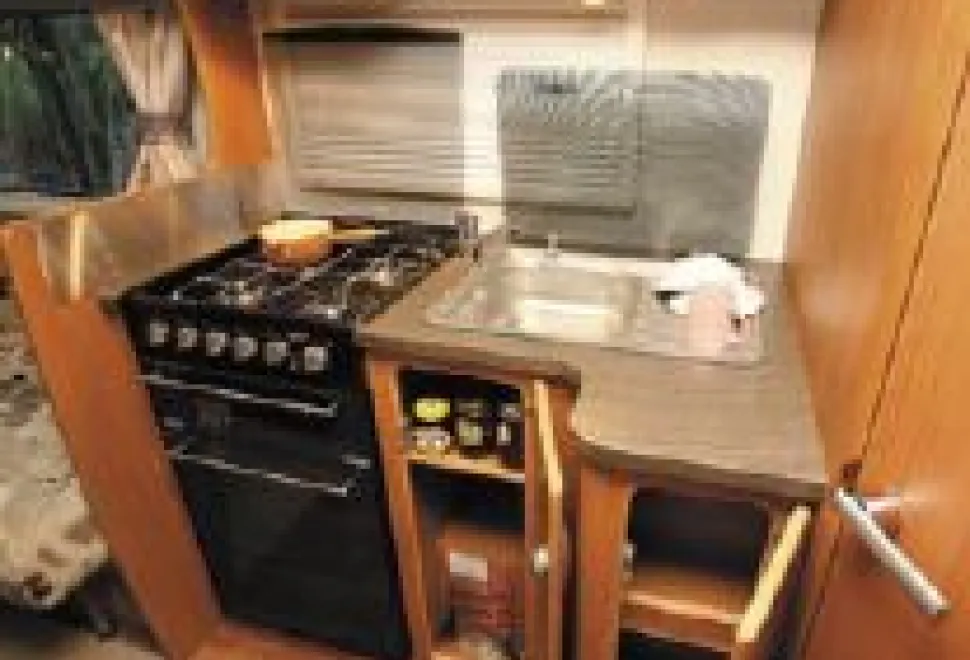
For those using gas burner ‘whistling’ kettles, Bentley Motorhomes have opted for a fairly upmarket kitchen, with a domestic-style Thetford Caprice cooker that includes a separate oven and grill, plus a three-burner gas hob with one electric plate. There’s also a stainless-steel sink with built-in drainer, plus a hinged glass cover. This is fed by a large chrome-effect mixer tap, and I found this combination fine for my washing-up needs. The current trend is for removable plastic draining boards, but with a combined sink and drainer at least you don’t have to worry so much about splashing water over the worktop.
The kitchen also features a Dometic extractor fan above the hob, with a couple of storage lockers above it. Further down, there are a couple of deep storage cupboards. Kitchen storage space under the sink is only limited by the fact that the gas bottle locker, with its door in the exterior wall on the offside, is also fitted in this space.
One good design feature is the fact that the fridge, cooker and gas bottle locker are all fitted in the centre of the vehicle, above the rear axle, making for good weight distribution.
The washroom at the rear has a Dometic toilet that doesn’t need its own fresh water tank (instead using water pumped from the main tank) so this also reduces weight at the rear of the vehicle, helping to make for better roadholding. Going back to the kettle for a minute, if – like me – you use an electric kettle, the only place for it is on a small area of worktop to the rear of the wardrobe, by the entrance door. Here, a double mains socket allows you to plug in the kettle and perhaps a toaster as well. It works fine, but having a hot kettle close to the entrance door might not be the safest idea, especially if kids are visiting you on site. However, there are no mains sockets in the main kitchen area on the offside.
TABLE MANNERS
Bentley are one of the first manufacturers to get their hands on a new design of freestanding dining table. It sits in its own locker above the cab, where it has to be lifted down for use. So, what’s unique about it? Well, it has a pair of legs that use a novel folding mechanism, allowing them to fold in half in the middle, then fold away on their own side, under the table top.
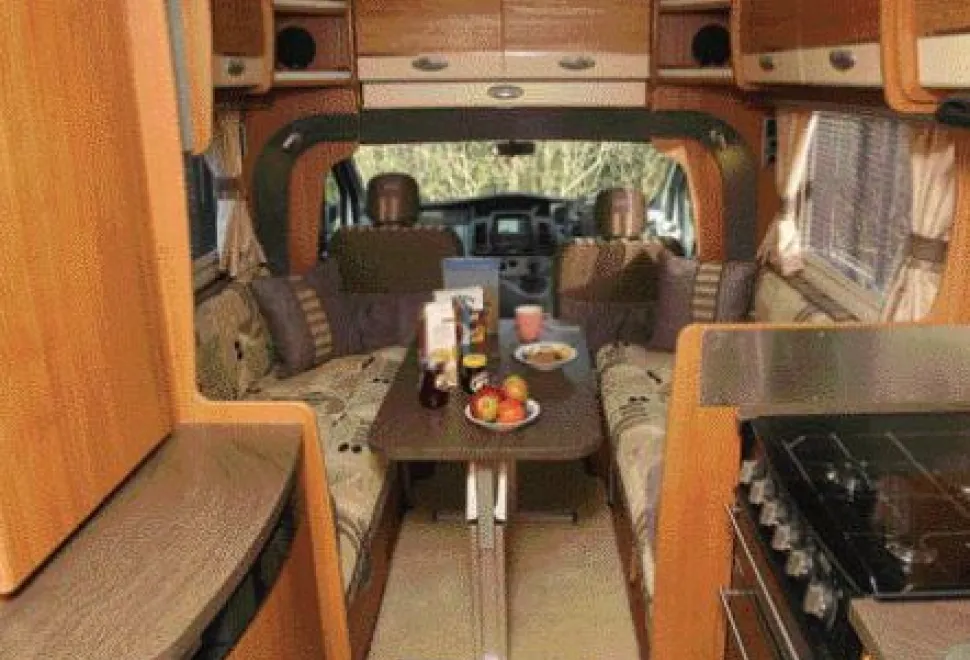
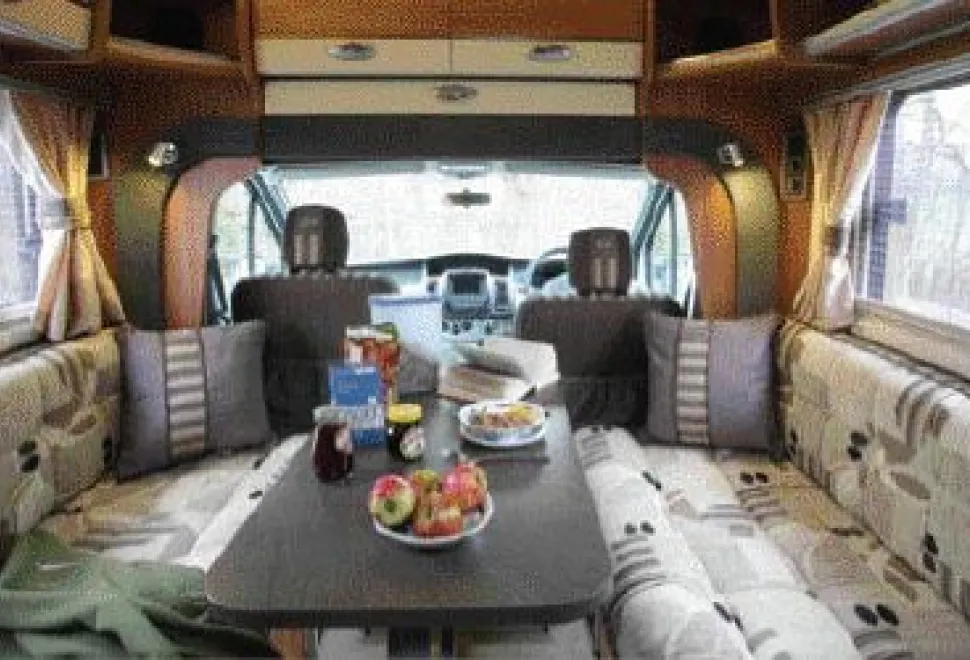
So, unlike the legs on traditional folding-leg tables, they don’t overlap each other, making for an uneven base to the folded table. Instead, they make a flat base to the folded table, which can then be stored in a much shallower locker. There’s definitely a knack in folding the legs back properly, but, once mastered, you’ll enjoy stowing away your flattened table. In use, the table sits between the inward-facing settees at the front of the Cobalt, allowing plenty of space for four or more to dine, although the vehicle will only sleep two people and has travelling seats for just two.
LOUNGING AROUND
With dinner over, it’s a simple matter to stow the table away and then you can relax on the settees. Two scatter cushions and a pair of bolsters allow you to sit back and use these settees like a chaise longue, but the cab seats are not mounted on swivel bases, so you can’t lounge in these. The vehicle retains the Renault’s existing cab roof, so headroom would be limited even if the cab seats did swivel. In fact, I hit my head a few times moving from the living space to the cab, so low is the cab roof. It’s something you get used to and learn to avoid – after a few initial bangs!
Lighting in the Cobalt is all LEDs, with no halogens or fluorescents, making it very efficient on power. Fittings include a pair of LED spotlamps in the lounge/diner, plus some stylish strip fittings above the roof lockers. Add in the rooflights above the kitchen and lounge, for daytime illumination, and you’ve got a lounge that’s always well-lit and comfortable to relax in.
It was a cold November when I visited the Peak District, but the gas/electric Truma heating system, which I used on mains hook-up power, kept the vehicle warm and toasty, with a couple of blown-air outlets in the lounge area and one in the rear washroom.
When it comes to on-site entertainment, there’s a mains socket under the offside settee, which I used to plug in my laptop computer when writing my test notes. If you prefer to watch telly, a flatscreen TV, which folds down from its own storage cupboard by the wardrobe, is an extra. If you don’t opt for this, you’ll still get the cupboard and bracket, so you can fit your own TV. In use, the television is well positioned for a couple of people sitting in the lounge/dinette to view the screen, plus a couple of speakers are already built-in to the wall above the cab.
POWDERING YOUR NOSE
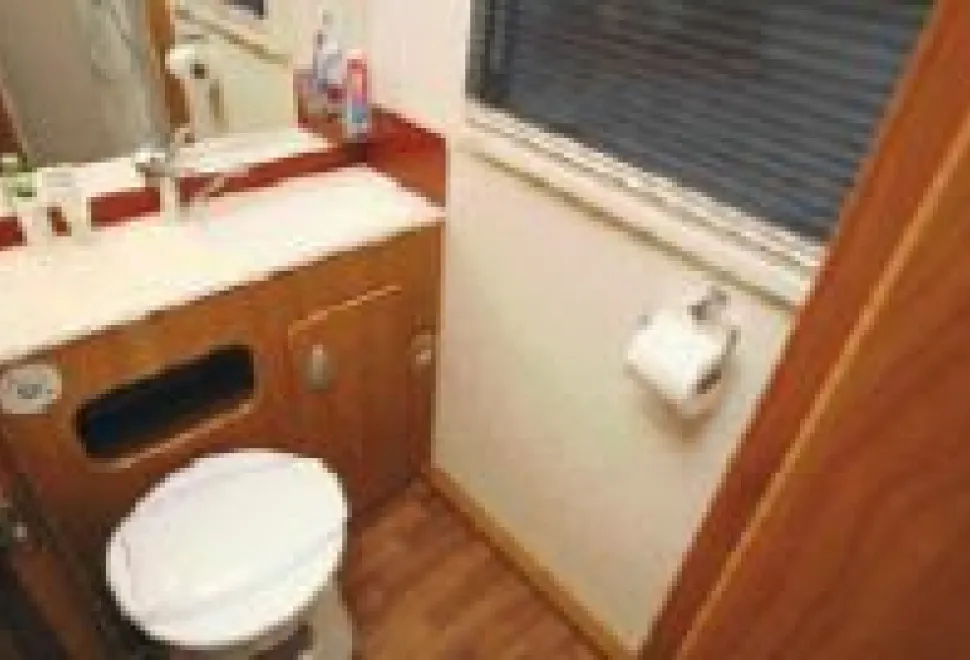
The Cobalt’s star feature it its luxurious end-washroom, which makes it a great ’van for those who don’t like to use on-sites facilities. It’s fitted with a Dometic ceramic-bowl cassette toilet, with electric flush, plus separate shower cubicle and large vanity unit.
Instead of opting for a trendy, but often impractical, Perspex bowl washbasin, Bentley Motorhomes have opted for a basin that’s more like a small version of a kitchen sink, with its own built-in draining board. This is a great idea, since the basin is very large and the draining board gives you somewhere to put your toiletries when in use. In addition, there’s plenty of storage, utilising a roof locker and a cupboard, plus a couple of shelves under the washbasin. Opposite the vanity unit, the shower cubicle is of a fair size, with a bi-fold door. It’s lined with mosaic-effect wall boarding and features a couple of spotlamps in the roof, plus a roof vent. It’s a great little shower compartment.
On the subject of water, the Cobalt has an in-board water tank, which is fitted under the nearside front settee. To fill it, there’s an exterior wall socket and you have the choice of either using a submersible pump (fitted in a water container) or a special hose connector, to connect directly to a tap. That’s useful versatility, plus the in-board nature of the water tank means that it’s going to be better for winter use, with less risk of freezing-up.
It doesn’t have its own direct drain-down plug, though. Instead, to drain it you either have to run all the water through the taps and into the waste tank, or you can drain it down via the water heater’s drain down tap. Meanwhile, the waste water tank is mounted under the floor in the centre of the vehicle, with its own drain tap at the rear.
All-in-all a great little washroom and the only design compromise is the strange position for the towel hook, right at the top of the rear wall. If you’re shorter than average, you might struggle to dry yourself after a shower!
BEDDING DOWN
When it’s time for bed, you’ve got a couple of options in the Cobalt. The first of these is to make-up a large transverse double bed, using the settee backs and squabs. I found it was best to put the knee-roll ends of the seat squabs against the wall, then use the seat backs over the central pull-out bed slats. Once set-up, this is a comfortable double, though not as long as some, thanks to the narrower width of this vehicle.
The alternative option is to make up two single beds. Sometimes, on a layout like this, you might have to use the swivelled cab seats to make up the foot of the bed, when using the settees as single beds. However, without swivelling cab seats, Bentley have instead opted cobalt to supply two extension bed bases that fit over the small storage boxes between the end of each settee and the back of the cab seats.
With these in place, the nearside settee becomes a slightly longer single bed than the offside one (since it extends slightly further back). Both single beds are over six foot long and I must admit that the longer nearside single bed was the one that I used for most of my week’s stay in the Cobalt. I found the base firm but comfortable and slept perfectly. You can also pull the seat bases away from the wall a little (as if making-up the double, but leaving a small gap in the middle), so that the cushion at the foot of the bed, in the cab area, aligns with the seat base that forms the main mattress section.
FINAL THOUGHTS
I really enjoyed spending a week in the Cobalt. It feels like a quality piece of kit, with solid fixtures and fittings. The quality shows in all areas, from the solid and secure Hartal entrance door to the individual catches and supporting fames for the roof lockers, which are all heavy-duty items.
In terms of comparisons to the competition, the Cobalt’s interior has a similar feel to one of Auto-Sleepers’ more expensive coachbuilt models. It probably targets the same market: couples who want an upmarket touring home with quality fittings and a traditional feel.
For buyers, of course, there’s also the chance for impressing Margot and Jerry next door, when you tell them that you’re soon to be taking delivery of your new Bentley!
To download the full motorhome review in PDF format exactly as it appeared in the March 2011 issue of Which Motorhome, click here.
If you don't already have Adode Acrobat to be able to open a PDF, download it for free



Back in the December 2010 issue of Which Motorhome, we had a First Sight test of the new Bentley Ochre prototype, a narrow-bodied coachbuilt based on the Renault Trafic. This model is part of a three-vehicle range introduced by this new company; the other two are the Indigo and Cobalt.
This month we’ve finally – and exclusively! – got our hands on a production vehicle, in the form of the Bentley Cobalt, giving us a chance to really put this new range, and manufacturer, to the test.
The people behind the new Bentley Motorhomes company will be well known to owners of older Autocruise motorhomes, since father and son team Gordon and Richard Bentley used to work for Autocruise, before the Swift Group took over this South Yorkshire-based firm. Gordon and Richard set up Bentley Motorhomes with some financial backing from John Cockburn, who worked with them at Autocruise, so between them they’ve certainly got enough experience of building motorhomes.
I picked up the Cobalt from the company’s factory in Swinton, near Sheffield, and was given a detailed handover and tour of the factory by Richard. He gave me some background on the new models, explaining, "We called the new range Artisan because it has been crafted by our experienced master-craftsmen. Our main focus with these new Renault Trafic-based models is to provide all the quality and luxury of a coachbuilt motorhome, but within a bodyshell that’s practically the same size as many large van conversions. This makes them easy to manoeuvre and park, with a more car-like driving experience than some larger coachbuilts."
JOINING THE TRAFIC
My destination for a week-long test of the Cobalt was the Derbyshire Peak District, so having driven through the outskirts of Sheffield, I was soon motoring in some of the country’s most beautiful scenery. With twisty, hilly, and often poorly surfaced roads, the Peak District is a good test of any motorhome chassis. The Trafic’s cab has you sitting slightly lower than in a Peugeot Boxer or Fiat Ducato, so it’s slightly easier to get in and out of. Like the Peugeot and Fiat, it has an easy-to-reach dash-mounted gearlever, with precise gearchanges.
The engine is a 115bhp, 2-litre dCi and this provided plenty of power, with only the steepest of Peak District hills forcing me to change down to third gear, on the six-speed gearbox. At all speeds, the engine noise in the cab is fairly subdued, adding to the car- like feel of driving this vehicle. You feel like you’re driving a large MPV, rather than a coachbuilt motorhome.
The Cobalt is based on a platform-cab Trafic, not a chassis-cab like most other coachbuilts. This means that the steel floor panel remains above the chassis members at the rear, so in effect it’s like a panel van with the steel walls and roof removed. Bentley Motorhomes also strengthen this platform with some extra steel along the sill areas. The end result is a very solid chassis and I noticed very little flex or creaking in the coachbuilt bodywork when driving along the challenging Derbyshire lanes.
Richard explained that it’s harder to build a coachbuilt on a platform chassis, since holes have to be drilled through the steel floor for fitting wiring and pipework. However, it’s probably worth the extra effort if it makes for a more rigid motorhome.
Standard specification includes built-in TomTom sat-nav, Bluetooth for mobile phone connection, and both driver and passenger airbags. I used the sat-nav system a lot during my test period and found it easy to work with, though I never worked out how to turn it off while still having the radio on, so I got used to Ken Bruce being interrupted by a nagging voice urging me to ‘turn around when possible!’ The company also markets an Elite Pack (for an extra £1224), which adds cab air-conditioning, a colour-coded front bumper,front foglights, plus electric windows and door mirrors. This was fitted to our test vehicle, though the air-con didn’t see much use during November in the Peak District!
One final point on the cab – the door mirrors look like standard Trafic panel van mirrors and not the extended mirrors fitted to most coachbuilt motorhomes. While it’s true that the Cobalt’s coachbuilt body isn’t much wider than the cab, those few inches still reduce rear visibility somewhat, so extended mirrors would have been a useful upgrade. However, speaking to Gordon Bentley back in the factory after the test, he told me that they will be extending the length of these existing Renault mirrors on future models, so rear view vision should then be improved.
PITCHING UP
The campsite I chose for the week wasn’t actually in Derbyshire, but was the Caravan Club’s Blackshaw Moor site near Leek in Staffordshire, just on the south-western edge of the Peak District. Having chatted to the friendly wardens, I found a vacant pitch and set about hooking-up to electrics and activating all the appliances.
One of the innovations that the team at Bentley are most proud of is their new ‘EOS’ energy management system. The company’s unique electrical control panel by the entrance door is used to activate the electrics once you’re hooked up, including the lighting circuits and water pump.
Its star feature, however, is the ability to tell you exactly how much battery time you have left. This is so precise that you can turn off one of the lights, or another electrical component, then watch the ‘time left’ figure increase on the digital display. This would be a great bonus if you’re ‘wild camping’ but, once hooked-up on site, the display is happy to inform you that you’ve got enough power ‘forever’!
Other features of this system include the ability to switch power sources for engine starting, if the engine battery is flat, plus a warning system if your electrical polarity on hook-up is the wrong way round. My only niggle with the control panel is that it isn’t very well lit, with the nearest light being opposite, in the kitchen area. At night, it is quite hard to see which button to press. When I returned the ’van I spoke to the company about this and they are going to look into a way of sorting out this issue.
While on the subject of electrics, Bentley Motorhomes have fitted a modern 12V electrical system which doesn’t use fuses. Instead, the system will cut-out, then automatically re-start, when you have fitted the new light, or whatever else caused it to trip. This clever box of tricks is fitted at the base of a small storage box behind the passenger cab seat.
The mains RCD unit is fitted under the driver’s seat, which you have to slide forward to gain access to it. I guess this is easier than unloading everything out of an under-seat locker to gain access to it, but it’s still not the most accessible of positions. Just behind the seat, another storage box houses the 115Ah leisure battery, which is a sealed-for-life unit.
TIME FOR A CUPPA
Is it just me, or is that first cup of tea also the main priority for other people once hooked-up on site? Getting the kettle on, be it electric or gas-powered, is the sign that everything’s ship-shape... the gas is turned on and the hook-up is properly connected!
For those using gas burner ‘whistling’ kettles, Bentley Motorhomes have opted for a fairly upmarket kitchen, with a domestic-style Thetford Caprice cooker that includes a separate oven and grill, plus a three-burner gas hob with one electric plate. There’s also a stainless-steel sink with built-in drainer, plus a hinged glass cover. This is fed by a large chrome-effect mixer tap, and I found this combination fine for my washing-up needs. The current trend is for removable plastic draining boards, but with a combined sink and drainer at least you don’t have to worry so much about splashing water over the worktop.
The kitchen also features a Dometic extractor fan above the hob, with a couple of storage lockers above it. Further down, there are a couple of deep storage cupboards. Kitchen storage space under the sink is only limited by the fact that the gas bottle locker, with its door in the exterior wall on the offside, is also fitted in this space.
One good design feature is the fact that the fridge, cooker and gas bottle locker are all fitted in the centre of the vehicle, above the rear axle, making for good weight distribution.
The washroom at the rear has a Dometic toilet that doesn’t need its own fresh water tank (instead using water pumped from the main tank) so this also reduces weight at the rear of the vehicle, helping to make for better roadholding. Going back to the kettle for a minute, if – like me – you use an electric kettle, the only place for it is on a small area of worktop to the rear of the wardrobe, by the entrance door. Here, a double mains socket allows you to plug in the kettle and perhaps a toaster as well. It works fine, but having a hot kettle close to the entrance door might not be the safest idea, especially if kids are visiting you on site. However, there are no mains sockets in the main kitchen area on the offside.
TABLE MANNERS
Bentley are one of the first manufacturers to get their hands on a new design of freestanding dining table. It sits in its own locker above the cab, where it has to be lifted down for use. So, what’s unique about it? Well, it has a pair of legs that use a novel folding mechanism, allowing them to fold in half in the middle, then fold away on their own side, under the table top.
So, unlike the legs on traditional folding-leg tables, they don’t overlap each other, making for an uneven base to the folded table. Instead, they make a flat base to the folded table, which can then be stored in a much shallower locker. There’s definitely a knack in folding the legs back properly, but, once mastered, you’ll enjoy stowing away your flattened table. In use, the table sits between the inward-facing settees at the front of the Cobalt, allowing plenty of space for four or more to dine, although the vehicle will only sleep two people and has travelling seats for just two.
LOUNGING AROUND
With dinner over, it’s a simple matter to stow the table away and then you can relax on the settees. Two scatter cushions and a pair of bolsters allow you to sit back and use these settees like a chaise longue, but the cab seats are not mounted on swivel bases, so you can’t lounge in these. The vehicle retains the Renault’s existing cab roof, so headroom would be limited even if the cab seats did swivel. In fact, I hit my head a few times moving from the living space to the cab, so low is the cab roof. It’s something you get used to and learn to avoid – after a few initial bangs!
Lighting in the Cobalt is all LEDs, with no halogens or fluorescents, making it very efficient on power. Fittings include a pair of LED spotlamps in the lounge/diner, plus some stylish strip fittings above the roof lockers. Add in the rooflights above the kitchen and lounge, for daytime illumination, and you’ve got a lounge that’s always well-lit and comfortable to relax in.
It was a cold November when I visited the Peak District, but the gas/electric Truma heating system, which I used on mains hook-up power, kept the vehicle warm and toasty, with a couple of blown-air outlets in the lounge area and one in the rear washroom.
When it comes to on-site entertainment, there’s a mains socket under the offside settee, which I used to plug in my laptop computer when writing my test notes. If you prefer to watch telly, a flatscreen TV, which folds down from its own storage cupboard by the wardrobe, is an extra. If you don’t opt for this, you’ll still get the cupboard and bracket, so you can fit your own TV. In use, the television is well positioned for a couple of people sitting in the lounge/dinette to view the screen, plus a couple of speakers are already built-in to the wall above the cab.
POWDERING YOUR NOSE
The Cobalt’s star feature it its luxurious end-washroom, which makes it a great ’van for those who don’t like to use on-sites facilities. It’s fitted with a Dometic ceramic-bowl cassette toilet, with electric flush, plus separate shower cubicle and large vanity unit.
Instead of opting for a trendy, but often impractical, Perspex bowl washbasin, Bentley Motorhomes have opted for a basin that’s more like a small version of a kitchen sink, with its own built-in draining board. This is a great idea, since the basin is very large and the draining board gives you somewhere to put your toiletries when in use. In addition, there’s plenty of storage, utilising a roof locker and a cupboard, plus a couple of shelves under the washbasin. Opposite the vanity unit, the shower cubicle is of a fair size, with a bi-fold door. It’s lined with mosaic-effect wall boarding and features a couple of spotlamps in the roof, plus a roof vent. It’s a great little shower compartment.
On the subject of water, the Cobalt has an in-board water tank, which is fitted under the nearside front settee. To fill it, there’s an exterior wall socket and you have the choice of either using a submersible pump (fitted in a water container) or a special hose connector, to connect directly to a tap. That’s useful versatility, plus the in-board nature of the water tank means that it’s going to be better for winter use, with less risk of freezing-up.
It doesn’t have its own direct drain-down plug, though. Instead, to drain it you either have to run all the water through the taps and into the waste tank, or you can drain it down via the water heater’s drain down tap. Meanwhile, the waste water tank is mounted under the floor in the centre of the vehicle, with its own drain tap at the rear.
All-in-all a great little washroom and the only design compromise is the strange position for the towel hook, right at the top of the rear wall. If you’re shorter than average, you might struggle to dry yourself after a shower!
BEDDING DOWN
When it’s time for bed, you’ve got a couple of options in the Cobalt. The first of these is to make-up a large transverse double bed, using the settee backs and squabs. I found it was best to put the knee-roll ends of the seat squabs against the wall, then use the seat backs over the central pull-out bed slats. Once set-up, this is a comfortable double, though not as long as some, thanks to the narrower width of this vehicle.
The alternative option is to make up two single beds. Sometimes, on a layout like this, you might have to use the swivelled cab seats to make up the foot of the bed, when using the settees as single beds. However, without swivelling cab seats, Bentley have instead opted cobalt to supply two extension bed bases that fit over the small storage boxes between the end of each settee and the back of the cab seats.
With these in place, the nearside settee becomes a slightly longer single bed than the offside one (since it extends slightly further back). Both single beds are over six foot long and I must admit that the longer nearside single bed was the one that I used for most of my week’s stay in the Cobalt. I found the base firm but comfortable and slept perfectly. You can also pull the seat bases away from the wall a little (as if making-up the double, but leaving a small gap in the middle), so that the cushion at the foot of the bed, in the cab area, aligns with the seat base that forms the main mattress section.
FINAL THOUGHTS
I really enjoyed spending a week in the Cobalt. It feels like a quality piece of kit, with solid fixtures and fittings. The quality shows in all areas, from the solid and secure Hartal entrance door to the individual catches and supporting fames for the roof lockers, which are all heavy-duty items.
In terms of comparisons to the competition, the Cobalt’s interior has a similar feel to one of Auto-Sleepers’ more expensive coachbuilt models. It probably targets the same market: couples who want an upmarket touring home with quality fittings and a traditional feel.
For buyers, of course, there’s also the chance for impressing Margot and Jerry next door, when you tell them that you’re soon to be taking delivery of your new Bentley!
To download the full motorhome review in PDF format exactly as it appeared in the March 2011 issue of Which Motorhome, click here.
If you don't already have Adode Acrobat to be able to open a PDF, download it for free
Our Verdict
Well made conversion that will appeal to traditionalists, while still having some innovative ideas (such as the fuse-less power management system).
Advantages
Well-made high quality conversion
Domestic-style Spinflo Caprice oven
Clever power supply display
Car-like drive of Renault Trafic base
All LED lighting for maximum battery life
Disadvantages
Towel hook mounted too high for shorter people
Rear view mirrors need extending (Bentley are sorting these)


