
Auto-Sleeper Cotswold EB
Image
Image
Image
Image
Image
Image
Image
Image
Image
Image
Image
Image


Description
Auto-Sleepers Cotswold EB 2011
Key Features
Model Year
2011
Product Class
Low Profile
Product Model Base
Peugeot Boxer
Price from (£)
£58295
Length (m)
7.17
Berths
2
Belted seats
2
Main Layout
End Washroom
Full Review
One of Auto-Sleepers’ latest low profile coachbuilts, the Cotswold EB, has soared to award-winning success.
Cotswold-based Auto-Sleepers is an enduring success story in the British motorhome industry, winning shed-loads of awards during its 50-year history.
One of its latest creations, the Cotswold EB, was launched to immediate acclaim - winning the 2010 Caravan Industry Motorcaravan of the Year and Thetford’s Washroom of the Year, prizes. Last May, it was also overall winner of the Caravan Club’s prestigious Design and Drive competition, and as one of the judges, I was generally most impressed. Having briefly reviewed EB’s sibling (the fixed bed, four-berth Cotswold), we were itching to give the EB an in-depth test.
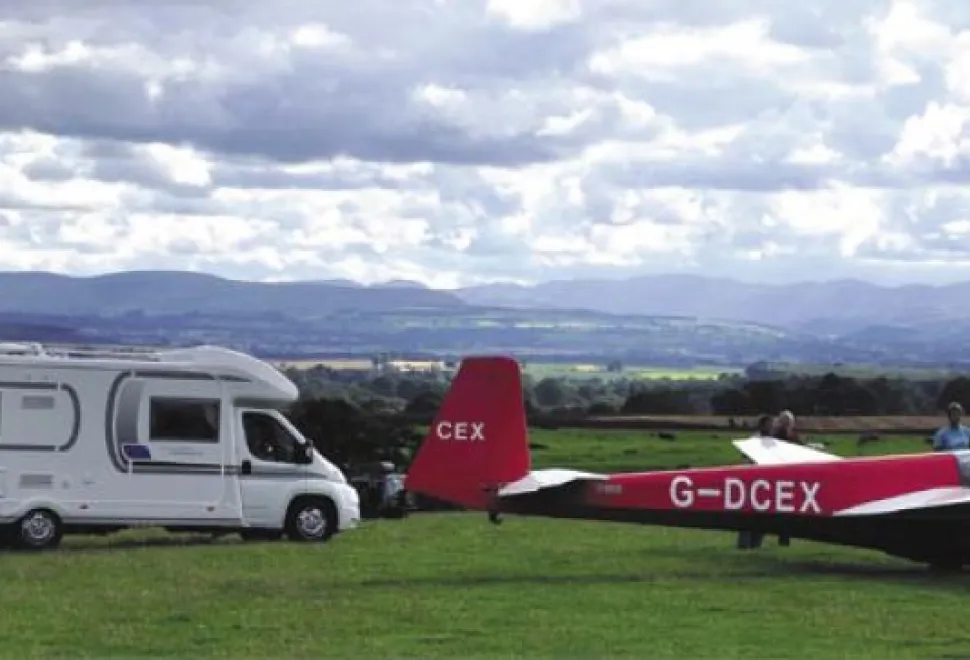
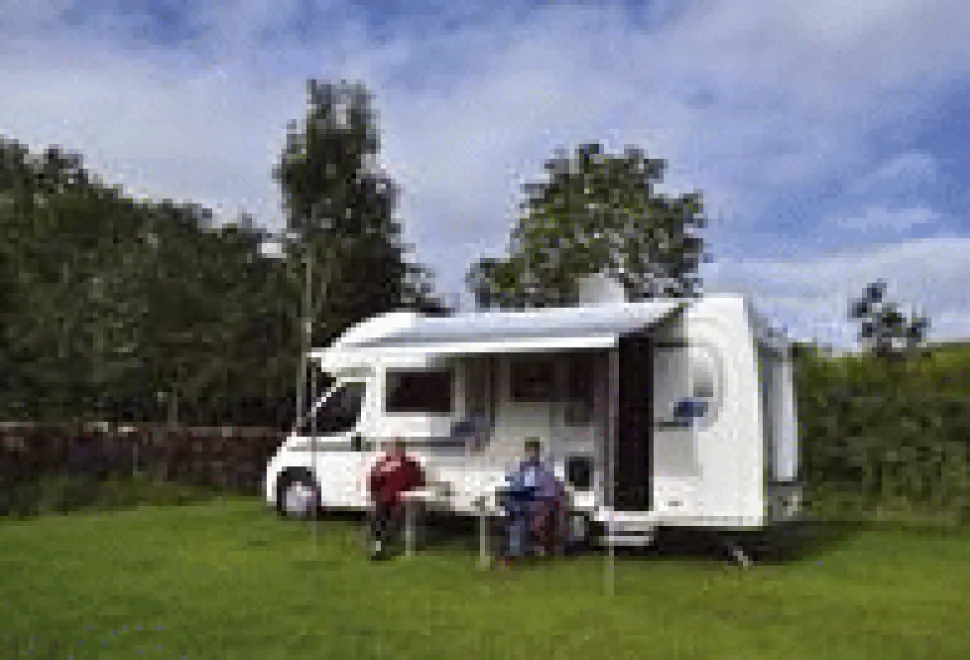
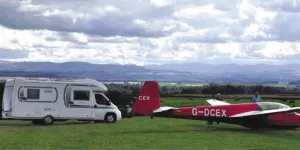
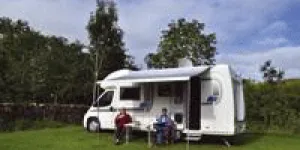
Certainly, Cotswold makes a modern styling statement. Walls are skinned in smooth GRP, and while the distinctive overcab isn’t exactly low profile, neither is it a bulbous luton: it’s somewhere in between. Long, but not outrageously so (7.16m/23ft 6in), this ’van is much better proportioned than some recent Auto-Sleepers efforts, while grey and blue decals complete a classy, up-to-the-minute picture.
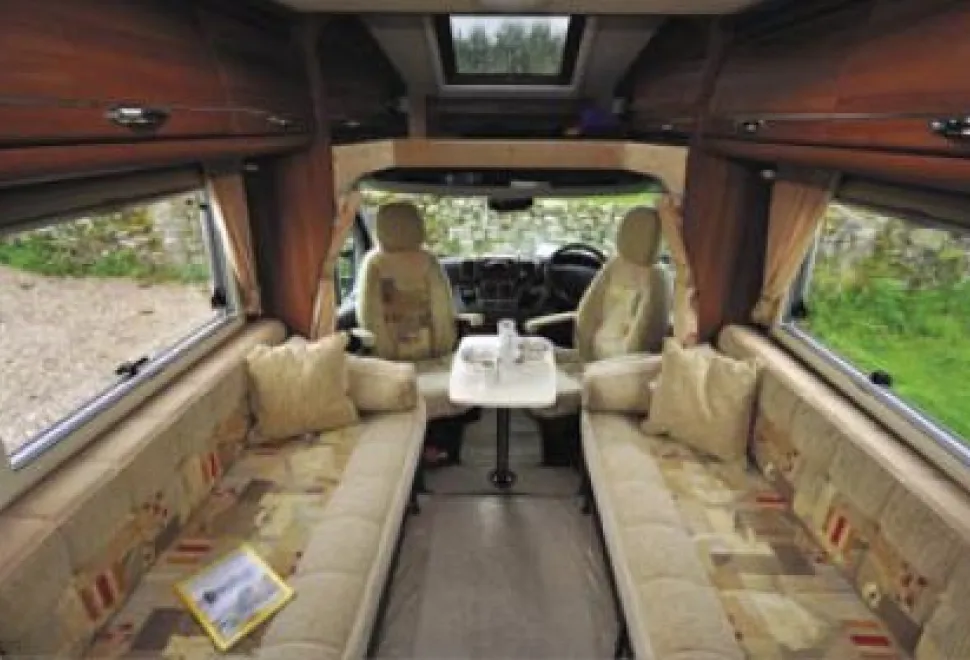
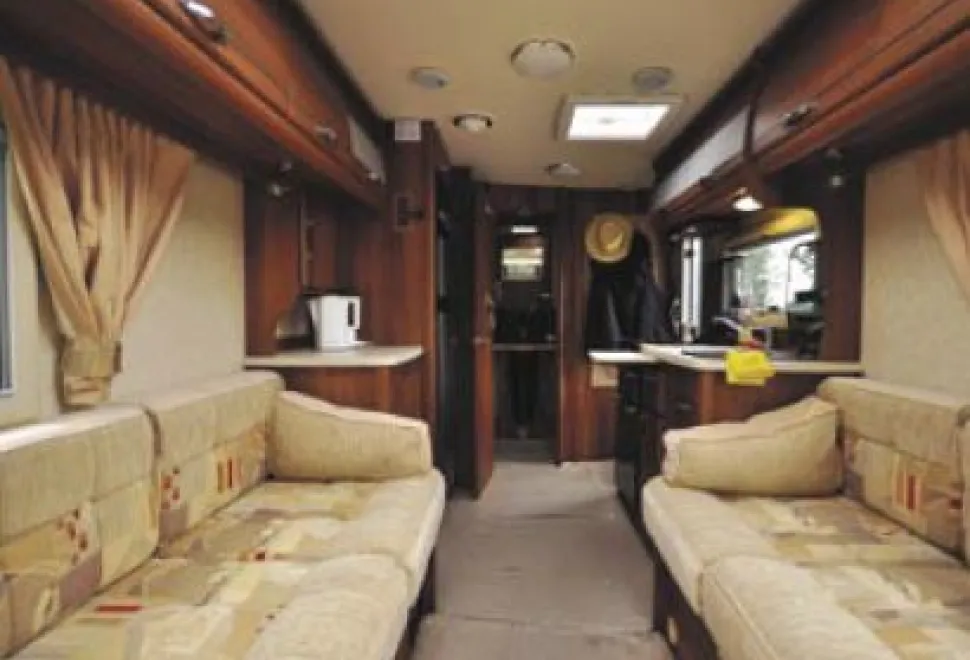
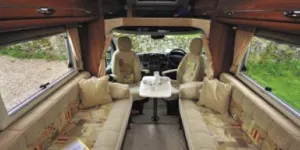
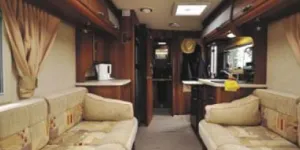
You enter at nearside rear via a good, strong habitation door (with window, blind and flyscreen) - tall people minding heads on the gas-strut door retainer. There’s a wooden wall and door to your right, a mirror facing you, the kitchen on your left, with big fridge/freezer opposite. Beyond that, a huge lounge - with twin settees - stretches forward to swivelling cab seats, the whole flooded with light from big windows and multiple rooflights.
Opening that wooden door reveals an impressive washroom. Woodwork in medium-dark ‘walnut’ is relieved by silver trim and handles, and on kitchen high-level lockers, by translucent plastic panels. Creamy wallboard and (Judy Cream) Belgian cloth upholstery, with russet highlights and pale velour panels, contrast with the wood. This upholstery could be vulnerable to staining, particularly the cab seats, but covers are removable and drycleanable. Loose-fit carpets (also in the cab) are pale, tweedy beige over walnut plankeffect vinyl flooring. Cab and lounge curtains are pale sand coloured.
THE OPTION TO FLY
Flying high in the award stakes - the Cotswold EB’s optional 157 horsepower engine fitted to our demonstrator also made it fly along the roads! However, standard fitting is the (2.2- litre) 130bhp motor that’s perfectly capable of pulling this heavy (4005kg GVW) beast at all sensible speeds - possibly giving slightly better fuel economy too. Either engine can only have the six-speed manual gearbox, as the ComfortMatic auto ’box is only offered by Fiat’s Ducato (and then only with the 3.0-litre engine). Peugeot, as a partner in the Sevel concern (which also produces Fiat’s Ducato and Citroen’s Relay), offers converters the lower camping car chassis pioneered by Fiat.
However, here Auto-Sleepers has stuck with Peugeot’s standard chassis. This makes the ’van slightly higher, while ours had a pronounced tail-high stance - needing both the (narrow, electric) exterior and moulded inner steps to gain access through the caravan door.
Sevel-built vans have ergonomically satisfying cockpits, with comfortable height-adjustable seats, plus steering wheel adjustable for reach and - marginally - rake. Instruments are clear and bright, the handbrake is a stretch down to the driver’s right, but the gearlever falls perfectly to hand. And there’s plenty of in-cab storage. Visibility
is reasonable, though thick A-pillars can be obstructive at roundabouts and junctions.
Happily, Auto-Sleepers hasn’t fitted window blinds, which exacerbate that problem, relying on cab curtains instead. Regrettably, the curtain rails are low set and can inhibit vision (for the tall) and full movement of sun visors. We understand revisions are promised - Peugeot having deleted the useful - but potentially head-bashing - overhead shelf to which the rails attach. Cab gizmos: this ’van has plenty - twin airbags, cruise control, cab air-conditioning, electric windows and mirrors and traction control. Central locking extends to the caravan door, though this was faulty on the test ’van. Both seats have two adjustable armrests and the fascia has fetching ‘wooden’ trim.
There’s no internal rear visibility, but two big (and vulnerable) door mirrors work excellently, especially in conjunction with the reversing camera screen. A second camera would be nice, showing the view aft when travelling forwards, but maybe that’s being greedy.
ROAD MANNERS
The Sevel X250 family of vehicles provided a handling revelation when launched in 2006, and they’re still just about top dog today (only VW’s - much smaller - T5 drives better). Whatever size ‘house’ behind the cab, the
front-wheel drive chassis holds the road and steers beautifully, inspiring great confidence. And if the most powerful engine is fitted, it positively urges you to unseemly speeds - here, a veritable ‘flying bungalow!’ Cotswold, on the heavy chassis (with sixteen-inch wheels), felt perfectly geared in forward travel (2200rpm at indicated 70mph) - whereas another converter’s 3.0-litre Peugeot (on a lighter chassis, and with fifteen inch wheels) seemed too low geared to us. However, this slightly higher overall gearing may adversely affect reversing: this Cotswold was unhappy on our one-in-eight hill, with some vibration and a smelly clutch.
On the move (once the excitable percussion section of cooker and grill pan had been muffled) the main rattle came from Auto-Sleepers’ traditional crockery set - the retaining strap being awkwardly mounted and hard to tighten. Cupboards, doors and Seitz concertina window blinds were all quiet, but gentle creaks emanated from somewhere in the overcab.
SOFA, SO GOOD
Forward lounges with inward-facing settees are a traditional British forte: this is a good example, with sofas 1.83m (6ft 0in) long on the nearside and 1.93m (6ft 4in) on the offside. Add swivelling cab seats and a whole family could be accommodated, once on site: with cab seatbelts only, this is definitely a two person conveyance.
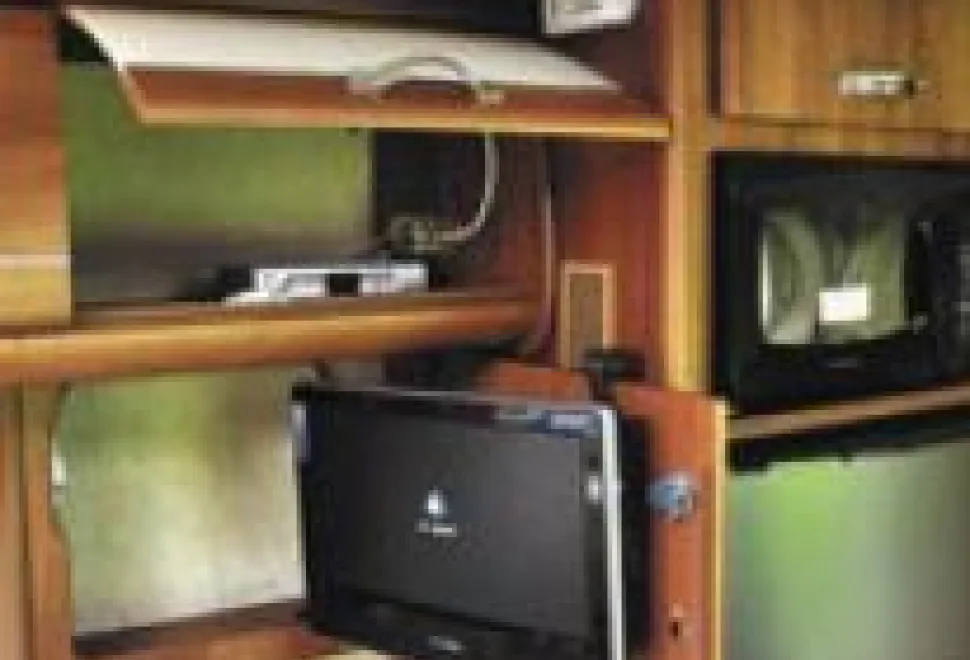
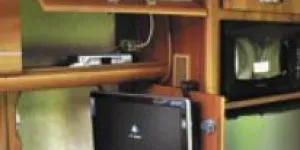
The settee squabs have a slight knee-roll and are quite deep, so some may require the (supplied) scatter cushions for support. The foam used is superb, and squishy removable armrest cushions are provided, but give little support, so feet-up sprawling is difficult: there’s only a slim front bulkhead to lean on, and that’s where you sit to watch TV. The Avtex fifteen-inch set has a dedicated cupboard opposite the kitchen. From a swivelled cab seat, the TV is rather far away; oh, the hardships of luxury living!
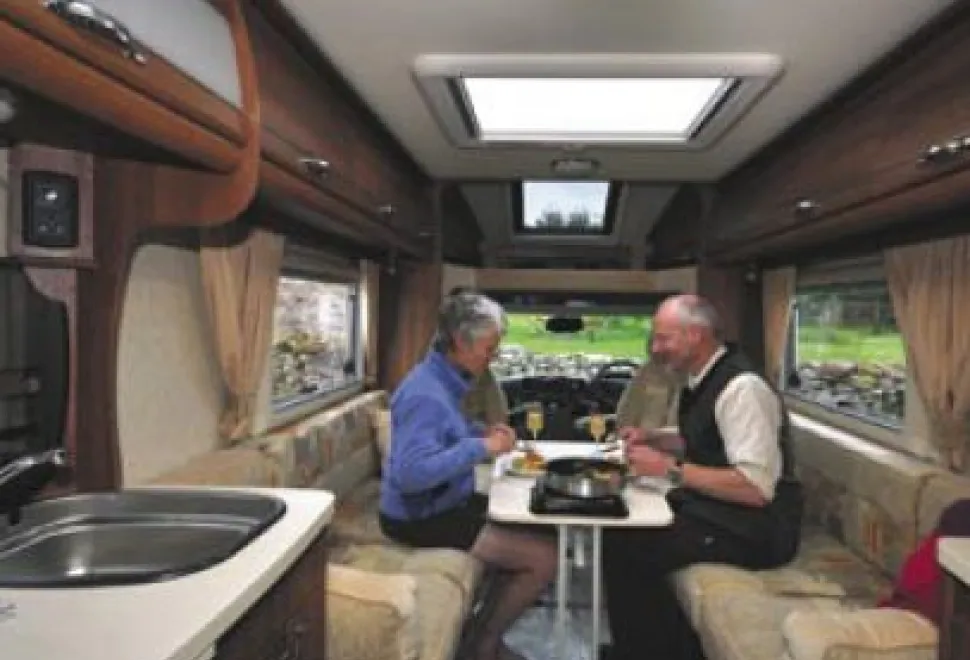
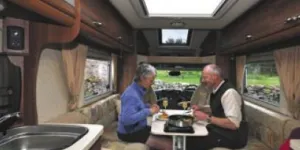
Adjustable LED lights at all four corners - above the settees - assist evening reading. For dining, Cotswold has a four-place, freestanding table stored in a dedicated slideout cupboard alongside the fridge. Catering for more, or tea-taking for two, a smaller single-leg table (stowed in the wardrobe) has a floor mounting close to the cab seats. The system works well, with room to squeeze past both tables’ legs. This is a popular lounge layout and you can see why: it’s practical, comfortable and roomy.
SINK THOUGHTS
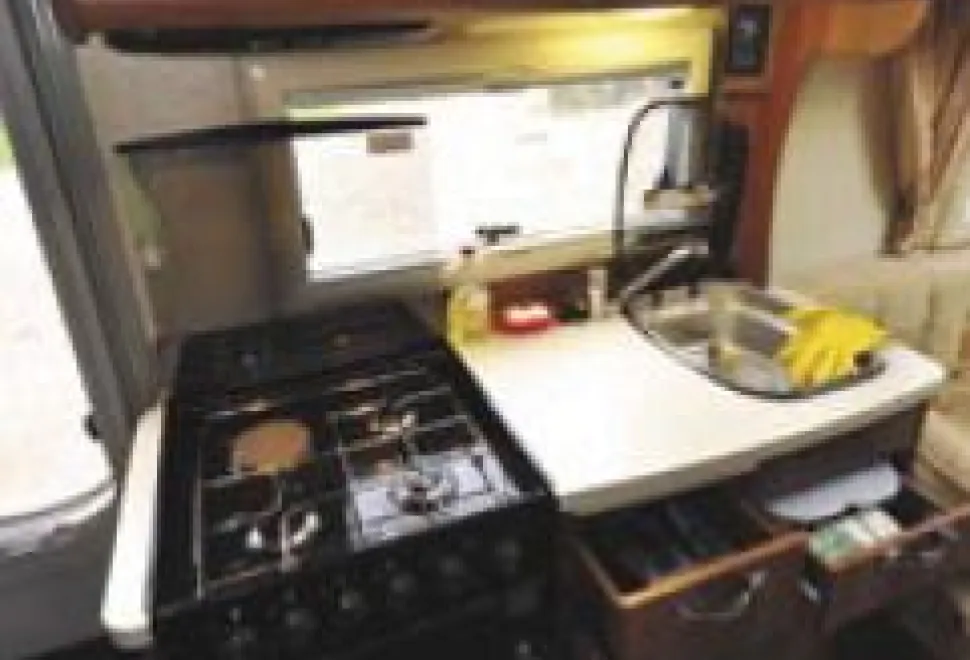
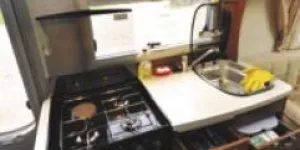
Kitchens have always been an Auto-Sleepers strong point, and this one is (largely) well specified. The main unit contains a Spinflo Caprice cooker, with three auto-ignition gas burners and one electric hotplate, under a glass cover.
There’s a grill, separate oven and floor-level pan cupboard (an intruding wheelarch restricting space). The creamy-coloured work-surface (a lightweight extension flap slides out from underneath) also contains a stainless steel sink, with glass lid and Whale mixer tap. There’s nowhere to stand hot pans though, because Auto-Sleepers has, unaccountably, omitted the outstanding stainless steel sink/drainer, which has been such a desirable feature of its ’vans. Instead, there’s a removable board, which (because of the tap’s position) didn’t fit, and actually
drained away from the sink!
Given that the cook is afforded all facilities to produce a slap-up meal, how is the ‘bottle washer’ supposed to cope? First, we stood newly washed crocks on a tea-towel; obviously, that was soaked immediately (fortunately there are two slide-out towel rails by the fridge), then Rona thought of using the grill pan as a draining rack. Talk about Heath Robinson! A little cutlery rack fits on the underside of the raised sink-lid, but was missing from the test ’van: it’s big enough to contain a few knives, forks and teaspoons, but that’s small consolation.
Moving on to less irritating features: there are two good drawers (one for cutlery) and two shelved cupboards below (one with Brabantia kitchen-roll holder). There are two high-level lockers - one split, and furnished to accommodate the crockery on one side, and some very nice glasses on t’other. There’s a domed fluorescent light over the surface and two small halogen lights in the extractor hood over the cooker. Because there’s a ceiling mounted smoke/heat alarm nearby (and if the door is closed to avoid draughts - there’s no hob windshield) you need the extractor, otherwise that blasted alarm keeps bleeping... And it sounds when you open the oven door, even if the extractor is working! We’d reposition it.
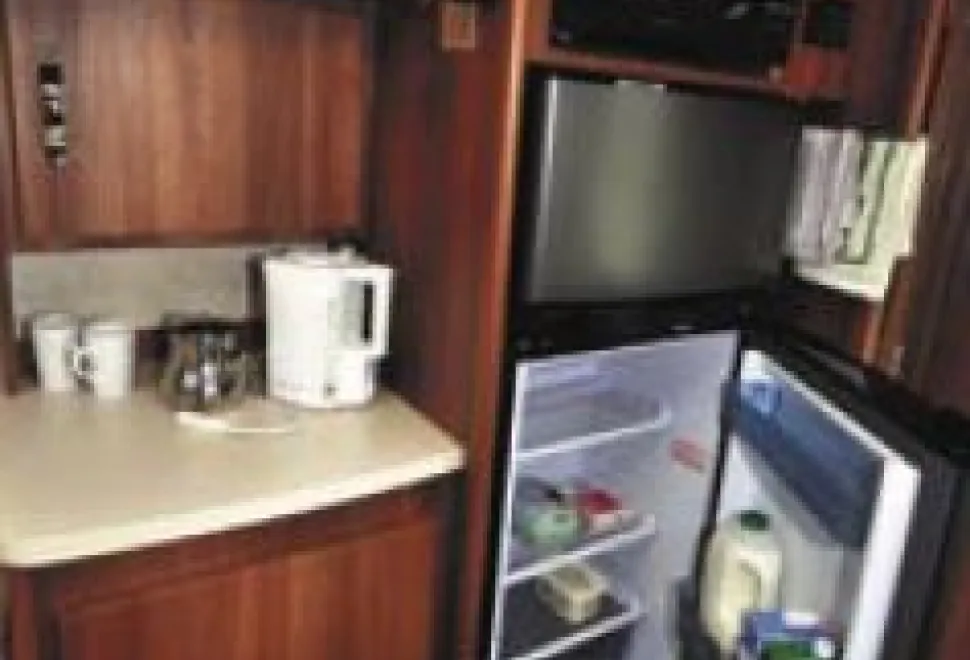
Mains and 12V sockets are sited high under the top cupboards, and there’s a sturdy rubbish bin mounted on the caravan door. On the offside wall, opposite the kitchen, is a large (silver-grey) Thetford Smart Energy Selection-equipped fridge/freezer. It’s such a luxury to just switch it on - leaving it to decide the correct power source. Above the freezer, and topped by yet another cupboard, is a Daewoo 700W microwave, set at a reasonable height for most folk to use safely. Adjacent, there’s an excellent work-surface with mains and 12V sockets, above a large cupboard containing the Sergeant EC325 power distribution unit.
In sum, this kitchen has most of the features to gladden any chef, apart from the strange omission of a proper drainer, which rather spoils the culinary experience.
THE SMALLEST ROOM?
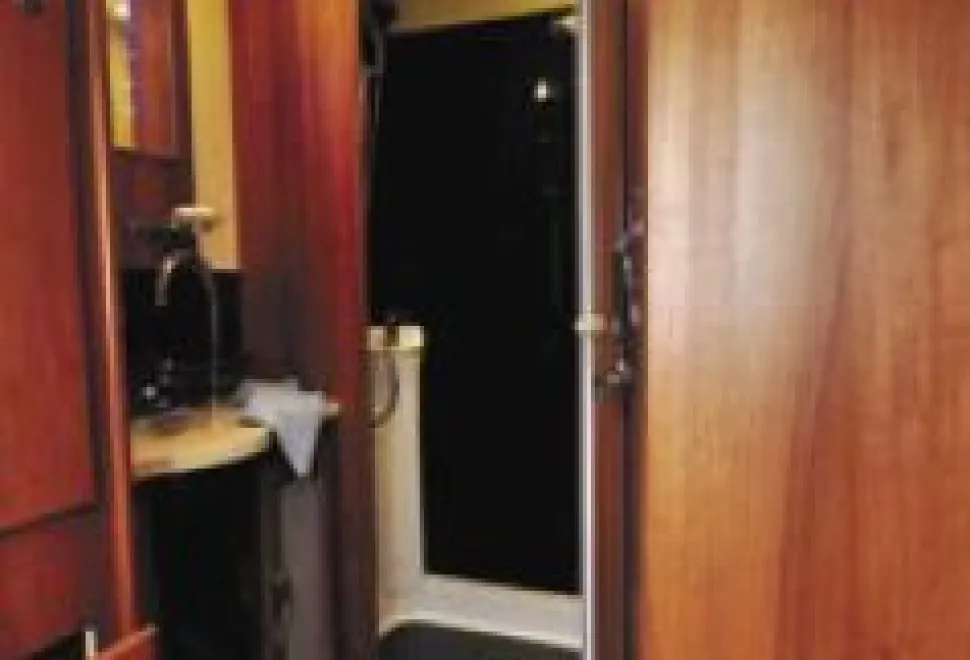
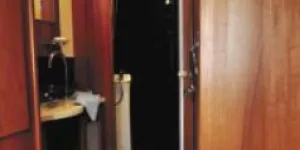
The washroom is the highlight of the Cotswold EB. Entered by the centrally located door, it occupies the full width of the ’van’s rear. In an alcove on the offside, facing aft, is (in our opinion) the best motorhome toilet currently available: Thetford’s 402 bench-type loo. There’s plenty of legroom, a translucent window (the blind’s translucent too), a ceiling dome light and useful cupboard above the toilet.
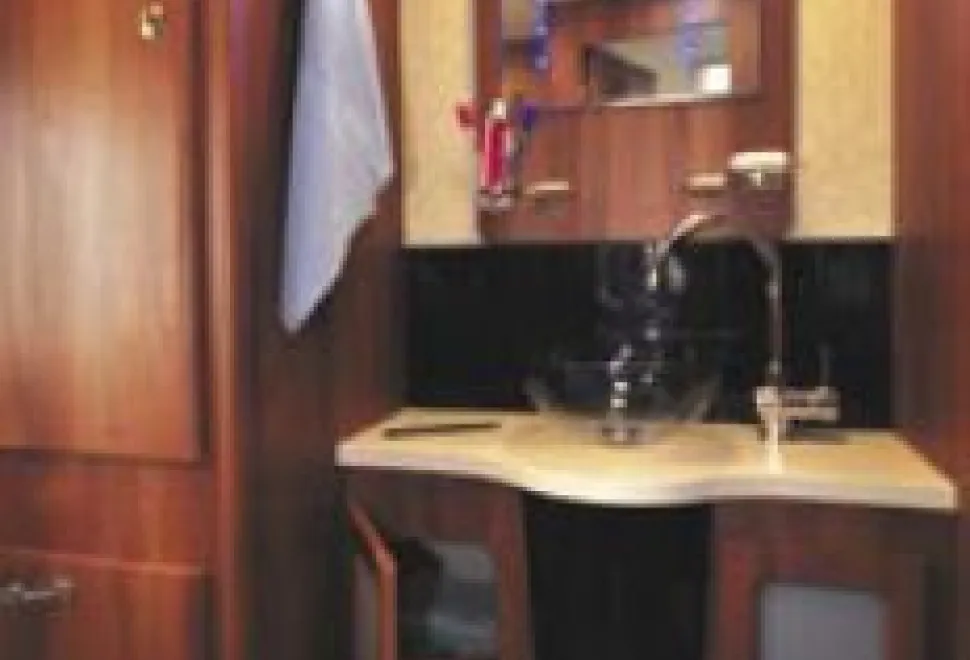
Opposite, in the offside rear corner, is a large wardrobe (1.05m/3ft 5.5in hanging drop), with three good-sized drawers below. Centrally, against the rear wall (under another domed ceiling light) is the washbasin: a clear plastic bowl set upon a cream surface with cupboards either side in the vanity unit below. A large mixer tap curves elegantly over the bowl, but its control lever is some distance away, so the unit’s surface gets wet when dripping hands switch off the water.
The classy effect is rather spoilt by a lack of chain or lever to open the plug - you have to fish around in the murky water to push-release it. Behind the washbasin (on a gloss black, tile-effect wall) are soap dish, toothbrush mug holder and a big mirror. Irresistibly, this contains two vertical rows of blue LED lights - switched on, they make you look like a Nav’i from the film Avatar! They are blindingly bright, but great fun - big kids’ll love them!
In the nearside rear corner is the very capacious shower cubicle, with clear folding doors. Two walls (those seen immediately) are covered in the same shiny black tile-effect material, with shower fittings on a white corner moulding. The effect is spectacular, though the remaining walls are covered with cream wallboard; it would have been nicer if the whole cubicle was uniformly finished in black ‘tiles.’ The shower also features a chromed accessories rack and a small vent in the ceiling: switch on the light and an extractor fan powers up. The shower tray has two outlets, and there’s a heating vent too (there’s another in the main washroom area). Because of the
lack of a shower rooflight, there’s nowhere from which to hang dripping coats: a removable rail might be a useful addition in here. All in all, this spacious washroom is a tour-de-force and well worthy of its awards.
BEDS FRAMED
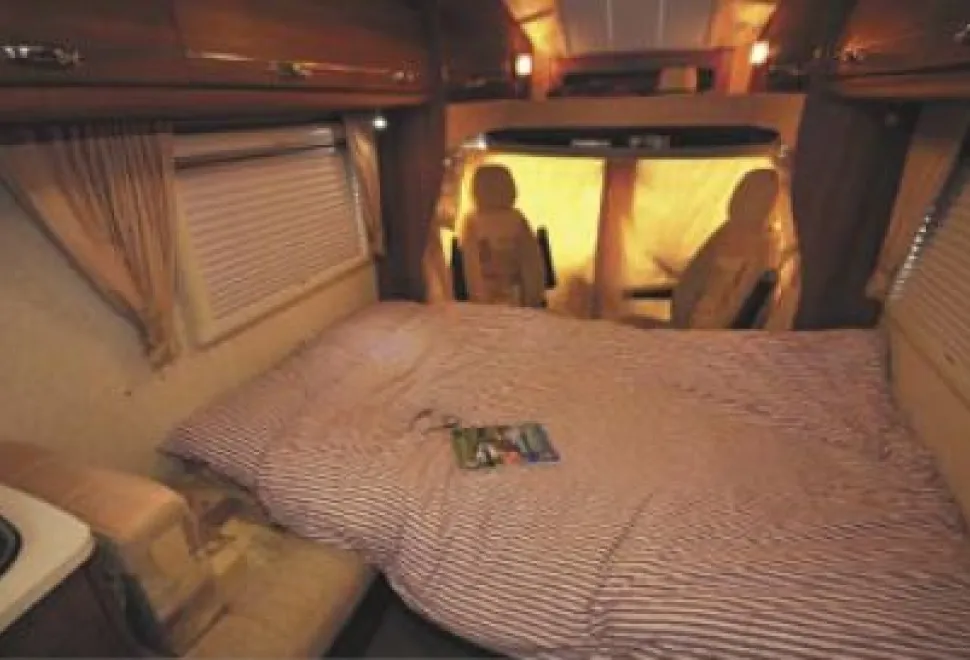
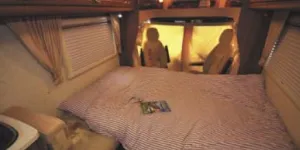
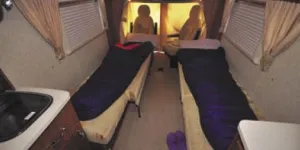
To us, making a big transverse double bed from parallel settees is no big deal, and we like having the dual-purpose space. Come bedtime, you retrieve bedding from the overcab, pull out the slatted bed bases (across the aisle) from under each settee, un-popper seatbacks from the wall and use them to form the middle of the bed. Turn seat squabs around so knee-rolls abut the walls. Roll out the sleeping bags or unfold the duvet, et voilà! It takes almost less time to do than to read the description...
The pullout bases stand on metal legs, but unlike Auto-Sleepers of yore, where tubular metal was used throughout, the bed frames are made of less sturdy plywood. It doesn’t help that the rear offside bed frame leg isn’t at the corner but set inboard to allow access to the under-bed drawer. I’d rather see the drawer position moved. As the settees are both six feet - or over - in length, you’d expect a monster transverse double; sadly, you don’t get one.
The bases emerge to make a bed just 1.30m (4ft 3in) wide, though at 2.12m (6ft 11.5in), it’s long enough for anyone. The remaining two feet of settee stays fixed. Why Auto-Sleepers has restricted the bed width in this luxury two berth ‘van to less than a standard domestic double is beyond me. Officially, the extra seating is left alongside for clothes, books etc. However, if the fixed sections of the settee bases also pulled out, then you’d have the choice: larger bed and no bedside seat, or narrower bed plus seats. We found the bed width too narrow for comfort, as we both sprawl at night. Frustrating.
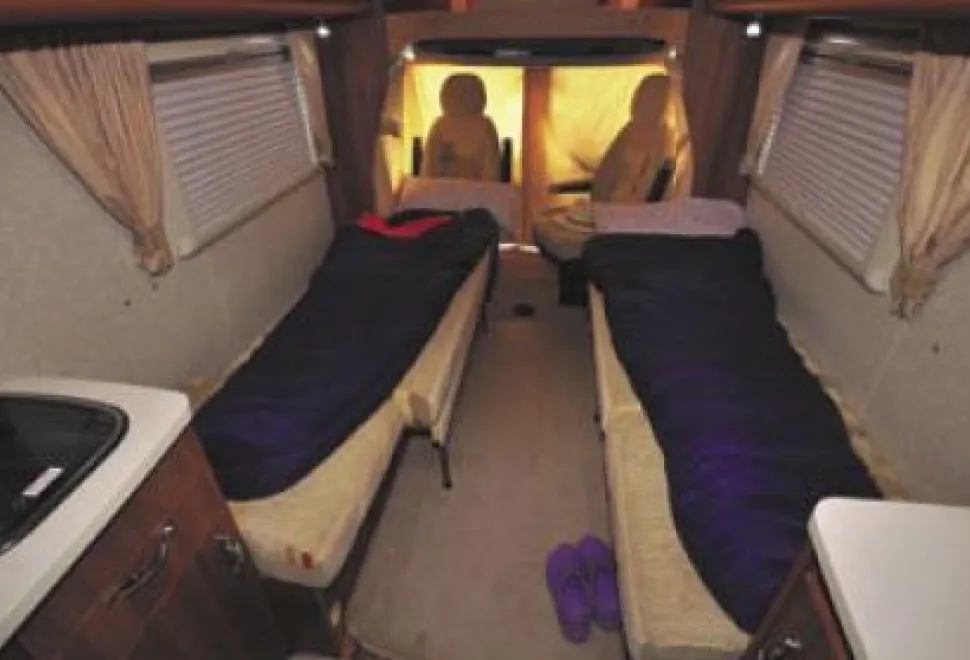
You can have alternative (longitudinal) single beds, each a generous 725mm (2ft 4.5in) wide, by simply removing the seat backrests and storing them in the cab. On the offside, the bed measures 1.91m (6ft 3.5in), on the nearside, 1.81m (5ft 11.5in). However, using the swivelled cab seat, this extends to 2.30m (7ft 6.5in), which is just grand. Excellent sleep was enjoyed on the best motorcaravan mattresses we’ve yet experienced.
LOADING LOADS
With its high capacity chassis, Cotswold EB provides a generous 522kg of payload with the standard engine (50kg less with the heavier 3.0-litre), and there’s reasonable storage space to accommodate this. The overcab base is cut away, allowing front seat occupants to enjoy light streaming through the big, fixed sunroof (there’s a blind, should sunlight become too intense). A lipped ledge around the edge enables storage of maps and similar lightweight stuff, with a slot right at the front for small oddments. Taller than most low profile overcabs, this allows high side cupboards, each taking a sleeping bag, pyjamas and pillow. We’d prefer a larger platform/cupboard for storage and smaller sunroof, but it does look superb.
The lounge has three, high-level lockers per side - one shelved, the other two not. The doors shut nicely with positive catches, but could usefully open higher. There’s storage under each settee: both (heavy) seat bases can be lifted for access, held up by metal rods at one end, but the unsupported ends drooped alarmingly. Gas struts would be more fitting in this upmarket motorhome. The offside settee base has a drawer, which, as previously suggested, could usefully be re-positioned forward. The rear section contains the leisure battery. The nearside base, also accessible via an exterior door, has a drop-down flap.
With ample kitchen drawers and cupboards and excellent wardrobe, cupboards and drawers in the washroom, Cotswold has sufficient space for most couples’ needs. If further capacity were needed, roof bars are fitted and might accept a roof box, though a ladder is an optional extra.
COTSWOLD’S KIT
For over £50,000, you’d expect a well-specified motorhome, and Cotswold doesn’t disappoint. For starters, there’s a spare wheel - perhaps difficult to access (mounted underneath amidships), but that’s a problem for roadside assistance! There’s a gas tank, with 20kg capacity (filled to 80 per cent maximum) offering much cheaper refills than cylinders.
An exterior-mounted Webasto DualTop unit provides space and water heating, using either diesel from the vehicle’s tank (smelling like an old tug-boat on start-up), or mains electricity at either one, or two kilowatts. You can choose both heating and water temperatures, and it’s very quiet in operation.
Underslung water tanks carry 102 litres fresh and 92 litres waste. Water is loaded via a Whale inlet system, so if you’re lucky enough to have a fully serviced pitch you can leave the hose connected and tap switched on. However, it takes forever to fill, and if using communal site facilities one foresees impatient queues. We’d prefer a good, old-fashioned filler neck.
Lighting inside is good, with a total of three circular ceiling domes through lounge and kitchen, plus the three oval domes in the washroom, another over the kitchen work surface, and yet another on the back wall of
the overcab. There are halogen lights each side of the overcab, four LED reading lights and white ‘mood’ lighting strips shine from above the lockers. The overcab sunroof is supplemented by a large wind-up Heki rooflight over the lounge and a smaller version over the kitchen. Another (basic) rooflight in the washroom seems a
little downmarket.
Sound and vision: there’s a pair of extra speakers over the kitchen, and a Maxview satellite dish control; wind up the dish and establish the location of your favoured satellite, using the sat-finding equipment, which occupies a goodly share of the cupboard above the television. Don’t forget to wind the dish flat before driving, as there’s no alarm to remind you!
PLAUDITS DESERVED
You’ll have gathered we found one or two design features irritating (double bed width and missing drainer, for instance), but overall, this is a superb motorhome, oozing class and appeal. It has all the features you might reasonably expect for the price, and more. The Cotswold EB fully deserves the plaudits it’s received, and it deserves to be a great success for Auto-Sleepers.
To read the full motorhome review in PDF format exactly as it appeared in the February 2011 issue of MMM, click here.
If you don't already have Adode Acrobat to be able to open a PDF, download it for free
Cotswold-based Auto-Sleepers is an enduring success story in the British motorhome industry, winning shed-loads of awards during its 50-year history.
One of its latest creations, the Cotswold EB, was launched to immediate acclaim - winning the 2010 Caravan Industry Motorcaravan of the Year and Thetford’s Washroom of the Year, prizes. Last May, it was also overall winner of the Caravan Club’s prestigious Design and Drive competition, and as one of the judges, I was generally most impressed. Having briefly reviewed EB’s sibling (the fixed bed, four-berth Cotswold), we were itching to give the EB an in-depth test.
Certainly, Cotswold makes a modern styling statement. Walls are skinned in smooth GRP, and while the distinctive overcab isn’t exactly low profile, neither is it a bulbous luton: it’s somewhere in between. Long, but not outrageously so (7.16m/23ft 6in), this ’van is much better proportioned than some recent Auto-Sleepers efforts, while grey and blue decals complete a classy, up-to-the-minute picture.
You enter at nearside rear via a good, strong habitation door (with window, blind and flyscreen) - tall people minding heads on the gas-strut door retainer. There’s a wooden wall and door to your right, a mirror facing you, the kitchen on your left, with big fridge/freezer opposite. Beyond that, a huge lounge - with twin settees - stretches forward to swivelling cab seats, the whole flooded with light from big windows and multiple rooflights.
Opening that wooden door reveals an impressive washroom. Woodwork in medium-dark ‘walnut’ is relieved by silver trim and handles, and on kitchen high-level lockers, by translucent plastic panels. Creamy wallboard and (Judy Cream) Belgian cloth upholstery, with russet highlights and pale velour panels, contrast with the wood. This upholstery could be vulnerable to staining, particularly the cab seats, but covers are removable and drycleanable. Loose-fit carpets (also in the cab) are pale, tweedy beige over walnut plankeffect vinyl flooring. Cab and lounge curtains are pale sand coloured.
THE OPTION TO FLY
Flying high in the award stakes - the Cotswold EB’s optional 157 horsepower engine fitted to our demonstrator also made it fly along the roads! However, standard fitting is the (2.2- litre) 130bhp motor that’s perfectly capable of pulling this heavy (4005kg GVW) beast at all sensible speeds - possibly giving slightly better fuel economy too. Either engine can only have the six-speed manual gearbox, as the ComfortMatic auto ’box is only offered by Fiat’s Ducato (and then only with the 3.0-litre engine). Peugeot, as a partner in the Sevel concern (which also produces Fiat’s Ducato and Citroen’s Relay), offers converters the lower camping car chassis pioneered by Fiat.
However, here Auto-Sleepers has stuck with Peugeot’s standard chassis. This makes the ’van slightly higher, while ours had a pronounced tail-high stance - needing both the (narrow, electric) exterior and moulded inner steps to gain access through the caravan door.
Sevel-built vans have ergonomically satisfying cockpits, with comfortable height-adjustable seats, plus steering wheel adjustable for reach and - marginally - rake. Instruments are clear and bright, the handbrake is a stretch down to the driver’s right, but the gearlever falls perfectly to hand. And there’s plenty of in-cab storage. Visibility
is reasonable, though thick A-pillars can be obstructive at roundabouts and junctions.
Happily, Auto-Sleepers hasn’t fitted window blinds, which exacerbate that problem, relying on cab curtains instead. Regrettably, the curtain rails are low set and can inhibit vision (for the tall) and full movement of sun visors. We understand revisions are promised - Peugeot having deleted the useful - but potentially head-bashing - overhead shelf to which the rails attach. Cab gizmos: this ’van has plenty - twin airbags, cruise control, cab air-conditioning, electric windows and mirrors and traction control. Central locking extends to the caravan door, though this was faulty on the test ’van. Both seats have two adjustable armrests and the fascia has fetching ‘wooden’ trim.
There’s no internal rear visibility, but two big (and vulnerable) door mirrors work excellently, especially in conjunction with the reversing camera screen. A second camera would be nice, showing the view aft when travelling forwards, but maybe that’s being greedy.
ROAD MANNERS
The Sevel X250 family of vehicles provided a handling revelation when launched in 2006, and they’re still just about top dog today (only VW’s - much smaller - T5 drives better). Whatever size ‘house’ behind the cab, the
front-wheel drive chassis holds the road and steers beautifully, inspiring great confidence. And if the most powerful engine is fitted, it positively urges you to unseemly speeds - here, a veritable ‘flying bungalow!’ Cotswold, on the heavy chassis (with sixteen-inch wheels), felt perfectly geared in forward travel (2200rpm at indicated 70mph) - whereas another converter’s 3.0-litre Peugeot (on a lighter chassis, and with fifteen inch wheels) seemed too low geared to us. However, this slightly higher overall gearing may adversely affect reversing: this Cotswold was unhappy on our one-in-eight hill, with some vibration and a smelly clutch.
On the move (once the excitable percussion section of cooker and grill pan had been muffled) the main rattle came from Auto-Sleepers’ traditional crockery set - the retaining strap being awkwardly mounted and hard to tighten. Cupboards, doors and Seitz concertina window blinds were all quiet, but gentle creaks emanated from somewhere in the overcab.
SOFA, SO GOOD
Forward lounges with inward-facing settees are a traditional British forte: this is a good example, with sofas 1.83m (6ft 0in) long on the nearside and 1.93m (6ft 4in) on the offside. Add swivelling cab seats and a whole family could be accommodated, once on site: with cab seatbelts only, this is definitely a two person conveyance.
The settee squabs have a slight knee-roll and are quite deep, so some may require the (supplied) scatter cushions for support. The foam used is superb, and squishy removable armrest cushions are provided, but give little support, so feet-up sprawling is difficult: there’s only a slim front bulkhead to lean on, and that’s where you sit to watch TV. The Avtex fifteen-inch set has a dedicated cupboard opposite the kitchen. From a swivelled cab seat, the TV is rather far away; oh, the hardships of luxury living!
Adjustable LED lights at all four corners - above the settees - assist evening reading. For dining, Cotswold has a four-place, freestanding table stored in a dedicated slideout cupboard alongside the fridge. Catering for more, or tea-taking for two, a smaller single-leg table (stowed in the wardrobe) has a floor mounting close to the cab seats. The system works well, with room to squeeze past both tables’ legs. This is a popular lounge layout and you can see why: it’s practical, comfortable and roomy.
SINK THOUGHTS
Kitchens have always been an Auto-Sleepers strong point, and this one is (largely) well specified. The main unit contains a Spinflo Caprice cooker, with three auto-ignition gas burners and one electric hotplate, under a glass cover.
There’s a grill, separate oven and floor-level pan cupboard (an intruding wheelarch restricting space). The creamy-coloured work-surface (a lightweight extension flap slides out from underneath) also contains a stainless steel sink, with glass lid and Whale mixer tap. There’s nowhere to stand hot pans though, because Auto-Sleepers has, unaccountably, omitted the outstanding stainless steel sink/drainer, which has been such a desirable feature of its ’vans. Instead, there’s a removable board, which (because of the tap’s position) didn’t fit, and actually
drained away from the sink!
Given that the cook is afforded all facilities to produce a slap-up meal, how is the ‘bottle washer’ supposed to cope? First, we stood newly washed crocks on a tea-towel; obviously, that was soaked immediately (fortunately there are two slide-out towel rails by the fridge), then Rona thought of using the grill pan as a draining rack. Talk about Heath Robinson! A little cutlery rack fits on the underside of the raised sink-lid, but was missing from the test ’van: it’s big enough to contain a few knives, forks and teaspoons, but that’s small consolation.
Moving on to less irritating features: there are two good drawers (one for cutlery) and two shelved cupboards below (one with Brabantia kitchen-roll holder). There are two high-level lockers - one split, and furnished to accommodate the crockery on one side, and some very nice glasses on t’other. There’s a domed fluorescent light over the surface and two small halogen lights in the extractor hood over the cooker. Because there’s a ceiling mounted smoke/heat alarm nearby (and if the door is closed to avoid draughts - there’s no hob windshield) you need the extractor, otherwise that blasted alarm keeps bleeping... And it sounds when you open the oven door, even if the extractor is working! We’d reposition it.
Mains and 12V sockets are sited high under the top cupboards, and there’s a sturdy rubbish bin mounted on the caravan door. On the offside wall, opposite the kitchen, is a large (silver-grey) Thetford Smart Energy Selection-equipped fridge/freezer. It’s such a luxury to just switch it on - leaving it to decide the correct power source. Above the freezer, and topped by yet another cupboard, is a Daewoo 700W microwave, set at a reasonable height for most folk to use safely. Adjacent, there’s an excellent work-surface with mains and 12V sockets, above a large cupboard containing the Sergeant EC325 power distribution unit.
In sum, this kitchen has most of the features to gladden any chef, apart from the strange omission of a proper drainer, which rather spoils the culinary experience.
THE SMALLEST ROOM?
The washroom is the highlight of the Cotswold EB. Entered by the centrally located door, it occupies the full width of the ’van’s rear. In an alcove on the offside, facing aft, is (in our opinion) the best motorhome toilet currently available: Thetford’s 402 bench-type loo. There’s plenty of legroom, a translucent window (the blind’s translucent too), a ceiling dome light and useful cupboard above the toilet.
Opposite, in the offside rear corner, is a large wardrobe (1.05m/3ft 5.5in hanging drop), with three good-sized drawers below. Centrally, against the rear wall (under another domed ceiling light) is the washbasin: a clear plastic bowl set upon a cream surface with cupboards either side in the vanity unit below. A large mixer tap curves elegantly over the bowl, but its control lever is some distance away, so the unit’s surface gets wet when dripping hands switch off the water.
The classy effect is rather spoilt by a lack of chain or lever to open the plug - you have to fish around in the murky water to push-release it. Behind the washbasin (on a gloss black, tile-effect wall) are soap dish, toothbrush mug holder and a big mirror. Irresistibly, this contains two vertical rows of blue LED lights - switched on, they make you look like a Nav’i from the film Avatar! They are blindingly bright, but great fun - big kids’ll love them!
In the nearside rear corner is the very capacious shower cubicle, with clear folding doors. Two walls (those seen immediately) are covered in the same shiny black tile-effect material, with shower fittings on a white corner moulding. The effect is spectacular, though the remaining walls are covered with cream wallboard; it would have been nicer if the whole cubicle was uniformly finished in black ‘tiles.’ The shower also features a chromed accessories rack and a small vent in the ceiling: switch on the light and an extractor fan powers up. The shower tray has two outlets, and there’s a heating vent too (there’s another in the main washroom area). Because of the
lack of a shower rooflight, there’s nowhere from which to hang dripping coats: a removable rail might be a useful addition in here. All in all, this spacious washroom is a tour-de-force and well worthy of its awards.
BEDS FRAMED
To us, making a big transverse double bed from parallel settees is no big deal, and we like having the dual-purpose space. Come bedtime, you retrieve bedding from the overcab, pull out the slatted bed bases (across the aisle) from under each settee, un-popper seatbacks from the wall and use them to form the middle of the bed. Turn seat squabs around so knee-rolls abut the walls. Roll out the sleeping bags or unfold the duvet, et voilà! It takes almost less time to do than to read the description...
The pullout bases stand on metal legs, but unlike Auto-Sleepers of yore, where tubular metal was used throughout, the bed frames are made of less sturdy plywood. It doesn’t help that the rear offside bed frame leg isn’t at the corner but set inboard to allow access to the under-bed drawer. I’d rather see the drawer position moved. As the settees are both six feet - or over - in length, you’d expect a monster transverse double; sadly, you don’t get one.
The bases emerge to make a bed just 1.30m (4ft 3in) wide, though at 2.12m (6ft 11.5in), it’s long enough for anyone. The remaining two feet of settee stays fixed. Why Auto-Sleepers has restricted the bed width in this luxury two berth ‘van to less than a standard domestic double is beyond me. Officially, the extra seating is left alongside for clothes, books etc. However, if the fixed sections of the settee bases also pulled out, then you’d have the choice: larger bed and no bedside seat, or narrower bed plus seats. We found the bed width too narrow for comfort, as we both sprawl at night. Frustrating.
You can have alternative (longitudinal) single beds, each a generous 725mm (2ft 4.5in) wide, by simply removing the seat backrests and storing them in the cab. On the offside, the bed measures 1.91m (6ft 3.5in), on the nearside, 1.81m (5ft 11.5in). However, using the swivelled cab seat, this extends to 2.30m (7ft 6.5in), which is just grand. Excellent sleep was enjoyed on the best motorcaravan mattresses we’ve yet experienced.
LOADING LOADS
With its high capacity chassis, Cotswold EB provides a generous 522kg of payload with the standard engine (50kg less with the heavier 3.0-litre), and there’s reasonable storage space to accommodate this. The overcab base is cut away, allowing front seat occupants to enjoy light streaming through the big, fixed sunroof (there’s a blind, should sunlight become too intense). A lipped ledge around the edge enables storage of maps and similar lightweight stuff, with a slot right at the front for small oddments. Taller than most low profile overcabs, this allows high side cupboards, each taking a sleeping bag, pyjamas and pillow. We’d prefer a larger platform/cupboard for storage and smaller sunroof, but it does look superb.
The lounge has three, high-level lockers per side - one shelved, the other two not. The doors shut nicely with positive catches, but could usefully open higher. There’s storage under each settee: both (heavy) seat bases can be lifted for access, held up by metal rods at one end, but the unsupported ends drooped alarmingly. Gas struts would be more fitting in this upmarket motorhome. The offside settee base has a drawer, which, as previously suggested, could usefully be re-positioned forward. The rear section contains the leisure battery. The nearside base, also accessible via an exterior door, has a drop-down flap.
With ample kitchen drawers and cupboards and excellent wardrobe, cupboards and drawers in the washroom, Cotswold has sufficient space for most couples’ needs. If further capacity were needed, roof bars are fitted and might accept a roof box, though a ladder is an optional extra.
COTSWOLD’S KIT
For over £50,000, you’d expect a well-specified motorhome, and Cotswold doesn’t disappoint. For starters, there’s a spare wheel - perhaps difficult to access (mounted underneath amidships), but that’s a problem for roadside assistance! There’s a gas tank, with 20kg capacity (filled to 80 per cent maximum) offering much cheaper refills than cylinders.
An exterior-mounted Webasto DualTop unit provides space and water heating, using either diesel from the vehicle’s tank (smelling like an old tug-boat on start-up), or mains electricity at either one, or two kilowatts. You can choose both heating and water temperatures, and it’s very quiet in operation.
Underslung water tanks carry 102 litres fresh and 92 litres waste. Water is loaded via a Whale inlet system, so if you’re lucky enough to have a fully serviced pitch you can leave the hose connected and tap switched on. However, it takes forever to fill, and if using communal site facilities one foresees impatient queues. We’d prefer a good, old-fashioned filler neck.
Lighting inside is good, with a total of three circular ceiling domes through lounge and kitchen, plus the three oval domes in the washroom, another over the kitchen work surface, and yet another on the back wall of
the overcab. There are halogen lights each side of the overcab, four LED reading lights and white ‘mood’ lighting strips shine from above the lockers. The overcab sunroof is supplemented by a large wind-up Heki rooflight over the lounge and a smaller version over the kitchen. Another (basic) rooflight in the washroom seems a
little downmarket.
Sound and vision: there’s a pair of extra speakers over the kitchen, and a Maxview satellite dish control; wind up the dish and establish the location of your favoured satellite, using the sat-finding equipment, which occupies a goodly share of the cupboard above the television. Don’t forget to wind the dish flat before driving, as there’s no alarm to remind you!
PLAUDITS DESERVED
You’ll have gathered we found one or two design features irritating (double bed width and missing drainer, for instance), but overall, this is a superb motorhome, oozing class and appeal. It has all the features you might reasonably expect for the price, and more. The Cotswold EB fully deserves the plaudits it’s received, and it deserves to be a great success for Auto-Sleepers.
To read the full motorhome review in PDF format exactly as it appeared in the February 2011 issue of MMM, click here.
If you don't already have Adode Acrobat to be able to open a PDF, download it for free
Our Verdict
Comfortable and well-equipped the Cotswold EB works well as a two-berth, but its heavy at 4005kg so you’ll need to have the correct licence to drive it.
Advantages
Smooth and modern GRP bodywork
Good kitchen, Caprice cooker with dual-fuel hob
Stylish washroom
Large comfy settees in lounge
Disadvantages
Heavy vehicle at 4005kg
No sink drainer


