
Venus 380/2
Image

Image
Image
Image
Image
Image
Image

Description
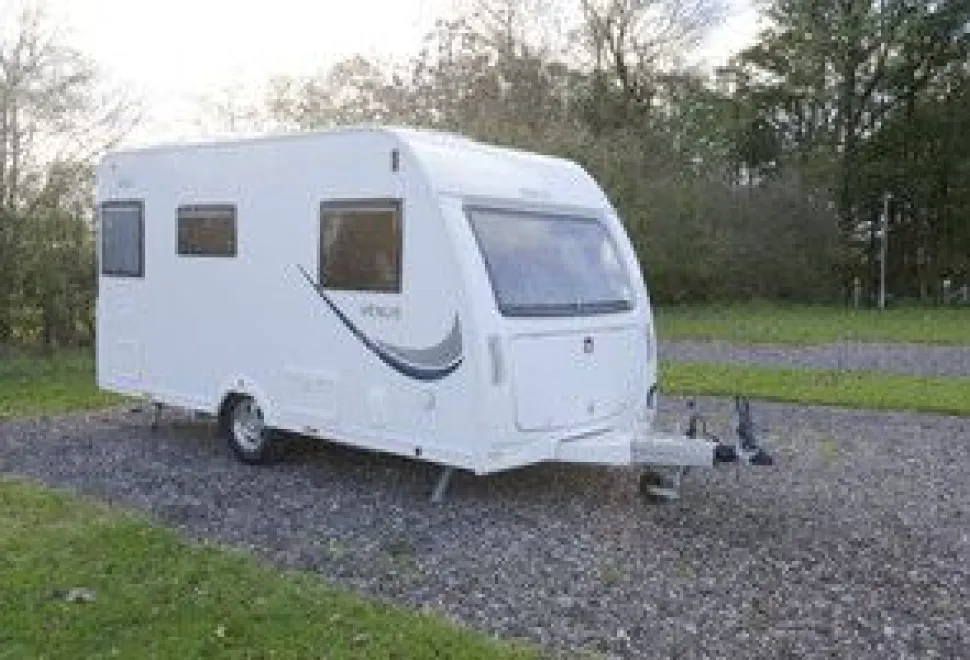
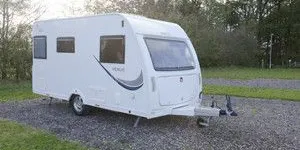
The Venus 380/2 is the slightest and cheapest caravan in its class. Venus caravans were launches in 2013 and, for 2014, this model gets longer settees, which means the single beds that can be made are suitable for taller people
Key Features
Model Year
2014
Product Class
Single Axle
Price from (£)
£11595
Berths
2
Full Review
The three-model Venus range offers a twin-bed layout, a model with a double bed and end shower room – and this classic two-berth layout, with an end shower room.
The Venus range arrived just over a year ago, to give buyers options on the extreme end of the lightweight tourer spectrum.
A year down the line, Venus caravans have acquired some significant changes for 2014 – and one model gets a change that increases its appeal to tall people. That’s the classic two-berth 380/2. Its settees are now longer, which is important if you use them as single beds.
Differences for 2014 to the Venus range include a change of chassis. The first Venuses were on AL-KO chassis; this latest range is on the BPW Swing V-Tech chassis. The Venus shape has been restyled and the Plus Pack now includes an alarm and a hitch-head stabiliser. And the Venus range is heated by the Truma 4kW Combi system, with a water heater capacity of 10 litres and a 3800-watt thermal output for warm air when used on both gas and electricity. When powered just on electricity, which is how we tested it, its output is 1800 watts. Warm-up time, in an outside temperature of just 7ºC, was a mere 10 minutes to a comfortable 20ºC.
The Plus Pack, which adds £399 to the cost of a Venus, now includes an alarm system, Winterhoff hitch-head stabiliser, alloy wheels, a spare wheel and carrier, door flyscreen and a radio/CD/MP3 player with iPod connection.
The 380’s layout gives you a full-width end shower room, which is where we start our review…
At 74cm deep the 390’s shower room is by no means among the largest you’ll find in a two-berth tourer. (But then that’s no surprise, because the caravan is only 3.96m long.) The surprise is the size of the shower, which occupies the whole of the nearside depth. We measured the shower tray at 72cm square; that’s almost domestic-sized. There’s a rail running across the roof, ideal for drying wet coats or towels.
The absence of a plastic lining on the shower walls may draw comment from caravanners accustomed to seeing showers fully cloaked in plastic or glass-reinforced plastic. But we’d say it’s not a concern; Lunar, which makes the Venus range, wouldn’t have put in a wallboard that’s not designed to repel water!
The basin is oval and quite small; like the floor space, though, it’s more than adequate. There is a towel hook high up on the forward offside wall. This shower room achieves everything you need and, in the context of the diminutive dimension, and light weight, of this tourer, it’s brilliantly designed.
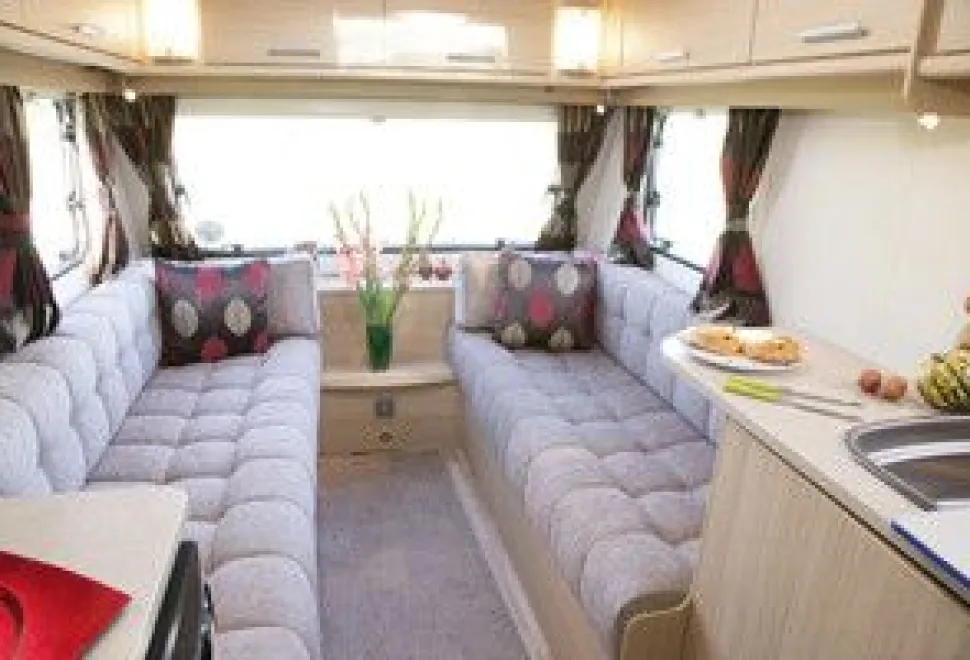
When you want to make up the double bed, you pull out the central base section; it’s housed under a ledge between the two seats. Webbing-linked slats slide out to sit on runners on the settee edges.
The table is 86cm long, which means that when it’s pushed right up to the windowsill there is still a good amount of seating space – almost a metre – on the aft side. The significance here is adaptability. When two are dining they can sit at the fore end of the settees. When guests arrive and coffees and cakes are on the agenda, the table is small enough to still enable this area to be used as a lounge…
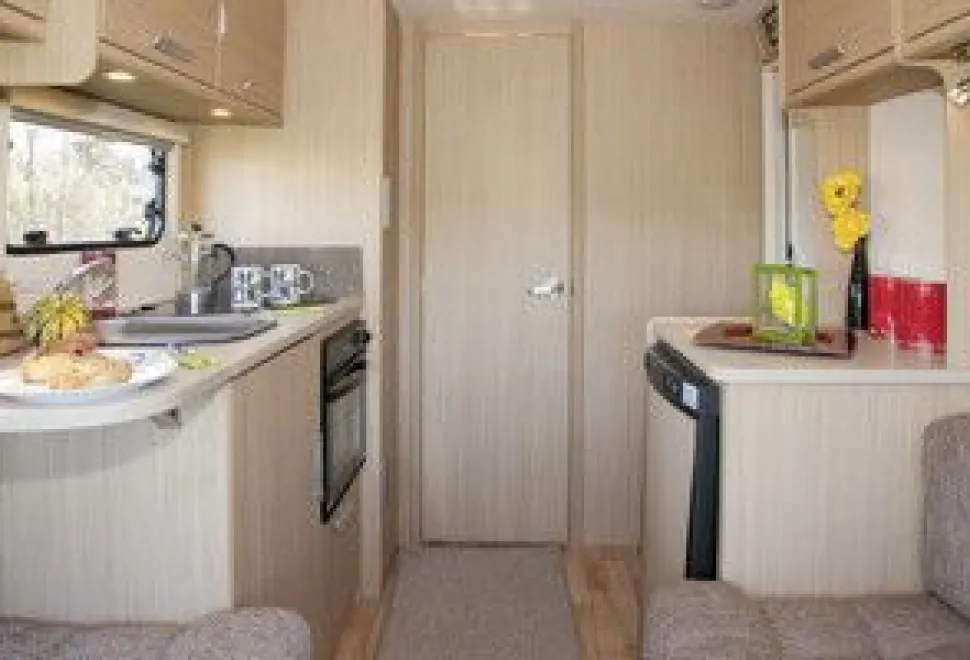
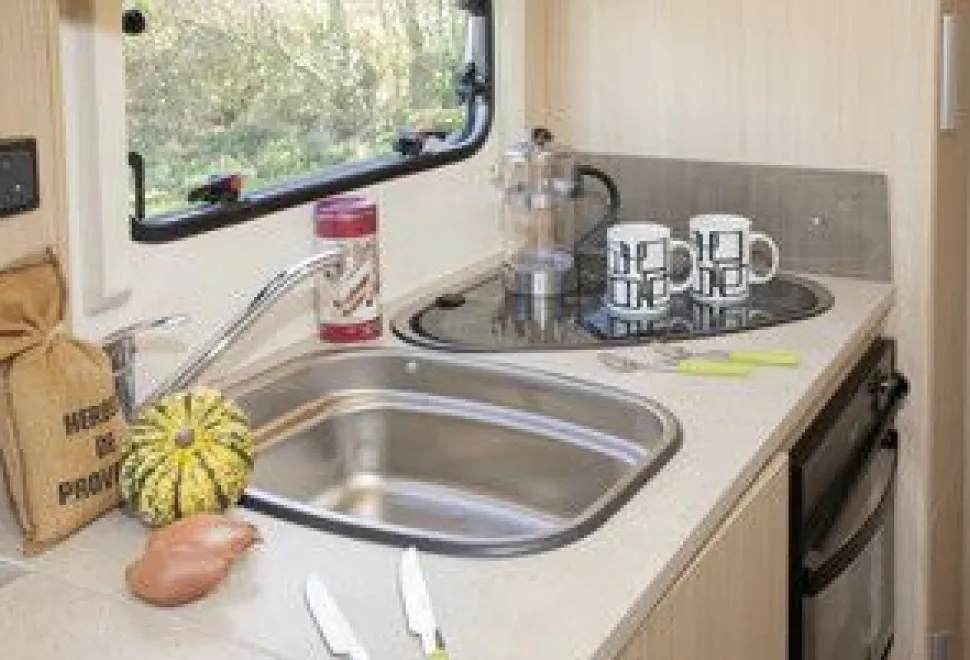
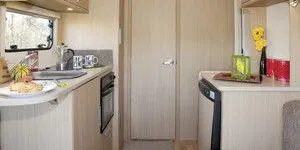
The designers of the Venus have taken every opportunity to trim out weight in order to achieve the 380’s bantam status. That includes using a combination oven-grill, which is lighter than a full oven with separate grill. The advantage goes further than weight. The shallower depth of this unit enables you to have a deep cupboard beneath it. That’s in addition to a full-depth, 52cm-wide cabinet alongside it.
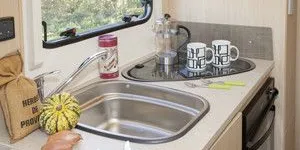
The three-burner hob is triangular, which creates surface space between it and the (rectangular) sink. Extra work surface is available to hinge up from the front end of the kitchen. When this is in place, there is a surface width of 47cm. And that, we quickly discovered during our test day, is more than adequate for making meals for two.
By the time our analysis had reached the kitchen we were discussing the wider merits of Venus and its lightweight advantage. Wallboading is a key element of weight-saving. Perhaps it’s in this central area of the 380/2 that the wallboarding is most noticeable, which is what sparked our discussion. There’s quite a lot of it, above the fridge, and on each side above the aft end of the seating. It’s just plain cream as you might expect, but there’s something unseen here that’s really important to the entire ethos of not just Venus but to every other caravan made in the Lunar factory. This wallboarding contains a thermoplastic honeycomb structure of air pockets. It makes a major contribution to the lightweight appeal of this company’s tourers. The honeycomb element was introduced for 2014 as part of Lunar’s Core policy; that’s all about bringing lighter weights to the market, giving you a wider choice of tow car.
It’s a 20-mile motorway-and-lane tow to Little Orchard Caravan Park from the Lunar factory; amply far enough to demonstrate the nimble characteristics of the 380. It was a joy to tow, admittedly behind a car almost twice as heavy as would be needed.
The Venus range arrived just over a year ago, to give buyers options on the extreme end of the lightweight tourer spectrum.
A year down the line, Venus caravans have acquired some significant changes for 2014 – and one model gets a change that increases its appeal to tall people. That’s the classic two-berth 380/2. Its settees are now longer, which is important if you use them as single beds.
Differences for 2014 to the Venus range include a change of chassis. The first Venuses were on AL-KO chassis; this latest range is on the BPW Swing V-Tech chassis. The Venus shape has been restyled and the Plus Pack now includes an alarm and a hitch-head stabiliser. And the Venus range is heated by the Truma 4kW Combi system, with a water heater capacity of 10 litres and a 3800-watt thermal output for warm air when used on both gas and electricity. When powered just on electricity, which is how we tested it, its output is 1800 watts. Warm-up time, in an outside temperature of just 7ºC, was a mere 10 minutes to a comfortable 20ºC.
The Plus Pack, which adds £399 to the cost of a Venus, now includes an alarm system, Winterhoff hitch-head stabiliser, alloy wheels, a spare wheel and carrier, door flyscreen and a radio/CD/MP3 player with iPod connection.
The 380’s layout gives you a full-width end shower room, which is where we start our review…
Showering
At 74cm deep the 390’s shower room is by no means among the largest you’ll find in a two-berth tourer. (But then that’s no surprise, because the caravan is only 3.96m long.) The surprise is the size of the shower, which occupies the whole of the nearside depth. We measured the shower tray at 72cm square; that’s almost domestic-sized. There’s a rail running across the roof, ideal for drying wet coats or towels.The absence of a plastic lining on the shower walls may draw comment from caravanners accustomed to seeing showers fully cloaked in plastic or glass-reinforced plastic. But we’d say it’s not a concern; Lunar, which makes the Venus range, wouldn’t have put in a wallboard that’s not designed to repel water!
The basin is oval and quite small; like the floor space, though, it’s more than adequate. There is a towel hook high up on the forward offside wall. This shower room achieves everything you need and, in the context of the diminutive dimension, and light weight, of this tourer, it’s brilliantly designed.
Sleeping
This is where the 380’s change for 2014 enhances its appeal. At 1.9m and 1.8m, the single beds are longer than those in the first Venus 380s; one bed is half a metre longer, the other is 40cm longer (the difference in length between the two beds is to allow for extra space in the kitchen).When you want to make up the double bed, you pull out the central base section; it’s housed under a ledge between the two seats. Webbing-linked slats slide out to sit on runners on the settee edges.
Storage
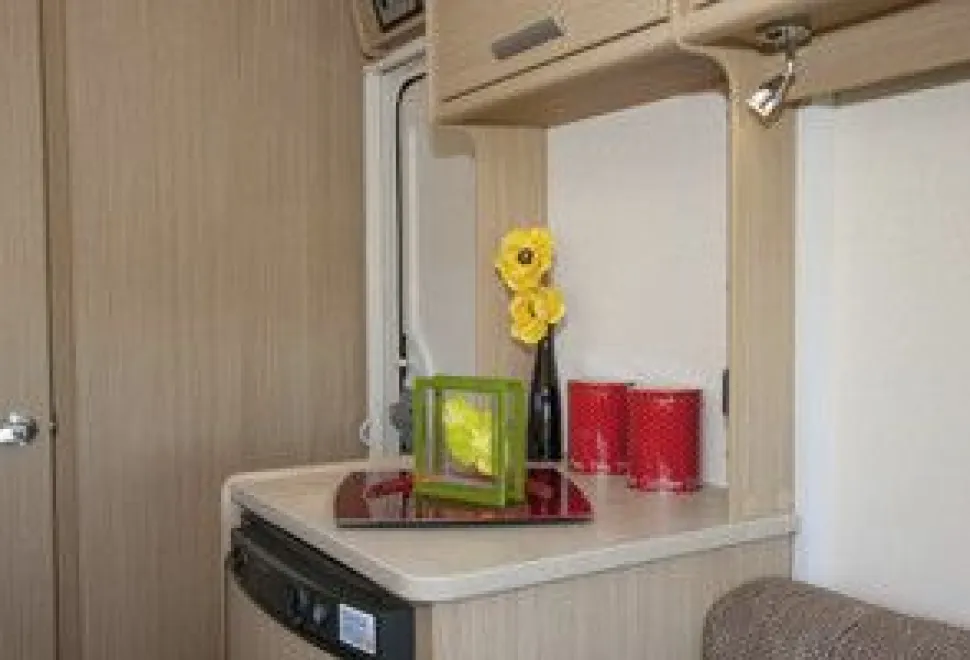
In a caravan that’s only 3.96m long and 2.12m wide you might assume storage could be a challenge. There is, though, a surprising amount of hideaway space. When you raise the settee bases (they stay up in place by means of cantilever springs), large storage areas are revealed. Six top lockers line the lounge, there is also one above the fridge forward of the door. The wardrobe is on the aft end of the kitchen. It gives you 38cm of hanging width, plus a two-shelf cabinet beneath; that’s the ideal place for footwear.Dining
The wardrobe is also where the freestanding table is stored, fitting neatly into clips on the aft wall.The table is 86cm long, which means that when it’s pushed right up to the windowsill there is still a good amount of seating space – almost a metre – on the aft side. The significance here is adaptability. When two are dining they can sit at the fore end of the settees. When guests arrive and coffees and cakes are on the agenda, the table is small enough to still enable this area to be used as a lounge…
Lounging
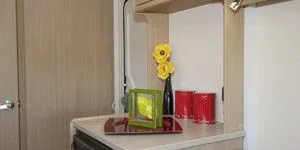
Put your feet up, nestle your shoulders into the bolster-style armrests and the firm scatter cushions – and relax. You can put these bolsters and cushions at either end, which is important for two reasons. One is that the TV points are in the front end of the lounge, so you’d want to put your TV on the windowsill; the other is that when you want to sit, feet-up and look at the view through the front window, you can.
Kitchen
The designers of the Venus have taken every opportunity to trim out weight in order to achieve the 380’s bantam status. That includes using a combination oven-grill, which is lighter than a full oven with separate grill. The advantage goes further than weight. The shallower depth of this unit enables you to have a deep cupboard beneath it. That’s in addition to a full-depth, 52cm-wide cabinet alongside it.The three-burner hob is triangular, which creates surface space between it and the (rectangular) sink. Extra work surface is available to hinge up from the front end of the kitchen. When this is in place, there is a surface width of 47cm. And that, we quickly discovered during our test day, is more than adequate for making meals for two.
By the time our analysis had reached the kitchen we were discussing the wider merits of Venus and its lightweight advantage. Wallboading is a key element of weight-saving. Perhaps it’s in this central area of the 380/2 that the wallboarding is most noticeable, which is what sparked our discussion. There’s quite a lot of it, above the fridge, and on each side above the aft end of the seating. It’s just plain cream as you might expect, but there’s something unseen here that’s really important to the entire ethos of not just Venus but to every other caravan made in the Lunar factory. This wallboarding contains a thermoplastic honeycomb structure of air pockets. It makes a major contribution to the lightweight appeal of this company’s tourers. The honeycomb element was introduced for 2014 as part of Lunar’s Core policy; that’s all about bringing lighter weights to the market, giving you a wider choice of tow car.
Towing
Venus caravans are narrower than most, at 2.12m. The compact width isn’t really noticeable in the open-plan layout of the 380. But we did notice it on the road. The Venus is barely wider than the Sorento that takes our caravans out on tow test; the view through the car’s own door mirrors was almost as good as that given by our extension mirrors.It’s a 20-mile motorway-and-lane tow to Little Orchard Caravan Park from the Lunar factory; amply far enough to demonstrate the nimble characteristics of the 380. It was a joy to tow, admittedly behind a car almost twice as heavy as would be needed.
Our Verdict
The Venus 380’s easy-tow advantage and its ability to be manhandled, if you need to do this, are both major plus-points. Its surprisingly spacious interior, and the rapid warm-up efficiency of its Truma 4kW blown air heating system create a lovely, comfortable environment.
But it’s the light weight and light price that makes this caravan such a star. And now, with longer settees (or beds), its appeal is even greater.
Advantages
The light weight and low price
The efficiency of the heating unit
The good amount of kitchen storage space
The surprising amount of general storage space


