
Buccaneer Caravel
Image
Image
Image
Image
Image
Image
Description
Could the big, bold – and, yes, beautiful – 2010 Buccaneer Caravel be the ultimate island bed caravan? it certainly comes pretty close
Key Features
Model Year
2010
Product Class
Twin Axle
Price from (£)
£22999
Berths
4
Full Review
Call it paranoia if you wish, but I swear I could feel dozens of pairs of eyes staring at me as I carefully angled the huge – and hugely expensive – rig through the entrance barrier at Ancaster’s Woodland Waters Holiday
Park near Grantham. And, to be fair (assuming I wasn’t imagining it), you could hardly blame them. I mean, this is one outfit that positively demands you look at it, whether you want to or not.
The Jeep tow vehicle doesn’t help in this respect, of course: the Cherokee was never the most shrinking of violets, but this 2009 model, with its pumped-up body and chrome toothy grin is difficult to miss.
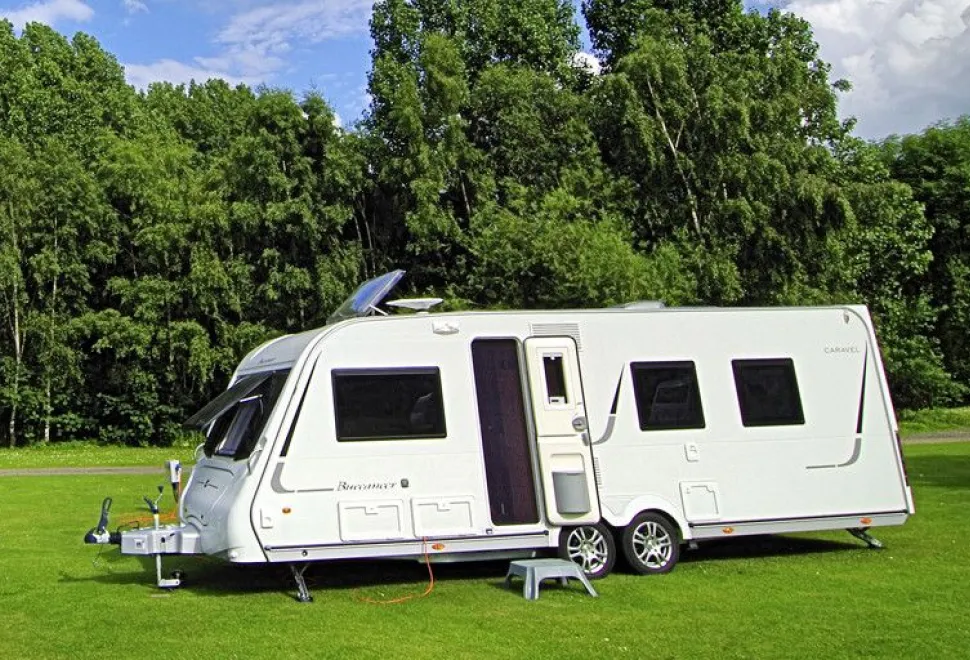
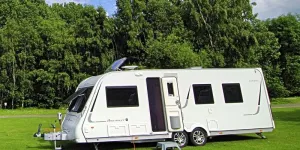
Then comes the caravan – all 7.96m of it. Don’t get me wrong: it’s not tastelessly brassy by any means, but you’d have to be chronically myopic to miss the multi-spoke alloy wheels (all four of them), blacked-out flush-fit windows and Lexus-style clear lens vertical tail lights. Thankfully, Explorer Group has chosen to go easy on the body addenda of its jaw-dropping flagship, so the graphics are simple and minimalist, the name badges contemporary and subtle.
With the Caravel pitched up (it’s easier than you might imagine, as it, like all big twins, responds to steering input from the car much more slowly than a smaller, single axle caravan ever would), evidence of good design common sense comes to the fore as you set about the business of turning it from mere on-tow trailer into home-from-home.
Take the water system, for instance. The water system is one of those terrific auto-fill affairs, which really makes a world of difference.
To use it, you simply plug your submersible pump into the caravan’s socket as usual, then nip inside and flick a switch, which causes the inboard tank to fill. Once the tank is full, the pump clicks off automatically. You can monitor the level constantly via the LED gauge, which is near to the door. As soon as the level drops, you flick another switch, and the fill system draws on the Aquaroll again to top it up. As long as you’ve got two Aquarolls (as we had during this test), you don’t need to make regular visits to the site’s water taps. It’s a brilliant system.
Staying with the water theme, this top-of-the-range model is equipped with the house-style Alde “wet” central heating system. This relies on a semi-sealed system of radiators and fluids – just like the system you have at home – for heat and hot water.
Given the unseasonably hot and dry spell we enjoyed throughout this trip, we never once touched the space heater. The water heater – especially when boosted by the electric element – produced loads of piping hot water in seemingly no time at all. Getting your head around the various hieroglyphics on the LCD control panel required me to break the habit of a lifetime and consult the handbook, but it’s all very straightforward once you’ve used it a couple of times.
Stepping inside into a world of leather is always a pleasurable experience in a caravan, and the Caravel’s ambience is frankly second to none. The mink-coloured hide smells like leather should, and it’s blissfully cool to the touch, even when the weather’s hot. Well worth the grand-or-so extra for the leather option. We loved the dark blue curtains and metal tie-backs, too, even if the tie-backs themselves weren’t terribly effective in use. The flush-fitted windows and top-quality pleated blinds mean you can fine-tune how much (or how little) light you want to enter the caravan.
That said, I doubt you’d ever feel you were being blinded by the light in this caravan, for it’s another model that’s unfortunate enough to be saddled with the ultra-dark-tinted windows that Explorer Group seems to be obsessed with. I’ll admit that they look terrific from the outside, but they really make the interior feel gloomy, even on sunny days, and you’re always fooled into believing that the weather outside is darker and gloomier than it really is.
On a more positive note, storage throughout this caravan is mighty impressive. As usual, one of the first things we did, once the caravan had been set up, was to nip into a nearby town (Grantham, in this instance) and stock up with various groceries for the days ahead.
All our tins and packets disappeared with consummate ease into the various high and low lockers and cupboards. Mrs Le C was particularly enamoured with the three wire baskets that emerge from the locker beneath the sink, which we used to stow everything from tins and plates to a bottle of wine. The head lockers are of a good size and sensibly shaped.
Following a familiarisation stroll around Woodland Waters’ impressive 70-plus acres of grounds, we wandered back to the Caravel for dinner and, given the still-warm weather, decided to forgo a hot meal in favour of a cold one.
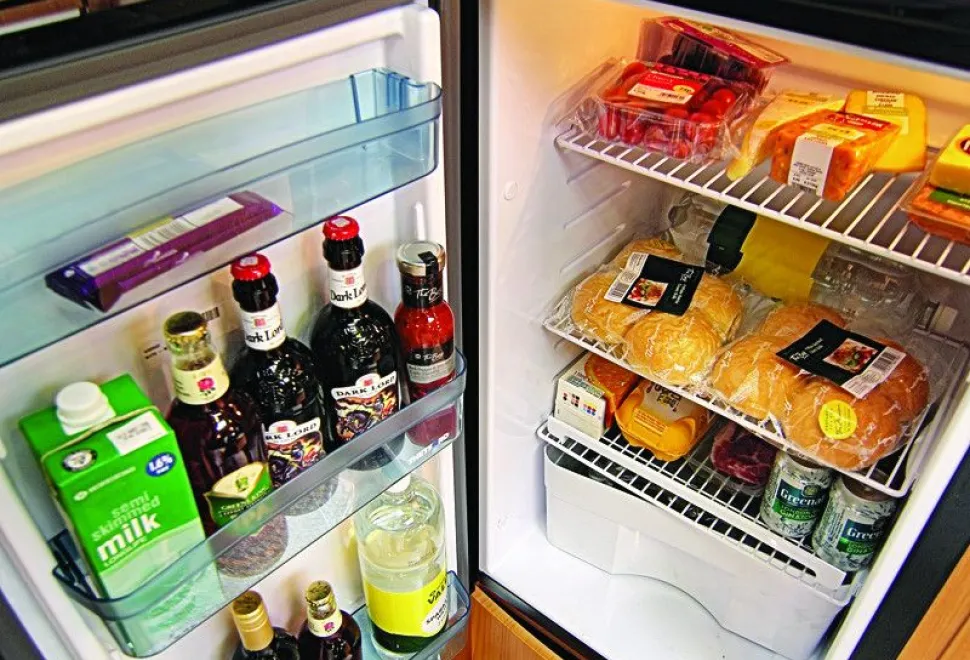
This is where the Caravel’s Thetford 175-litre fridge-freezer came to the fore, and I have to say that in my opinion it’s the best of its type on the market today. Firing it up entails nothing more than the press of a button. The resultant display on the LCD read-out is both easy to read and simple to understand.
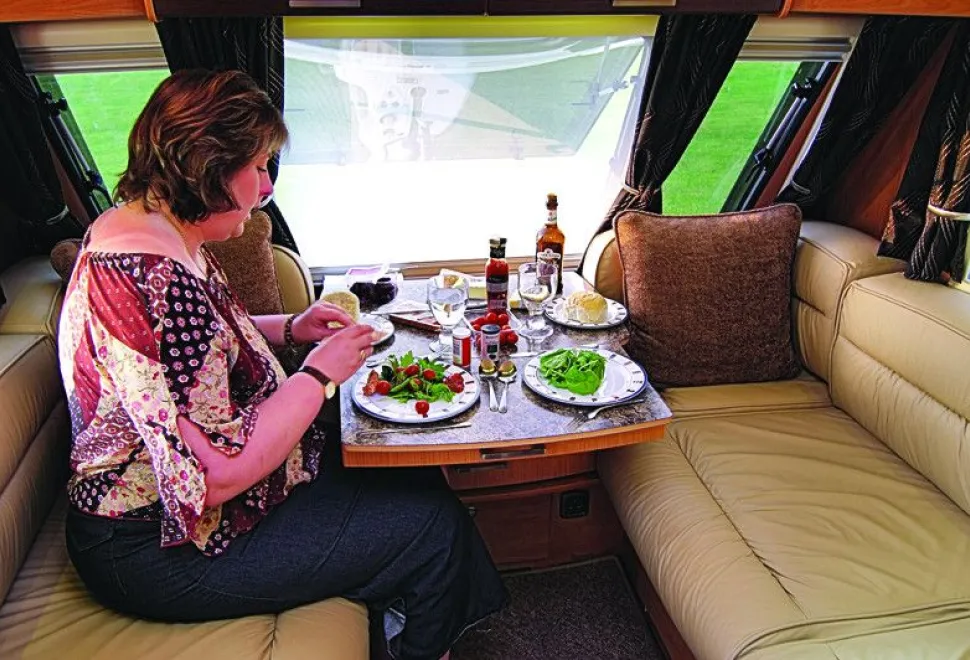
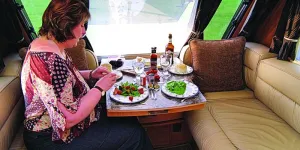
It was a pleasant surprise to find that we didn’t have to use the main folding dining table for dinner, too. Obviously, if you have a couple of guests for dinner, then you will need to employ it. But for two of us, the sliding chest-top table extension offered room enough for our various plates, bowls, glasses and condiments.
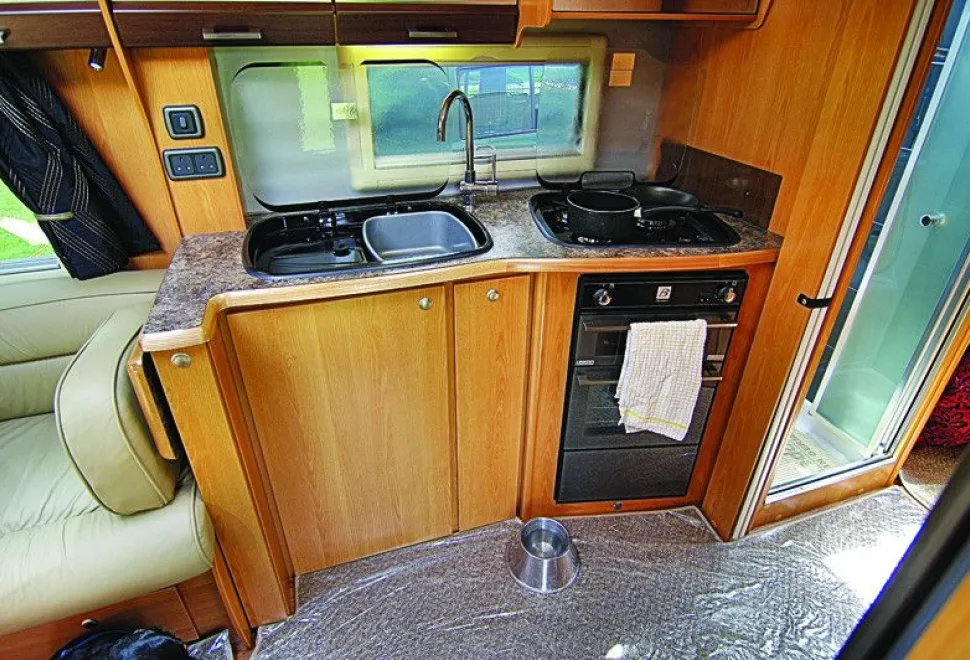
Being every inch the New Man, I volunteered to do the washing up, and was delighted to use what is almost certainly the single biggest mixer tap I’ve ever seen in a caravan. No worries about filling a kettle from that one, I can tell you.
Once again, the Alde system came up trumps with plenty of piping hot water, and the mini-tsunamis from the vigorous scrubbings in the washing up bowl were safely contained by the sensibly deep-sunk sink and drainer.
After a hard day’s relaxing, we decamped back into the lounge. We never take a television away with us on these test trips, so out came the paperbacks and the playing cards, and on went the stereo. I’d already clocked the Caravel’s MP3-friendly stereo on the Explorer website a few days before, so I fished out my iPod, aux-in lead and conjoined the two. Then it was a simple matter of selecting “aux” on the stereo’s source button, and the lounge was filled with the soothing sounds of, er, Nirvana.
So, a great set-up, but it does have a fundamental flaw that really needs addressing on future models. The problem is that the stereo unit isn’t recessed quite enough within its roof locker. This means that, with an aux-in lead plugged into its face-plate, the locker door won’t shut without pressing hard on the lead itself – which could eventually damage the lead irreparably. You can leave the door open, of course, but if there’s a hard protuberance in a given closed environment, chances are I’ll crack my head on it at least twice. The solution? Recess the stereo an inch or so further into the locker. Job done.
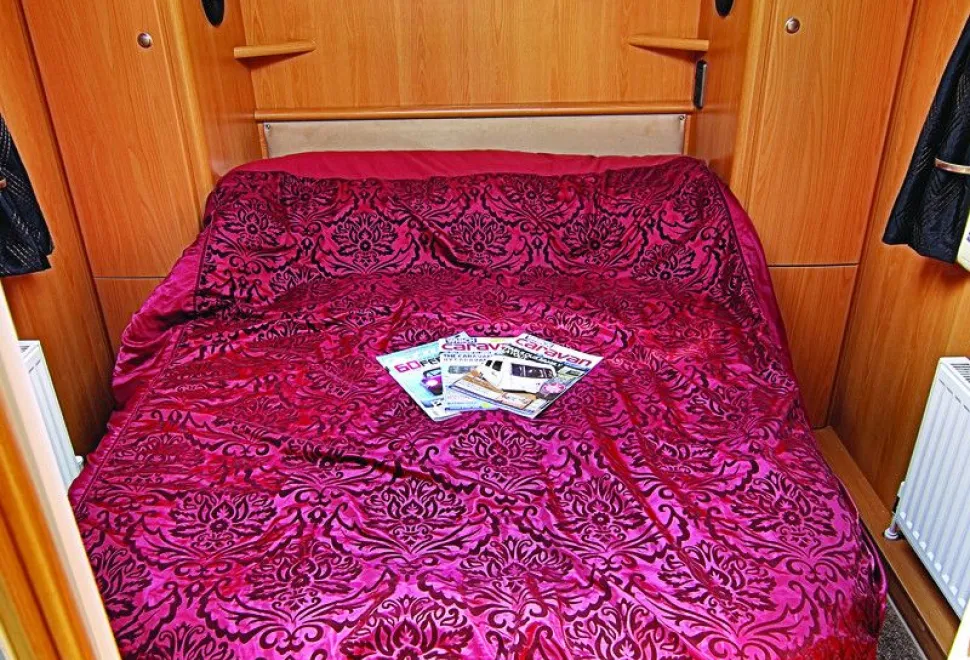
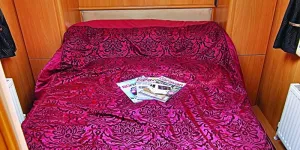
The Caravel’s island bed measures a healthy 1.86m by 1.37m, and is garnished with his ‘n’ hers split-level wardrobes, roof lockers, reading lights, radio speakers – and even wall-mounted radiators. Come the morning, the lady of the house can repair to the nifty little dressing table in the offside front corner (complete with multi-adjustable mirror), while the unit in the opposing corner can be used as a television station. There’s an astonishing amount of storage space beneath the bed-base, too.
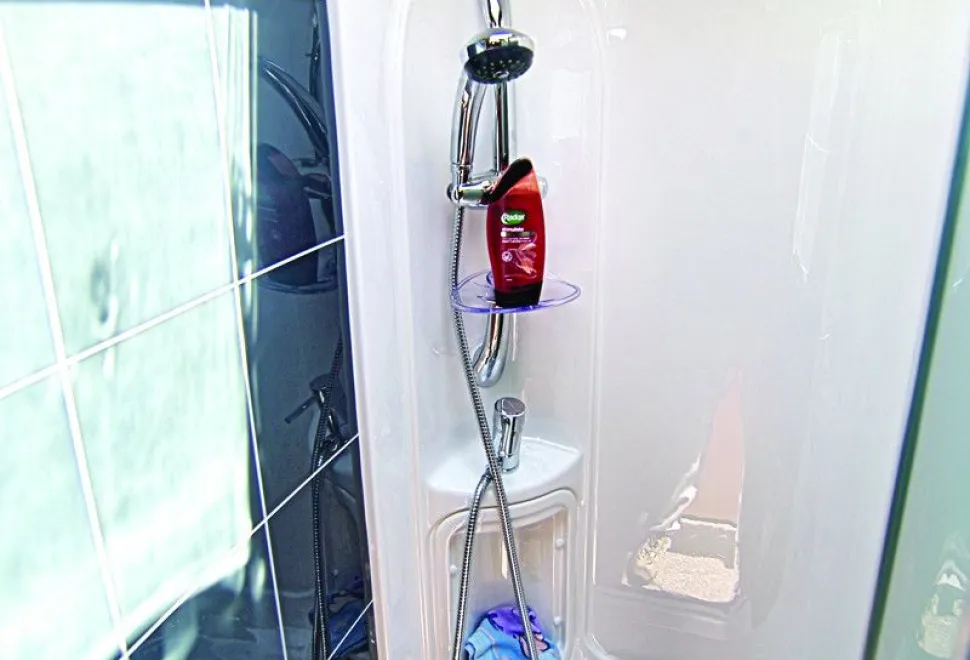
I need two things to get going in the morning: a cup of coffee and loads of hot water for the shower, so while the former was brewing and after a quick 10-minute burst on the Alde boiler controls, I volunteered to be the first test guinea-pig for the central shower cubicle.
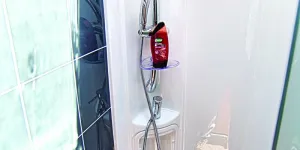
The dark blue plastic tiles have really lifted the little room dramatically out of the sea of plain boring white that we find in most caravans. The shower riser can be adjusted to a height that means the (mightily powerful) shower jet isn’t directed at my midriff. And while bottle stowage space is only average, the ribbed foot-step beneath (actually a clever way of disguising one of the wheel arches) gives you a good place for the shampoo bottles.
Much as I could have lingered over my ablutions for hours (it was Sunday, after all), the aroma of sizzling bacon soon tempted me out of the bathroom, and as I set to, helping with the eggs and toast, I couldn’t help noticing that the domestic-standard cooker had only three gas burners. One of them – considerably bigger than the others – is intended for a wok or the like, but you’d think over £22,000 would warrant a full quartet of gas burners, or maybe three burners and an electric hotplate.
Park near Grantham. And, to be fair (assuming I wasn’t imagining it), you could hardly blame them. I mean, this is one outfit that positively demands you look at it, whether you want to or not.
The Jeep tow vehicle doesn’t help in this respect, of course: the Cherokee was never the most shrinking of violets, but this 2009 model, with its pumped-up body and chrome toothy grin is difficult to miss.
Then comes the caravan – all 7.96m of it. Don’t get me wrong: it’s not tastelessly brassy by any means, but you’d have to be chronically myopic to miss the multi-spoke alloy wheels (all four of them), blacked-out flush-fit windows and Lexus-style clear lens vertical tail lights. Thankfully, Explorer Group has chosen to go easy on the body addenda of its jaw-dropping flagship, so the graphics are simple and minimalist, the name badges contemporary and subtle.
With the Caravel pitched up (it’s easier than you might imagine, as it, like all big twins, responds to steering input from the car much more slowly than a smaller, single axle caravan ever would), evidence of good design common sense comes to the fore as you set about the business of turning it from mere on-tow trailer into home-from-home.
Take the water system, for instance. The water system is one of those terrific auto-fill affairs, which really makes a world of difference.
To use it, you simply plug your submersible pump into the caravan’s socket as usual, then nip inside and flick a switch, which causes the inboard tank to fill. Once the tank is full, the pump clicks off automatically. You can monitor the level constantly via the LED gauge, which is near to the door. As soon as the level drops, you flick another switch, and the fill system draws on the Aquaroll again to top it up. As long as you’ve got two Aquarolls (as we had during this test), you don’t need to make regular visits to the site’s water taps. It’s a brilliant system.
Staying with the water theme, this top-of-the-range model is equipped with the house-style Alde “wet” central heating system. This relies on a semi-sealed system of radiators and fluids – just like the system you have at home – for heat and hot water.
Given the unseasonably hot and dry spell we enjoyed throughout this trip, we never once touched the space heater. The water heater – especially when boosted by the electric element – produced loads of piping hot water in seemingly no time at all. Getting your head around the various hieroglyphics on the LCD control panel required me to break the habit of a lifetime and consult the handbook, but it’s all very straightforward once you’ve used it a couple of times.
Stepping inside into a world of leather is always a pleasurable experience in a caravan, and the Caravel’s ambience is frankly second to none. The mink-coloured hide smells like leather should, and it’s blissfully cool to the touch, even when the weather’s hot. Well worth the grand-or-so extra for the leather option. We loved the dark blue curtains and metal tie-backs, too, even if the tie-backs themselves weren’t terribly effective in use. The flush-fitted windows and top-quality pleated blinds mean you can fine-tune how much (or how little) light you want to enter the caravan.
That said, I doubt you’d ever feel you were being blinded by the light in this caravan, for it’s another model that’s unfortunate enough to be saddled with the ultra-dark-tinted windows that Explorer Group seems to be obsessed with. I’ll admit that they look terrific from the outside, but they really make the interior feel gloomy, even on sunny days, and you’re always fooled into believing that the weather outside is darker and gloomier than it really is.
On a more positive note, storage throughout this caravan is mighty impressive. As usual, one of the first things we did, once the caravan had been set up, was to nip into a nearby town (Grantham, in this instance) and stock up with various groceries for the days ahead.
All our tins and packets disappeared with consummate ease into the various high and low lockers and cupboards. Mrs Le C was particularly enamoured with the three wire baskets that emerge from the locker beneath the sink, which we used to stow everything from tins and plates to a bottle of wine. The head lockers are of a good size and sensibly shaped.
Following a familiarisation stroll around Woodland Waters’ impressive 70-plus acres of grounds, we wandered back to the Caravel for dinner and, given the still-warm weather, decided to forgo a hot meal in favour of a cold one.
This is where the Caravel’s Thetford 175-litre fridge-freezer came to the fore, and I have to say that in my opinion it’s the best of its type on the market today. Firing it up entails nothing more than the press of a button. The resultant display on the LCD read-out is both easy to read and simple to understand.
It was a pleasant surprise to find that we didn’t have to use the main folding dining table for dinner, too. Obviously, if you have a couple of guests for dinner, then you will need to employ it. But for two of us, the sliding chest-top table extension offered room enough for our various plates, bowls, glasses and condiments.
Being every inch the New Man, I volunteered to do the washing up, and was delighted to use what is almost certainly the single biggest mixer tap I’ve ever seen in a caravan. No worries about filling a kettle from that one, I can tell you.
Once again, the Alde system came up trumps with plenty of piping hot water, and the mini-tsunamis from the vigorous scrubbings in the washing up bowl were safely contained by the sensibly deep-sunk sink and drainer.
After a hard day’s relaxing, we decamped back into the lounge. We never take a television away with us on these test trips, so out came the paperbacks and the playing cards, and on went the stereo. I’d already clocked the Caravel’s MP3-friendly stereo on the Explorer website a few days before, so I fished out my iPod, aux-in lead and conjoined the two. Then it was a simple matter of selecting “aux” on the stereo’s source button, and the lounge was filled with the soothing sounds of, er, Nirvana.
So, a great set-up, but it does have a fundamental flaw that really needs addressing on future models. The problem is that the stereo unit isn’t recessed quite enough within its roof locker. This means that, with an aux-in lead plugged into its face-plate, the locker door won’t shut without pressing hard on the lead itself – which could eventually damage the lead irreparably. You can leave the door open, of course, but if there’s a hard protuberance in a given closed environment, chances are I’ll crack my head on it at least twice. The solution? Recess the stereo an inch or so further into the locker. Job done.
The Caravel’s island bed measures a healthy 1.86m by 1.37m, and is garnished with his ‘n’ hers split-level wardrobes, roof lockers, reading lights, radio speakers – and even wall-mounted radiators. Come the morning, the lady of the house can repair to the nifty little dressing table in the offside front corner (complete with multi-adjustable mirror), while the unit in the opposing corner can be used as a television station. There’s an astonishing amount of storage space beneath the bed-base, too.
I need two things to get going in the morning: a cup of coffee and loads of hot water for the shower, so while the former was brewing and after a quick 10-minute burst on the Alde boiler controls, I volunteered to be the first test guinea-pig for the central shower cubicle.
The dark blue plastic tiles have really lifted the little room dramatically out of the sea of plain boring white that we find in most caravans. The shower riser can be adjusted to a height that means the (mightily powerful) shower jet isn’t directed at my midriff. And while bottle stowage space is only average, the ribbed foot-step beneath (actually a clever way of disguising one of the wheel arches) gives you a good place for the shampoo bottles.
Much as I could have lingered over my ablutions for hours (it was Sunday, after all), the aroma of sizzling bacon soon tempted me out of the bathroom, and as I set to, helping with the eggs and toast, I couldn’t help noticing that the domestic-standard cooker had only three gas burners. One of them – considerably bigger than the others – is intended for a wok or the like, but you’d think over £22,000 would warrant a full quartet of gas burners, or maybe three burners and an electric hotplate.
Our Verdict
verdict
The Buccaneer Caravel is a stunning looking caravan with high spec including Alde heating, a 175-litre fridge-freezer. Certain aspects of the washroom (it’s a bit small), kitchen (only a three-burner hob) and lounge (the position of the stereo) disappoint a little, and those tinted windows will, we’re sure, continue to polarise opinion among buyers. But, as an overall package, this leather-lined luxury cruiser scores a solid ten out of ten on the desirability-ometer.
Advantages
Automatic fill water system
Alde heating
Leather upholstery option
175-litre fridge-freezer
Disadvantages
The ultra-dark-tinted windows make the interior feel gloomy
Only three gas burners


