
Avondale Osprey
Image
Key Features
Model Year
2008
Product Class
Single Axle
Price from (£)
£15495
Berths
4
Full Review
CONFESSION time: I have a bit of a soft spot for Avondale’s ‘Bird’ caravans. The first-ever test caravan to come my way was a 1995 Avondale Mayfly, (not a bird, admittedly) complete with cheerfully twee curtains, fiddle-rails galore and a dinky little rear lantern window.
After years spent labouring under the misapprehension that a neighbour’s rather austere early 1970s ABI Monza was as good as caravans got, it seemed to me to be the height of camping luxury and modernity.
I also seem to recall that the prose which appeared in print shortly afterwards was as purple as it was possible to get this side of a manufacturer’s advertisement.
Twelve years later, and the rosy spectacles have long gone (as has the Mayfly, which breathed its last in 2001), but Avondale’s range of single-axle clubman caravans remains, albeit in a barely recognisable form.
The Osprey, tested here in its 2008 guise, first appeared back in 1999 and is still going strong today, thanks in no small part, I would imagine, to the rallying fraternity who clearly appreciate its tried-and-tested layout and unusually opulent feel.
It works as a family caravan, that’s true, but I’d lay good odds that 90 per cent of Osprey customers are retired couples who divide their time between full-blown club sites and facility-light CLs and CSs.
The 2008 Osprey is almost indistinguishable from the 2007 model, which is not necessarily a bad thing. Externally, the story is much the same as it was in 2007, with a second glance needed to distinguish it from the lesser Argente range.
Look closely, and you’ll spot a smooth-finish front locker door where the Argente’s continues with the body crease that begins beneath the grab handles, while its considerably bigger – and more heavily moulded – front panel lifts the inevitable roof join discreetly out of view.
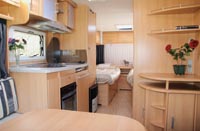 Step inside and the differences are much more obvious. The Argente’s flat-fronted framed locker doors and simple handles are replaced by solid-looking, curved unitary doors that have a much richer hue and more upmarket handles.
The curvier central table unit is lifted, too, by the provision of a sliding tambour door at floor level, although finding the same corner pods and 12v lights as fitted to cheaper Avondales undoes a little of that good work.
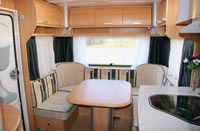
Our test model was equipped with the warmer-looking ‘Ashford’ soft furnishing scheme, which brings with it the added benefit of entirely contrasting chocolate brown scatter cushions; opt for the simpler, greener ‘Newbury’ scheme, and the scatters are finished in the exact same material.
For decadent mornings with the papers, Osprey owners can choose between either a parallel (‘S’) or L-shaped (‘L’) main lounge design at no extra cost.
The L-shaped lounge arguably makes more sense in the fixed-bed Eagle than it does in the EIY (erect it yourself) bed Osprey, however, simply because the double bed from any L-shaped lounge is almost always smaller than the parallel equivalent.
And so it is here: the Osprey S’s double bed measures a generous 6ft 8in by 5ft 10in, while the Osprey L’s is just 4ft 2in wide, if exactly the same length. The latter loses out on the former’s twin single bed option, too.
That said, there’s something decadent about stretching out in an L-shaped lounge. As ever, whether this is reason enough to make do with a smaller bed (and slightly compromised dining arrangements) is something only you can decide.
Whichever Osprey you choose, you still get the eternally handy nearside single dinette, complete with fold-out cantilever bunk overhead. As somewhere to tuck into the bacon ‘n’ eggs first thing without having to first wrestle with the bed cushions, this is a terrific area, and one whose single bed provision may well appeal to those who prefer to sleep apart.
So far, so average, then. But just look at the size of that kitchen. Erect a small net halfway along that expanse of worktop space and you could almost play table tennis on it. It’s huge.
It’s well-equipped, too. You don’t get the big 180-litre fridge-freezer that’s in the range-topping Land-Ranger DD, but the LCD-controlled 113-litre combination affair you do get is hardly penny-pinching, especially when you factor in the domestic-style unitary cooker, 800W microwave oven and large sink/drainer.
Out back, the Osprey and Avocet have had their enormous, full-width end washrooms tweaked for 2008, leaving them looking and feeling more special than before. There was never much wrong with the trademark cylindrical shower unit or solid-feeling washbasin, anyway, and the walk-in wardrobe is as big as ever.
 As somewhere to brandish the Vosene and Colgate then slip into your clothes, this washroom takes some beating, not least as the top-notch pull-together window blinds guarantee absolute privacy.
Towcar-wise, you’re looking at something weighing more than 1700kg if you’re in the habit of loading your caravans up to their MTPLM – so Nissan Pathfinder, or similar.
Keep the load down to 50kg or so per occupant, and something weighing about 1600kg (one of the bigger new Mondeo estates or a Honda CR-V, for example) and packing a healthy turbocharged diesel engine should more than suffice.
The latest ‘Birds’ come factory-equipped with AL-KO’s proven AKS hitch stabiliser and remarkable ATC System, this latter gently applying the caravan’s brakes should on-board sensors detect that a snake is starting to get out of control.
Fact-file:
Price: £15,495
Berths: 4
MRO: 1270kg (25cwt)
Payload: 230kg (4.5cwt)
MTPLM: 1500kg (29.5cwt)
Internal length: 18ft 5in (5.65m)
Overall length: 23ft 3in (7.09m)
Overall width: 7ft 5in (2.29m)
Overall height: 8ft 6in (2.59m)
Internal headroom: 6ft 4in (1.93m)
Bed sizes: Front single 1.81m x 0.70m (5ft 10in x 2ft 3in), front single 1.89m x 0.70m (6ft 2in x 2ft 3in); or 1 front double 2.08m x 1.81m (6ft 8in x 5ft 10in); nearside single 1.83m x 0.630m (6ft x 2ft 1in) and nearside bunk 1.72m x 0.54m (5ft 6in x 1ft 8in).
• A full version of this review appeared in the April 2008 issue of Which Caravan magazine. To subscribe to the magazine, click here.
After years spent labouring under the misapprehension that a neighbour’s rather austere early 1970s ABI Monza was as good as caravans got, it seemed to me to be the height of camping luxury and modernity.
I also seem to recall that the prose which appeared in print shortly afterwards was as purple as it was possible to get this side of a manufacturer’s advertisement.
Twelve years later, and the rosy spectacles have long gone (as has the Mayfly, which breathed its last in 2001), but Avondale’s range of single-axle clubman caravans remains, albeit in a barely recognisable form.
The Osprey, tested here in its 2008 guise, first appeared back in 1999 and is still going strong today, thanks in no small part, I would imagine, to the rallying fraternity who clearly appreciate its tried-and-tested layout and unusually opulent feel.
It works as a family caravan, that’s true, but I’d lay good odds that 90 per cent of Osprey customers are retired couples who divide their time between full-blown club sites and facility-light CLs and CSs.
The 2008 Osprey is almost indistinguishable from the 2007 model, which is not necessarily a bad thing. Externally, the story is much the same as it was in 2007, with a second glance needed to distinguish it from the lesser Argente range.
Look closely, and you’ll spot a smooth-finish front locker door where the Argente’s continues with the body crease that begins beneath the grab handles, while its considerably bigger – and more heavily moulded – front panel lifts the inevitable roof join discreetly out of view.
Step inside and the differences are much more obvious. The Argente’s flat-fronted framed locker doors and simple handles are replaced by solid-looking, curved unitary doors that have a much richer hue and more upmarket handles. The curvier central table unit is lifted, too, by the provision of a sliding tambour door at floor level, although finding the same corner pods and 12v lights as fitted to cheaper Avondales undoes a little of that good work.
Our test model was equipped with the warmer-looking ‘Ashford’ soft furnishing scheme, which brings with it the added benefit of entirely contrasting chocolate brown scatter cushions; opt for the simpler, greener ‘Newbury’ scheme, and the scatters are finished in the exact same material.
For decadent mornings with the papers, Osprey owners can choose between either a parallel (‘S’) or L-shaped (‘L’) main lounge design at no extra cost.
The L-shaped lounge arguably makes more sense in the fixed-bed Eagle than it does in the EIY (erect it yourself) bed Osprey, however, simply because the double bed from any L-shaped lounge is almost always smaller than the parallel equivalent.
And so it is here: the Osprey S’s double bed measures a generous 6ft 8in by 5ft 10in, while the Osprey L’s is just 4ft 2in wide, if exactly the same length. The latter loses out on the former’s twin single bed option, too.
That said, there’s something decadent about stretching out in an L-shaped lounge. As ever, whether this is reason enough to make do with a smaller bed (and slightly compromised dining arrangements) is something only you can decide.
Whichever Osprey you choose, you still get the eternally handy nearside single dinette, complete with fold-out cantilever bunk overhead. As somewhere to tuck into the bacon ‘n’ eggs first thing without having to first wrestle with the bed cushions, this is a terrific area, and one whose single bed provision may well appeal to those who prefer to sleep apart.
So far, so average, then. But just look at the size of that kitchen. Erect a small net halfway along that expanse of worktop space and you could almost play table tennis on it. It’s huge.
It’s well-equipped, too. You don’t get the big 180-litre fridge-freezer that’s in the range-topping Land-Ranger DD, but the LCD-controlled 113-litre combination affair you do get is hardly penny-pinching, especially when you factor in the domestic-style unitary cooker, 800W microwave oven and large sink/drainer.
Out back, the Osprey and Avocet have had their enormous, full-width end washrooms tweaked for 2008, leaving them looking and feeling more special than before. There was never much wrong with the trademark cylindrical shower unit or solid-feeling washbasin, anyway, and the walk-in wardrobe is as big as ever.
As somewhere to brandish the Vosene and Colgate then slip into your clothes, this washroom takes some beating, not least as the top-notch pull-together window blinds guarantee absolute privacy.Towcar-wise, you’re looking at something weighing more than 1700kg if you’re in the habit of loading your caravans up to their MTPLM – so Nissan Pathfinder, or similar.
Keep the load down to 50kg or so per occupant, and something weighing about 1600kg (one of the bigger new Mondeo estates or a Honda CR-V, for example) and packing a healthy turbocharged diesel engine should more than suffice.
The latest ‘Birds’ come factory-equipped with AL-KO’s proven AKS hitch stabiliser and remarkable ATC System, this latter gently applying the caravan’s brakes should on-board sensors detect that a snake is starting to get out of control.
Fact-file:
Price: £15,495
Berths: 4
MRO: 1270kg (25cwt)
Payload: 230kg (4.5cwt)
MTPLM: 1500kg (29.5cwt)
Internal length: 18ft 5in (5.65m)
Overall length: 23ft 3in (7.09m)
Overall width: 7ft 5in (2.29m)
Overall height: 8ft 6in (2.59m)
Internal headroom: 6ft 4in (1.93m)
Bed sizes: Front single 1.81m x 0.70m (5ft 10in x 2ft 3in), front single 1.89m x 0.70m (6ft 2in x 2ft 3in); or 1 front double 2.08m x 1.81m (6ft 8in x 5ft 10in); nearside single 1.83m x 0.630m (6ft x 2ft 1in) and nearside bunk 1.72m x 0.54m (5ft 6in x 1ft 8in).
• A full version of this review appeared in the April 2008 issue of Which Caravan magazine. To subscribe to the magazine, click here.


