
Wheelhome Vikenze III-e 2TS campervan
Description
Base vehicle: Vauxhall Combo-e Life SE Price from: £58,000 Berths: 1 Travel seats: 2 Length: 4.40m Width: 1.92m Height: 1.84m Gross weight: 2,290kg Payload: 310kg
Key Features
Full Review
Wheelhome Vikenze III-e 2TS electric campervan review
Words and photos: Peter Vaughan
The last time I drove an electric campervan it was based on the Nissan e-NV200 van and had a realistic range of around 65 miles. Although its maker, probably rightly, was claiming a world first, it was always going have rather niche appeal.
That was eight years ago, when EV sales in the UK were still a paltry 2,500 cars per annum. Now, one in five new car sales is a battery electric model.
Since 2014, however, diesel has still had near total domination in leisure vehicles, with just a handful of companies offering conversions of the electric Nissan (later with 124 miles range) and, more recently, the BEV (battery electric) versions of the Toyota Proace and Vauxhall Vivaro (each claiming up to 205 miles range). All are, of course, small pop-top campers; we’re still a long way from seeing viable electric motorhomes.
The latest arrival in the world of electric campers comes from Wheelhome – not surprising as its campervans are usually super-compact (smaller, lighter vehicles are better suited to becoming EVs), and boss, Stephen Wheeler, is something of an electric evangelist. Not only a Tesla owner, he tows a Dashaway caravan (his own design) behind it and has now launched the company’s first fully electric campervan – the Vikenze III-e.
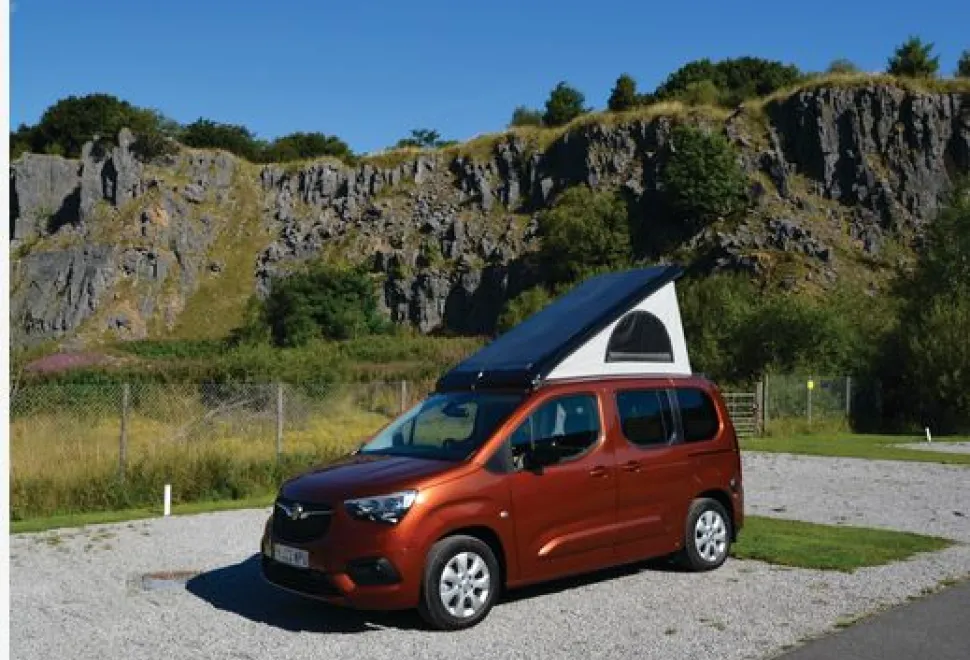
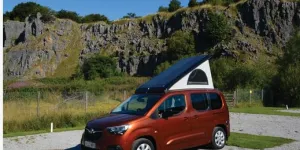
Based on the Vauxhall Combo-e Life, the camper is an evolution of the previous petrol-e engined conversion and looks all but identical on the outside. This sister vehicle to the Citroën ë-Berlingo, Peugeot e-Rifter and Toyota Proace City Electric is little bigger than a VW Golf in this standard-wheelbase version and Wheelhome converts the car, rather than the van, so the spec includes features such as lane keeping assistance, alloy wheels, a heated steering wheel, reversing camera and 8in touchscreen. As a daily driver and day van for popping to the beach, it looks perfect, but can it really offer more serious touring? That’s what we wanted to find out...
The Vikenze campervan range
This wouldn’t be coals to Newcastle but batteries to Buxton as I’d booked the Caravan and Motorhome Club’s scenic site at Grin Low. Sadly, the Managing Editor wouldn’t sign off my planned recce of charging points on the Côte d’Azur!
However, Buxton is still 100 miles from home and Stephen had already done some more serious testing, taking the very first Vikenze III-e (our test vehicle is the second) from Essex to Shetland. On that 2,104-mile round trip, he averaged a range of 150 miles, a figure we’d hope to beat in warm summer weather. More importantly, perhaps, the ‘fuel’ cost of his trip was only £125 – about a quarter of the price of diesel for a similar-sized campervan.
Delivered on a trailer to MMM HQ, the little Vauxhall’s dashboard registered a 94% full battery and claimed 160 miles of range (Vauxhall’s official figure is 174 miles with batteries full), so plenty to get us to Derbyshire. No need, then, to plug into our domestic supply at home, which would slowly ‘top up the tank’ via a normal three-pin socket. No necessity to have a wallbox, either, which costs around £800 and cuts charging time to seven-and-a-half hours (empty to full). Time to switch on and head off.
How it all works
It’s a bit of a surprise that you need a key to unlock and start the Combo-e but even more of a shock when you turn the ignition and not much happens. It takes a few drives before your brain stops waiting for some engine noise! A slight whirring can be heard as you pull away but the overwhelming impression of driving this camper is how quiet it is. Occasionally, road noise interferes, or over a pothole my cutlery clattered, but mostly silence is golden.
It’s a delightfully easy vehicle to pilot, too. There are, of course, no gears, just a toggle to engage drive or reverse and, having done that, the electric parking brake releases automatically. The performance from the 134bhp electric motor is quite lively, the controls are light and, although the ride seems a tad too firm, that is in line with most modern cars. Next to the ‘gear lever’ switch is another for drive modes – Power is for driving fully loaded, Eco reduces performance and cuts back on heating and air-con (no thanks, it was over 30 degrees on test), so Normal is what you’ll use most of the time.
Then, under D for drive is B for braking – or, actually, regenerative braking. Press this and the gauge on the right of the dash shows you how you’re actually topping up your battery each time you lift off the accelerator. It feels a bit unnatural at first, as if you’re braking quite firmly without touching the brake pedal, but, once you’ve learned its ways, it’ll increase your range – and give you smoother progress.
Another useful feature is the miles per kWh display. Think of this as the equivalent of MPG and remember that this Vauxhall has a 50kWh battery. We arrived on site with an average of 3.6m/kWh, which, multiplied by 50, would have given a total range of 180 miles (despite lots of stops for photos and filming) from a full battery. Even better, at the end of our test, a cross-country route and deliberately gentle driving achieved an impressive 4.8m/kWh. Then, in contrast, the last hurried dash home, including 70mph cruising, resulted in just 2.7m/kWh.
You can do the maths…
Recharging the campervan
If these figures still seem a little low compared with the 500-mile range you might get from a diesel campervan, remember that after a couple of hours (or, say, 120 miles) you’ll probably be ready for a rest stop. Park where there’s a 100W fast charger and you can go from 15% to 80% charge in around 30 minutes. It’s easy, too, as I discovered at the Tawny Owl pub, just off the A1, where I munched on scampi and chips while the Vauxhall dined on renewable electricity.
It’s at this point that you’ll need the services of an app, such as Zap-Map, showing the location of charging points, their cost and even whether they are working or occupied. But, if your camping is kept more local, you might be able to simply recharge on your campsite.
This is possible because the Vikenze is independent of the site electricity for cooking, lighting and even heating. Everything on the habitation side is powered by a huge bank of lithium batteries under the centre console in the cab – the 640Ah capacity is six times that of a typical campervan! Then there’s a 300W solar panel on the roof (three times the usual) and a 3,000W inverter to supply mains power to the appliances and three-pin sockets.
So, with the living area taking nothing from the site, the usual orange camping cable can top up your EV batteries. Wheelhome says that you’ll be drawing similar current to a caravan or motorhome using 230V for its fridge, heating, hot water, etc, and that you’ll usually add seven miles of range for every hour hooked up. Arrive at 5pm, leave at 10 the next morning, and you’ll have added 119 miles-worth of ‘fuel’ to get you home or to your next holiday stopover.
The campervan's layout
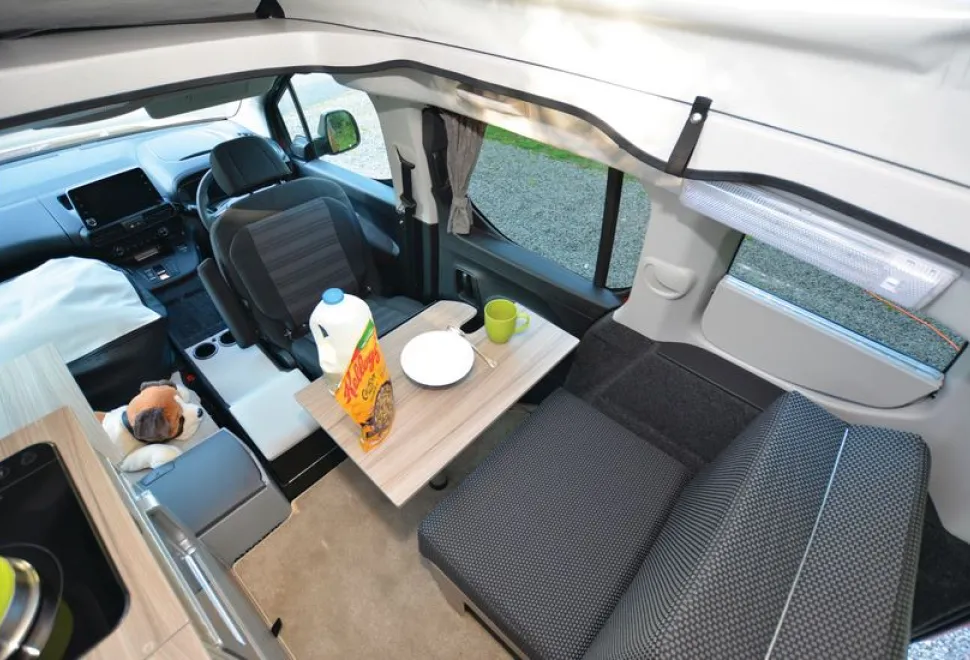
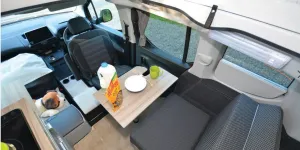
It’s electric power for Wheelhome’s own design of elevating roof, too, but the Essex firm has been doing this since 1996, so it’s no surprise that you just flick a switch to achieve up to 1.98m of headroom. That done, in around 18 seconds, the next job is to slide the driver’s seat forward, cleverly turning it into a rear-facing pew in the living area. The passenger seat, meanwhile, folds flat, revealing an optional soft bag that is designed to keep your bedding out of the way. And, if you have a small dog, there’s a slot-in platform for its bed here, too.
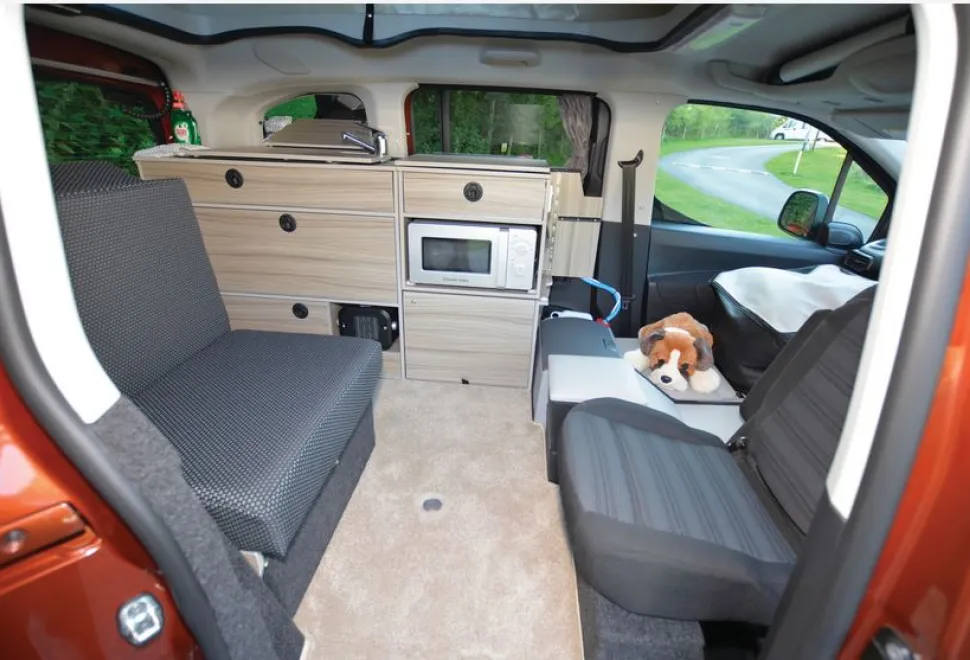
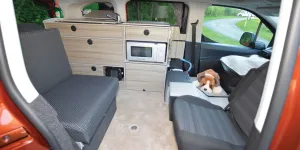
Now set up for camping, you have a nearside kitchen unit and two seats facing each other by the offside sliding door. It may seem odd to have things this way around (the mirror image of the earlier, petrol version), but the nearside sliding door cannot be opened when the EV charging cable is in situ, so instead this door is just used as a service point for the Porta Potti and the 10-litre fresh water carrier.
The offside door is the one you use for access, although you can also enter through the tailgate. Just inside, I found the rear-facing seat the more comfortable one for relaxing and watching YouTube, while the forward-facing chair is better suited to dining.
For this, you’ll need to add the island leg table, the (necessarily oddly shaped) top of which is actually the cover for the sink and draining board – Wheelhome has long been a master of dual-purpose design.
Two can sit face-to-face in this mini-dinette but you may need to watch for clashing feet/knees if you’re both tall. It’s unlikely to worry most buyers, though, as 90% of Wheelhome owners are singletons.
The storage
Presumably, they are also folk who don’t pack light, because the amount of storage incorporated into this rather tiny campervan is incredible. The locker under the seat is a lot more capacious than you’d expect but it’s the wind-down compartment in the roof that’s really clever. Wheelhome likens it to a large suitcase and you’ll pack it with plenty of clothes, towels, etc, but you can only reach your clobber with the roof raised.
Even more ingenious is the underfloor storage, accessed via a trapdoor under the carpet right at the back of the camper. This optional space (an extra £635) is said to be approximately 120 litres but only you (and other MMM readers) will know it’s there – great for security.
For solo use, I’d rather have this than the roof locker, which I banged my head on a couple of times, but, as a two-berth, the underfloor area becomes an essential as the ‘suitcase’ in the roof gets fitted with a mattress and becomes an upstairs bed (its storage space is lost).
The Vikenze's kitchen
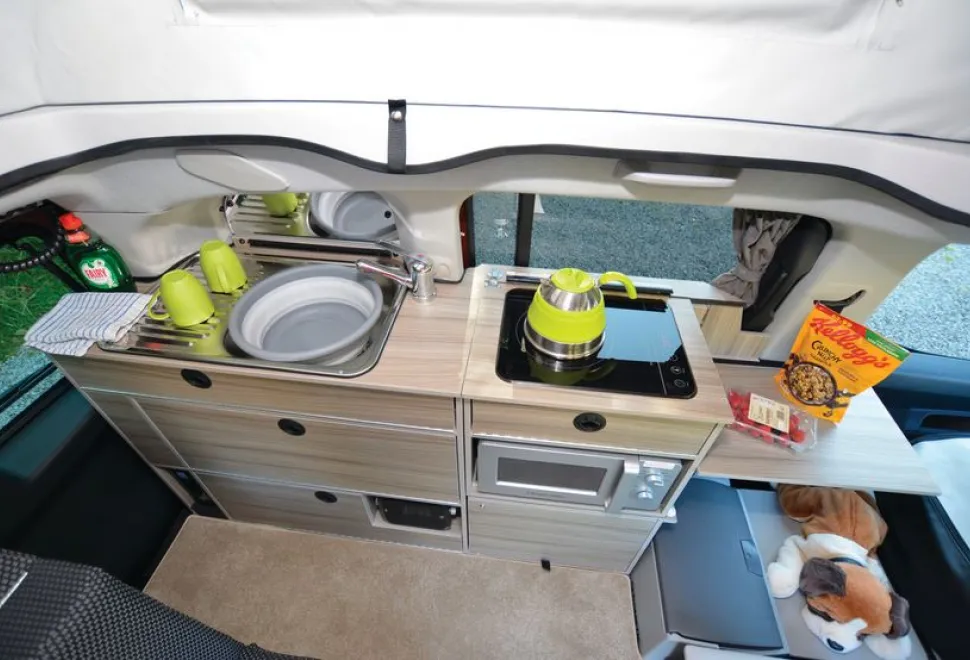
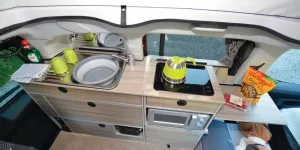
Not that the galley is short of cupboard capacity – it, too, seems to use every square inch. And, of course, there’s an 18-litre portable compressor fridge for all your perishable grub.
So, the fridge is electric but so, too, is all your cooking – a feature first introduced on a Wheelhome in 2013.
As standard, there’s a single-ring induction hob and a 600W microwave but you can also have a nine-litre built-in electric oven as a £168 option. The kitchen also comes with a full-sized sink with integral draining board, a small cutlery holder and an additional worktop above the fridge (which is the hob cover moved to a new position). Best of all, you can reach everything while sitting in the back seat, making cooking easy.
The Vikenze's bed
If you haven’t ordered the upper mattress, the only bed (as here) is created from the forward-facing seat, which simply slides forward and folds flat. The bed slopes away slightly where your feet go (on the base of the rear-facing seat), but this didn’t seem to matter and the mattress length is a fairly generous 1.91m.
The aisle alongside the kitchen is retained with the bed made, so there’s standing room for undressing, but cleverer still is the fact that the Porta Potti is easily reached for night-time use. The section of galley containing the microwave and hob simply swings away to the right, then a lid lifts to reveal the loo, where it can simply be used in situ.
Our Verdict
Not everyone will be ready for the extra planning involved in EV motoring, nor accept downsizing to this degree, but Wheelhome’s use of space in the compact Combo is remarkable and the fact that its EV batteries can be charged on a campsite makes all the difference.
Disadvantages


