
Swift Mondial FB (2010)
Image
Image
Image

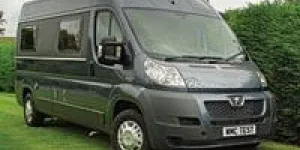
Description
Swift Mondial FB 2010
Key Features
Model Year
2010
Product Class
High top
Product Model Base
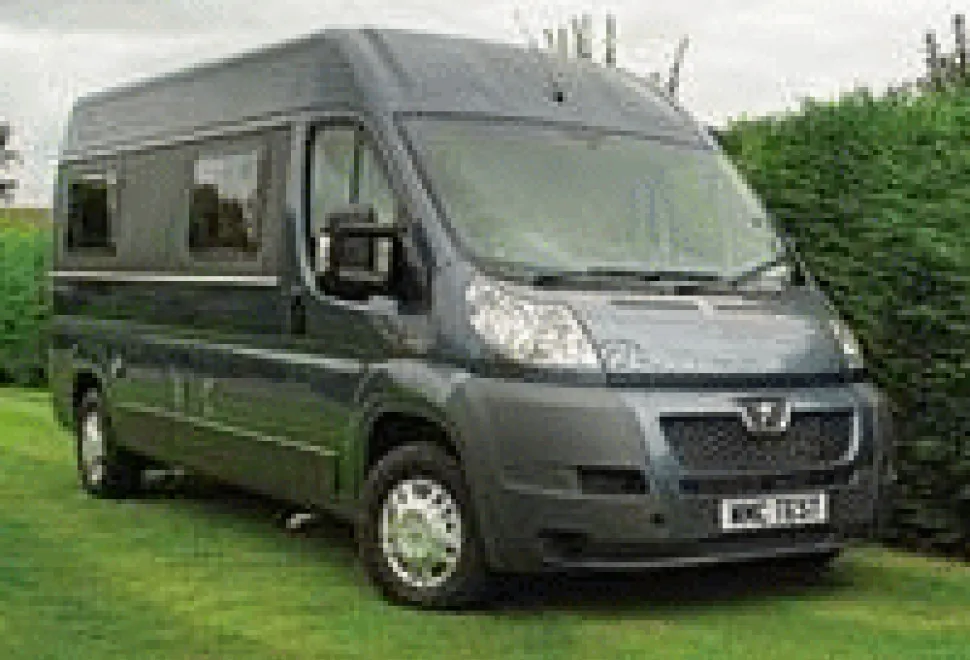
Peugeot Boxer
Price from (£)
£39095
Length (m)
6.00
Berths
3
Belted seats
4
Main Layout
French Bed
Full Review
STEPPING inside the Mondial FB’s generous sliding door aperture produces a familiar-looking picture.
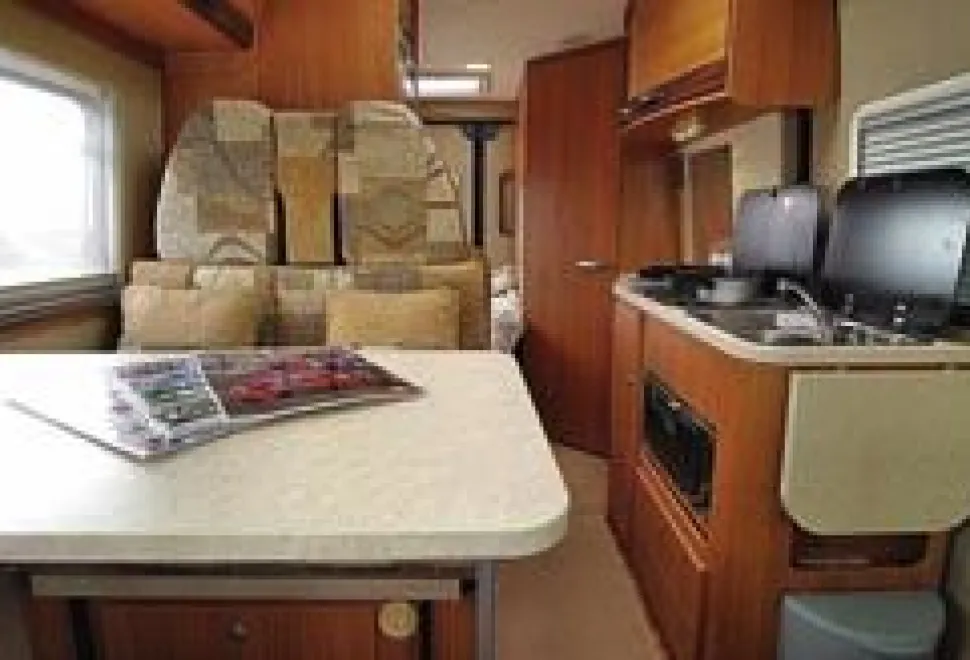
In fact, if you currently own an Autocruise Pace, you’ll feel right at home in the FB’s lounge area, for it’s practically identical, right down to the half-dinette (which conceals a pair of fully-belted travel seats), expensive-looking duo-tone cabinetry and swivel cab seats.
The upholstery pattern is slightly different, but only a practised eye would ever spot it.
As with the Pace, the Mondial’s half-dinette sits atop a raised dais that, in order to bring it level with cab area (and so avert the dreaded ‘swinging feet’ syndrome), is a good six inches higher than the floor level elsewhere in the ’van, where headroom measures a coachbuilt-rivalling 6ft 3in.
The dinette seating position is typically a little upright (although the more svelte owner should be able to get his or her feet up on the seat base at a push), but we’d wager most owners will gravitate naturally to the more adjustable cab seats for those lazy afternoons spent in the company of the Sunday papers and a good bottle of Shiraz.
Dining for two (or even three) is perfectly comfortable herein, too. In the absence of any trick table extensions, the occupier of the cab passenger seat will have to go hungry, but tête à tête dining for two – the FB’s most likely dining scenario – will be a spacious and relaxing affair with easy access to the nearby kitchen between courses.
Speaking of which, there’s more Pace-alike design – at first glance, at any rate – in the FB’s kitchen – and that’s by no means a bad thing.
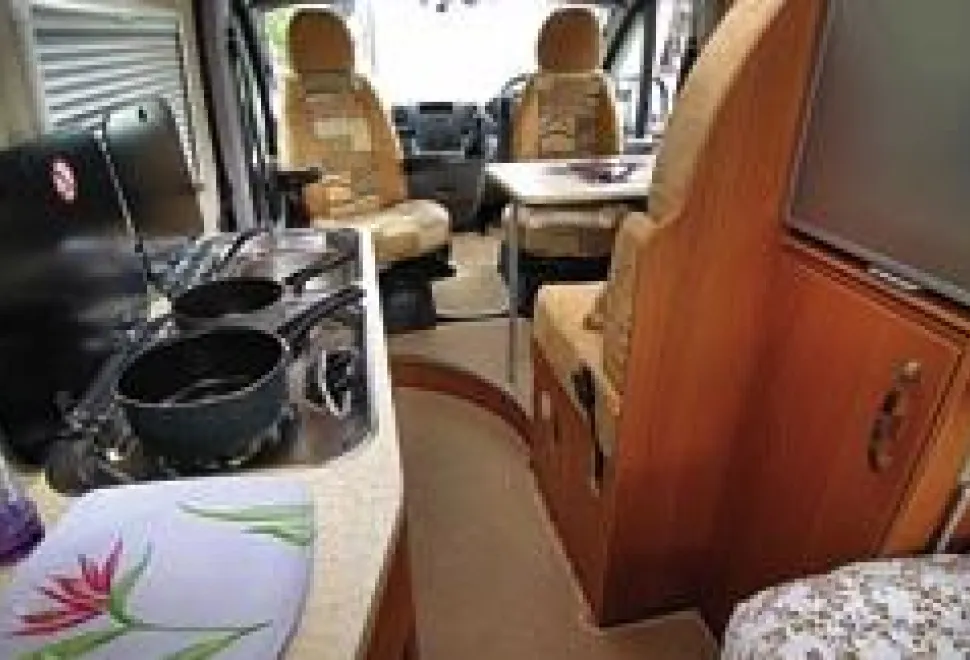
The hob comprises a manual spark-ignition two-burner Smev, aided and abetted by a low set (and also manual spark ignition) Smev grill beneath, below which are a pair of generously-proportioned drawers.
This, however, is where the similarities to the Pace end, for worktop space to the left of the hob is extremely generous (we’ll come to one of the reasons why a little later) – and not just for a van conversion.
In fact, we can think of a few coachbuilts that would kill for this amount of worktop space, especially with the Pace-alike fold-up extension by the sliding door area deployed.
Storage space hereabouts comprises a pair of eye-level lockers (one of which is pre-designed to accommodate a flatscreen TV, with its 12V/230V sockets and aerial point, the other fitted with fixed crockery racks), two large low cupboards and a decent-sized open shelf behind the folding extension flap.
There’s more, too – the fridge (a Waeco compressor-type) lives opposite at waist height, and above it sits a large, and surprisingly deep locker.
The door beneath the fridge, incidentally, opens to reveal the half wardrobe – it sports more than a modicum of hanging space on its longitudinal rail, although ultimate storage capacity is offset a little by the presence of the Sargent charger/trips/fuses unit.
And so to the FB’s intriguing Unique Selling Point. To be honest, trying to squeeze a French bed into a van conversion shouldn’t really work – the X2/50 may be a big old Hector (certainly compared to the slim-hipped Ford Transit), but it’s certainly no coachbuilt.
And yet, the tape measure tells the story: with the inner section of bed base folded and slotted into position, the bed itself measures a more than respectable 6ft 1in in length, with a maximum of 3ft 10½in (and a minimum of 3ft 3in) available across.
To put that into perspective, the French bed in Swift’s own Bolero 680FB low-profile (a motorhome that is more than 7m long overall) measures 6ft 2in by 4ft 3in.
Better still – certainly compared to the bed in the Pace – this area can be put to good use during the day.
First thing in the morning, you can sit on the end of the bed and use the mirror behind the end of the kitchen worktop for hair and beauty.
And as well as folding and clipping into place, the inner bed base can be removed completely (as can the accompanying half of the mattress), opening up either a good-sized single bed, or a quasi-settee.
Leave it in place, and you can leave your bedding there, the raised bed base acting as a sort of securing lip, and still get the bulkiest of IKEA flat-pack furniture in through the rear doors thanks to the near two-foot gap between the bed and washroom wall opposite.
The folded bed base is sturdy enough to use as a grab handle to haul yourself in through the rear doors, too.
In fact, heretical as it may sound, this seems to me to be a much more practical and versatile approach to the design of a dual-role vehicle than that of the transverse bed layout phenomenon sired by the Adria Twin.
Storage space beneath the bed may be a little more restricted, thanks to the presence of the offside rear wheelarch, but there’s still plenty of room left for a raft of camping gear, folding bikes etc.
And the washroom? You’re unlikely to get terribly excited about the slightly old fashioned tip-up washbasin, but the vanity unit itself is well-designed with plenty of storage space, and with the curtain pulled around, there’s a surprising amount of showering space. Again, we can think of one or two coachbuilts that would benefit from similar levels of elbow room.
A full version of this review was first published in the November 2009 issue of Which Motorcaravan magazine.
In fact, if you currently own an Autocruise Pace, you’ll feel right at home in the FB’s lounge area, for it’s practically identical, right down to the half-dinette (which conceals a pair of fully-belted travel seats), expensive-looking duo-tone cabinetry and swivel cab seats.
The upholstery pattern is slightly different, but only a practised eye would ever spot it.
As with the Pace, the Mondial’s half-dinette sits atop a raised dais that, in order to bring it level with cab area (and so avert the dreaded ‘swinging feet’ syndrome), is a good six inches higher than the floor level elsewhere in the ’van, where headroom measures a coachbuilt-rivalling 6ft 3in.
The dinette seating position is typically a little upright (although the more svelte owner should be able to get his or her feet up on the seat base at a push), but we’d wager most owners will gravitate naturally to the more adjustable cab seats for those lazy afternoons spent in the company of the Sunday papers and a good bottle of Shiraz.
Dining for two (or even three) is perfectly comfortable herein, too. In the absence of any trick table extensions, the occupier of the cab passenger seat will have to go hungry, but tête à tête dining for two – the FB’s most likely dining scenario – will be a spacious and relaxing affair with easy access to the nearby kitchen between courses.
Speaking of which, there’s more Pace-alike design – at first glance, at any rate – in the FB’s kitchen – and that’s by no means a bad thing.
The hob comprises a manual spark-ignition two-burner Smev, aided and abetted by a low set (and also manual spark ignition) Smev grill beneath, below which are a pair of generously-proportioned drawers.
This, however, is where the similarities to the Pace end, for worktop space to the left of the hob is extremely generous (we’ll come to one of the reasons why a little later) – and not just for a van conversion.
In fact, we can think of a few coachbuilts that would kill for this amount of worktop space, especially with the Pace-alike fold-up extension by the sliding door area deployed.
Storage space hereabouts comprises a pair of eye-level lockers (one of which is pre-designed to accommodate a flatscreen TV, with its 12V/230V sockets and aerial point, the other fitted with fixed crockery racks), two large low cupboards and a decent-sized open shelf behind the folding extension flap.
There’s more, too – the fridge (a Waeco compressor-type) lives opposite at waist height, and above it sits a large, and surprisingly deep locker.
The door beneath the fridge, incidentally, opens to reveal the half wardrobe – it sports more than a modicum of hanging space on its longitudinal rail, although ultimate storage capacity is offset a little by the presence of the Sargent charger/trips/fuses unit.
And so to the FB’s intriguing Unique Selling Point. To be honest, trying to squeeze a French bed into a van conversion shouldn’t really work – the X2/50 may be a big old Hector (certainly compared to the slim-hipped Ford Transit), but it’s certainly no coachbuilt.
And yet, the tape measure tells the story: with the inner section of bed base folded and slotted into position, the bed itself measures a more than respectable 6ft 1in in length, with a maximum of 3ft 10½in (and a minimum of 3ft 3in) available across.
To put that into perspective, the French bed in Swift’s own Bolero 680FB low-profile (a motorhome that is more than 7m long overall) measures 6ft 2in by 4ft 3in.
Better still – certainly compared to the bed in the Pace – this area can be put to good use during the day.
First thing in the morning, you can sit on the end of the bed and use the mirror behind the end of the kitchen worktop for hair and beauty.
And as well as folding and clipping into place, the inner bed base can be removed completely (as can the accompanying half of the mattress), opening up either a good-sized single bed, or a quasi-settee.
Leave it in place, and you can leave your bedding there, the raised bed base acting as a sort of securing lip, and still get the bulkiest of IKEA flat-pack furniture in through the rear doors thanks to the near two-foot gap between the bed and washroom wall opposite.
The folded bed base is sturdy enough to use as a grab handle to haul yourself in through the rear doors, too.
In fact, heretical as it may sound, this seems to me to be a much more practical and versatile approach to the design of a dual-role vehicle than that of the transverse bed layout phenomenon sired by the Adria Twin.
Storage space beneath the bed may be a little more restricted, thanks to the presence of the offside rear wheelarch, but there’s still plenty of room left for a raft of camping gear, folding bikes etc.
And the washroom? You’re unlikely to get terribly excited about the slightly old fashioned tip-up washbasin, but the vanity unit itself is well-designed with plenty of storage space, and with the curtain pulled around, there’s a surprising amount of showering space. Again, we can think of one or two coachbuilts that would benefit from similar levels of elbow room.
A full version of this review was first published in the November 2009 issue of Which Motorcaravan magazine.
Our Verdict
The Swift Mondial’s ixed bed layout is impressive and would work well for a couple.
Advantages
Unusually large fixed bed
Good kitchen with lots of worktop space
Good storage space under bed accessed from rear
Twin cab swivel seats and four travel seats
Disadvantages
Half dinette only dines two


