
Rimor Horus 66 high-top campervan

Description
Combining a perennially popular UK layout with keen pricing seems like a great recipe from Italy
Key Features
Full Review
Words and photos: Peter Vaughan
The Rimor Horus 66
Up until now, Rimor’s Horus range – named after an Egyptian falcon-headed god – has offered the predictable continental campervan layouts with fixed beds (double, bunks or singles) at the rear. However, at the February NEC show, it launched a model not only developed for British buyers, but available exclusively on these isles.
The new Horus 66 is not just right-hand drive, it also has its sliding door on our nearside, while inside is a layout that will be completely familiar to buyers of British-built campervans.
This isn’t the company’s first rear lounge model (it already makes the Super Brig Suite coachbuilt). However, with this newcomer, it is going headlong into competition with firm favourites like the Auto-Trail V-Line, Elddis Autoquest CV20 and Swift Select 122.
It does so with a keen price tag, but then Rimor has aways been a brand with value for money at its heart.
The base vehicle
While Rimor motorhomes use a mix of Fiat and Ford chassis, the campervan range sticks solely with the Ducato and there’s no change to that policy here.
So, what you see is a six-metre, long-wheelbase Fiat with a maximum gross weight of 3,500kg (other entry-level models save money with a 3,300kg van), and the now entry-level 140bhp engine and six-speed manual gearbox. The nine-speed automatic is available for an additional £2,600, while metallic grey is the only alternative to the standard white – for an extra £995.
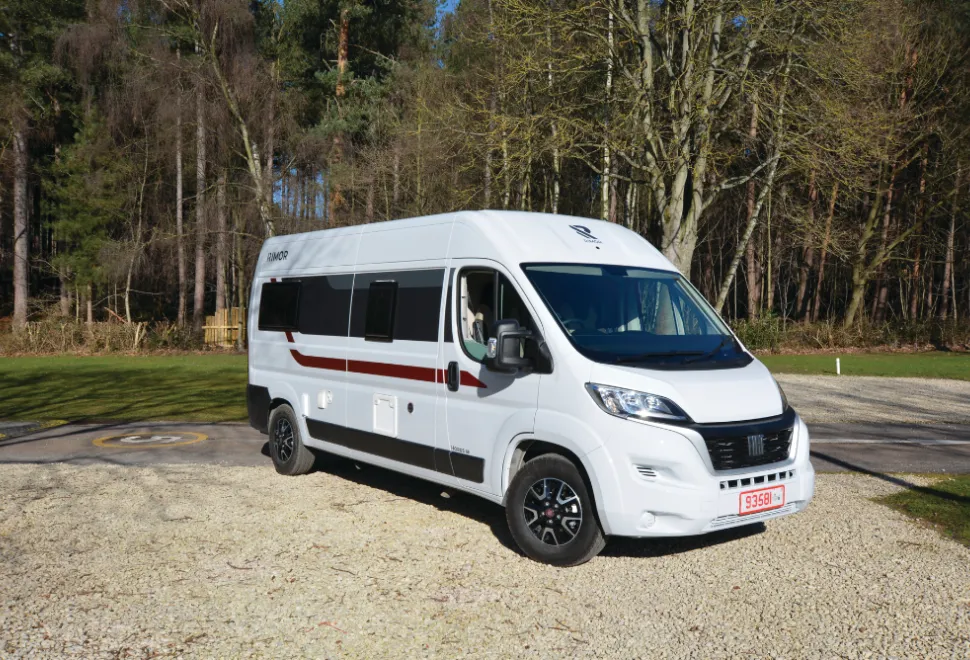
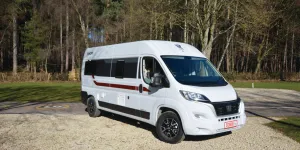
Outside, you can see this is, of course, the latest Series 8 version of the Ducato by virtue of the bold Fiat branding on the grille – Rimor must be one of the few firms not to replace this with its own name.
Externally, there are also caravan-style windows, which sit proud of the body and simple grey and red graphics that do enough to say ‘leisure vehicle’ without being garish.
The colour-coded front bumper, electric step (with automatic retraction on starting) and external shower point (on the offside) are all standard features, while the 16in alloy wheels are an optional extra (at £995).
The exterior
Unusually on an imported model, the Horus also comes with a 25kg underslung LPG tank, which should cater for a lot of camping as it only has to supply the cooker and, if there’s no hook-up, the water heater (space heating comes from a Webasto diesel-fired system).
The blown-air heater coped supremely easily with some very wintry conditions (including snow) during our test and, with sub-zero overnight lows, it was reassuring to find the 85-litre fresh water tank mounted inboard.
The waste tank (90 litres) is mounted underneath but, here again, the Horus betters many rivals with a large-bore drain that is operated by a T-handle rather than a fiddly little tap – speed of emptying is like comparing the hare and the tortoise.
What’s included
On the base vehicle front, Rimor keeps things simple. You get what you need but miss out on some of the fancy fittings available on these newest-generation Ducatos.
What matters most, perhaps, is that the manual gearbox is now delightfully light and easy to use and the latest 2.2-litre engine is smoother and more refined than the old 2.3-litre.
The handling remains taut and surefooted, with a firm ride but almost no lean – the downside being a few rattles (mainly from the blinds) on poorly surfaced roads.
Stop/start is the one ‘modern’ addition, while the small (5in) radio display (with Bluetooth and USB input) is a combined option with the cab blinds, at £1,995.
The cab gets a removable carpet (the living area does without but has a smart plank-effect flooring), and the seats stay in Fiat’s fabric, rather than being retrimmed to match the rear lounge. They do have twin armrests apiece and both adjust for height, however, and their colouring blends well with the rest of the interior.
Despite the furniture immediately behind, I was able to get totally comfy at the wheel (I’m 5ft 10in), but taller drivers will need to check this out.
Cab air-conditioning, cruise control, electric mirrors, remote central locking and ESC (traction control) are all standard, but you might want to add a reversing camera ( for which the supplying dealer, M and C, quotes £399).
The lounge
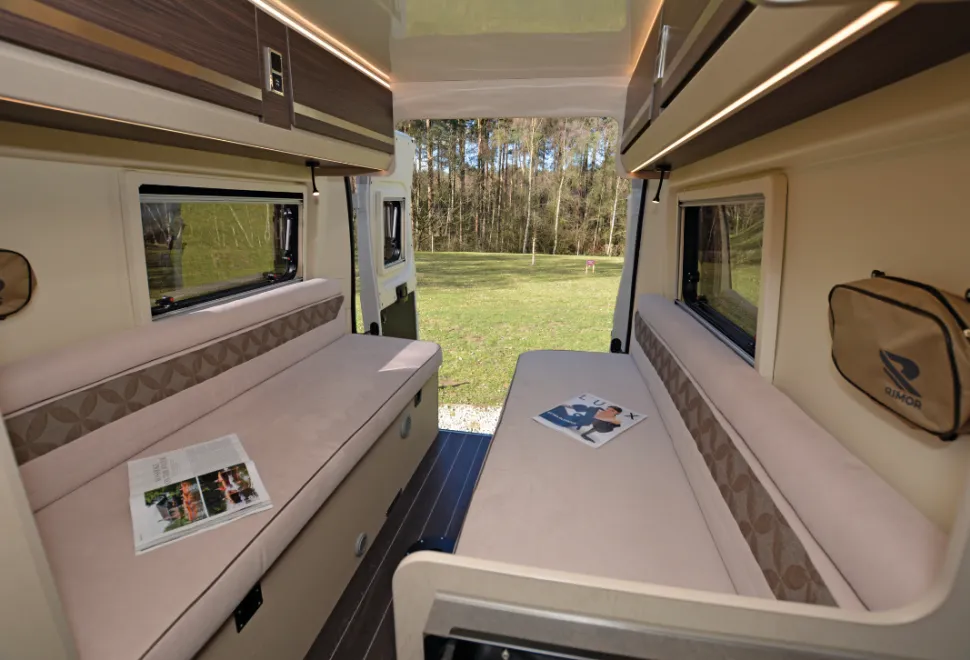
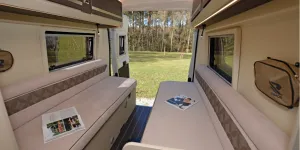
This is the classic two-person campervan with a spacious rear lounge but travel seats just for the couple in the cab. But what a space in which to relax, with settees that are each 1.97m (6ft 5.5in) long and opening windows on three sides.
There’s no sunroof overhead (the only opening rooflight is in the kitchen area), but I didn’t miss that as much as I expected. Partly, I suspect that’s because of the unusual glossy finish on the ceiling which reflects light down into the living area. In fact, artificial lighting is way more than simply adequate. There are long LED strips above and below the top cupboards in addition to touch operated ceiling lamps. Even better, each settee has a reading light on a flexible stalk.
There are mains sockets and double USB ports above each sofa, too, and a novelty is the Rimor-branded carrying pouches that clip to the walls on either side.
Of course, there’s plenty of room to put your feet up and stretch out, either with backs against the barn doors (facing the TV point on the washroom wall, with 230V and aerial sockets) or leaning against the furniture – even better when it’s warm enough to have the back doors open. But this is also a comfortable dining area.
Another unusual aspect for an imported campervan is that the table is removable. Mounted on a single leg that looks quite industrial in scale, this fixes into a cross-section fitting in the floor and then screws down tight. If you ever thought that an island leg table couldn’t be wobble-free (most aren’t), this one will prove you wrong.
There’s no specific home to store the table or leg but we found that the former could slot behind the driver’s seat and the latter can live on the overcab shelf.
The storage
There’s no shortage of stowage space in this campervan. The offside seat base houses the battery locker and the fresh water tank, but still has room for two single duvets. Opposite, the whole seat base is empty for outdoor chairs and all sorts of other clobber. It can be accessed at the end (with the back doors open). Note, lifting the seat base is quite awkward as there are no stays to hold it up.
Above, the handleless cupboards push to unlatch and have lips inside to keep their contents inside (if only they were all like this). The nearside top lockers are a decent size, but the offside ones are noticeably deeper.
The beds
At night, the lounge becomes the bedroom, but you have the choice of single beds or a double. Blackout is catered for by pleated blinds, which are an unexpected plus on a budget-priced campervan. They seemed to chatter less on the road when the flyscreen sections are pulled down and, in the morning, can be opened a crack at the top to let in a chink of daylight without compromising privacy.
If you sleep separately, nothing could be easier – you simply stow both of the backrest cushions in the cab and then the settees instantly become twin beds (71cm wide). A point to note here is that the whole backrest cushion is removed, unlike some rivals where the top part of the cushion is fixed to the wall. It’s surprising how much of a benefit this seems in terms of extra space.
A double – or should I say almost super king size – bed takes little extra effort. There are two support bars to slot in before slatted bed frames pull out to fill the gangway. Then the main section of each backrest forms the centre of the mattress, with the smaller ‘sausage’ cushions at the top (which add to seating comfort) simply discarded under the bed.
You can still sleep lengthways for easier access but this bed is huge and the four cushions that make up the mattress fit tightly together, so there are no noticeable joins or ridges. Then, in the morning, if you rise before your better half, the front seats both have swivel bases, so you can enjoy a cuppa here while the other occupant snores on.
You do have to bend down as you enter the cab, though, because Rimor retains the overcab storage that many campervans now eshew in order to offer an easier walk through.
The kitchen
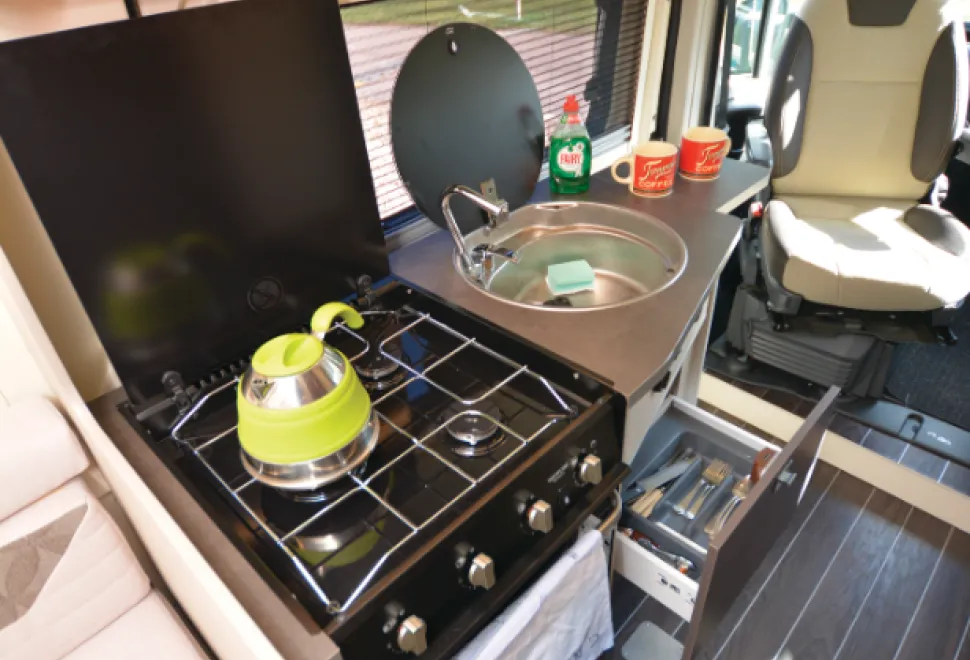
While other Horus models have a simple two-burner hob, the 66 again shows its anglophile nature with a Thetford Triplex cooker that not only adds a third gas ring but also a combined oven and grill.
Alongside the hob is a round sink with a good-quality Argo tap and domestic-sized outlet – no ‘doll’s house plumbing’ here! There’s a fairly typical folding worktop flap at the forward end of the galley, and two mains sockets below, providing the perfect place for my trusty Tassimo coffee machine.
On the front of the kitchen unit you’ll find the Webasto heating and Whale water heater controls, as well as the gas tank level gauge and a switch to shut off the gas supply when travelling. Down below, the galley includes three large drawers (one with cutlery holder) – so much better for easy access than the cupboards you might have anticipated. And, of course, there’s another top cupboard directly over the kitchen.
There’s no flyscreen on the door, which is adjacent to the kitchen, but of course all the habitation area windows (and the single rooflight) have mesh to keep out the little pests. Then, facing the entrance is the fridge, mounted at waist height, so you can find your pate and patisserie without bending down! Below that, what looks like a wardrobe is a large shelved cupboard – possibly more useful, depending on how you dress while away on your travels.
The washroom
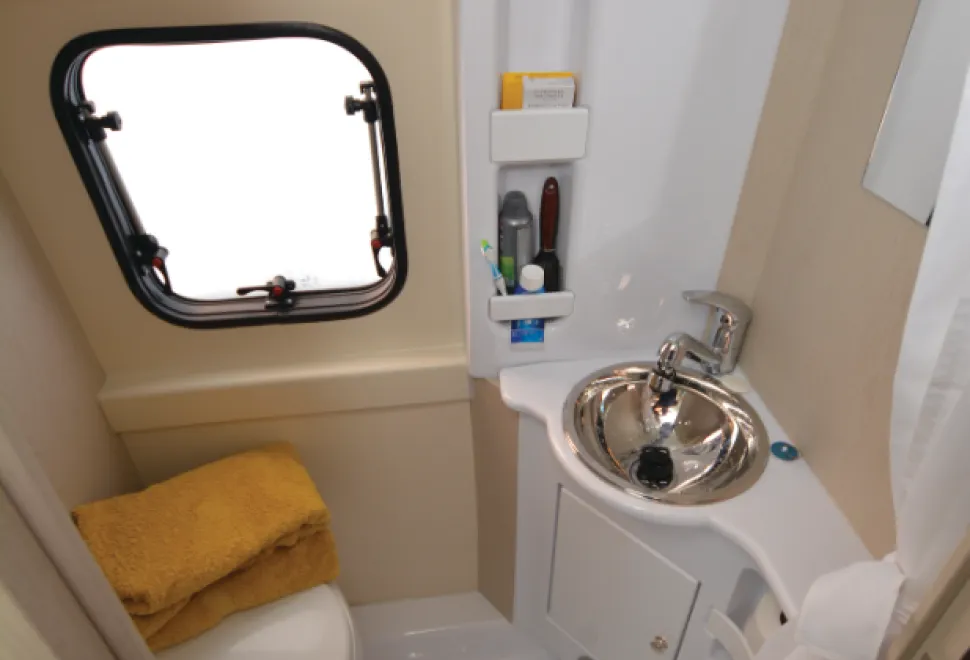
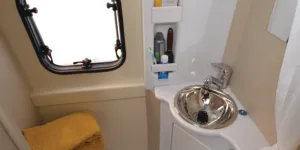
The other feature of the offside is the washroom. This is one area that is expected to see detail changes in production, but only in terms of finish rather than its layout. So, it will still be a good-sized space with plenty of leg and shoulder room when sitting on the Thetford bench cassette toilet. There’s an opaque opening window here, too, but without a flyscreen.
One of the best features of the zone is the stainless-steel corner washbasin, once again with a domestic-sized outlet. There’s also a large wall mirror, plus recesses for toiletries and a small cupboard built into the plastic moulding under the washbasin. For showering, the curtain only covers the door, so is not too enveloping or intrusive, while the basin’s tap pulls out to become the showerhead. It can be hand held or clipped to the ceiling and provides either a jet or a spray.
For a campervan, it’s actually quite a good shower, although the single outlet in the tray means that some mopping up will be required unless you’ve managed to park precisely level.
Motorhome supplied by M and C Ltd
Tel: 01482 448157
motorhomesltd.co.uk
Insurance: £435.17
Tel: 0800 975 1307
shieldtotalinsurance.co.uk
For quote details: motorhome.ma/QuoteInfo
Our Verdict
<p>So anglicised that you could almost think it was built in Blighty, this Rimor has a UK-handed layout with a rear lounge and a kitchen with an oven and grill. It’s also well priced and has some good detail design. If you’re looking for a two-berth campervan, this one should be on your list – you might well ask yourself why you’d want to spend more on some rivals.</p>
Disadvantages


