
Love Campers VW ID Buzz fixed roof campervan
Description
Can you feel the buzz? We try out one of the first campers based on VW’s new all-electric van
Key Features
Full Review
Words and photos: Iain Duff
The Love Campers VW ID Buzz
I’ve never been cool in my life. The only time I ever got close to it was when I played football with Oasis and Robbie Williams backstage at Glastonbury in the summer of 1995.
But when I got behind the wheel of this Volkswagen ID Buzz campervan conversion, it felt like I was making a slight return to those heady Britpop days – without the mud or beer, obviously.
The admiring glances, the pointing, the headlights flashing; as I zipped along the Sussex coastal roads, for a while I really did feel like I was the centre of attention. Of course, all this had nothing whatsoever to do with me and everything to do with the ID Buzz.
The conversion
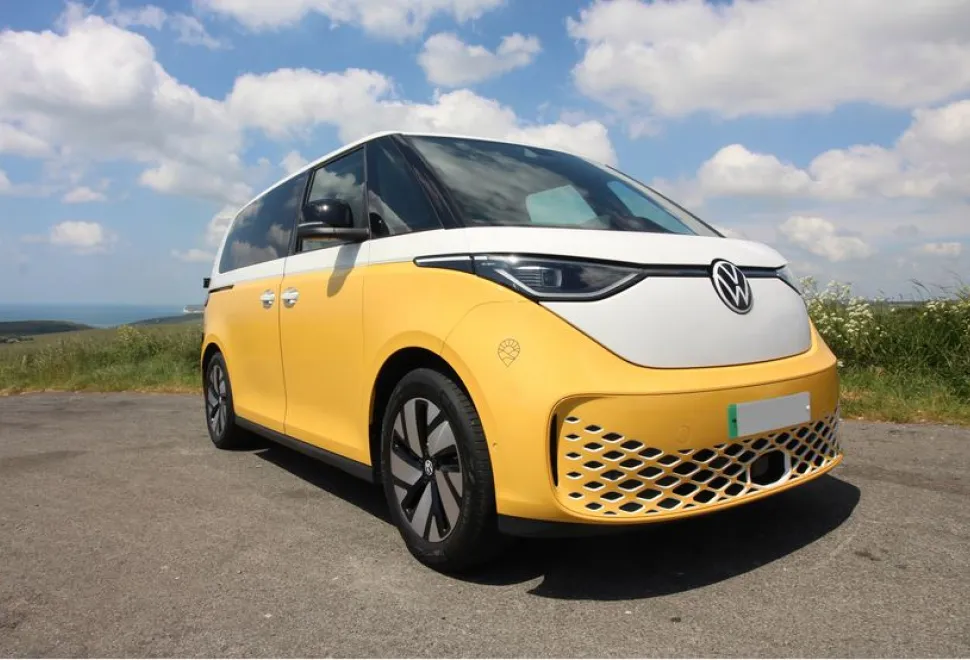
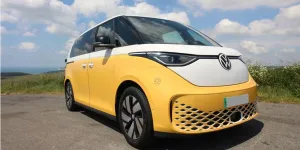
If you’ve been living under a rock this past year, the ID Buzz is VW’s long-awaited new electric van and it’s fair to say there’s been a bit of a, ahem, buzz about it. Taking its inspiration from the classic VW Type 2 camper, it combines retro styling with the most up-to-date EV technology.
Volkswagen has promised there will be a California campervan version, but it seems likely to be another couple of years at least before it comes to the market.
Of course, it wasn’t going to be long before someone came up with an ID Buzz conversion and this one, from East Sussex-based Love Campers, is the first we’ve seen and it certainly catches the eye. The exterior is a vibrant yellow and white two-tone finish, achieved with a wrapped lower half. It’s sunshine on wheels.
This model was built for campervan hire company, Wild Drives, and it fits perfectly with the rental company’s eco-friendly ethos.
Based on the ID Buzz Cargo, the van version rather than the people-carrier, the conversion offers a fully off-grid experience with a solar panel on the roof that powers the campervan’s 12V systems. It’s totally gas-free, with electric cooking and heating on board. So no burning of fossil fuels whatsoever. The campervan is also fitted with natural fibre insulation and sustainable materials are used wherever possible – the worktops are made from bamboo and all the wood is FSC certified.
The living space
Before going any further, there’s one significant issue that needs to be addressed, and that’s the amount of living space inside the campervan. First of all, the ID Buzz is strictly for two people at most – determined by the fact that there are only two belted seats on board – so you can rule out any big family holidays.
But even taking that into consideration, this is a compact set-up. It’s slightly shorter overall than the T6.1, for example, and for various reasons – significantly, the lack of a pop-top roof and swivel seats – the space available to live in is considerably less than the Transporter.
If your ideal campervan includes a shower compartment, a king-size bed, a 90-litre fridge/freezer and a triple-burner cooker and oven, then you’re going to be disappointed.
Probably the biggest factor to consider is the fact that there’s not a lot of headroom, due to the lack of a pop-up roof. I’m only 5ft 10in and I was only just able to sit comfortably. For me, this isn’t a major issue, as I’m used to having sitting room only in my own campervan, but it’s something you need to take into consideration, especially if you’re taller.
Likewise, if, like me, you’re of a bigger build, you might find it rather cramped inside and difficult to move around, and that is compounded if you’re sharing the space. On the other hand, the layout means everything is well within reach.
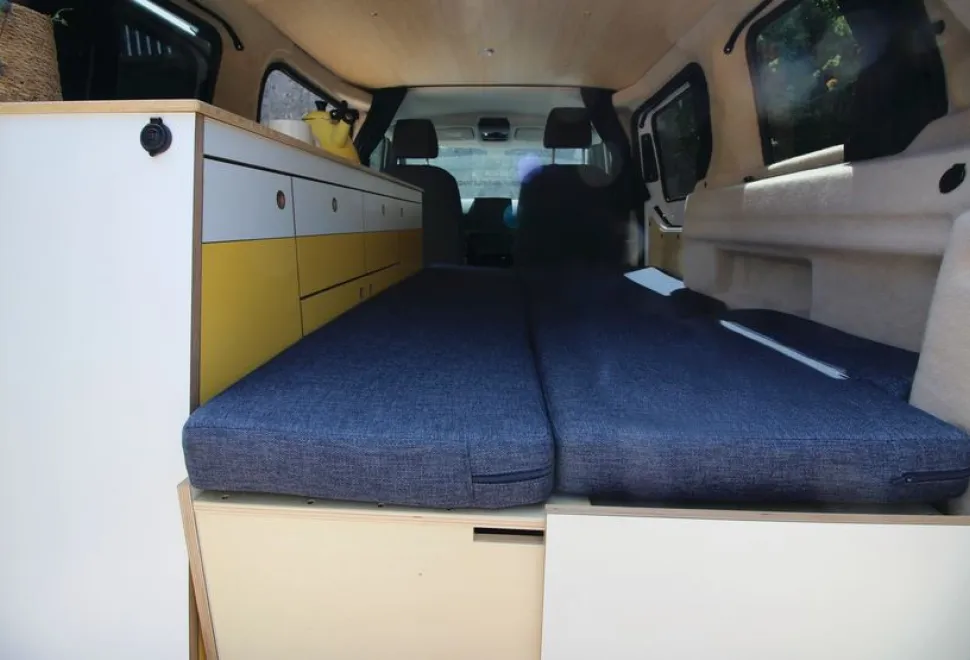
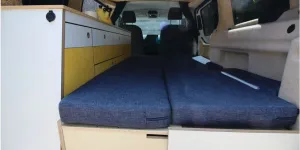
Make sure, too, that the bed is big enough for you – it measures 1.78m by 1.07m when it’s set up and it takes up pretty much the entire available floor space in the back.
So, clearly, if you are likely to need lots of room on your travels then this is probably not for you, no matter how cool it looks – although a driveaway awning might be something to think about. Having said that, what space there is, Love Campers has made really good use of.
The interior
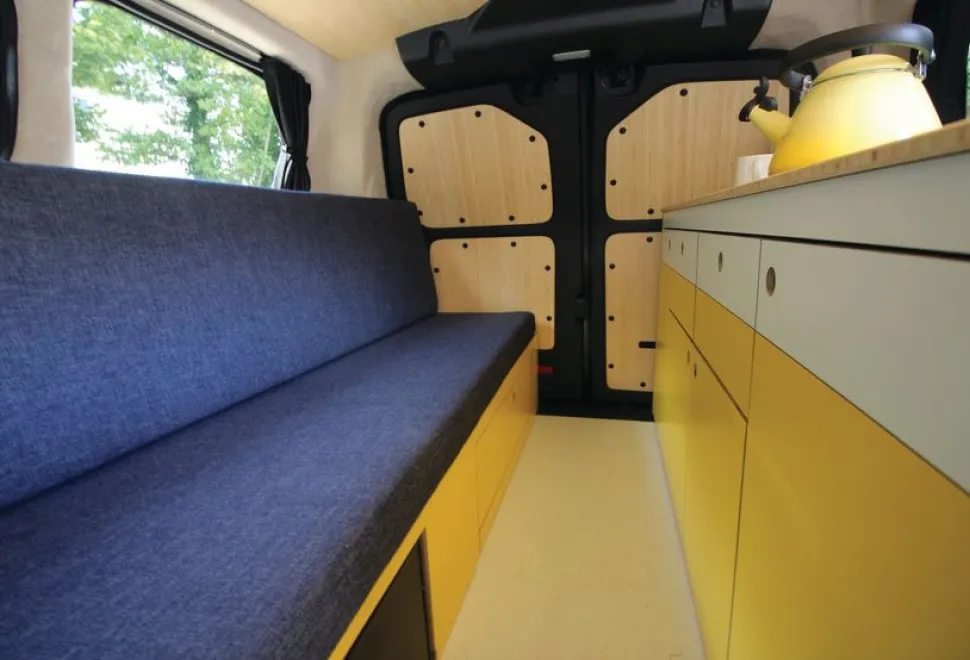
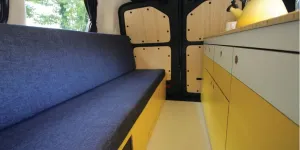
Instead of the typical side kitchen layout that you’d expect to see in a Transporter conversion, the Love Campers ID Buzz has a galley kitchen running along the left side and a long, side-facing settee opposite.
At night, the sofa can quickly be turned into your double bed, by simply pulling out its slatted frame and rearranging the cushions.
The interior colour scheme matches the yellow and white of the exterior, giving the inside a bright summery feel that makes up for the lack of windows on the rear doors. The furniture is hand-built using a modern plywood and bamboo, and it all gives off a distinctly 1960s vibe that reflects the retro influence on the exterior design.
The kitchen
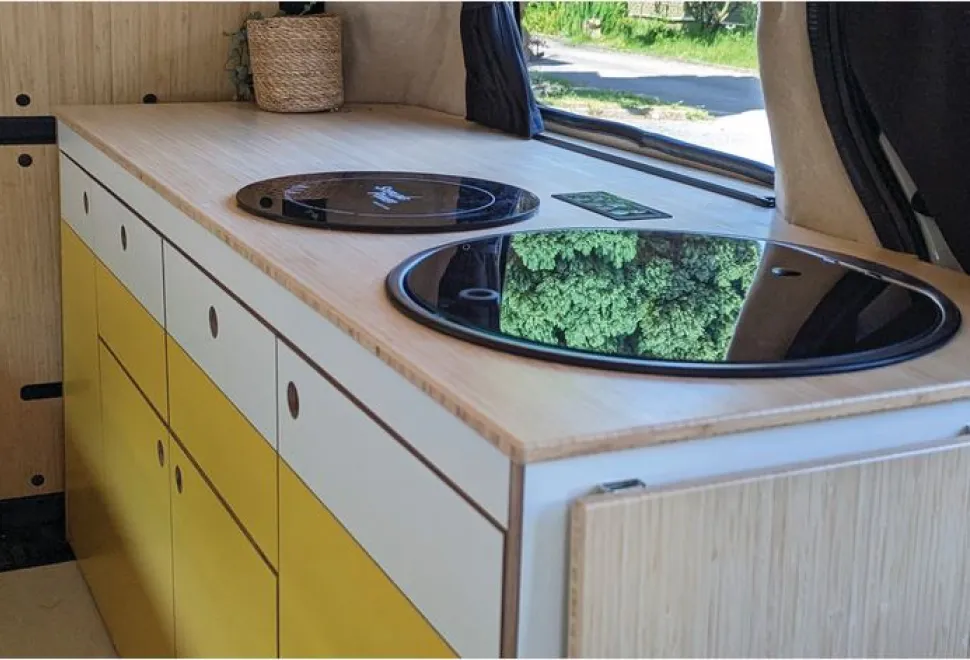
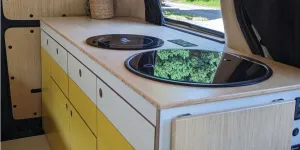
Cooking is done on a single-ring Sterling electric induction hob. It’s relatively limited, but ideal for boiling the kettle or rustling up classic one-pot camping meals. There’s a decent worktop space to the left of the hob and, at the end of the unit, there’s a small foldaway extension that can be used as a mini table or desk. This is also where you’ll find the control panel for the electrics and a 230V three-pin socket.
The galley also features a sink and tap, which is supplied from a 30-litre fresh water tank. There’s a separate waste water tank, too.
Below the work surface, there is a decent amount of cupboard and drawer space and there’s a good storage area under the settee, where you can stash bedding during the day. Fresh food can go in the Vitrifrigo 30-litre drawer fridge that pulls out from under the sofa, where it is neatly tucked away.
In keeping with the off-grid theme, there’s no mains hook-up, so electric power for the living area comes from a 200Ah lithium leisure battery, a 2,000W inverter and a 110W solar panel on the roof. There are USB-A and USB-C sockets to charge your devices and you can charge laptops and other larger devices off the inverter.
Electric dream machine
Of course, for all its stylish good looks, the ID Buzz will live or die by its performance and its ability to persuade petrol and diesel vehicle owners that they should turn to battery power. Most of us are wary of change, but the truth is this is the future, and, like it or not, we’re just going to have to get used to it.
Thankfully, if the ID Buzz is an example of what we should expect, then getting used to it shouldn’t be a problem, certainly as far as driving goes. The 77kWh battery pack gives a WLTP range of up to 258 miles before it needs a charge, but with a full payload it’s more realistic to expect a range of around 200 miles. And, of course, that range is the big difference from combustion engines. A full tank of diesel might get you 500 miles before you need to refill, and then it’s just a question of finding a garage, filling up and you’re back on the road in a few minutes.
Here you’ll have to tailor your travel plans to suit the limited range; for longer journeys that means working out roughly where you’re going to stop and how long that will take. The batteries can be replenished from 5% to 80% in around 30 minutes, on a 170kW fast charger, while a full charge from empty on a 7kW home wallbox will take 11 hours.
Behind the wheel
Like most UK motorists, I’d never driven an electric vehicle before, so I really didn’t know what to expect. But once you get over that weirdness of there being no engine sound – and it really is weird – then it’s just like driving any automatic.
Use the accelerator to speed up, use the brake to slow down. It really is as simple as that.
And, if your idea of an electric vehicle is a milk float humming along at 15mph, then this is going to blow your mind. The electric motor has a maximum output of 150kW – that’s the equivalent of 201bhp (204PS), which puts it on a par with top-spec Transporters.
It is extremely nippy around town, and on the motorway cruises along serenely at 70mph. In fact, driving really is a pleasant experience overall. The front cab is fairly basic but packed with the most up-to-date tech, including a 10in touchscreen for the sat-nav, reversing camera and entertainment system.
Summary
So does the ID Buzz work as a campervan? Well, if you accept that you’ll need to make some compromises, then it certainly does. Yes, space is limited, but, in many ways, that’s not the point.
In my many years of camping, I’ve never had so many fellow campers come over for a chat. Everyone wanted a nosey inside and everyone was impressed by what they saw. So, people are looking beyond the size and seeing it for what it is.
Yes, at almost £70,00, it’s pretty expensive. Yes, it’s quite small. No, there’s not an awful lot room to move around in. But it’s cool.
And if you’re not 100% convinced, then why not hire first? This very model is available for you to take out for a weekend or a longer trip. By the time you return it, you’ll know whether this is for you or not.
Where to hire
If you want to hire the ID Buzz campervan, Wild Drives offers rental from £150 per night or £1,199 a week. Wild Drives is an electric campervan hire and sustainable travel company based in Brighton and founded by Lewis Nyman in 2022.
As well as Buzz, you can also hire Eve – a four berth campervan based on a 2021 Citroën ë-Dispatch.
Wild Drives also offers planned routes with the campervans, which can either be bought “off the shelf” or designed to the customer’s requirements
A litter picker is included with every hire, bedding is all bamboo based, and food waste is composted at the end of the trip.
Our Verdict
<p>Like it or not, electric is the future for campervans and, with the ID Buzz, it’s already here. This Love Campers conversion looks great, is well done and drives like a dream… overall, this is a fantastic package and, best of all, you’re going to be the coolest person on the campsite. </p>
Disadvantages


