
K2 Base Camp (2011)
Image
Image
Image
Image
Image
Key Features
Model Year
2011
Product Class
Rising Roof
Product Model Base
Peugeot Partner
Price from (£)
£6995
Length (m)
4.13
Berths
2
Belted seats
5
Main Layout
Campervan
Full Review
BASED in Portsmouth, K2 Trading is owned and run by motorhome enthusiast Kevin Watkins, who started his business five years ago.
He began by selling conversions on secondhand Mazda Bongos, but has now built up his range to include the Renault Trafic-based St Moritz and the Citroën Berlingo/Peugeot Partner-based Base Camp models.
Keen to keep costs down, Kevin normally only builds on secondhand base vehicles, sourcing low-mileage examples through the motor trade. As an example of this, the Base Camp we are looking at here is an all-new conversion, built on a 2003 Peugeot Partner with 35,000 miles on the clock. As a result, it’s for sale with a keen price tag of just £6995. If you opt for the conversion only, on your own base vehicle, then the cost is £3995.
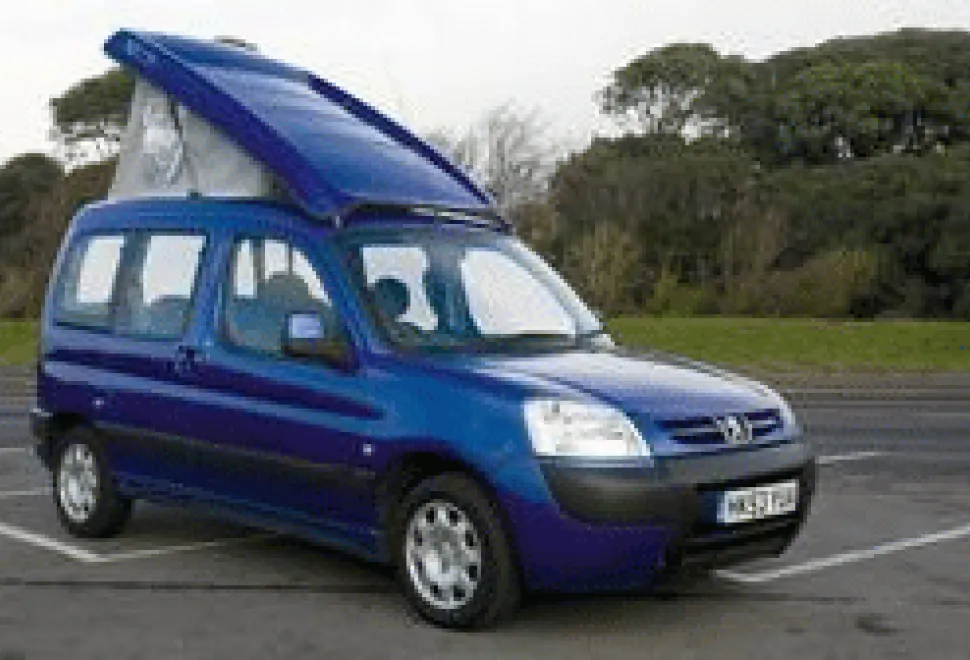
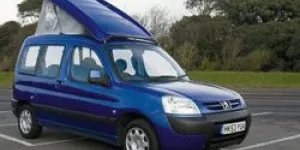
As motorhome conversions go, the Base Camp is a fairly simple design, with minimal facilities. These consist chiefly of a double bed, a cloth-sided elevating roof for extra headroom, an island-leg table, plus a couple of storage boxes at the rear which can be set up as a basic kitchen or seating area.
It might seem odd to say it, but the minimalist nature of the conversion is also one of its strengths. The two storage/kitchen boxes at the rear can be completely removed from the vehicle, leaving you with a five-seater MPV that has plenty of load space for your weekly shopping. Then, when you’re planning a short break, simply put the furniture back in and away you go.
MPV space
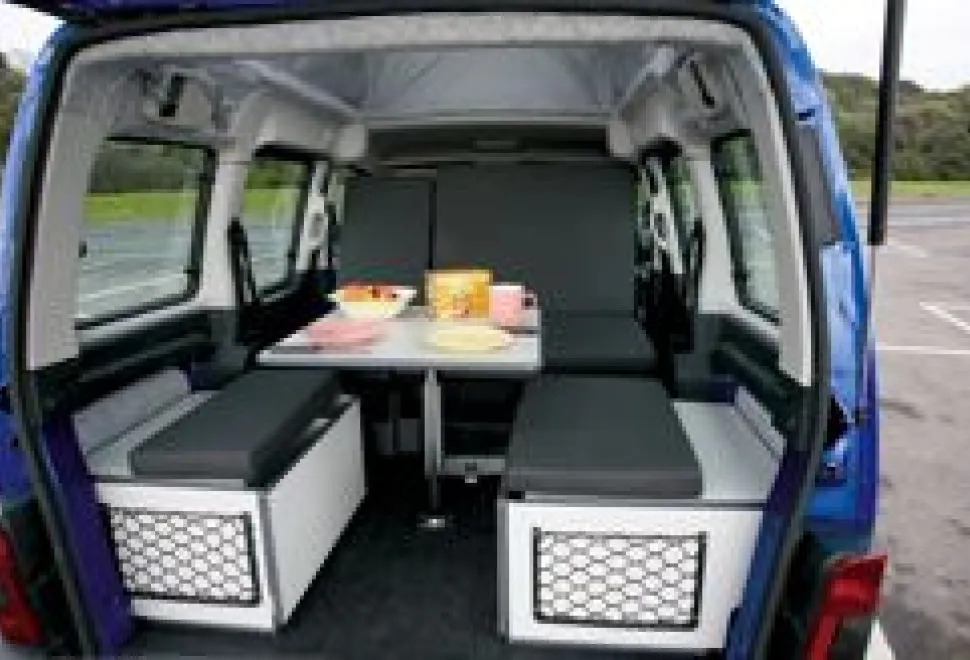
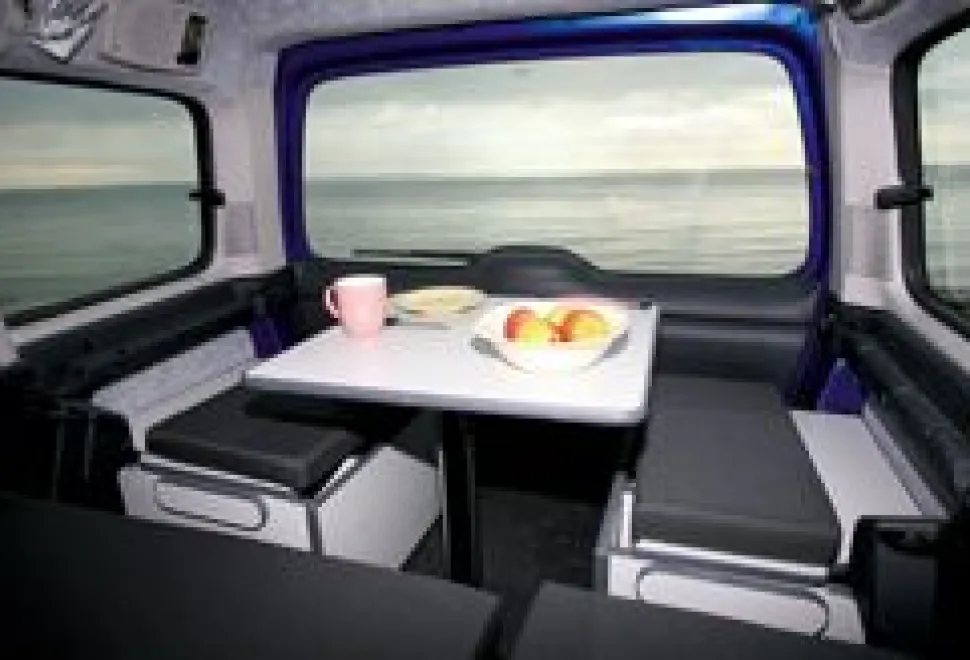
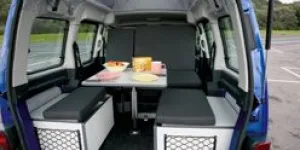
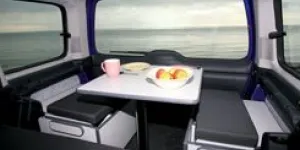
With the furniture back inside, you’ve still got the full five-seat MPV travelling space. Once you arrive on site, the rear seats fold down and a set of laminated plywood panels (fixed to the back of the seats) fold up to create rear-facing seating for up to three people. With seat squabs placed upon them, the two rear furniture boxes also form a couple of seats, allowing up to five people to sit inside. An island-leg table can then be set up between the boxes.
Cooking
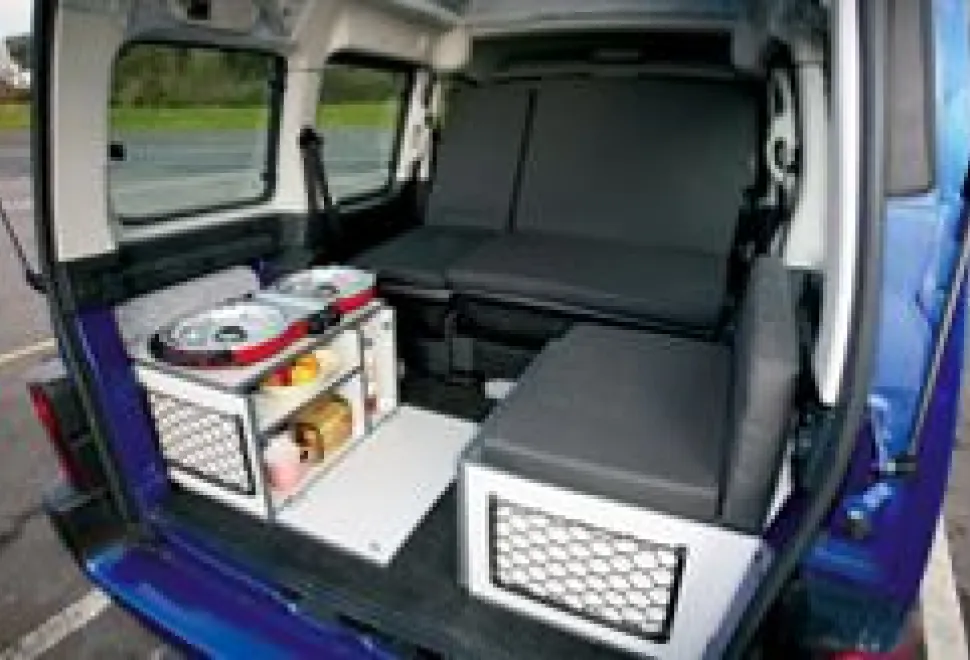
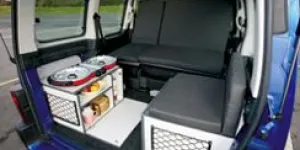
If you want to cook a meal, a small portable gas hob is quickly set up on one of the rear furniture boxes. At the moment this is the extent of the kitchen facilities, with no fixed sink or fridge. Instead, owners have to use a washing-up bowl, filled from a five-litre water bottle, plus they will need to take their own portable coolbox if needed.
Following our visit, Kevin now plans to design new rear furniture units, which will include a built-in hob and a built-in sink with its own cold water supply. He is also thinking about fitting folding legs to these units, so they could be removed from the conversion once on-site. They could then be used as free-standing kitchen units in an awning.
Bedtime
At night-time, the panels on the back of the rear-facing seats fold flat and are used in conjunction with the tops of the rear furniture boxes, to make a very flat double bed base. The cushions making up the mattress of this bed are quite thin, but should be fine for a few nights away. Once set up, the bed is 1.73m (5ft 8in) long, which should be fine for many people, but Kevin is considering modifications that would make the bed 10-20cm longer if needed.
We asked Kevin who was the typical buyer for the Base Camp and he explained that most owners are couples who just want an occasional campervan, but with the flexibility of carrying grandchildren if needed. The conversion would also be ideal for hobbyists, such as fishermen or bird watchers, who want a small vehicle that can easily access out-of-the-way beauty spots.
Despite its small size, the Base Camp would also be idea for families with up to three children. In this scenario, the adults could use the conversion’s double bed at night, with the kids perhaps sharing their own tent outside the camper. During the day, the whole family could travel in the vehicle, plus the five of them could all squeeze together round the small table, for dining inside the ’van.
The Base Camp comes as standard with fairly minimal equipment, but Kevin can add an electric hook-up for around £200, which would then give owners the flexibility to use electric fan heaters and 12V/mains-powered coolboxes.
The build-quality and attention to detail seem very good in the Base Camp, with the elevating roof, in particular, looking very stylish and solid.
Once on site, it takes a few minutes to convert the rear seating area into its rear-facing mode, and you need to stand outside the ’van when doing this (not much fun if it’s raining!), but the design is very clever. Unlike some other ‘micro’ conversions, at least you retain the vehicle’s original rear seats and seatbelts, giving the full five-person carrying capacity.
This first sight review was published in the April 2011 issue of Which Motorhome magazine.
He began by selling conversions on secondhand Mazda Bongos, but has now built up his range to include the Renault Trafic-based St Moritz and the Citroën Berlingo/Peugeot Partner-based Base Camp models.
Keen to keep costs down, Kevin normally only builds on secondhand base vehicles, sourcing low-mileage examples through the motor trade. As an example of this, the Base Camp we are looking at here is an all-new conversion, built on a 2003 Peugeot Partner with 35,000 miles on the clock. As a result, it’s for sale with a keen price tag of just £6995. If you opt for the conversion only, on your own base vehicle, then the cost is £3995.
As motorhome conversions go, the Base Camp is a fairly simple design, with minimal facilities. These consist chiefly of a double bed, a cloth-sided elevating roof for extra headroom, an island-leg table, plus a couple of storage boxes at the rear which can be set up as a basic kitchen or seating area.
It might seem odd to say it, but the minimalist nature of the conversion is also one of its strengths. The two storage/kitchen boxes at the rear can be completely removed from the vehicle, leaving you with a five-seater MPV that has plenty of load space for your weekly shopping. Then, when you’re planning a short break, simply put the furniture back in and away you go.
MPV space
With the furniture back inside, you’ve still got the full five-seat MPV travelling space. Once you arrive on site, the rear seats fold down and a set of laminated plywood panels (fixed to the back of the seats) fold up to create rear-facing seating for up to three people. With seat squabs placed upon them, the two rear furniture boxes also form a couple of seats, allowing up to five people to sit inside. An island-leg table can then be set up between the boxes.
Cooking
If you want to cook a meal, a small portable gas hob is quickly set up on one of the rear furniture boxes. At the moment this is the extent of the kitchen facilities, with no fixed sink or fridge. Instead, owners have to use a washing-up bowl, filled from a five-litre water bottle, plus they will need to take their own portable coolbox if needed.
Following our visit, Kevin now plans to design new rear furniture units, which will include a built-in hob and a built-in sink with its own cold water supply. He is also thinking about fitting folding legs to these units, so they could be removed from the conversion once on-site. They could then be used as free-standing kitchen units in an awning.
Bedtime
At night-time, the panels on the back of the rear-facing seats fold flat and are used in conjunction with the tops of the rear furniture boxes, to make a very flat double bed base. The cushions making up the mattress of this bed are quite thin, but should be fine for a few nights away. Once set up, the bed is 1.73m (5ft 8in) long, which should be fine for many people, but Kevin is considering modifications that would make the bed 10-20cm longer if needed.
We asked Kevin who was the typical buyer for the Base Camp and he explained that most owners are couples who just want an occasional campervan, but with the flexibility of carrying grandchildren if needed. The conversion would also be ideal for hobbyists, such as fishermen or bird watchers, who want a small vehicle that can easily access out-of-the-way beauty spots.
Despite its small size, the Base Camp would also be idea for families with up to three children. In this scenario, the adults could use the conversion’s double bed at night, with the kids perhaps sharing their own tent outside the camper. During the day, the whole family could travel in the vehicle, plus the five of them could all squeeze together round the small table, for dining inside the ’van.
The Base Camp comes as standard with fairly minimal equipment, but Kevin can add an electric hook-up for around £200, which would then give owners the flexibility to use electric fan heaters and 12V/mains-powered coolboxes.
The build-quality and attention to detail seem very good in the Base Camp, with the elevating roof, in particular, looking very stylish and solid.
Once on site, it takes a few minutes to convert the rear seating area into its rear-facing mode, and you need to stand outside the ’van when doing this (not much fun if it’s raining!), but the design is very clever. Unlike some other ‘micro’ conversions, at least you retain the vehicle’s original rear seats and seatbelts, giving the full five-person carrying capacity.
This first sight review was published in the April 2011 issue of Which Motorhome magazine.
Our Verdict
Retaining five travel seats makes this an ideal dual-use vehicle, but its overnight facilities are basic and the bed is small. But it’s only £6995!
Advantages
It’s £6995 on a used vehicle!
Retains five travel seats
Frugal and fits anywhere
Conversion only costs £3995
Disadvantages
Limited facilities and small bed


