
Jerba Cromarty (2011)
Image
Image
Image
Image
Image

Key Features
Model Year
2011
Product Class
Rising Roof
Product Model Base
Volkswagen T5
Price from (£)
£36850
Length (m)
5.29
Berths
4
Belted seats
4
Main Layout
Campervan
Full Review
Jerba: it’s a funny old name when you think about it. Google it, and while the manufacturer of this Volkswagen campervan emerges top of the resultant list, it turns out that Jerba is actually North Africa’s largest island, situated in the Gulf of Gabes, south-east of Tunisia.
Jerba, then, may not be the most apt name for a camper built in North Berwick. Cromarty, though – well, that’s a sea-port just to the north of Jerba’s small factory, as well as being one of the more pronounceable names on Radio 4’s shipping forecast.
Truth be told, I’m just a little anxious about testing the Cromarty. Editor Vaughan beat me to the Jerba punch in Which Motorhome’s re-launch issue, back in April, when he returned from a brief sortie in the Cromarty’s gas-free little brother, the SWB Tiree, waxing lyrical about its ‘bespoke build and great finish’.
What if my findings are as Polar opposite to his as the vehicle’s two names are?
No matter. With the Cromarty packed, and Jerba’s founding father, Simon Poole, on board, the better to steer us onto our first photoshoot location of the day, I get cracking, and straightaway wish there was something just a little more potent under the bonnet than the 102bhp 2.0TDI engine provided.
It feels brisk enough most of the time, but I later discovered that overtaking manoeuvres in particular can get a little protracted, especially when driving into a headwind.
If you’re planning to drive any great distances in your Cromarty, I’d strongly recommend the 140bhp motor, which has usefully more fire in its belly and brings with it the added bonus of a sixth cog in the manual gearbox.
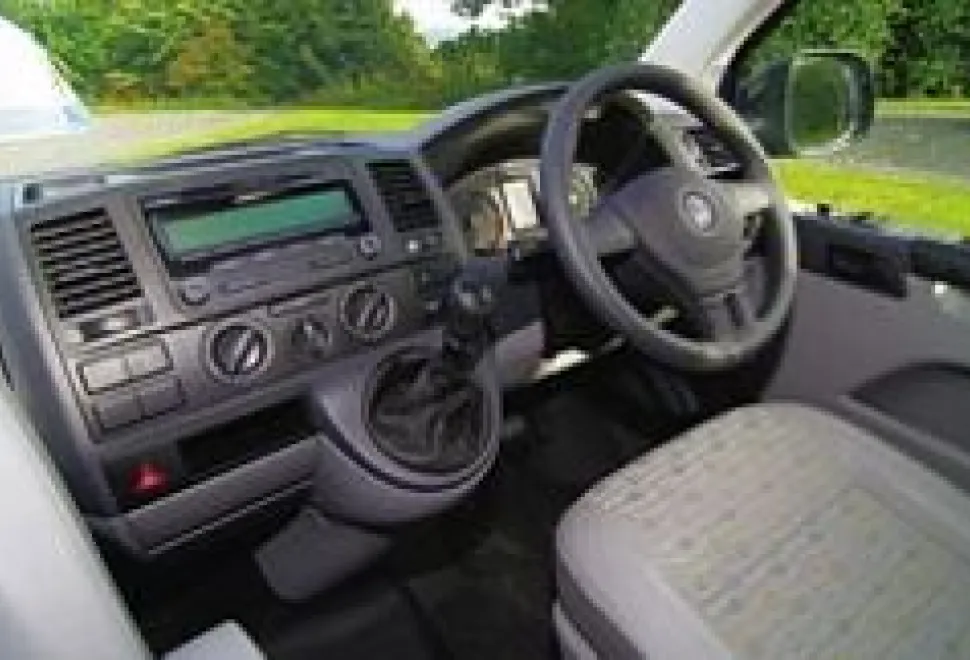
In most other respects, however, the latest T5’s dynamics certainly represent a useful leap over the already impressive model it replaces. The cabin feels of a higher standard, more car-like and less van-like, and the central digital display calls to mind premium German saloons.
Our test model’s electric windows and central locking add a further dash of luxury, but you really can go mad with Jerba’s extensively bespoke approach to manufacturing if you’re not careful. Six-disc CD multichanger, perhaps? DSG transmission? 180bhp under your right foot? All-wheel-drive?
Or maybe sir or madam would like to tick the options box marked ‘heated cab seats’ or ‘satellite navigation’?
Personally speaking, I’d add ‘cab air-conditioning’ (£911) to the bigger engine upgrade (£1888, or north of £3000 if you want DSG as well) I’d treat our test model to were it my money on the line, and probably leave it at that, although if I had a large family, specifying the VW-sourced removable central bench seat would be hugely tempting.
Probably the most impressive dynamic aspect of driving the Cromarty, though, is its almost spooky lack of conversion noise. That would be impressive enough in a high-top conversion, but one with an elevating roof?
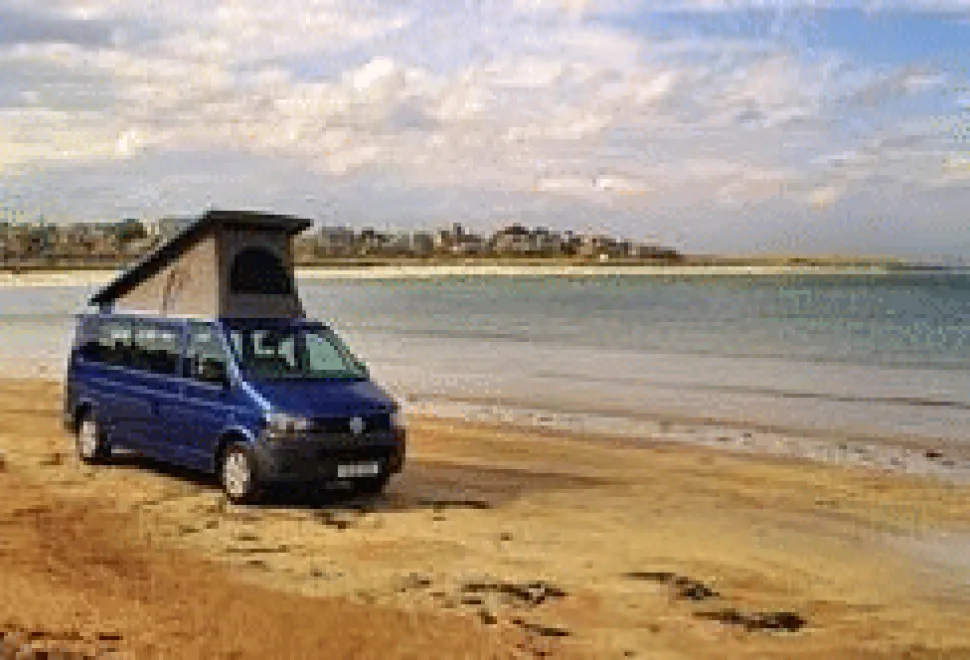
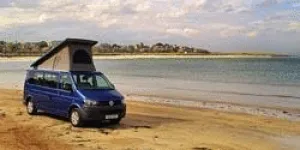
If you’ve assumed that this is just another VW camper fitted with a Reimo roof, then I’m afraid you’re mistaken. In fact, Jerba’s LWB contender warrants a roof from German specialist manufacturer, SCA. Quite apart from being a thoroughly well-engineered affair that opens up a whopping 7ft 6in of standing headroom at its highest point when deployed, it also folds down in such a way as to render the entire camper just 1.99m high – and that’s enough to squeeze the Cromarty into most domestic garages and beneath most car park height restrictors.
It’s not quite as kindergarten-simple to operate as the side-hinged affair used by Bilbo’s, but it’s not far off, and the large windows, while requiring those long of arm or tall of body in order to reach the zips, look and feel beautifully integrated.
Better still, the Cromarty doesn’t actually look like a camper at first sight. There are no visible services cut into the sidewalls and no gaudy stickers and badges loudly proclaiming its camper status. It looks, in fact, just like a big MPV, and nothing more – and that’s got to be good from a security perspective.
On-site pitching was almost laughably straightforward. Switching on the gas is easy enough, but the location of the mains electric and water inlet – behind a hinged portion of the rear bumper is positively inspired, and negates the need for invasive hole-drilling in the sidewalls.
Then it was indoors, release a couple of straps, push the roof bed up on its gas struts and shove the entire canvas roof skywards, before opening the windows (one mesh, two plastic) and switching the optional Webasto diesel-fired heater onto its lowest setting to take the edge off the chill.
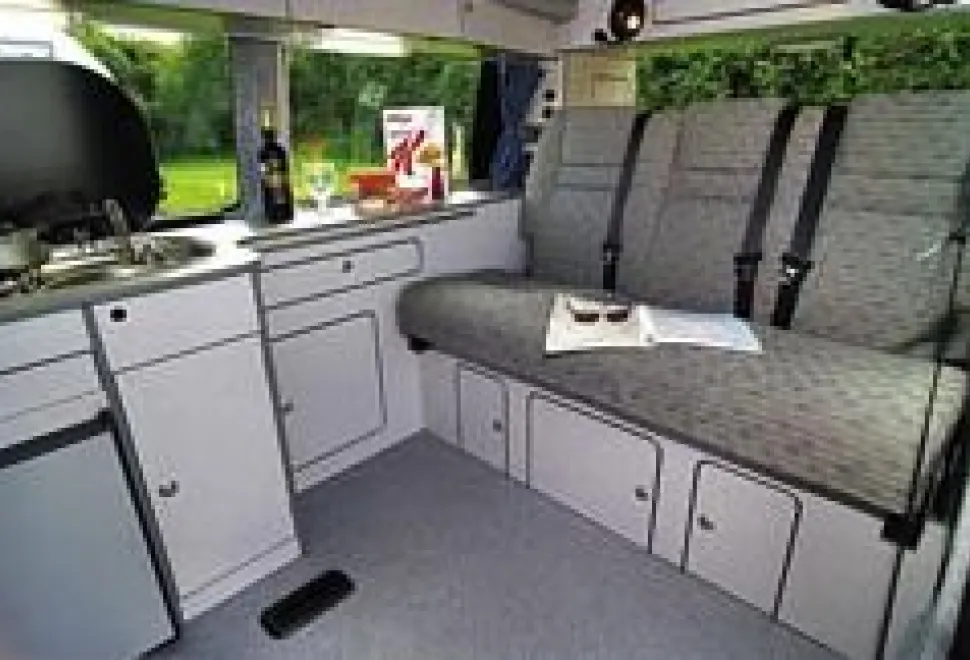
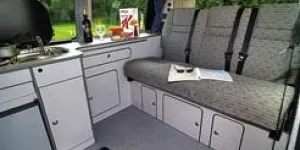
With the remainder of my box brownie duties completed, I relaxed on the beautifully integrated RIB crash-tested rear bench seat, and straightaway noticed that my size nines were dangling helplessly in space.
To be fair to Jerba’s Simon Poole, he’s aware of the problem, but short of truncating the bench to clear the source of the problem – the rear wheelarches – there’s not a lot else he can do. Oh well, I can always kick off my shoes and curl my feet under me, I suppose!
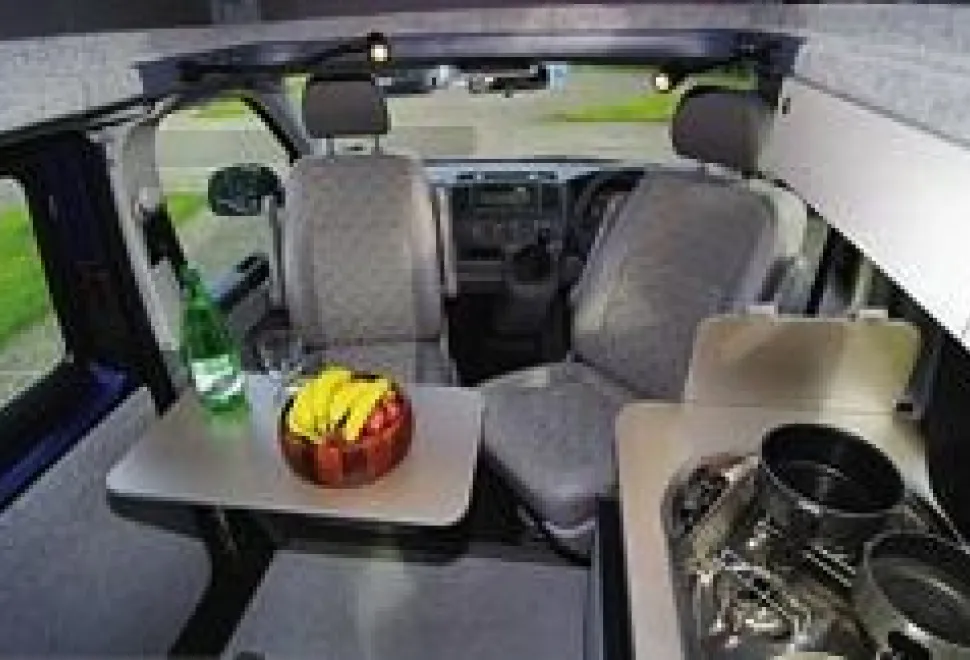
I’m still comfortable, though – the main table (which clips away behind the driver’s seat when not in use) slides a useful distance fore and aft to serve as a side-by-side dining table up close, or somewhere to plonk your plonk and books a little further away.
Or slide it all the way towards the galley and create a sort of giant L-shaped kitchen for those marathon cooking sessions.
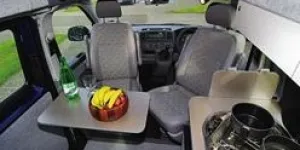
There’s a second lounging area up front (complete with its own, smaller table) in the shape of the cab seats, and while the usual T5 rules apply (leave the vehicle in gear, drop the handbrake and raise the seats to their highest positions before swivelling), there’s a decent amount of space to bear, as well as his ’n’ hers bendy reading lights, which is good to know if you want to make up the bed early and still have somewhere to relax.
The kitchen itself is typical VW fare, albeit particularly well engineered and installed.
The hob boasts three spark-ignition burners and forms part of a single unit that also encompasses the surprisingly substantial stainless steel sink, while lower down sits the little 62-litre Vitrifrigo compressor fridge, a cutlery drawer and a two-shelf cupboard.
Further storage space is provided at lower level to the right of the kitchen, while serried ranks of shoulder-level flap lockers offer more stowage space for small tins, boxes and packets. As camper kitchens go, this is one of the better examples you’re likely to see.
Dinner for one proved to be an easy test for the Cromarty’s hob, and with the crocks sluiced at the shower block (a boiler is an expensive – at £2495 – option, but comprises Webasto’s excellent diesel-fired Thermotop C combined heating/boiler system) and an ill-advised spooky film shivered through on my laptop (thanks to Jerba’s generous provision of two mains sockets close to the rear bench, I could re-charge my mobile phone, too), I decided to call it a night.
This is crunch-time for any VW camper. A bit of forward-planning is always required if you don’t want to end up having to go outside, but a camper’s bed should be straightforward to make up.
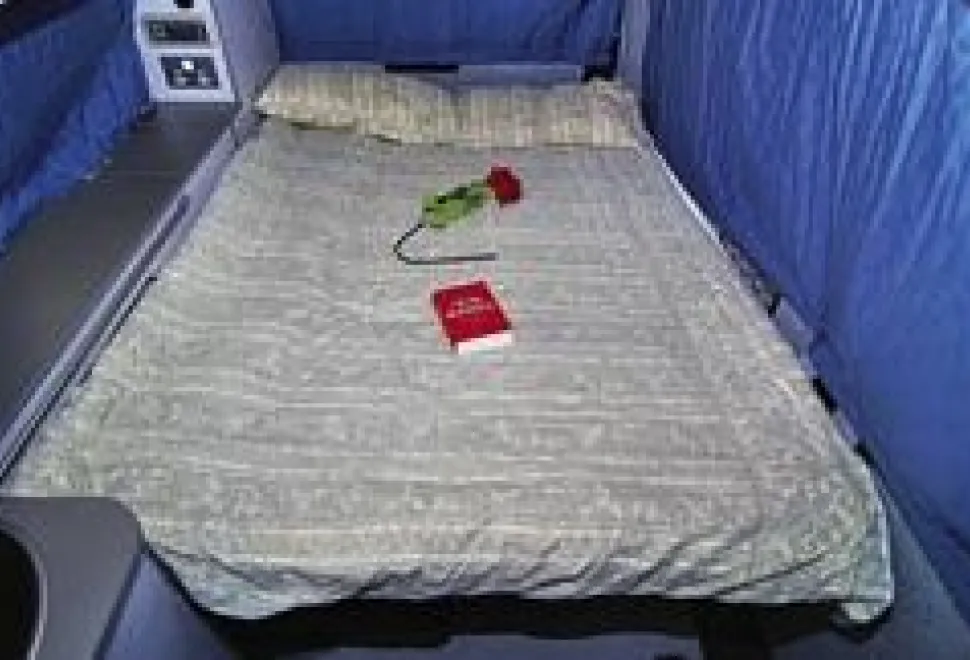
Thankfully, the Jerba’s RIB bench proves to be well-behaved: pulling on a lever allows the seat base to flip over 180 degrees, while manipulation of the padded bar beneath causes the backrest to flop neatly into position.
As long as you’ve remembered to keep the rearmost portion of the bed clutter-free during the day, the conversion from lounge to bed should take no more than two or three minutes.
As for night-time privacy, both sides of the Jerba – and the tailgate window – can be tightly curtained-off by single drapes, while a huge fabric affair keeps prying eyes out up front.
I suppose the best way to sum up the Jerba is whether or not it’s better than a Bilbo’s Celex, and I’m afraid the answer is ‘no’. Crucially, however, neither is the Bilbo’s a significantly better bet than the Jerba.
Managing an honourable draw with one of the true superstars of the VW camper world after just four years in the business? That’s no mean feat.
A longer version of this review was published in the November 2010 issue of Which Motorhome magazine.
Jerba, then, may not be the most apt name for a camper built in North Berwick. Cromarty, though – well, that’s a sea-port just to the north of Jerba’s small factory, as well as being one of the more pronounceable names on Radio 4’s shipping forecast.
Truth be told, I’m just a little anxious about testing the Cromarty. Editor Vaughan beat me to the Jerba punch in Which Motorhome’s re-launch issue, back in April, when he returned from a brief sortie in the Cromarty’s gas-free little brother, the SWB Tiree, waxing lyrical about its ‘bespoke build and great finish’.
What if my findings are as Polar opposite to his as the vehicle’s two names are?
No matter. With the Cromarty packed, and Jerba’s founding father, Simon Poole, on board, the better to steer us onto our first photoshoot location of the day, I get cracking, and straightaway wish there was something just a little more potent under the bonnet than the 102bhp 2.0TDI engine provided.
It feels brisk enough most of the time, but I later discovered that overtaking manoeuvres in particular can get a little protracted, especially when driving into a headwind.
If you’re planning to drive any great distances in your Cromarty, I’d strongly recommend the 140bhp motor, which has usefully more fire in its belly and brings with it the added bonus of a sixth cog in the manual gearbox.
In most other respects, however, the latest T5’s dynamics certainly represent a useful leap over the already impressive model it replaces. The cabin feels of a higher standard, more car-like and less van-like, and the central digital display calls to mind premium German saloons.
Our test model’s electric windows and central locking add a further dash of luxury, but you really can go mad with Jerba’s extensively bespoke approach to manufacturing if you’re not careful. Six-disc CD multichanger, perhaps? DSG transmission? 180bhp under your right foot? All-wheel-drive?
Or maybe sir or madam would like to tick the options box marked ‘heated cab seats’ or ‘satellite navigation’?
Personally speaking, I’d add ‘cab air-conditioning’ (£911) to the bigger engine upgrade (£1888, or north of £3000 if you want DSG as well) I’d treat our test model to were it my money on the line, and probably leave it at that, although if I had a large family, specifying the VW-sourced removable central bench seat would be hugely tempting.
Probably the most impressive dynamic aspect of driving the Cromarty, though, is its almost spooky lack of conversion noise. That would be impressive enough in a high-top conversion, but one with an elevating roof?
If you’ve assumed that this is just another VW camper fitted with a Reimo roof, then I’m afraid you’re mistaken. In fact, Jerba’s LWB contender warrants a roof from German specialist manufacturer, SCA. Quite apart from being a thoroughly well-engineered affair that opens up a whopping 7ft 6in of standing headroom at its highest point when deployed, it also folds down in such a way as to render the entire camper just 1.99m high – and that’s enough to squeeze the Cromarty into most domestic garages and beneath most car park height restrictors.
It’s not quite as kindergarten-simple to operate as the side-hinged affair used by Bilbo’s, but it’s not far off, and the large windows, while requiring those long of arm or tall of body in order to reach the zips, look and feel beautifully integrated.
Better still, the Cromarty doesn’t actually look like a camper at first sight. There are no visible services cut into the sidewalls and no gaudy stickers and badges loudly proclaiming its camper status. It looks, in fact, just like a big MPV, and nothing more – and that’s got to be good from a security perspective.
On-site pitching was almost laughably straightforward. Switching on the gas is easy enough, but the location of the mains electric and water inlet – behind a hinged portion of the rear bumper is positively inspired, and negates the need for invasive hole-drilling in the sidewalls.
Then it was indoors, release a couple of straps, push the roof bed up on its gas struts and shove the entire canvas roof skywards, before opening the windows (one mesh, two plastic) and switching the optional Webasto diesel-fired heater onto its lowest setting to take the edge off the chill.
With the remainder of my box brownie duties completed, I relaxed on the beautifully integrated RIB crash-tested rear bench seat, and straightaway noticed that my size nines were dangling helplessly in space.
To be fair to Jerba’s Simon Poole, he’s aware of the problem, but short of truncating the bench to clear the source of the problem – the rear wheelarches – there’s not a lot else he can do. Oh well, I can always kick off my shoes and curl my feet under me, I suppose!
I’m still comfortable, though – the main table (which clips away behind the driver’s seat when not in use) slides a useful distance fore and aft to serve as a side-by-side dining table up close, or somewhere to plonk your plonk and books a little further away.
Or slide it all the way towards the galley and create a sort of giant L-shaped kitchen for those marathon cooking sessions.
There’s a second lounging area up front (complete with its own, smaller table) in the shape of the cab seats, and while the usual T5 rules apply (leave the vehicle in gear, drop the handbrake and raise the seats to their highest positions before swivelling), there’s a decent amount of space to bear, as well as his ’n’ hers bendy reading lights, which is good to know if you want to make up the bed early and still have somewhere to relax.
The kitchen itself is typical VW fare, albeit particularly well engineered and installed.
The hob boasts three spark-ignition burners and forms part of a single unit that also encompasses the surprisingly substantial stainless steel sink, while lower down sits the little 62-litre Vitrifrigo compressor fridge, a cutlery drawer and a two-shelf cupboard.
Further storage space is provided at lower level to the right of the kitchen, while serried ranks of shoulder-level flap lockers offer more stowage space for small tins, boxes and packets. As camper kitchens go, this is one of the better examples you’re likely to see.
Dinner for one proved to be an easy test for the Cromarty’s hob, and with the crocks sluiced at the shower block (a boiler is an expensive – at £2495 – option, but comprises Webasto’s excellent diesel-fired Thermotop C combined heating/boiler system) and an ill-advised spooky film shivered through on my laptop (thanks to Jerba’s generous provision of two mains sockets close to the rear bench, I could re-charge my mobile phone, too), I decided to call it a night.
This is crunch-time for any VW camper. A bit of forward-planning is always required if you don’t want to end up having to go outside, but a camper’s bed should be straightforward to make up.
Thankfully, the Jerba’s RIB bench proves to be well-behaved: pulling on a lever allows the seat base to flip over 180 degrees, while manipulation of the padded bar beneath causes the backrest to flop neatly into position.
As long as you’ve remembered to keep the rearmost portion of the bed clutter-free during the day, the conversion from lounge to bed should take no more than two or three minutes.
As for night-time privacy, both sides of the Jerba – and the tailgate window – can be tightly curtained-off by single drapes, while a huge fabric affair keeps prying eyes out up front.
I suppose the best way to sum up the Jerba is whether or not it’s better than a Bilbo’s Celex, and I’m afraid the answer is ‘no’. Crucially, however, neither is the Bilbo’s a significantly better bet than the Jerba.
Managing an honourable draw with one of the true superstars of the VW camper world after just four years in the business? That’s no mean feat.
A longer version of this review was published in the November 2010 issue of Which Motorhome magazine.
Our Verdict
It may appear to be just another VW conversion with folding rear seat, but the Jerba is well made and has lots of clever ideas - iike the hidden mains hook-up point.
Advantages
Well-engineered SCA roof
No holes cut in side of van
Clever bumper hatch for mains hook-up
Wide rear RIB seat with three seatbelts
Disadvantages
Rear seating may be too high for some


