
Eco Campers Evolution PHEV campervan



Description
Base vehicle: Ford Transit Custom PHEV Price from: £75,995 Berths: 4 Travel seats: 4/6 Length: 4.97m Width: 1.99m Height: 2.10m Gross weight: 3,400kg
Key Features
Full Review
Words & photos: Peter Vaughan
The Eco Campers Evolution PHEV
If you read last month’s feature on electric campervans and thought that’s not for me – yet – but still want to consider a move away from diesel, there are remarkably few options. New petrol-engined leisure vehicles are rarer than cockerel dentures and, although Toyota introduced its first hybrid Prius 25 years ago, such technology has so far been almost completely ignored by the van market.
However, CampervanCo, from Scotland, is one of a small band of companies that has been marketing conversions based on the Toyota Alphard Hybrid, a people-carrier that is not officially sold in the UK. As such, it has to be at least 10 years old when imported, which keeps costs down (fully converted vehicles are sub-£30k), but won’t suit those wanting a newer vehicle.
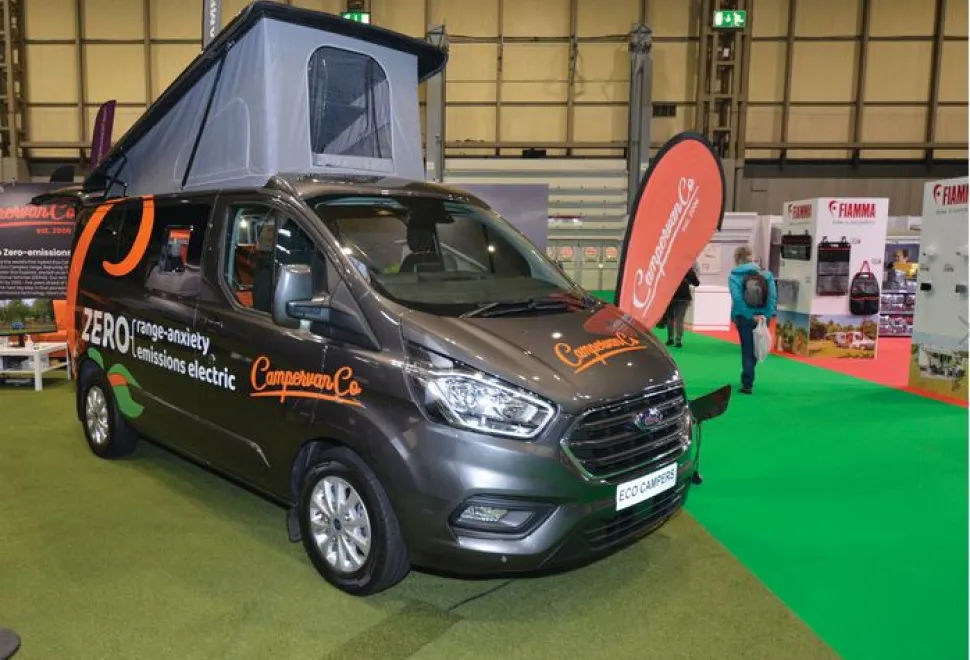
Thus, it has recently launched a conversion based on the Ford Transit Custom PHEV – the only plug-in petrol/electric hybrid van on sale in Britain. We reviewed this base vehicle, which is propelled by a 92.9kW (125bhp) electric motor, in our November 2020 issue (visit motorhome.ma/whiexact for a library of all our road tests).
CampervanCo has been developing its conversion of the Ford, which outwardly looks just like a diesel Transit Custom (bar the flap for the plug) for the past two years, finally revealing the prototype at the NEC show in February. The beauty of this base vehicle is that, not only does it have the same internal space as any other SWB Transit Custom, but it also overcomes range anxiety and inadequate charging infrastructure.
The range
Providing backup to the 13.6kWh battery under the floor is a 1-litre petrol engine – Ford’s Ecoboost unit as seen in the Fiesta, Focus, etc – which acts as a range extender.
Thus, the Evolution PHEV has a claimed pure electric range of 26 miles – ideal for shopping, commuting and low emission zones – but a total range of over 300 miles. CampervanCo says that, on test, it has achieved 91mpg driving the Evolution around town in hybrid mode, while on the motorway around 26mpg can be expected.
The layout
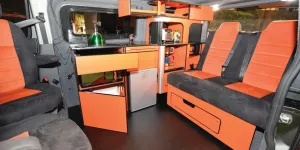
Beyond the use of a hybrid base vehicle, the Eco Campers conversion might, at first, appear to offer little that’s new. After all, this is another pop-top camper with a rear bench/bed and side kitchen. However, CampervanCo has a stated aim of becoming net zero by 2025 and, as part of this, is researching aspects such as lightweight fittings and alternative types of heating, cooking, fridges, etc.
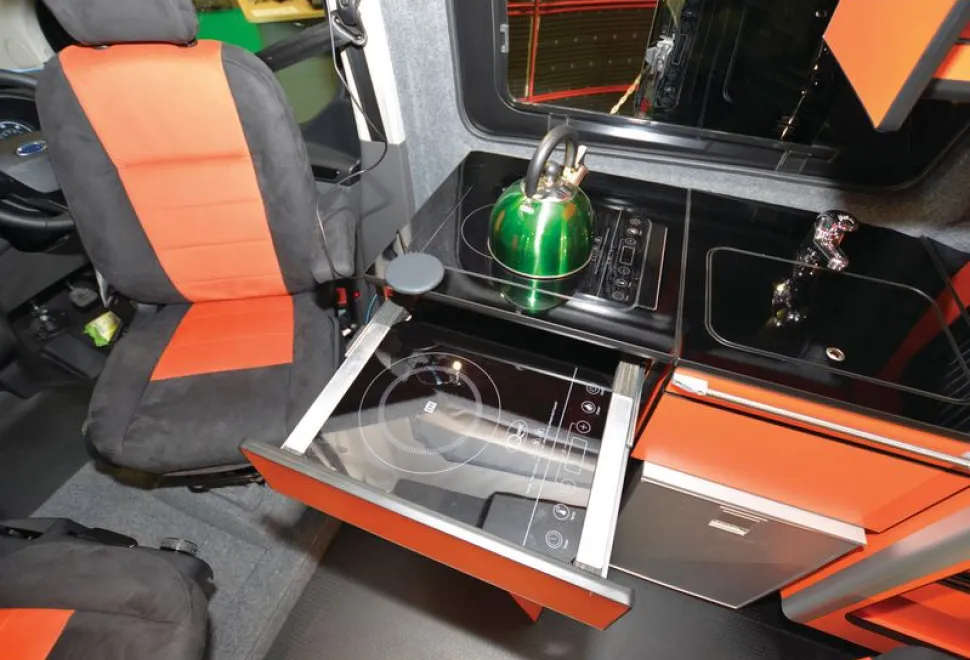
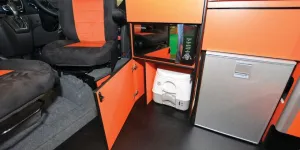
Already, the Evolution employs lightweight plywood and the kitchen includes two removable sections – one for the cooker, microwave and toilet, the second for the sink and fridge. If you remove these day-to-day, the theory is that you’ll be driving a lighter, more efficient vehicle.
The kitchen
Then there’s the kitchen equipment itself. You won’t find gas in this campervan, so cooking is on a pair of induction rings (one sliding out from beneath the other). Also fitted are a microwave and coffee maker, with all this powered by a 3,000W Clayton lithium battery with inverter.
Energy efficiency
There’s 1,000W of solar panels, too, and, recognising the low angle of the sun in the UK, the panels can be attached to the awning rail for greater efficiency.
And the development of this greener campervan is ongoing. CampervanCo is working on introducing its own aluminium-framed seat/bed system which, it is hoped, will save 30kg compared with a bought-in unit. Then there’s a groundbreaking new heating system, using heat capture technology, which should be available from early next year. And, in the meantime, the Evolution has twice the insulation of its forebears to cut energy wastage.


