
Danbury Doubleback
Image
Image
Image
Image
Image
Image
Image
Image
Description
Price from: £55,249 Berths: 4 Travel seats: 4 Length: 5.29m Base vehicle: VW Transporter T5 LWB Type: Rising-roof campervan Layout: Side kitchen, rear bench seat
Key Features
Model Year
2014
Product Class
Rising Roof
Product Model Base
Volkswagen T5
Price from (£)
£55249
Length (m)
5.30
Berths
2
Belted seats
2
Main Layout
Campervan
Full Review
THE launch of the original Doubleback conversion of the VW T5, by Cardiff-based Overlander Motorhomes in February 2012, caused a considerable stir, being heralded as “the first major advance in campervan design since the rising roof”.
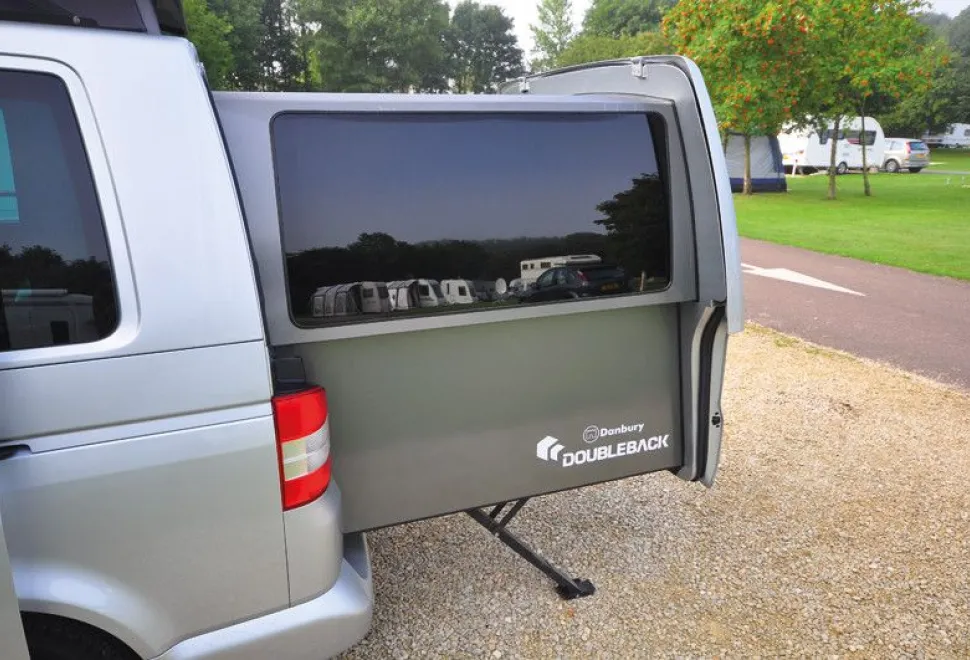
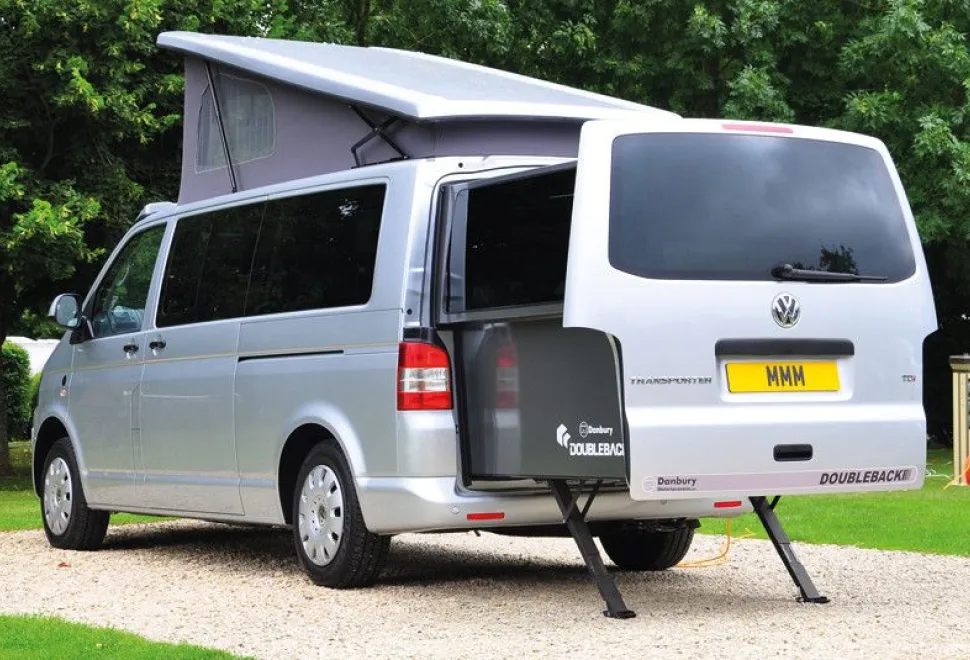
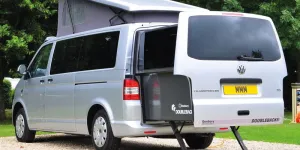
It featured an electrically-operated rear slide-out, dramatically lengthening the long-wheelbase Vee-Dub by nearly two metres, and promising greater interior space when camping.
Fast forward 18 months and Danbury Motorcaravans, in collaboration with Overlander, has now launched a revised version of the Doubleback.
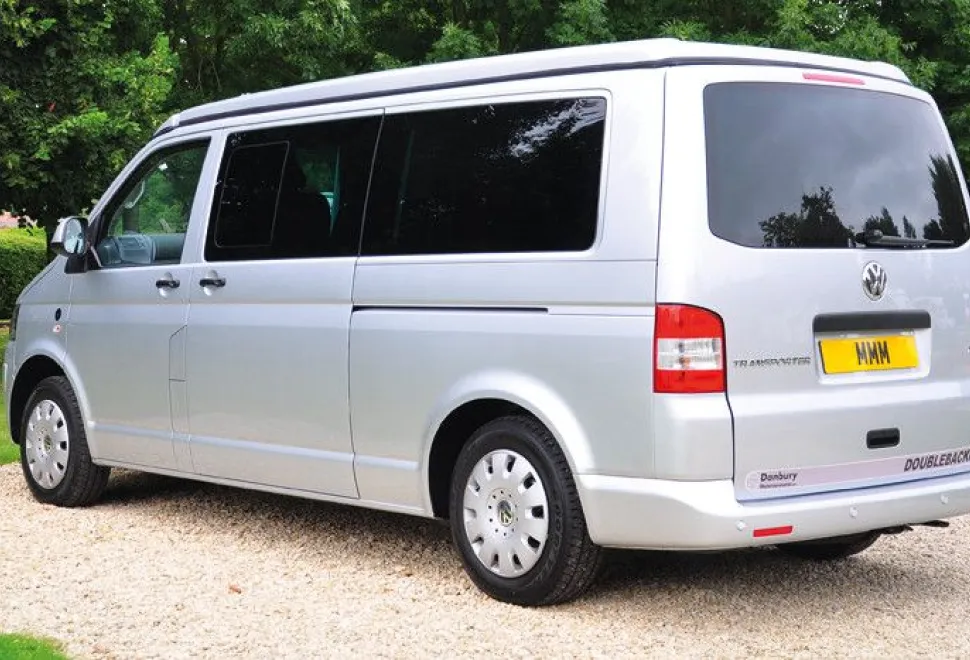
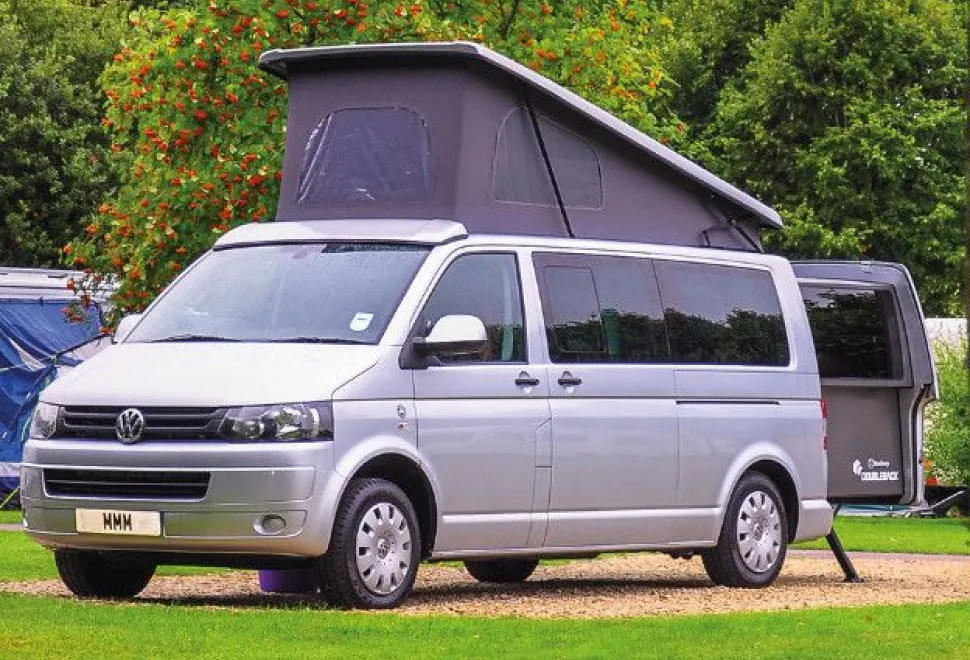
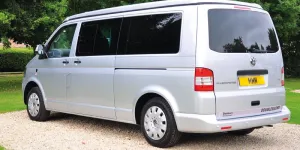
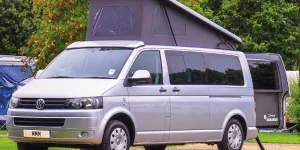
The futuristic pod, still made in Cardiff, of the same lightweight, aircraft-grade, aluminium composite material, is now 70cm shorter, and incorporates a bench seat for two rear passengers – a major plus for owners wishing to use their camper as a family car.
Prices now start at £55,249 for a 100bhp-engined Doubleback – the one we tested cost over £60k – so this is an expensive camper. We were intrigued to see if the price is justified by enhanced practicality over the myriad traditional campervan designs based on the T5.
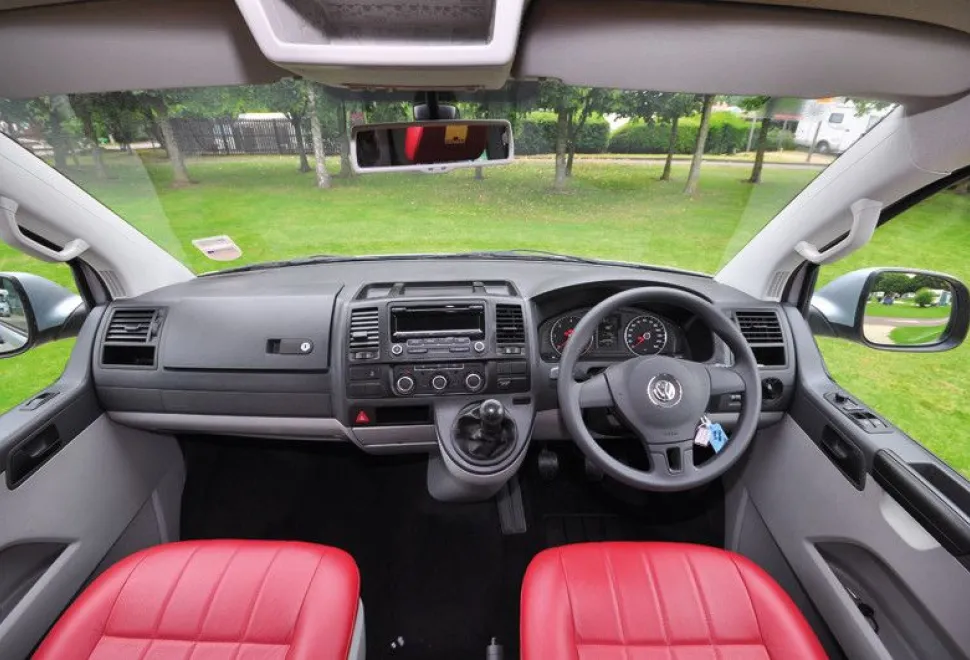
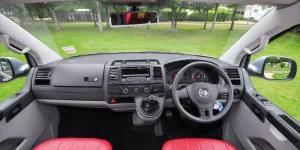
The cab, typical of most facelifted T5s, has a crystal-clear instrument display (although it lacked some features, including the trip computer, which we would have expected, given the vehicle’s price), a slick six-speed gearbox (the gearstick on the lower fascia falling neatly to hand), and a lovely, small, multi-adjustable steering wheel.
The seats lacked armrests, but were beautifully finished in maroon leather and, being height-adjustable, anyone should be able to attain a comfortable driving position.
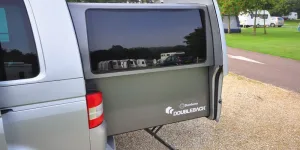
Extending the pod is done by pressing a switch by the sliding door. A motor whirrs and the pod, taking just a few seconds, performs its slide-out trick. Should the pod come across an obstruction, it will stop until the offending article is removed.
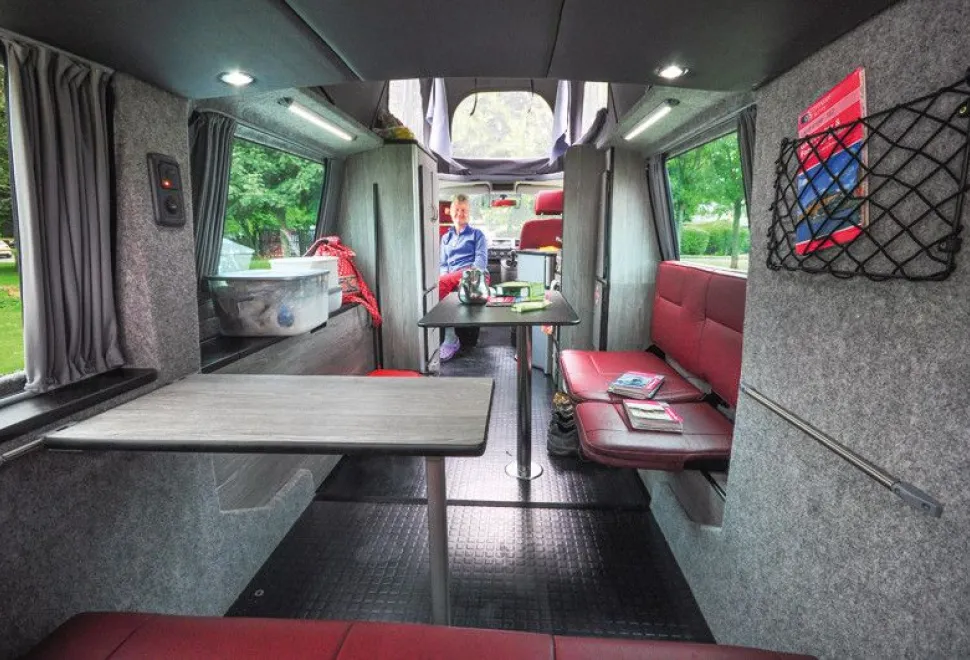
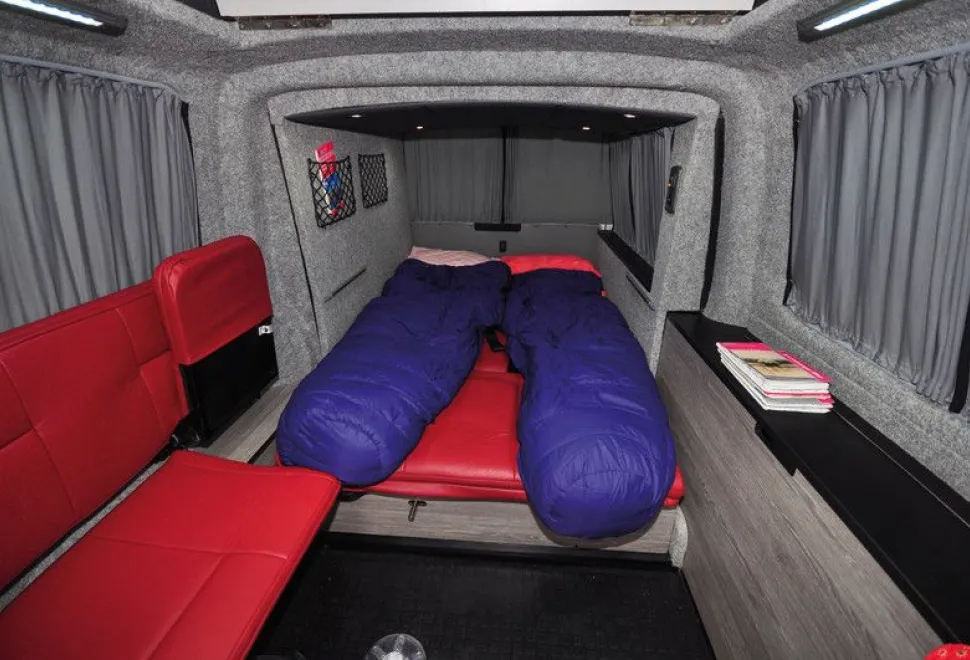
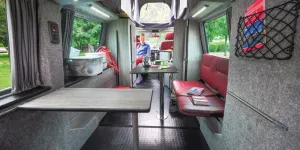
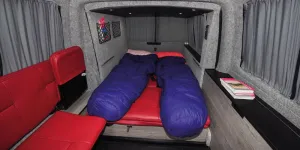
When extended, the Doubleback offers greatly increased interior floor space. Aft of the kitchen, inward-facing seating (hidden when the pod is retracted), is split two-thirds/one-third, the seat squabs held folded upwards (cinema style) by press-studded straps (which are quite awkward to release). These seats appear rather thin and flat, looking somewhat utilitarian – nonetheless, like the bench seat, they are covered in high-quality maroon hide.
Behind the nearside storage unit – opposite the tip-up seats – is open space, with the windowsill of the nearside window lifting to reveal a slim cupboard. The bench seat is now far away to the rear, in its ‘cave’.
Four can travel and sleep in this camper, so what’s it like for lounging? The bench seat at the back isn’t very comfortable for long-term sitting (though the cushions are slightly moulded), because the seat cushion is only about three inches thick and the seat itself is set very low, which is necessary because the pod is only 1.20m high (3ft 11in) and headroom from the seat just 87cm (2ft 10in).
To reach the seat involves crouching through the first part of the pod and, with the top bed in its lowered position, it is like entering a cave, bent double, for several feet. There are four small LED lights in the pod roof, but no reading lights.
Those minimalist, drop-down, side seats are no more comfortable than they look, though one person can sit with his/her feet up.
But there’s only support for half your back so, again, it’s not a long-term proposition.
Once the table is in place, it is steady, but would only serve one diner, and it’s difficult to extricate yourself from behind its leg, while keeping your head low within the pod’s restricted confines.
The other pole-mounted table sits in a floor socket, positioned to serve those on the drop-down side seats. Its ingenious tabletop forms part of, and fits within, the trim of the sliding door (as does its pole). The tabletop is very light and thin, but also curves down at the edges and is slippery.
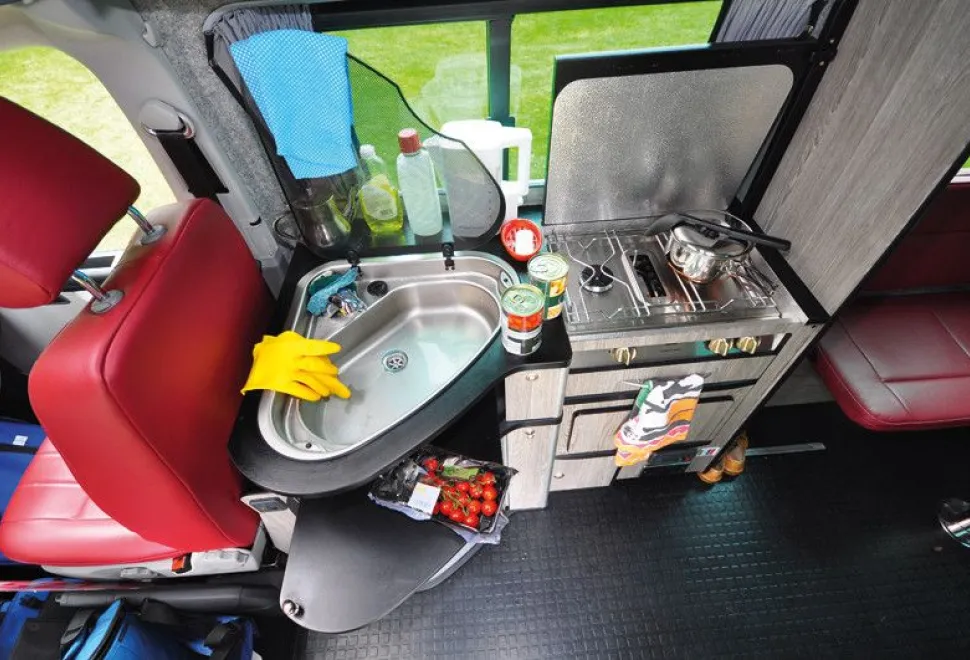
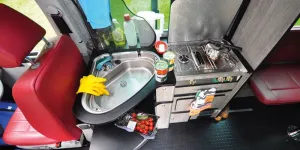
The kitchen unit starts behind the driver’s seat, with its black surface extending outwards to curve around a good-sized, stainless-steel sink with internal cold water tap and glass lid.
Below, two levels of tambour door follow the curve, the top one opening to reveal a cubby with a most useful pull-out work-surface and the bottom door hiding the small (50-litre) Waeco compressor fridge, set well back under the sink.
Therein lies an operational problem – because it’s at floor level, and so recessed, you have to hunker down to access your milk. The door cannot open beyond 90 degrees, so switching the fridge on, or adjusting its temperature, is done by feel and guesswork.
Alongside the sink, under a flush worktop lid, is a two-burner LP Tasman hob – manual ignition rather than electronic – with grill underneath. In use, the burner adjustment was very sensitive, shutting off the gas irritatingly easily, resulting in calls of “Now, where did I leave those matches?”
One problem not immediately apparent by daylight became very clear at night – there’s a mismatch between the curves of the VW tailgate and the pod’s, so there’s a gap big enough to insert an exploratory hand through which light and air passes on each side.
The Reimo-sourced roof bed descends easily and can quite easily be returned to the roof, though it’s hinged near the back, and must be pushed at the correct point; a technique quickly learnt.
The practical difficulty is creating room for the pod to retract. That’s why the side-facing seats have to be slimline and folding, and why the windowsill storage opposite doesn’t have a front door, but is top-opening.
Therefore, storage facilities in the Doubleback are largely in the kitchen and the tall unit opposite – both are beyond the innermost reach of the pod.
The metal-lined, but unsealed, gas locker is, unusually, above floor level, in the cupboard aft of the kitchen – it contains one Campingaz 907 cylinder, but the gas drop-out in the cupboard floor seemed very small. There was no central control unit or isolating switches, and the only 12V socket we could find was the cab’s cigarette lighter.
This is an edited extract taken from the January 2014 issue of MMM magazine. You can download a digital version of that issue here.
It featured an electrically-operated rear slide-out, dramatically lengthening the long-wheelbase Vee-Dub by nearly two metres, and promising greater interior space when camping.
Fast forward 18 months and Danbury Motorcaravans, in collaboration with Overlander, has now launched a revised version of the Doubleback.
The futuristic pod, still made in Cardiff, of the same lightweight, aircraft-grade, aluminium composite material, is now 70cm shorter, and incorporates a bench seat for two rear passengers – a major plus for owners wishing to use their camper as a family car.
Prices now start at £55,249 for a 100bhp-engined Doubleback – the one we tested cost over £60k – so this is an expensive camper. We were intrigued to see if the price is justified by enhanced practicality over the myriad traditional campervan designs based on the T5.
The cab, typical of most facelifted T5s, has a crystal-clear instrument display (although it lacked some features, including the trip computer, which we would have expected, given the vehicle’s price), a slick six-speed gearbox (the gearstick on the lower fascia falling neatly to hand), and a lovely, small, multi-adjustable steering wheel.
The seats lacked armrests, but were beautifully finished in maroon leather and, being height-adjustable, anyone should be able to attain a comfortable driving position.
Extending the pod is done by pressing a switch by the sliding door. A motor whirrs and the pod, taking just a few seconds, performs its slide-out trick. Should the pod come across an obstruction, it will stop until the offending article is removed.
When extended, the Doubleback offers greatly increased interior floor space. Aft of the kitchen, inward-facing seating (hidden when the pod is retracted), is split two-thirds/one-third, the seat squabs held folded upwards (cinema style) by press-studded straps (which are quite awkward to release). These seats appear rather thin and flat, looking somewhat utilitarian – nonetheless, like the bench seat, they are covered in high-quality maroon hide.
Behind the nearside storage unit – opposite the tip-up seats – is open space, with the windowsill of the nearside window lifting to reveal a slim cupboard. The bench seat is now far away to the rear, in its ‘cave’.
Four can travel and sleep in this camper, so what’s it like for lounging? The bench seat at the back isn’t very comfortable for long-term sitting (though the cushions are slightly moulded), because the seat cushion is only about three inches thick and the seat itself is set very low, which is necessary because the pod is only 1.20m high (3ft 11in) and headroom from the seat just 87cm (2ft 10in).
To reach the seat involves crouching through the first part of the pod and, with the top bed in its lowered position, it is like entering a cave, bent double, for several feet. There are four small LED lights in the pod roof, but no reading lights.
Those minimalist, drop-down, side seats are no more comfortable than they look, though one person can sit with his/her feet up.
But there’s only support for half your back so, again, it’s not a long-term proposition.
CAMPERVAN DINING
For eating, there are two tables. The smaller one, which stores on the back of the storage cabinet inside the sliding door, is removed with the door open. It clips to one or other of two rails attached to the pod wall and has a single adjustable leg.Once the table is in place, it is steady, but would only serve one diner, and it’s difficult to extricate yourself from behind its leg, while keeping your head low within the pod’s restricted confines.
The other pole-mounted table sits in a floor socket, positioned to serve those on the drop-down side seats. Its ingenious tabletop forms part of, and fits within, the trim of the sliding door (as does its pole). The tabletop is very light and thin, but also curves down at the edges and is slippery.
CAMPERVAN KITCHEN
The kitchen unit starts behind the driver’s seat, with its black surface extending outwards to curve around a good-sized, stainless-steel sink with internal cold water tap and glass lid.Below, two levels of tambour door follow the curve, the top one opening to reveal a cubby with a most useful pull-out work-surface and the bottom door hiding the small (50-litre) Waeco compressor fridge, set well back under the sink.
Therein lies an operational problem – because it’s at floor level, and so recessed, you have to hunker down to access your milk. The door cannot open beyond 90 degrees, so switching the fridge on, or adjusting its temperature, is done by feel and guesswork.
Alongside the sink, under a flush worktop lid, is a two-burner LP Tasman hob – manual ignition rather than electronic – with grill underneath. In use, the burner adjustment was very sensitive, shutting off the gas irritatingly easily, resulting in calls of “Now, where did I leave those matches?”
NOT-SO-PORTABLE CAMPERVAN POTTI
As usual in a traditional campervan, there’s no separate facility for ablutions. There’s a small portable toilet, but it’s stored well above floor height, in a cupboard in the nearside storage unit.CAMPERVAN CURTAINS
The Doubleback’s curtains are truly excellent. Of slightly stretchy blackout material, silvery-grey on one side and black on the reverse, they are held securely in strong rails, both top and bottom, and they keep both campsite lights and morning sun at bay. They are fitted to all windows, other than the cab, for which insulated screens are supplied – we’d prefer extending the curtain system to the cab.One problem not immediately apparent by daylight became very clear at night – there’s a mismatch between the curves of the VW tailgate and the pod’s, so there’s a gap big enough to insert an exploratory hand through which light and air passes on each side.
The Reimo-sourced roof bed descends easily and can quite easily be returned to the roof, though it’s hinged near the back, and must be pushed at the correct point; a technique quickly learnt.
SPACE EXPLORATION
Surely, one of the main benefits of having the extending pod is all the extra space and storage you’d enjoy? Floor area, certainly… storage, regrettably not.The practical difficulty is creating room for the pod to retract. That’s why the side-facing seats have to be slimline and folding, and why the windowsill storage opposite doesn’t have a front door, but is top-opening.
Therefore, storage facilities in the Doubleback are largely in the kitchen and the tall unit opposite – both are beyond the innermost reach of the pod.
CRUISING THROUGH THE CAMPERVAN OPTIONS
If a campervan costs upwards of £60,000, you’d expect it to be fully equipped with every gizmo. However, the Doubleback lacks a heater (a diesel-powered unit being a £999 option). Removable carpets are another option not fitted to the test vehicle, neither did it have VW’s cruise control and trip computer options, though cab air-conditioning did feature.The metal-lined, but unsealed, gas locker is, unusually, above floor level, in the cupboard aft of the kitchen – it contains one Campingaz 907 cylinder, but the gas drop-out in the cupboard floor seemed very small. There was no central control unit or isolating switches, and the only 12V socket we could find was the cab’s cigarette lighter.
This is an edited extract taken from the January 2014 issue of MMM magazine. You can download a digital version of that issue here.
-
For great digital Which Motorhome subscription deals, click here.
- For great digital MMM subscription deals, click here.
Our Verdict
The Doubleback is an interesting concept with an exciting high-tech slide-out pod. It offers lots more internal floor space when on site, but no more storage than many traditional campervans - perhaps less. Facilities and comfort are rather basic for the elevated price.
Advantages
Car-like drive of VW
Excellent curtains in living area
Good-sized sink
High-quality (optional) leather trim
Spare wheel as standard
Disadvantages
Lack of storage
Difficulty of converting lower bed
Poor access to the fridge


