
CMC Reimo Caddy Camp Maxi



Description
Berths: 2-3 Travel seats: 5 Base vehicle: Volkswagen Caddy Maxi Gross vehicle weight: 2,345kg Payload: 400kg
Key Features
Full Review
With its Caddy Camp, Kent-based CMC isn’t the first converter to have a crack at the Volkswagen’s smaller van. Volkswagen itself offered a short-lived conversion. Danbury and Wellhouse Leisure have both dabbled with the Caddy in the past, while others, including Reimo, supply furniture and fittings for DIY Caddy conversions.
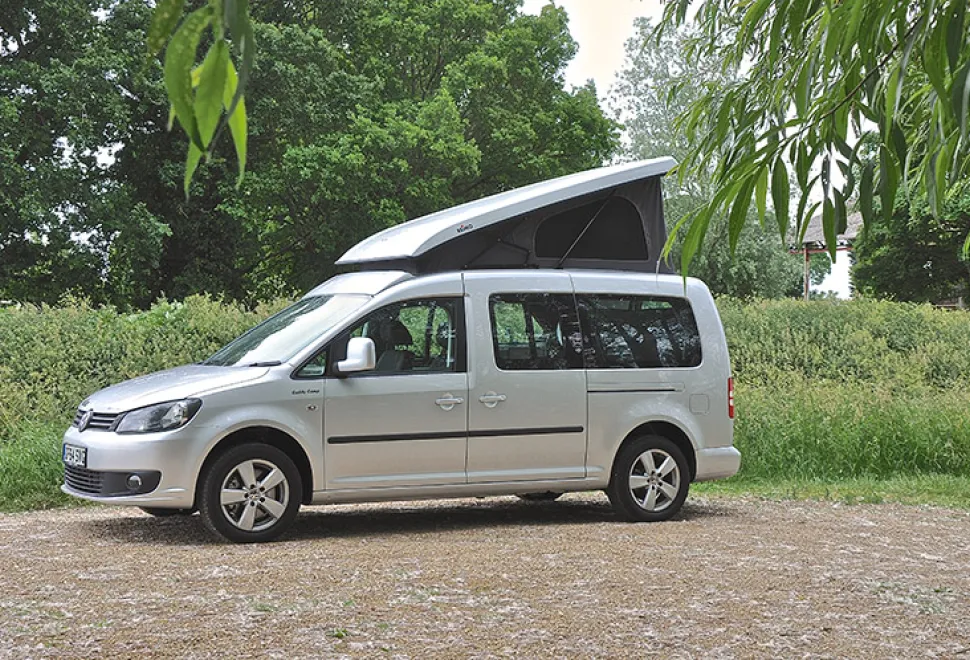
So why the Caddy? Adding windows to vans isn’t always a great design success, but the Caddy carries off its extra glazing with aplomb. Even with its 40cm stretch over the standard Caddy, the Maxi refuses to look ungainly.
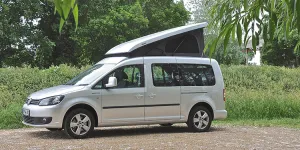
There are also a number of diminutive campers that look like they are sporting a Mohican, such is the narrowness of the pop-top in comparison to the vehicle. Not so the Caddy Camp, whose roof sits neatly atop like a far more conservative hairdo. The Reimo roof adds only a few centimetres to the overall height, making the ‘van multi-storey-car-park-proof.
With so much anticipation around the T6, the fact that a fourth-generation Caddy was also on the cards went largely unnoticed when it was announced in February. Like the T6, the fourth iteration of the Caddy will have a mild facelift and won’t change dimensionally, so the conversion you see on this third-generation Caddy will be carried through.
The ‘van is currently available with two engine choices and three gearbox options: a 1.6-litre TDI engine (101bhp) and five-speed manual gearbox as standard, or, for £2,300 more, you get a 2-litre TDI (138bhp) with a six-speed manual gearbox. Both engines are available with Volkswagen’s great semi-automatic DSG gearbox, although this adds another £1,578 to the price.
The driving position is the most car-like of any campervan I have yet tested. That’s no great surprise, as the Caddy started out as a commercial version of the Golf.
A glance back reminds you that you’re in a camper, although the lounge seats obstruct the nearside rear three-quarter view when they are folded up to maximise rear storage.
The engine is quiet, but I found the 101bhp unit seriously lacking in torque. The gearing isn’t low to make up for this, so the engine has to be revved quite hard to get underway with any degree of urgency. Fully loaded with five people, the Caddy Camp would be better served by the 138bhp engine.
When it comes to ride and handling, the suppleness means you could be driving a modern Golf. There’s no conversion noise either, not even a squeak from the roof.
The lower height of the Caddy is immediately obvious – with a ceiling height of just 1.20m with the rising roof down. Unclip the two Reimo-branded straps where they secure the roof to the rear of the ’van, push the bed board up, and you’re left with a vastly improved ceiling height of 2.09m at the rear, tapering down to 1.78m over the kitchen. Many T5-sized conversions can’t match that.
The layout looks spartan, compared with other Caddy campers that have attempted (not too successfully) to feature all the equipment you’d expect to find in a T5. Mind you, compared to VW’s own go at Caddy conversion (row upon row of wall-hung pouches and a bed – nothing else), the Reimo looks luxurious.
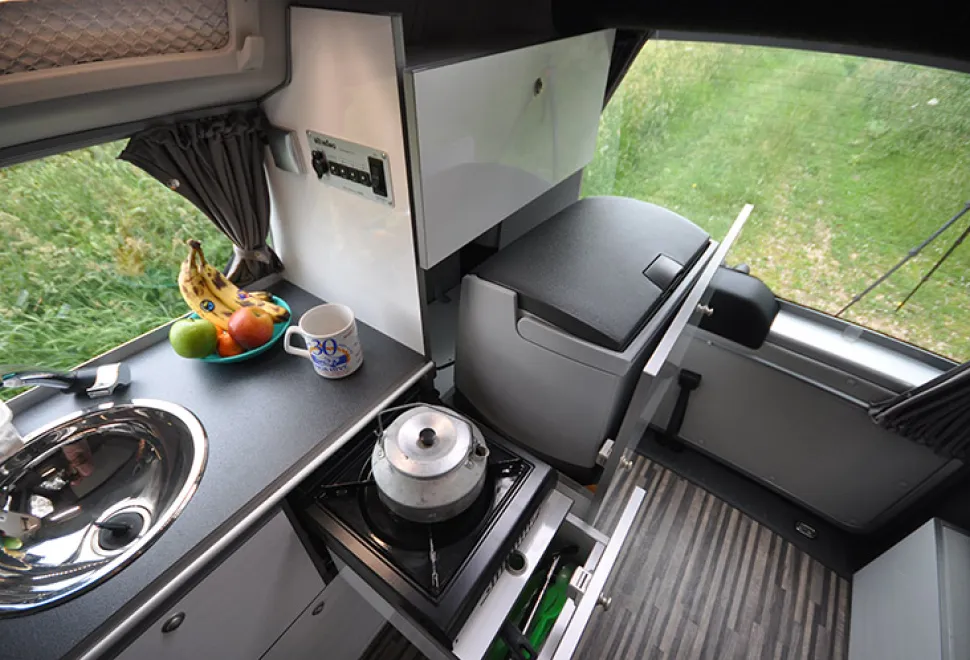
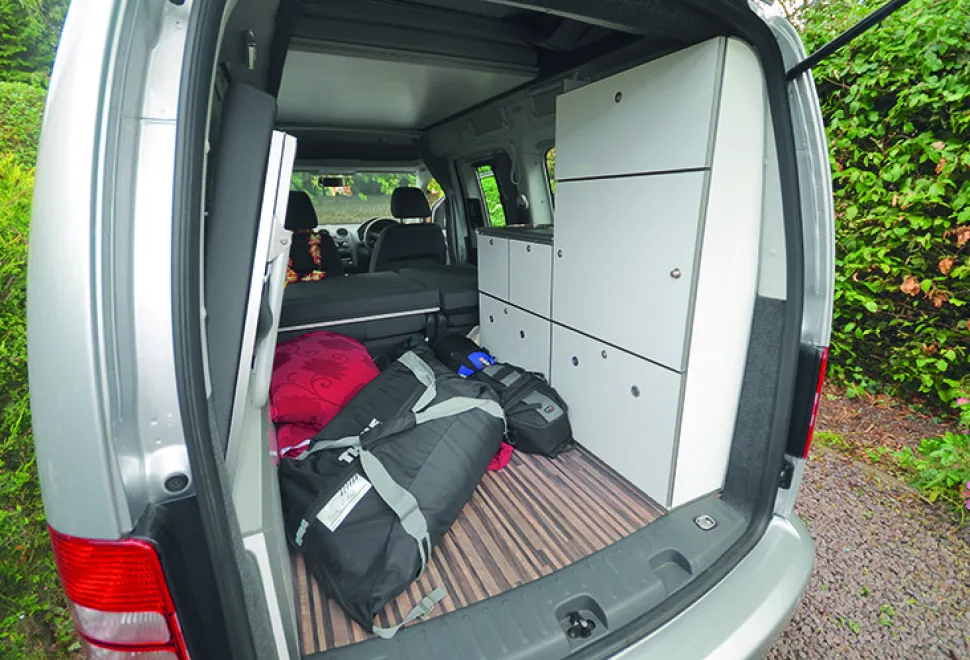
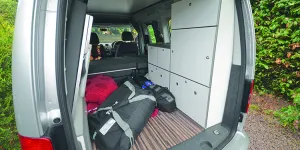
The only fixed-position furniture is an offside rear unit made up of cupboards and a small sink unit. Opposite are two fold-down lounge seats that can be used individually or together, depending on whether you plan to use the kitchen or fit the rail-hung, single-leg table.
The living space is flexible, comfortable and large enough for two to lounge in comfort. A couple and one child would just about fit here, but cabin fever could set in quite quickly on a rainy day.
That flexibility is never better demonstrated than when the lounge seats are folded up to the wall and the ’van is packed and ready for camping. The space behind the back seats is significantly bigger than in many larger van conversions. My mountain bike went in with ease.
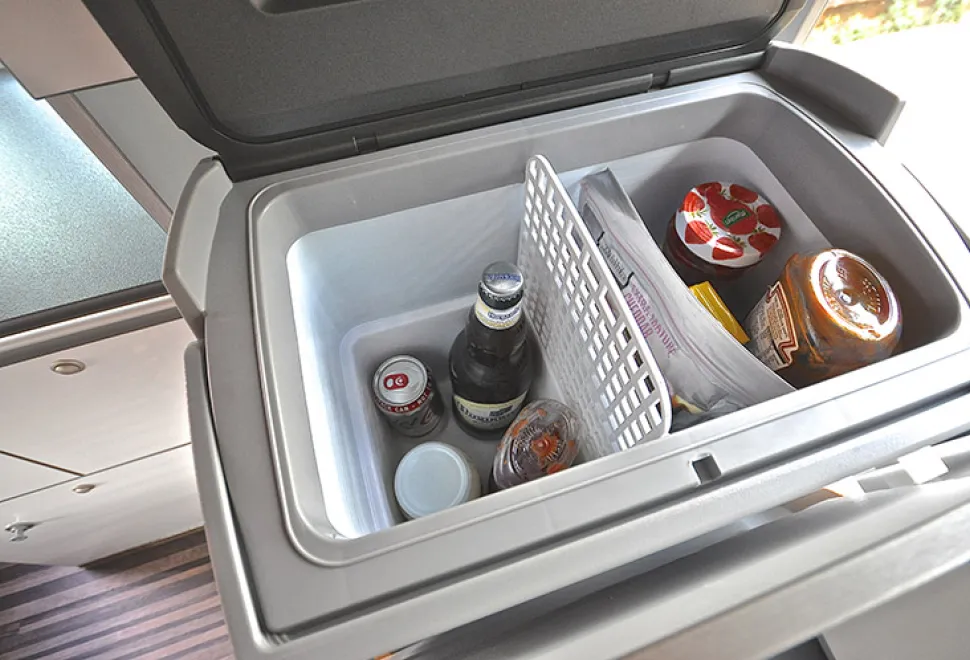
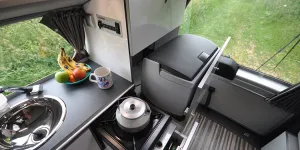
The kitchen takes the brunt of the compromises such a ‘van needs to make. Cooking is done on a single-burner hob that slides out of a cupboard below the worktop. There’s a small stainless steel sink and a flip-up worktop to the left. The 18-litre fridge is in another drawer, and can conveniently be removed entirely so you can load it in your kitchen at home.
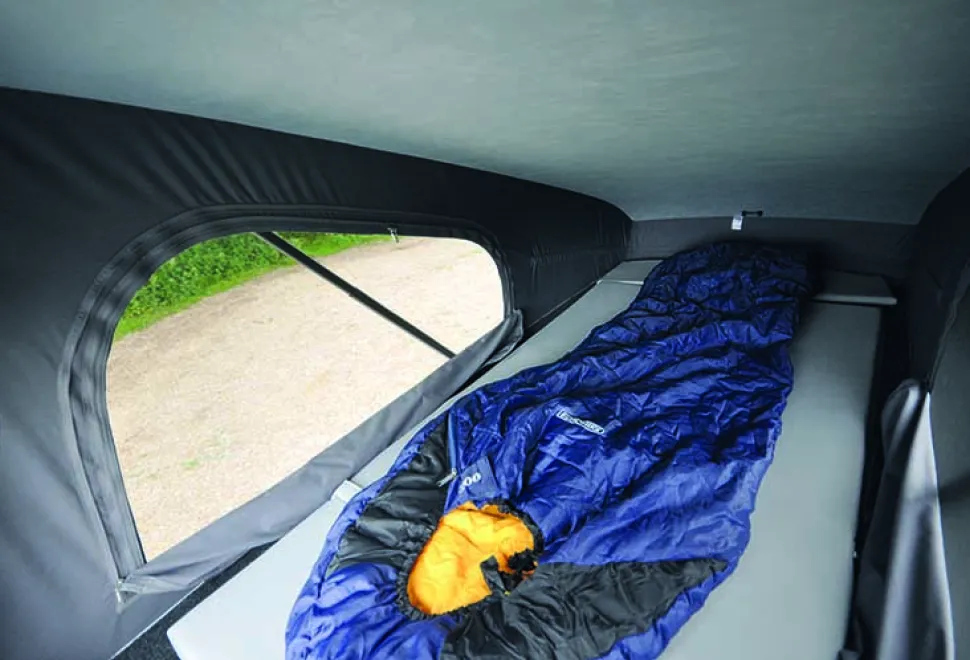
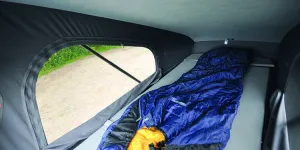
The Caddy has a surprising number of sleeping options for its size: there’s a roof bed and a choice of a single or a double bed downstairs. The profile tapers in towards the roofline, making the available space upstairs narrower than a T5 or a Ford Transit Custom, but with the meshed windows open the space is still welcoming.
The roof bed is also large enough for a couple of kids (or a single adult), at 1.92m long by 0.80m wide. It’s the best bed and would be ideal for someone using the Caddy on their own.
The beds downstairs make up simply and quickly from the furniture and cushions. The single bed is a couple of metres long by 0.70m wide, while the double is the same length but 1.34m at its widest, tapering down to 1.10m. We’ve seen many a T5 with a smaller bed than this.
This is an abridged version of the full review appearing in the October 2015 issue of MMM.
Our Verdict
The Caddy Camp Maxi makes the very best use of the space available. It works wonderfully well for one or two people, but larger groups and families should probably go for a larger base vehicle.
Disadvantages


