
Auto-Sleeper Windrush (2012)
Image
Image
Image
Image
Image
Image
Image
Image
Image

Image
Image
Image







Description
Auto-Sleepers Windrush 2012
Key Features
Model Year
2012
Product Class
High top
Product Model Base
Peugeot Boxer
Price from (£)
£46495
Length (m)
6.00
Berths
4
Belted seats
4
Main Layout
Bunk Beds
Full Review
Family motorhoming in a panel van – the very latest high-top blows in from the Cotswolds.
Auto-Sleepers is one of the UK’s most long-lived and respected producers of motorcaravans, having been around for over 50 years and with a reputation for making quality products at the higher end of the market. Van conversions have always been an AS speciality – the very first Auto-Sleeper was one – so when a new-and-very-different model emerges from the firm’s Cotswold home it deserves immediate attention.
And this one was so new that when I arrived to pick it up from the Willersey factory, it was still being tweaked by the product development department. No excuses here, but I must use the dreaded P-word, as the ‘van was the first to be built and a prototype. Would I need to be gentle with it? There was only one way to find out, so I loaded my sleeping bag, toothbrush and kettle and headed off to the Caravan Club’s site at Broadway.
WHAT’S IN A NAME?
Windrush is the name of the new Auto-Sleeper, and it proved appropriate as during the test, the tail of Hurricane Katia was busy ‘tweaking’ our weather – wind-rush indeed! The name follows the current Auto-Sleepers’ tradition of naming its ‘vans after Cotswold villages – however, Windrush offers a layout that’s anything but traditional for an Auto-Sleeper, so this one shares a name with a local river.
I’m no Auto-Sleepers historian, but I cannot remember another Auto-Sleeper with bunks, and that’s exactly what the Windrush provides. But there’s more, as bunk-equipped van conversions are rare beasts too – providing family-friendly accommodation in a six-metre panel van is potentially a great idea, but tricky. It’s been done before though – I’ve seen bunks in models from both Timberland (in the past) and more recently, WildAx. Doing it is one thing, but doing it well – in what is undeniably a small space – is a whole different kettle of cod.
FORM AND FUNCTION
First, a couple of caveats: based on the long wheelbase version of Peugeot’s Boxer, the Windrush is actually based on the ‘window van’, so fenestration is single-glazed, in tinted flush glass. These windows look superb from outside, but their tint might make the interior feel rather gloomy on dull days. Also, there’s always going to be a greater risk of condensation inside (compared to the more oft-found double-glazed plastic windows) when the weather’s cold outside.
In addition, the test vehicle was fitted with the, then current, Euro 4 compliant engine. At the time, Euro 5 Boxers were on the way, so we might expect 2012 models to be fitted with the new engine, while cab enhancements can include a new multimedia features-equipped stereo and special dash trim. Engine outputs are set to be improved too, while Euro 5 should bring better fuel economy, along with its planet-saving talents.
OUTS AND INS
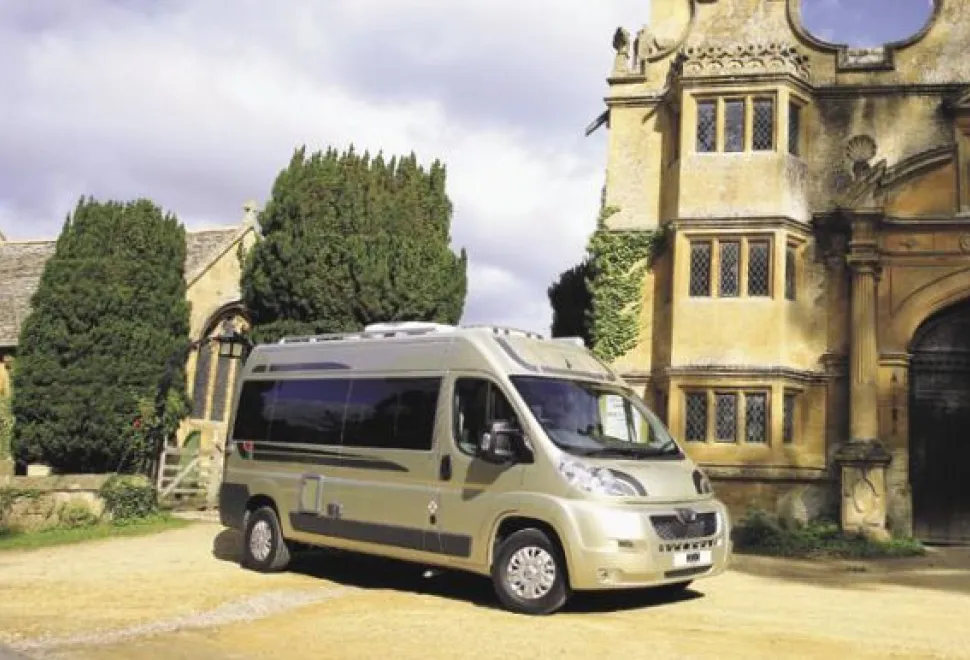
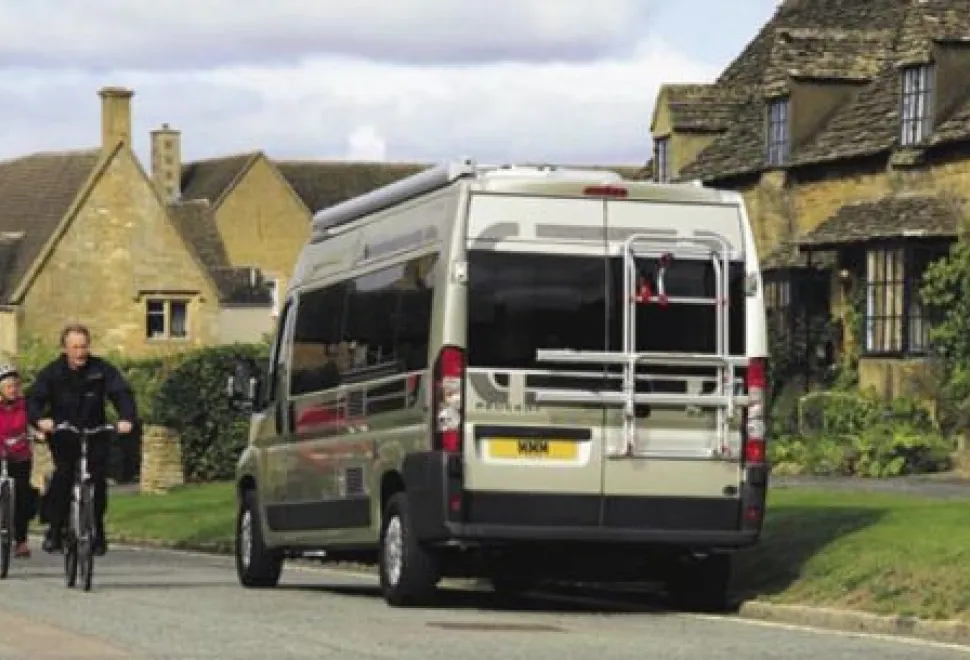
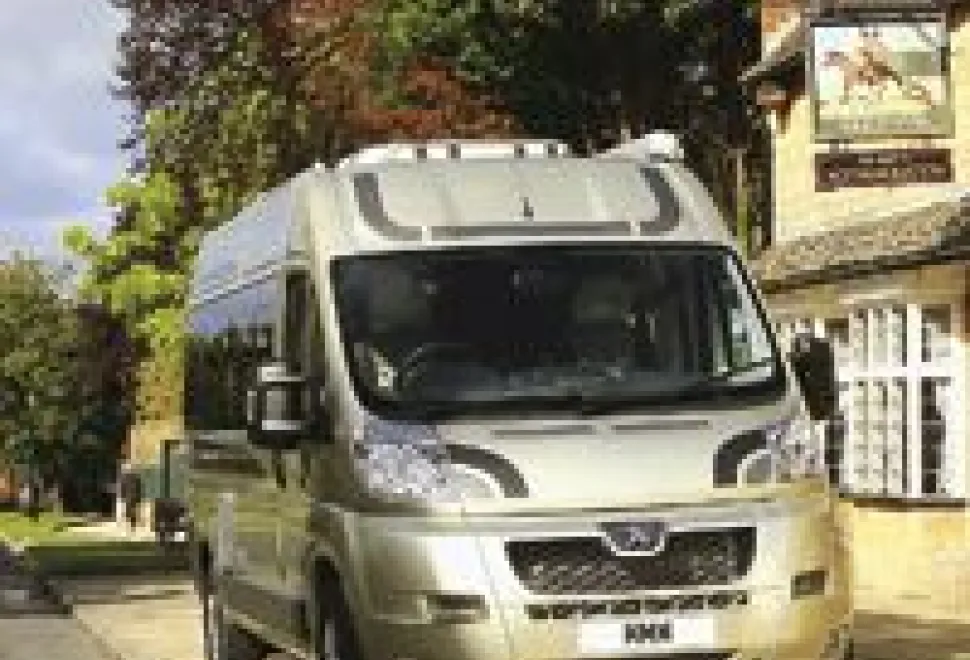
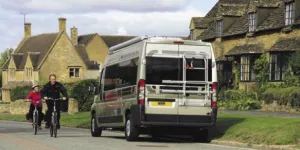
The long wheelbase Boxer’s external delights are well documented, and you either like the shape or don’t care for it. I’m in the former camp, and even after five years, to my eye, it still appears fresh and quite cutting-edge. The test vehicle’s Champagne gold colour, understated graphics and those stylish tinted windows combine to make a good-looking camper. I spent a fair bit of time talking to other campers about the ‘van, such was its magnetic qualities. Externally, details are also important: alloy wheels look great, the awning is standard and there’s a barbecue point, and a TV signal input socket (for easy connection to free-standing aerial, sat dish, or campsite piped TV).
Mounted on the driver’s side B-pillar is the filler that announces the presence of a gas tank – 25 litres gives a capacity of around 12.5kg of LPG. Newbies might be pleased to discover that, with this system, the days of lugging cylinders are over – you simply fill up at one of the many filling stations (across much of Europe) that sell autogas. The water-fill system is a love-it-or-hate-it device: Whale’s Aquasource has a plug-in filler that incorporates 12V power, and accepts a connection to a (supplied) submersible pump for on-pitch top-ups.
Should you be lucky enough to find yourself on a super-pitch (with its own tap) you can connect directly to the mains, thus the tank is constantly kept topped up. It’s the conventional filling of the tank that detractors dislike, they feel it’s too slow. Convenience verses speed? Only you can decide.
A quick peer under the rear and I discovered that a spare wheel is fitted but there’s more: Auto-Sleepers’ eye for practical detail has seen the fitting of a remote valve that allows the checking of its pressure – no grovelling required.
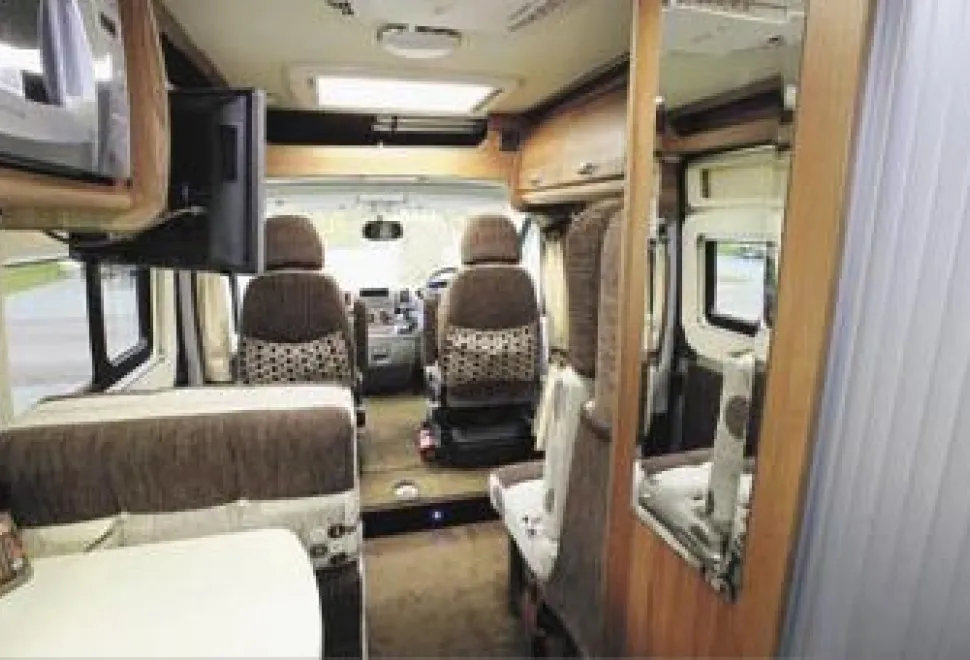
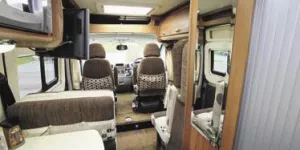
Step aboard and you’re greeted by Auto-Sleepers’ current carpentry colour, which is a deep, matt-finished, silver-trimmed brown. Coupled with the currently-fashionable, coffee-crème fabrics (and dark brown removable carpet) all looks very pleasant and well constructed. Pleated blinds (with flyscreens) adorn all the windows, except the rears (which don’t open), where there’s only room for curtains. The cab has curtains too, and although they’re okay, I’d rather see cab blinds that do a better job of blackout and insulation. This is especially noticeable as there are no curtains in the lounge. Maybe these are on the options list, but this is no deal breaker, as it’s easy to have them retro-fitted for about £450.
As I said, the tinted side windows can make things a tad gloomy, but thankfully, a Midi Heki rooflight illuminates the lounge well. One advantage of the flush glazing is the presence of ‘pop-in-and-slide’ openers in the lounge. Good for general ventilation, they can also be used safely while on the road. In the kitchen, the test ‘van had the optional living area air-conditioning fitted, and this incorporates a smaller rooflight that does the job. I would expect to see a Mini Heki here in standard trim. More AS attention to detail sees a high quality fire extinguisher and smoke and carbon monoxide detectors all in place.
BOXERCISE
The Peugeot Boxer chassis provides excellent performance, with great handling, powerful brakes and light steering. The cab is comfy during long journeys, the external mirrors superb. Differences with other motorhomes come, therefore, in the details, while the aforementioned Euro 5 version – when it arrives in 2012 – will merely improve the beast. Better performance (from increased engine outputs) and improved fuel economy should be the results.
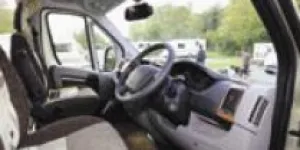
Up in the cab, air-conditioning is standard, as are steering wheel-mounted audio controls. Auto-Sleepers adds rather thick swivels, so tall folks may find the cab seats a touch high. For me, at five-foot-ten, they were fine. There’s little interior vision to the rear, but a fitted camera, with interior mirror-style monitor solves the problem. In use, it proved itself well, with a clear picture that gave a very good view of the latest tailgater, and when reversing.
VERSATILE FRONT
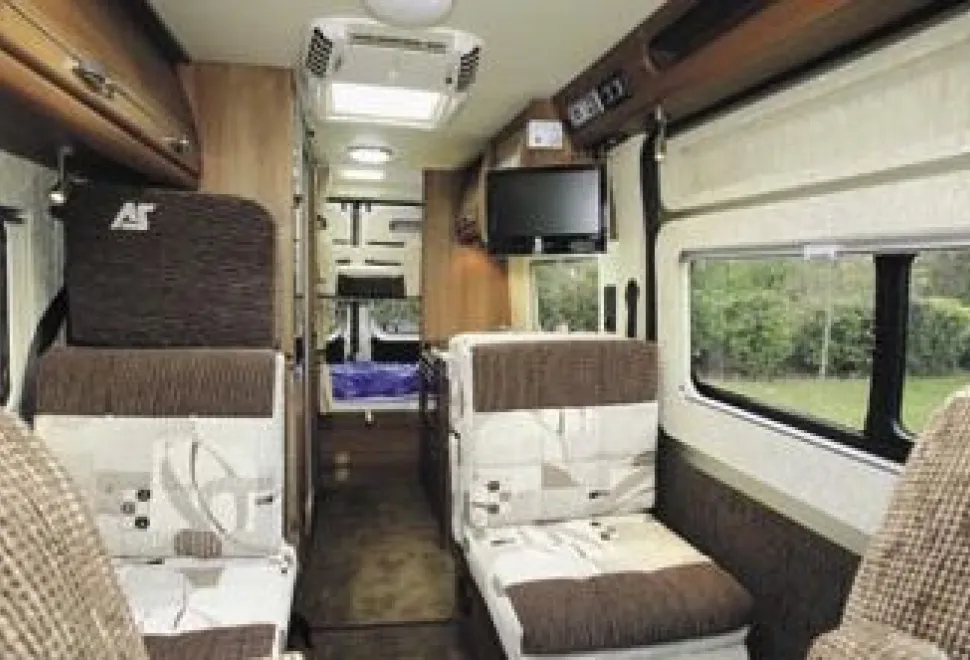
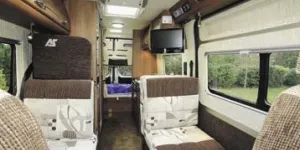
As a four-berth motorcaravan aimed squarely at families, the Windrush provides a total of four, fully-belted travel seats. The rears are mounted on steel frames – top belt mounts secured to the vehicle’s steel sides. Seat squabs are a tad unsupportive though – probably a consequence of having to provide foam, the density and shape of which, has to make a comfy bed. Swivel the cab seats and a four-seater lounge is made, albeit with the cab chairs up a step (this is the case in many of the type).
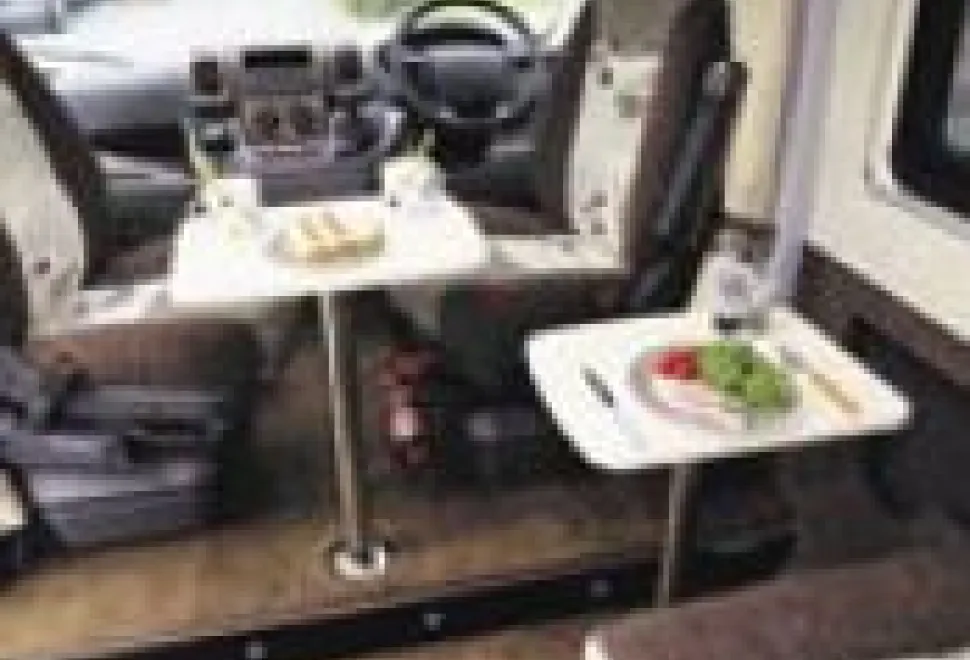
Because of this, Auto-Sleepers has provided several positions for the two small tables it supplies. Stored neatly on the offside (with their pedestal legs in the overcab), these can be arranged in two of three sockets: in front of each rear travel seat or in between the cab seats. They’re small though – with just enough room for a plate, cup and maybe a cruet, so provide dining for just two people.
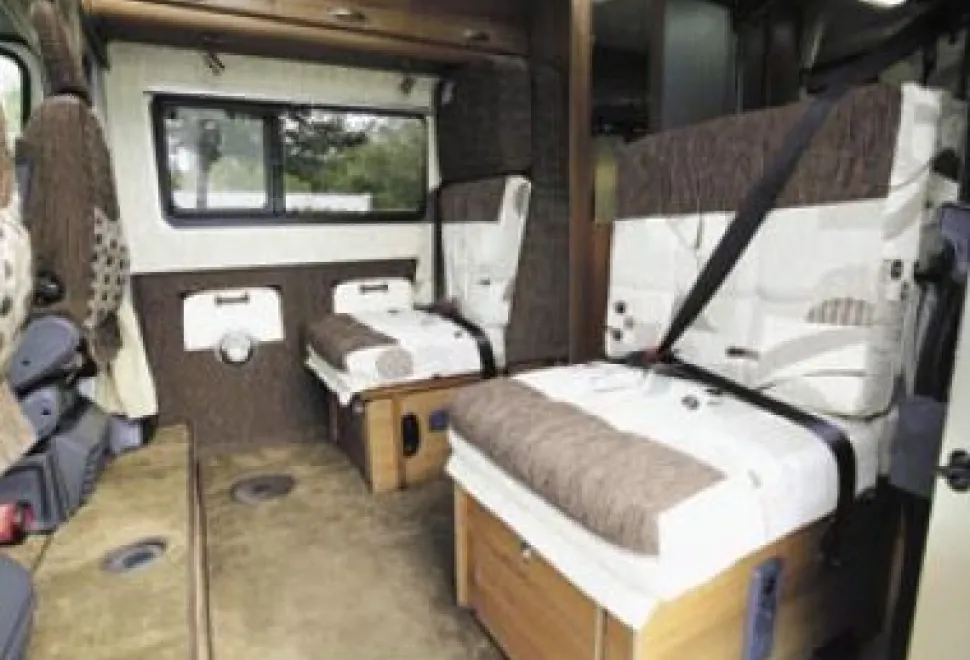
However, the versatility continues in here, as the rear seats flatten (something that’s also part of bed construction) to make benches. Once this is done, table number three emerges from its home in the overcab, to stand between the benches and provide for four at dinner time. On the offside, the bed infill cushion also provides a backrest – the created sofa completely changes the character of the lounge, adding another layer of versatility.
Entertainment in here is assured, as rear speakers are connected to the radio and a TV/ DVD player (optional) is mounted at a reasonable height for viewing. Sockets are supplied to feed signals from other devices (satellite dish or digi-box) mounted in the kitchen’s overhead locker. The kids can be kept happy en-route too, as 12V sockets are mounted above – located here to power a pair of portable DVD players that hang on the backs of the cab seats. An effective range of LEDpowered lighting completes a lounge-diner that’s about as versatile as it’s possible to be.
IN THE KITCHEN
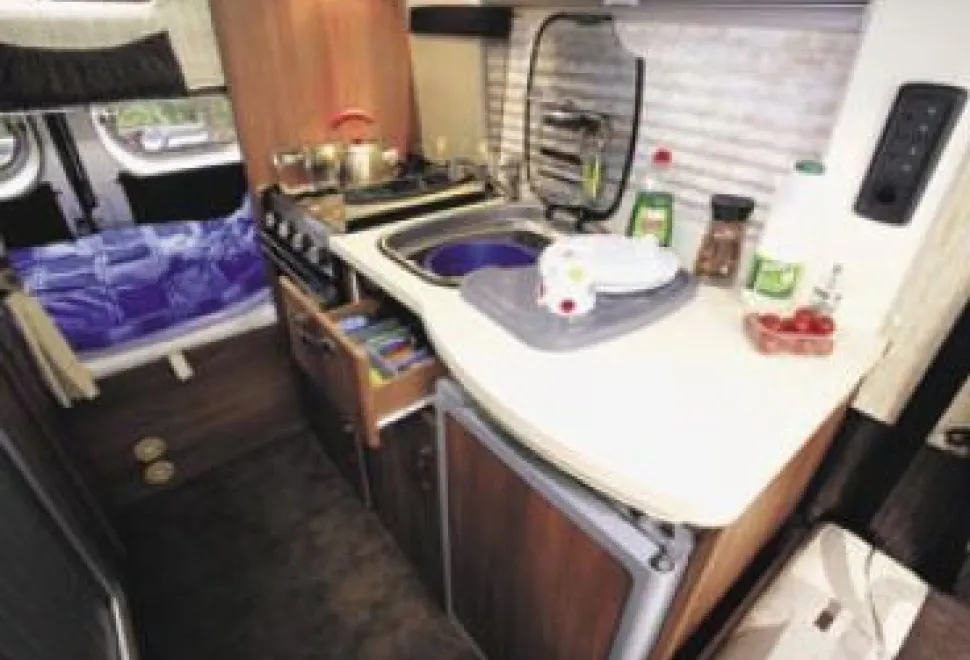
Fully equipped best describes the Windrush galley, as a decent cooker and microwave oven are standard-fit items. There’s a good slab of worktop too, and another pull-out section that emerges from below it. The stove is Thetford’s neat, half-height Triplex unit, which provides three hob burners, one of which is a high-speed device that boiled my kettle in double-quick time. Below, there’s an oven/grill big enough for a Sunday roast.
The fridge is less impressive, as it’s a basic, dare I say, cheap model that ‘boasts’ a shallow interior – a rather paltry capacity in a family ‘van. The microwave is unremarkable, aside from the fact that it’s mounted at a reasonably user-friendly height above the work-top.
The storage menu provides a high-level locker and with two small shelves alongside, while down below, there’s one decent drawer and two cupboards. The locker has no shelves and one of the cupboards is mostly filled with the electrics distribution unit. Kitchen storage space is, therefore, rather limited. Auto-Sleepers seems to realise this, as one of the (three) overhead lockers in the lounge is fitted out with racks for plates and mugs. It’s
easy to criticise of course, and this galley does provide a lot in a small space; many larger coachbuilt motorhomes offer less.
One thing that does need immediate attention though is the worktop area. The back of the nearside rear seat abuts, and with no splash/leak guard, it would not be long beforethe upholstery became contaminated. A simple screen mounted here should cure the problem.
DESIGNER WASHROOM?
The washroom is a new design, and it’s brave too – incorporating one of the latest ideas in unusual fashion. Approached through a sliding tambour door, the Windrush bathing department presents a moulded sidewall – above a twin-drain wet-room floor – that incorporates a sliding washbasin. The generous basin slides across on a
chrome rail, landing above the toilet. This also leaves a good chunk of the wet-room floor available for showering. You simply slide the basin back when the toilet is needed. There’s a long mirror, toilet roll holder, towel ring and handy soap dispenser in here too.
The whole is very strongly made, and a roof-mounted extractor fan provides ventilation in this windowless room. However, with the basin slid back to allow use of the toilet, the space was a little confined, my left shoulder against the inside of the door, right hip against the side of the basin when standing. Sitting on the loo was better, but as it’s around 400mm (4in) off the floor, it was almost too high for comfortable use.
The basin shares the shower head as its tap, but with the basin slid over the swivel-bowl loo for use, it proved too high up on its bracket and deposited water more into the basin’s moulded in soap dish than in its bowl. There’s enough showering space in here, but the re-positioned shower head lacks enough length to its hose, so it hangs across the room and in the way.
Both storage for cosmetics and a surface to put them down when in use are lacking – there is a high-level, chrome-rail-fiddled, shelf, but it slopes and could be used only for holding in cloth wash bags. I’m very reluctant to be less than enthusiastic about this design, as much of it is very clever and it is very well executed.
DRIFTING OFF
Almost without a doubt, it’s the bunks that will make folks buy a Windrush. And these bunks are more for young people than adults, as they’re quite compact (5ft 11in x 2ft 2in). However, as an almost intrepid motorhome tester, I tried sleeping here and was presently surprised. My five-foot-ten, 13-stone (he claims) bulk spent a cosy night. I was able to read my book, which was well illuminated by one of the strip-LED lamps at the bunks’ heads. Each also gets a cubby and a 12V and mains socket that are conveniently located to power little darlings’ electronic entertainment gizmos. Each bunk also has a locker at its foot – somewhere for kids’ personal items perhaps?
Frames are constructed strongly in metal, but proved rather overcomplicated: protruding curtain rails and the metalwork in general, proved to be a bit of a bonce-basher. A simpler set-up with some padding in key areas would improve things and I think this is the type of thing that might happen on production examples – Auto-Sleepers having indicated that changes will be made.
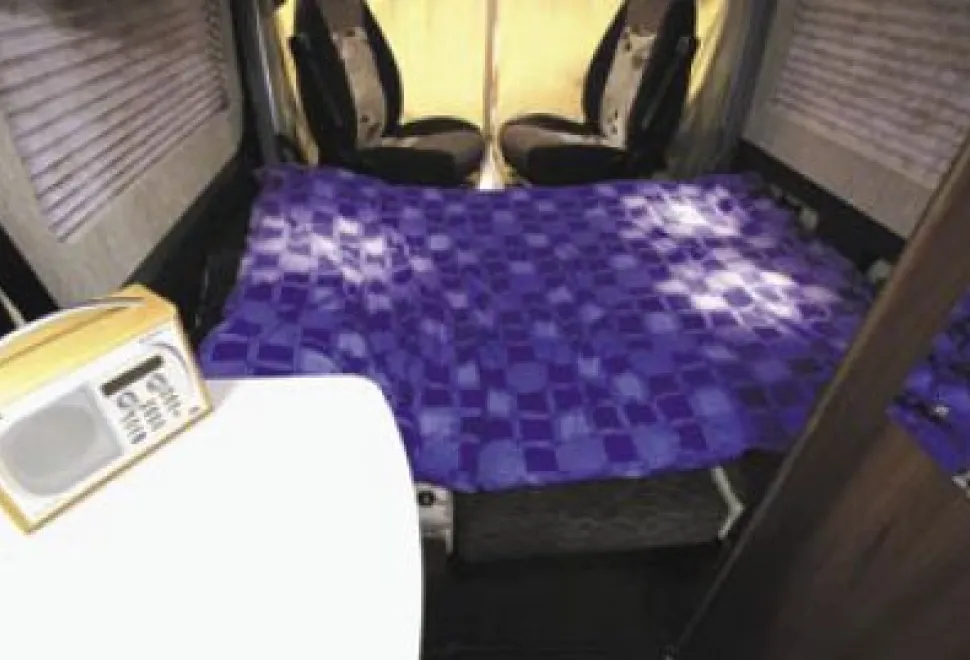
With the kids tucked up, what about mum and dad? The parents or grandparents get to sleep in a transverse double bed in the lounge. The seats flatten and the cushion that forms the aforementioned sofa backrest now
plays its primary role, filling the gap between and completing the bed. All is supported by strong metal frames, and the result is a flat, comfy double – the adjacent kitchen unit serves as a nice night table. Clothes for two can be folded onto each cab seat and reading lamps also serve, two on the offside, one on the nearside. I might add a downlighter here (the side door aperture precludes the fitting of a potentially headbashing ‘dangling’ reading lamp) for the second person sleeping head to the nearside. But I’m being picky, this bedroom works very well indeed.
To read the full motorhome review in PDF format exactly as it appeared in the December 2011 issue of MMM, please click here
If you don't already have Adode Acrobat to be able to open a PDF, download it for free
Auto-Sleepers is one of the UK’s most long-lived and respected producers of motorcaravans, having been around for over 50 years and with a reputation for making quality products at the higher end of the market. Van conversions have always been an AS speciality – the very first Auto-Sleeper was one – so when a new-and-very-different model emerges from the firm’s Cotswold home it deserves immediate attention.
And this one was so new that when I arrived to pick it up from the Willersey factory, it was still being tweaked by the product development department. No excuses here, but I must use the dreaded P-word, as the ‘van was the first to be built and a prototype. Would I need to be gentle with it? There was only one way to find out, so I loaded my sleeping bag, toothbrush and kettle and headed off to the Caravan Club’s site at Broadway.
WHAT’S IN A NAME?
Windrush is the name of the new Auto-Sleeper, and it proved appropriate as during the test, the tail of Hurricane Katia was busy ‘tweaking’ our weather – wind-rush indeed! The name follows the current Auto-Sleepers’ tradition of naming its ‘vans after Cotswold villages – however, Windrush offers a layout that’s anything but traditional for an Auto-Sleeper, so this one shares a name with a local river.
I’m no Auto-Sleepers historian, but I cannot remember another Auto-Sleeper with bunks, and that’s exactly what the Windrush provides. But there’s more, as bunk-equipped van conversions are rare beasts too – providing family-friendly accommodation in a six-metre panel van is potentially a great idea, but tricky. It’s been done before though – I’ve seen bunks in models from both Timberland (in the past) and more recently, WildAx. Doing it is one thing, but doing it well – in what is undeniably a small space – is a whole different kettle of cod.
FORM AND FUNCTION
First, a couple of caveats: based on the long wheelbase version of Peugeot’s Boxer, the Windrush is actually based on the ‘window van’, so fenestration is single-glazed, in tinted flush glass. These windows look superb from outside, but their tint might make the interior feel rather gloomy on dull days. Also, there’s always going to be a greater risk of condensation inside (compared to the more oft-found double-glazed plastic windows) when the weather’s cold outside.
In addition, the test vehicle was fitted with the, then current, Euro 4 compliant engine. At the time, Euro 5 Boxers were on the way, so we might expect 2012 models to be fitted with the new engine, while cab enhancements can include a new multimedia features-equipped stereo and special dash trim. Engine outputs are set to be improved too, while Euro 5 should bring better fuel economy, along with its planet-saving talents.
OUTS AND INS
The long wheelbase Boxer’s external delights are well documented, and you either like the shape or don’t care for it. I’m in the former camp, and even after five years, to my eye, it still appears fresh and quite cutting-edge. The test vehicle’s Champagne gold colour, understated graphics and those stylish tinted windows combine to make a good-looking camper. I spent a fair bit of time talking to other campers about the ‘van, such was its magnetic qualities. Externally, details are also important: alloy wheels look great, the awning is standard and there’s a barbecue point, and a TV signal input socket (for easy connection to free-standing aerial, sat dish, or campsite piped TV).
Mounted on the driver’s side B-pillar is the filler that announces the presence of a gas tank – 25 litres gives a capacity of around 12.5kg of LPG. Newbies might be pleased to discover that, with this system, the days of lugging cylinders are over – you simply fill up at one of the many filling stations (across much of Europe) that sell autogas. The water-fill system is a love-it-or-hate-it device: Whale’s Aquasource has a plug-in filler that incorporates 12V power, and accepts a connection to a (supplied) submersible pump for on-pitch top-ups.
Should you be lucky enough to find yourself on a super-pitch (with its own tap) you can connect directly to the mains, thus the tank is constantly kept topped up. It’s the conventional filling of the tank that detractors dislike, they feel it’s too slow. Convenience verses speed? Only you can decide.
A quick peer under the rear and I discovered that a spare wheel is fitted but there’s more: Auto-Sleepers’ eye for practical detail has seen the fitting of a remote valve that allows the checking of its pressure – no grovelling required.
Step aboard and you’re greeted by Auto-Sleepers’ current carpentry colour, which is a deep, matt-finished, silver-trimmed brown. Coupled with the currently-fashionable, coffee-crème fabrics (and dark brown removable carpet) all looks very pleasant and well constructed. Pleated blinds (with flyscreens) adorn all the windows, except the rears (which don’t open), where there’s only room for curtains. The cab has curtains too, and although they’re okay, I’d rather see cab blinds that do a better job of blackout and insulation. This is especially noticeable as there are no curtains in the lounge. Maybe these are on the options list, but this is no deal breaker, as it’s easy to have them retro-fitted for about £450.
As I said, the tinted side windows can make things a tad gloomy, but thankfully, a Midi Heki rooflight illuminates the lounge well. One advantage of the flush glazing is the presence of ‘pop-in-and-slide’ openers in the lounge. Good for general ventilation, they can also be used safely while on the road. In the kitchen, the test ‘van had the optional living area air-conditioning fitted, and this incorporates a smaller rooflight that does the job. I would expect to see a Mini Heki here in standard trim. More AS attention to detail sees a high quality fire extinguisher and smoke and carbon monoxide detectors all in place.
BOXERCISE
The Peugeot Boxer chassis provides excellent performance, with great handling, powerful brakes and light steering. The cab is comfy during long journeys, the external mirrors superb. Differences with other motorhomes come, therefore, in the details, while the aforementioned Euro 5 version – when it arrives in 2012 – will merely improve the beast. Better performance (from increased engine outputs) and improved fuel economy should be the results.
Up in the cab, air-conditioning is standard, as are steering wheel-mounted audio controls. Auto-Sleepers adds rather thick swivels, so tall folks may find the cab seats a touch high. For me, at five-foot-ten, they were fine. There’s little interior vision to the rear, but a fitted camera, with interior mirror-style monitor solves the problem. In use, it proved itself well, with a clear picture that gave a very good view of the latest tailgater, and when reversing.
VERSATILE FRONT
As a four-berth motorcaravan aimed squarely at families, the Windrush provides a total of four, fully-belted travel seats. The rears are mounted on steel frames – top belt mounts secured to the vehicle’s steel sides. Seat squabs are a tad unsupportive though – probably a consequence of having to provide foam, the density and shape of which, has to make a comfy bed. Swivel the cab seats and a four-seater lounge is made, albeit with the cab chairs up a step (this is the case in many of the type).
Because of this, Auto-Sleepers has provided several positions for the two small tables it supplies. Stored neatly on the offside (with their pedestal legs in the overcab), these can be arranged in two of three sockets: in front of each rear travel seat or in between the cab seats. They’re small though – with just enough room for a plate, cup and maybe a cruet, so provide dining for just two people.
However, the versatility continues in here, as the rear seats flatten (something that’s also part of bed construction) to make benches. Once this is done, table number three emerges from its home in the overcab, to stand between the benches and provide for four at dinner time. On the offside, the bed infill cushion also provides a backrest – the created sofa completely changes the character of the lounge, adding another layer of versatility.
Entertainment in here is assured, as rear speakers are connected to the radio and a TV/ DVD player (optional) is mounted at a reasonable height for viewing. Sockets are supplied to feed signals from other devices (satellite dish or digi-box) mounted in the kitchen’s overhead locker. The kids can be kept happy en-route too, as 12V sockets are mounted above – located here to power a pair of portable DVD players that hang on the backs of the cab seats. An effective range of LEDpowered lighting completes a lounge-diner that’s about as versatile as it’s possible to be.
IN THE KITCHEN
Fully equipped best describes the Windrush galley, as a decent cooker and microwave oven are standard-fit items. There’s a good slab of worktop too, and another pull-out section that emerges from below it. The stove is Thetford’s neat, half-height Triplex unit, which provides three hob burners, one of which is a high-speed device that boiled my kettle in double-quick time. Below, there’s an oven/grill big enough for a Sunday roast.
The fridge is less impressive, as it’s a basic, dare I say, cheap model that ‘boasts’ a shallow interior – a rather paltry capacity in a family ‘van. The microwave is unremarkable, aside from the fact that it’s mounted at a reasonably user-friendly height above the work-top.
The storage menu provides a high-level locker and with two small shelves alongside, while down below, there’s one decent drawer and two cupboards. The locker has no shelves and one of the cupboards is mostly filled with the electrics distribution unit. Kitchen storage space is, therefore, rather limited. Auto-Sleepers seems to realise this, as one of the (three) overhead lockers in the lounge is fitted out with racks for plates and mugs. It’s
easy to criticise of course, and this galley does provide a lot in a small space; many larger coachbuilt motorhomes offer less.
One thing that does need immediate attention though is the worktop area. The back of the nearside rear seat abuts, and with no splash/leak guard, it would not be long beforethe upholstery became contaminated. A simple screen mounted here should cure the problem.
DESIGNER WASHROOM?
The washroom is a new design, and it’s brave too – incorporating one of the latest ideas in unusual fashion. Approached through a sliding tambour door, the Windrush bathing department presents a moulded sidewall – above a twin-drain wet-room floor – that incorporates a sliding washbasin. The generous basin slides across on a
chrome rail, landing above the toilet. This also leaves a good chunk of the wet-room floor available for showering. You simply slide the basin back when the toilet is needed. There’s a long mirror, toilet roll holder, towel ring and handy soap dispenser in here too.
The whole is very strongly made, and a roof-mounted extractor fan provides ventilation in this windowless room. However, with the basin slid back to allow use of the toilet, the space was a little confined, my left shoulder against the inside of the door, right hip against the side of the basin when standing. Sitting on the loo was better, but as it’s around 400mm (4in) off the floor, it was almost too high for comfortable use.
The basin shares the shower head as its tap, but with the basin slid over the swivel-bowl loo for use, it proved too high up on its bracket and deposited water more into the basin’s moulded in soap dish than in its bowl. There’s enough showering space in here, but the re-positioned shower head lacks enough length to its hose, so it hangs across the room and in the way.
Both storage for cosmetics and a surface to put them down when in use are lacking – there is a high-level, chrome-rail-fiddled, shelf, but it slopes and could be used only for holding in cloth wash bags. I’m very reluctant to be less than enthusiastic about this design, as much of it is very clever and it is very well executed.
DRIFTING OFF
Almost without a doubt, it’s the bunks that will make folks buy a Windrush. And these bunks are more for young people than adults, as they’re quite compact (5ft 11in x 2ft 2in). However, as an almost intrepid motorhome tester, I tried sleeping here and was presently surprised. My five-foot-ten, 13-stone (he claims) bulk spent a cosy night. I was able to read my book, which was well illuminated by one of the strip-LED lamps at the bunks’ heads. Each also gets a cubby and a 12V and mains socket that are conveniently located to power little darlings’ electronic entertainment gizmos. Each bunk also has a locker at its foot – somewhere for kids’ personal items perhaps?
Frames are constructed strongly in metal, but proved rather overcomplicated: protruding curtain rails and the metalwork in general, proved to be a bit of a bonce-basher. A simpler set-up with some padding in key areas would improve things and I think this is the type of thing that might happen on production examples – Auto-Sleepers having indicated that changes will be made.
With the kids tucked up, what about mum and dad? The parents or grandparents get to sleep in a transverse double bed in the lounge. The seats flatten and the cushion that forms the aforementioned sofa backrest now
plays its primary role, filling the gap between and completing the bed. All is supported by strong metal frames, and the result is a flat, comfy double – the adjacent kitchen unit serves as a nice night table. Clothes for two can be folded onto each cab seat and reading lamps also serve, two on the offside, one on the nearside. I might add a downlighter here (the side door aperture precludes the fitting of a potentially headbashing ‘dangling’ reading lamp) for the second person sleeping head to the nearside. But I’m being picky, this bedroom works very well indeed.
To read the full motorhome review in PDF format exactly as it appeared in the December 2011 issue of MMM, please click here
If you don't already have Adode Acrobat to be able to open a PDF, download it for free
Our Verdict
Long-wheelbase van conversion that shows lots of attention to detail and works well on all practical levels.
Advantages
Well equipped kitchen
Smart modern washroom
LPG filler point
Standard-fit air-conditioning
Disadvantages
Cab swivel seats may be too high for some
Cab curtains are not blackout versions


