
Buying a holiday home: your complete guide
Buying a holiday home: your complete guide
Buying a holiday home or holiday lodge opens up a vast number of benefits and allows you to enjoy time on a fantastic holiday park for days, weeks or even months at a time.
Armed with a compendium of advice, choosing and buying your first holiday home will be a joyous experience. With our guide by your side, you have all of the info you need to ensure your big step into holiday home ownership goes smoothly
What is a holiday home?
A second home. A get-away-from-it-all retreat.
A place where you can spend quality family time… that defines a holiday home.
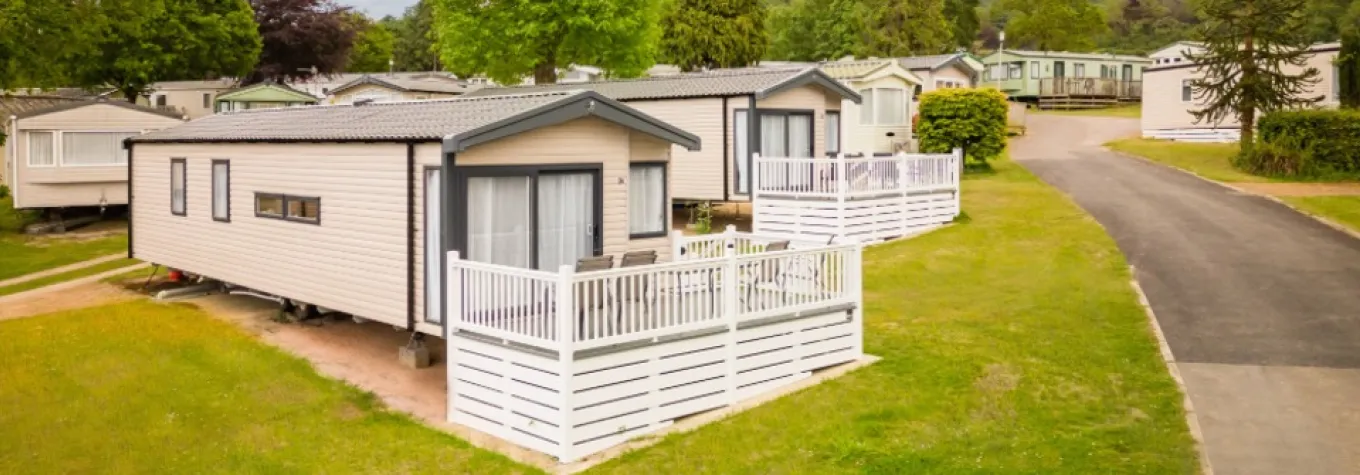
In the context of a holiday park, these homes are static caravan holiday homes, or lodges, that you purchase for your exclusive use for holidays, or you can buy for investment and rent the holiday home out.
Why buy a holiday home in the UK?
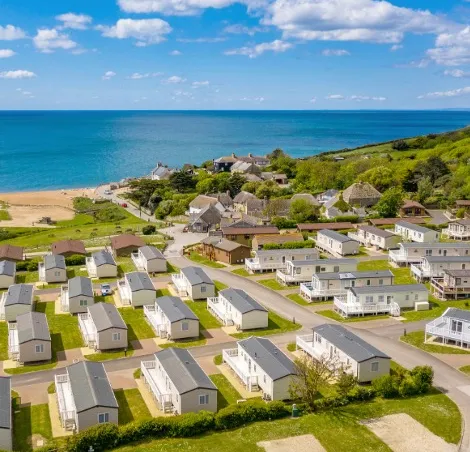
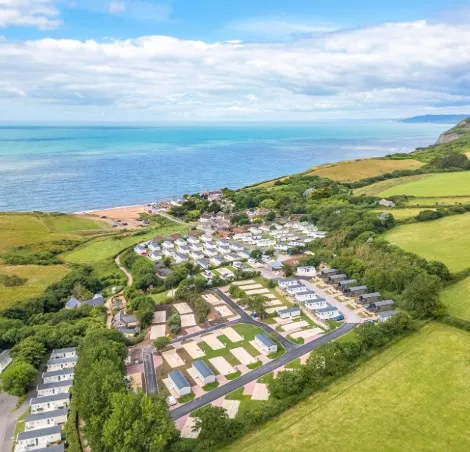
Buying a UK holiday home will change your lifestyle, giving you a leisure-time focus like never before.
And buying a holiday home in the UK means you can avoid airport hassles, flight delays and all the aspects of going abroad that you can’t control.
The key to holiday home happiness is choosing the right location for you.
Things to consider before buying a holiday home or holiday lodge
A guide on some of the key things to consider before buying a holiday home or holiday lodge.
The right location
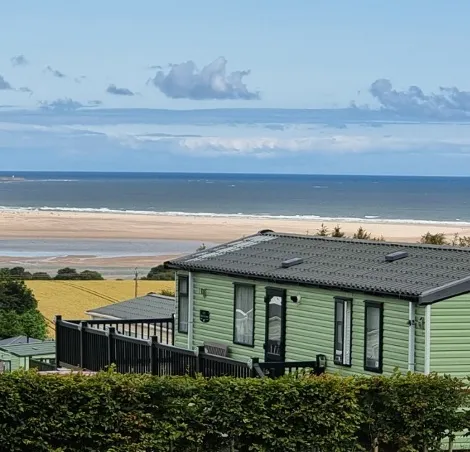
Now, the best step: where do you want your holidays home to be? A glorious hillside or valley location surrounded by walking opportunities? Close to the coast, with family attractions in close proximity? A mix of the two? (Yes, that can be achieved.) A quiet woodland location where the only sound is birdsong? Or within easy reach of city life, where theatre, restaurants, retail attractions, gyms and more are on hand?
It all depends, of course, on how you prefer to spend your leisure time. After all, buying a holiday home provides you with an extension of your home life preferences – in a different location. So, things that you like doing in your free-from-work time at – or from – home are likely to be broadly similar to those that you will choose to do using your holiday home as a base.
At the same time, you can consider a location for a holiday home that puts you in proximity to different things than exist in the region of your main home. Achieving that will considerably enrich your leisure lifestyle. Think in terms of a choice of golf courses, on different terrains, offering different challenges, perhaps. Similarly, walking or cycling routes that are not available close to your home. and watersports – on lakes or sea. Holiday home ownership will enable you to broaden your horizons.
So, here’s where to start in the location decision process…If you buy a holiday home within around two hours of your home, you will be able to use if more often than if it’s a considerable distance away. So that’s one of the main start points in finding your ideal location. After all, it’s not just for main holidays; it’s ideally for weekends, too. And the more you use your holiday home, the more value you will get from your investment in leisure.
Choosing the right park for you
Full-on family fun? Or quiet and remote? Each park has its own character, and its facilities play a big part in creating that.
Do you want a location in which you can escape from the realities of work life for a while? Somewhere quiet, where the only sound is birdsong and breeze rustling through leaves.
Much will depend on whether you’re a couple or whether you have a family. Or maybe you’re a couple with a ‘part-time’ family – grandchildren, perhaps, who may come and share your holiday home retreat occasionally. If that’s the case, you may prefer a park where the focus is firmly on family fun? A swimming pool, a restaurant, play areas, entertainment, perhaps; somewhere to which the kids will be really excited to go, for things they can’t do at home.
And that, is the essence of holiday home ownership – a home where life differs from that at your main home, however you define it.
Between the two extremes of tranquillity and family focus there is a large choice of types of park. What suits you is so individual – and, until you research, and then visit parks, you may not have a clear idea of what suits you. Sometimes, a park just feels ‘right’, indefinably.
Now it’s time to look at individual parks, and to draw up a shortlist of maybe three, or four. Then visit – more than once. One of those visits should ideally be on a rainy day – because, if a park still appeals to you in the inevitable reality of rain, then the chances are you will be happy there.
Get it right first time
While a few parks will allow you to move a holiday home onto them from another park, this is by far the exception rather than the rule, so it’s best to get your park choice right first time.
Choosing your pitch
Some pitches have a view. Parking space varies – one car or two – or, occasionally, space for three. How much space is there between the holiday homes? On sunny days, does your plot get sun for most of the day? Or is it tree-shaded? Is there space for your children to play without leaving the pitch? And how far is it to the park’s adventure playground (if there is one)? If you can see it from your pitch, you are more likely to allow children to go there unsupervised (depending on age, of course).
And how far is it to the start of the park’s dedicated dog walk (again, if there is one)? We know this is a bit mundane, but consider the proximity of rubbish bins and recycling stations – you would find walking a considerable distance to these somewhat boring (especially in the rain); conversely, you don’t want to be holidaying too close to them – they’re not pretty and there is always the chance of a whiff or two!
Number of bedrooms
The number of bedrooms you need depends not just on the number of family members who will be using your lodge or holiday home – but also on whether you intend to rent it out, to offset costs. If this is your plan, a three-bedroom unit is going to have wider appeal.
Styles and décor
Modern. minimalist and simple? Country cottage? Traditional? All décor styles are out there in the vast choice of holiday homes and lodges, we’ve picked out a few in this guide, to give you a flavour of what’s on offer. One with a particularly innovative layout is the Atlas Status.
Length of season
Some holiday home parks are open all year. Some close for a period during the winter; this length of time varies from two weeks to around three months. So, choose a park that suits your needs – if you want to be able to use your holiday home at any time of the year, picks a park that is open all year.
Chassis treatments
And finally… Consider what’s underneath a holiday home… When you buy a holiday home you may be able to specify the level of treatment applied to its chassis during manufacture. This is important to the longevity of the holiday home and also has an influence on how much maintenance it will require.
Most holiday home manufacturers offer a choice of chassis finishes; some offer greater protection capability than others.
Painted chassis have basic protection. Fully galvanised chassis have great protection from rust; these are specifically recommended if you are buying a holiday home or park home to be sited in a coastal area, where salty air can accelerate the rust process.
A fully galvanised chassis has been treated to provide enhanced protection from corrosion. This is the highest level of protection. It is the one that requires the least maintenance.
Part, or pre-galvanised, chassis are the mid-range option. These chassis are made of galvanised steel that was coated before the chassis was constructed. The difference between this and a fully galvanised chassis is that steel edges can be exposed during construction, and it is possible that rust can appear here over time.
Painted chassis are the most cost-effective type of chassis. It is also the type that requires the most regular maintenance. Standard recommendation is that you have this type of chassis painted once a year.
How long can I keep a new holiday home?
When you're buying a holiday home or lodge, you will get what is called a ‘licence agreement’. This states the period of time that your holiday home can be kept on the park. On some parks, you have to replace your holiday home after only 10 years, others much longer; some 15, some 20, some longer. Very clearly, the idea of all holiday homes on a park being reasonably new is so that the park always looks pristine.
As a generalisation, you can keep lodges for longer than holiday homes; you can expect to find a 20-year licence agreement for a lodge, and some are 40 years and more.
The length of the licence agreement is one of the first things to look into when you are considering a particular park, because it hugely influences the way in which you will be calculating the amount of investment in your leisure home and your plans to save up for its eventual replacement.
What are the running costs of a holiday home or holiday lodge?
That’s the annual pitch fee, electricity, gas and insurance.
Your pitch fee, sometimes called ground rent, is the largest of the running costs of a holiday home. That’s the amount you pay to occupy the piece of land on which your holiday home sits. The amount of the fee reflects the facilities and location of the park. For example, a small park with no facilities and no view is going to have lower pitch fees than a park in a beautiful location that has a restaurant, swimming pool, gym, golf course, entertainment and more.
You can expect to pay anything from around £2,500 to £12,000 and more in ground rent. Much depends on the location and the facilities on the park. It stands to reason that a park in a sought-after location with a raft of family facilities will charge more for a pitch than a park with minimal facilities, in an unspectacular location.
What are the arrangements for electricity and gas on holiday parks?
Electricity is metered and you pay for it monthly, quarterly or annually, depending on the park.
Gas for holiday homes usually comes in 47kg cylinders. You buy the cylinders through the park, and, when they are empty, you can buy a replacement through the park. That’s called an exchange scheme – having paid for the first cylinder, thereafter you only pay for the gas contained in replacement cylinders. When you get your first cylinder – or cylinders (most buyers get two) – you can expect to pay £70-£100 per cylinder, plus the gas inside it; around £85. Thereafter, you can expect to pay around £85 for a full replacement cylinder. Prices vary from park to park.
On some parks, gas is piped to each holiday home from a central tank. In this case, each holiday home’s gas usage will be metered and paid for quarterly or annually.
Holiday home or holiday lodge – what’s the difference?
Holiday home? Static caravan? Lodge? What do these terms mean?
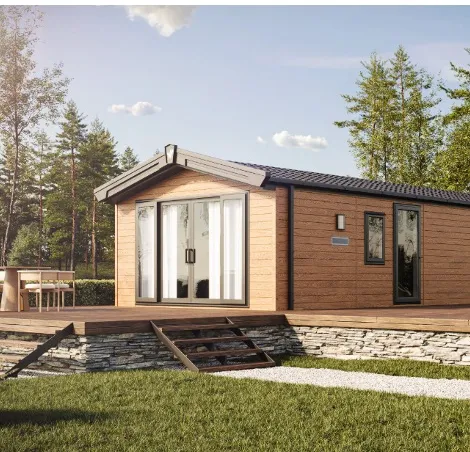
Broadly, the term holiday home is taken to mean a unit that is 12ft to 14ft wide. A lodge is 20ft or 22ft wide. Lodges cost more than holiday homes because they are generally larger, but the lines get blurred, because some lodges are 14ft wide; examples include the Atlas Jasmine Lodge, 43ft by 14ft.
The distinction between the terms ‘holiday home’ and ‘static caravan’ is slightly obscure. At one time, all caravans not designed for towing were called ‘statics’. Then the marketeers decided the term ‘holiday home’ should replace ‘static’ to make them sound more appealing, so the industry switched its terminology. Then the internet arrived, and, with it, the concept of keywords. People search for ‘statics’, so the term remains alive and well online!
Holiday homes are usually 12-14ft wide and 28-40ft long, or more.
Both lodges and holiday homes have either two or three bedrooms and a few have four.
BS 3632 or EN 1647
EN 1647 is the standard that a holiday home or lodge made to specification tailored to leisure use must be built to.
Any home or lodge with the BS 3632 standard will be suitable for year-round use, so insulation is of a higher standard than homes built to EN 1647.
When choosing a holiday home from some manufacturers you can specify an upgrade from EN 1647 to BS 3632; among these is Pemberton.
How much do holiday homes cost?
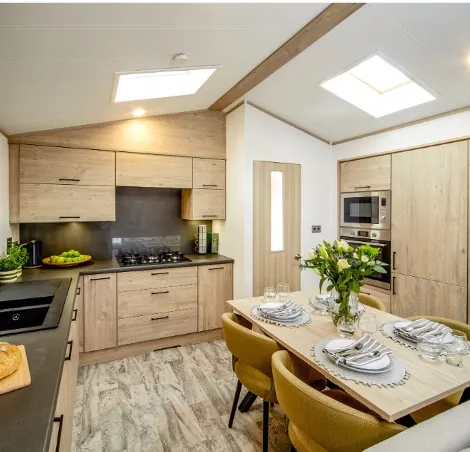
There are holiday homes for all budgets, including entry-level, mid-level and super-luxury holiday homes. The levels of specification and luxury range from those that are quite basic up to holiday homes and lodges that are magnificently luxurious and large – with prices to match.
You can buy a pre-owned holiday home for around £15,000 or less. That’s a good place to start. You can then, perhaps, upgrade to a new one after a few years.
New holiday homes start at around £30,000 and climb in price commensurate with a level of luxury and size. When buying new, whatever your budget, a key factor to look for is options; some have a list of options that you can go for – or not go for, so that you are not paying for features in the holiday home that you don’t need.
The park on which your caravan is sited influences the amount you pay for a new holiday home, too. A park in a prime location will charge more because demand is high, and people are prepared to pay more to get a holiday home in that location. Also, the more facilities, the higher the cost, as the park needs to recoup its costs in providing those facilities.
Finally, there’s transport and siting costs. Almost always, parks include these in the purchase price. So, too, will be a connection to mains and waste water services, and to the park’s electricity supply.
Part exchange
Some parks will consider taking in part exchange a holiday home at another park, or touring caravans or motorhomes.
Buying pre-owned
Just like buying a car, touring caravan or motorhome, you don’t have to buy a new one. Searching in the pre-owned holiday home sector can get you a unit at much less than the cost of a new one.
That’s ideal if you are not sure how often you will be able to use your holiday home, and also, as a first-time buyer, it gets you into the market without spending a vast amount of money.
Finance
Spreading the cost, and paying for your holiday home from income, rather than from capital, can make holiday home ownership even more enticing. Many parks offer advice on buying on finance. And there are companies that specialise in providing finance for holiday home purchase. Among these are Black Horse and SureFinance, Pegasus Finance and FourSeasons Static Caravan & Lodge Finance.
Parkdean Resorts has a finance calculator on its website. You put in the price of the holiday home, the amount of deposit, and the loan term that suits you, and it calculates the monthly payment for you.
Is buying a holiday home or holiday lodge to let a good investment?
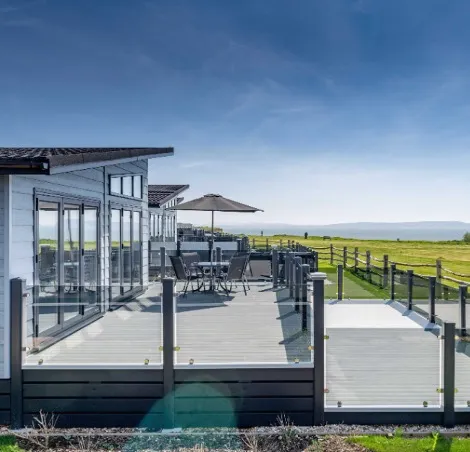
It can be! If you let out your holiday home during school holidays, when demand is high, it can prove to be an excellent investment, because fees reach their peak then. The more weeks in the year you make your holiday home available to let, the greater your return on investment.
Choosing the right layout for renting appeal
If you are looking to buy for investment, that will have a bearing on the layout of the home you choose. Those with three bedrooms are clearly more versatile and have wider appeal. There's something else to consider about bedrooms: the width of single beds. Some holiday homes have twin beds that are narrower than the standard domestic single bed size, and so are only ideal for children.
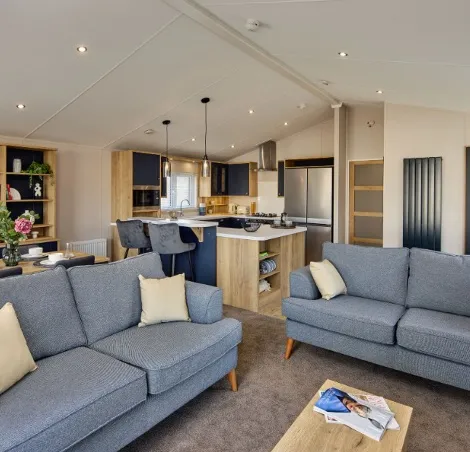
Lots of lounge seating is key. So is a sizeable kitchen with plenty of work surface. And, in general, the higher the level of equipment, the more you can charge for the rent; we're talking about dishwashers and washing machines, in particular.
A centre-lounge layout can be ideal for rental; these homes have bedrooms at each end.
You can also consider going for the super-luxury hot tub holiday market. If you decide to go for a hot tub, it's wise that you choose a park that offers the service to empty and refill it between renting, and also has the expertise to check and maintain water additive levels as part of the rental scheme service. There will be a cost attached to this, of course, as with all park rental services, so the costs will have a bearing on what you charge for rent.
How much rent to charge
Your holiday home or lodge could generate you an income – or you could let it out to offset some of the costs. Which of those extremes you go for depends on how much your worktime permits you to use your holiday home.
If you can only use it for two or three main holidays, for example, you can let it out for chunks of the year and generate a substantial income – especially if you let it out during school holidays, when demand is high, and you can charge more money.
Or, if you merely want your holiday home to earn a proportion of its ongoing costs such as site fees and insurance, you can tailor the amount of time that it’s available for letting to that. Many parks have schemes in place to facilitate and manage letting. Be aware, though, that some parks do not permit letting, so it’s something to check when you are choosing the park that suits your needs.
Length of agreement
The number of years that you can keep a holiday home on a pitch varies from park to park. This is called the licence agreement, and ranges from 15 years to 20 and more for holiday homes. Many parks offer 40 and 50-year agreements for lodges. There are exceptions; among them are the four parks in the Boutique Resorts group, that have 250-year licence agreements.
What are the pros and cons of buying a holiday home or holiday lodge?
Pros of buying a holiday home or holiday lodge?
So many it’s impossible to count. In a nutshell, though, buying a holiday home will add a new dimension to your life; a venue for relaxation, for quality family time.
Cons of buying a holiday home or holiday lodge?
There is only one. That’s the possibility that you may get bored with the region that your chosen park is in. But it’s a con that you can guard against, by doing careful research before you buy, to make sure there is enough to sustain your leisure-time interest for a very long time.
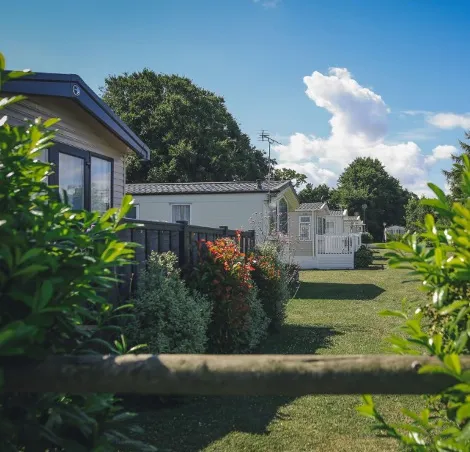
Buying a holiday home abroad
Most of the major British holiday home manufacturers export holiday homes and lodges – because there is a growing market in the obvious popular destinations, including Spain, France, Portugal and Greece.
And prices are surprisingly affordable, with new holiday homes being advertised at around £40,000 and pre-owned ones for under £11,000.
It is usual to find that prices of new holiday homes include transportation and siting.
There are companies that specialise in selling holiday homes abroad. They act as agents, and this is surely the easiest route, although there will be a fee for the service.
You can alternatively buy direct from a park, or from an individual.
When choosing a park, factors to bear in mind include proximity to an airport, and driving distance from home if you want to have the choice of flying or driving.
Also consider where the nearest supermarkets are. And, of course, whether to go for a park close to the coast or inland.
There is so much choice, you’ll find it daunting – unless, of course, you already have a favourite location!
If you are planning to rent out your holiday home, consider the appeal of the facilities on the park – swimming pools and restaurants are obvious examples.
Buying a holiday home FAQs
-
Can you live in a holiday home or lodge?
By definition, a holiday park is exactly that – and is not licenced for residential occupancy. So, you can’t live permanently in a holiday home or lodge, and parks will ask you to provide proof of a permanent residential address.
-
Are my family and friends allowed to stay at my holiday home?
Some parks that do not permit letting do allow your family and friends to stay at your holiday home when you are not there – provided that you are not charging them any money to be there. Others, though, allow friends and family to visit only while you are there.
-
Can a holiday home or holiday lodge be my main residence?
Your holiday home, on a holiday park, can’t be your main residence. There are rules in place: you must have a pemanent, main residence address somewhere else, because holiday home parks are licensed for holiday use, not for residential occupation. You will be asked to provide proof, to the holiday park, of your permanent address.
-
How long is a holiday park season?
That varies. Some close from the end of October to the start of March. Some close for two weeks in the early part of the year; some four, some six. Some holiday home parks have a 12-month season; that is to say, you can use your holiday home at any time of the year – but you can’t live there, even though the park doesn’t close.
-
Can I visit my holiday home on a day basis during the closed months?
That depends on the park and its rules. Some allow you to visit your holiday home when the park is closed but not stay overnight; other parks close completely.
-
Do I need insurance for a holiday home?
Amid the excitement of choosing and buying a holiday home it’s easy to overlook an important element that you might dismiss as mere admin. Insuring your holiday home is not only wise, it’s mandatory, because parks ask owners to provide proof, each year, that you have a policy in place.
There are several insurance providers that specialise in holiday homes and lodges. Among them are Intasure, Leisuredays, Towergate, Coast, Adria Flux and Ripe.
To cover this extremely important topic we have produced a park home and holiday home insurance guide to go into things in more detail. As with any other form of insurance, shop around for the policy that best suits your needs.
-
Do you pay Stamp Duty on a holiday home?
The simple answer is ‘no’.
-
Is Council Tax payable on a holiday home?
You don’t have to pay Council Tax for a holiday home because it is not a main residence. Some parks, though, include an amount in the pitch fee, which is a contribution to the local authority business rates that the holiday park pays.
Latest park & holiday home articles


Next Shows

The Big Land Rover Fest 11th - 12th July 2026
Experience The Big Land Rover Fest – a weekend of off-roading, live music, club displays and family fun at Newbury Showground, 11–12 Ju...

The Norfolk Motorhome & Campervan Show 17th - 19th July 2026
Join The Norfolk Motorhome & Campervan Show, 17-19 July 2026, for the Out & About Live Summer Party! Explore motorhomes, live demos, an...

Retro Festival 7th - 9th August 2026
Retro Festival celebrates timeless hits, vintage vehicles, fashion shows, and fairground fun.