
Rimor Kilig 79 Plus motorhome




Peter Vaughan Content Editor: Motorhomes
Peter Vaughan Content Editor: Motorhomes
Description
This new addition to Rimor’s range boasts seven berths and seven travel seats in under seven metres, so it’s definitely fit for family forays…
Key Features
Full Review
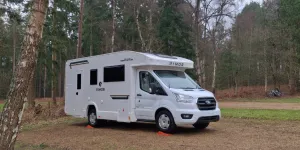
This could well be the only seven-berth, seven travel seat motorhome on sale in the UK that you can drive on a standard Class B car licence. And, if you’re imagining something supersized to fit in all those bodies, think again – this new Rimor is under 7m long.
It’s hardly surprising, then, that the Kilig 79 Plus was highly commended in the Out & About Live Motorhome Awards 2026, in association with Creation, especially when you factor in the price tag, which (at £59,995) sounds like a mistake, or a throwback to pre-Covid times – you can spend nearly as much on a top-spec Volkswagen Golf these days…
No optional extras
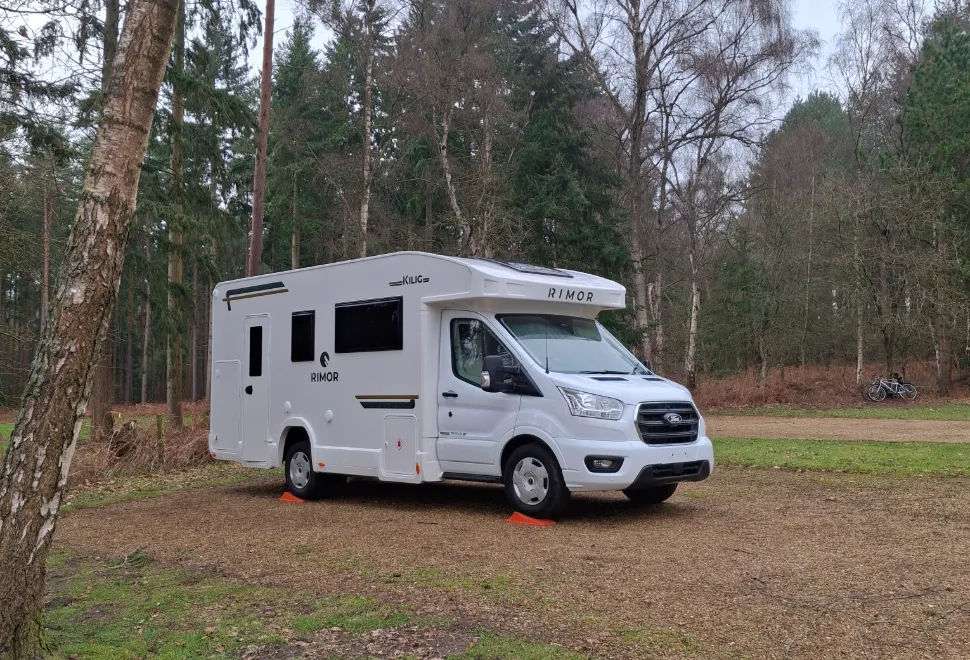
And don’t think that is just a base figure onto which you have to add this pack and that pack. The only optional extra on our test vehicle was the eight-speed automatic transmission (at £3,000) – a six-speed manual is standard. Future production models will even look a little smarter than ‘our’ example as they’ll have a grey cab.
There’s certainly nothing to give away that low price on the outside, apart from perhaps the plastic wheel trims (alloys are a £1,300 option). The caravan-style double-glazed windows that sit proud of the bodywork are to be expected on any budget motorhome. What you wouldn’t expect is the remote control alarm system that’s standard, as well as M and C’s ‘go anywhere’ warranty which allows you to get any issues resolved locally, rather than having to return to the Hull dealership.
Plenty of entry-level motorhomes do without the overcab sunroof fitted here or have a lesser leisure battery than the 100Ah AGM unit secreted in its own skirt compartment. And the Kilig also benefits from the same MEB-300 Smart Energy System as more expensive models in the Rimor range. With a dedicated app, you can now control lights from your phone, while more efficient battery recharging and easier integration of solar panels are further benefits.
Versatile garage space
On the offside, the gas locker is large (for two 13kg cylinders) and low to avoid back-breaking lifting.
Garage doors are fitted on both sides to the rear, with new pop-out locks that are easy to use. This space also reveals the versatility of the layout, with space under the lower bunk bed measuring 76cm wide and 50cm high across the full width of the motorhome. There are lashing points to secure any heavy gear while, if you want to carry bikes, the bed folds up against the back wall and headroom is increased to 1.50m.
The garage area is limited to 200kg, while overall payload is a generous 697kg – clearly Rimor has been more successful at reducing weight than yours truly post-Christmas indulgence…
Even with six 75kg adults on board that would leave 247kg for food, clothes, etc, and we’d expect at least some of the occupants to be youngsters. One thing that isn’t included, though, is a spare wheel.
Up-plating to 3,750kg is possible (free) if you need even more payload (and have a suitable licence), while a gross weight of four tonnes is achievable (at a cost of £1,295) with airbags on the rear suspension.
Entry to the living area is on the offside, where the door is not linked to the central locking but does have a flyscreen. Inside, two small steps lead up to a flat floor all the way to the cab.
Ford Transit chassis
The whole Kilig range (seven low-profiles and five overcabs) is based on the Ford Transit but, once again, the spec is better than you might expect. For a start, it’s the 165hp motor under the bonnet, so you shouldn’t run out of steam in the Alps even fully loaded.
You also get the SYNC4 12in touchscreen with Apple CarPlay and Android Auto, a colour reversing camera, stop/start and assistance systems including lane keeping and hill start.
The front seats have covers rather than a full retrim but tilting squabs, adjustable lumbar support and twin armrests ensure that you’re comfy on a long drive. In any case, the Ford’s driving position is more car-like than a Fiat’s, with lower seating and much greater adjustability of the leather-bound steering wheel.
An electronic handbrake is another added convenience, along with automatic headlights and front fog lamps.
On the road, the Kilig never feels over-bodied, with good stability at motorway speeds and fuel economy a little over 30mpg when touring. Even better, there were few rattles from the living area, making driving more pleasant than in some motorhomes costing much more.
Seven berths
But what you really want to know is how Rimor has squeezed seven berths into a fairly modestly sized motorhome – and does it work?
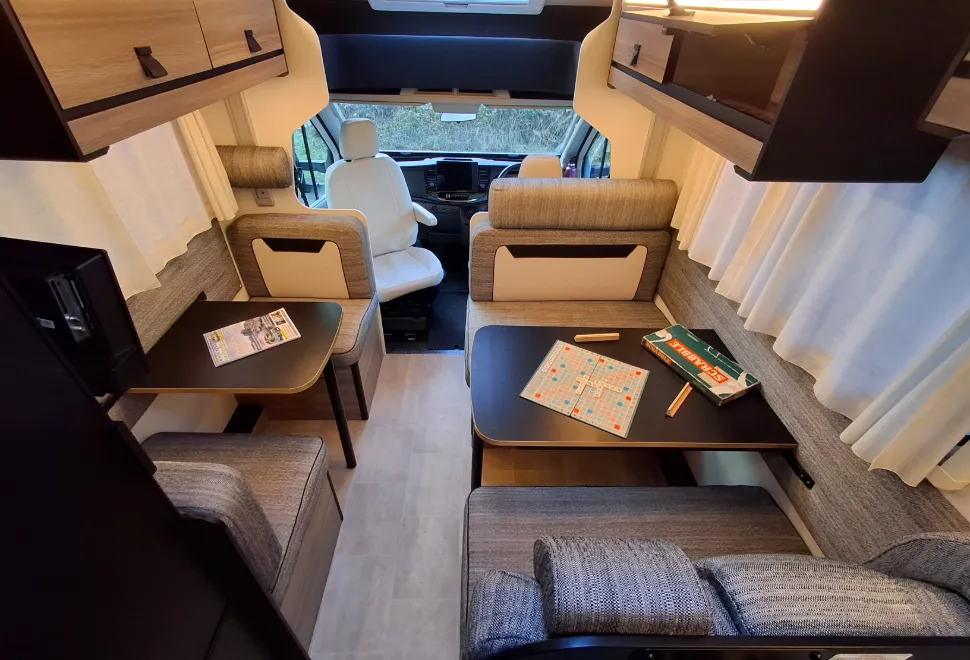
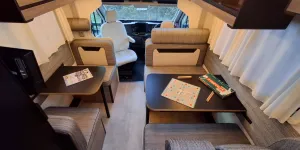
Well, the layout is a bit of a classic amongst family motorhomes, featuring double and single pullman dinettes behind the cab and a pair of bunk beds across the rear. It does this with a dash of Italian design flair, with green panels breaking up the expanses of wood, a very generous array of LED lighting and gold edging on the two tables. The completely redesigned interior of the 2026-model Kiligs gives the impression of being in a considerably costlier vehicle.
We did try sitting seven adults on board and it is possible without any discomfort, although no one is going to be able to stretch out and put their feet up and the occupant of the swivelled passenger cab seat would need to eat dinner from a tray on their lap.
The two-seater nearside dinette is also a little more compact than the offside seating, so legroom is tighter here – the kids’ table, then?
Wherever you sit, there’s plenty of artificial lighting and good daylight (and views out) thanks to the large side windows and overcab skylight. Net curtains afford privacy, if you prefer, and, if you’re less mob-handed, it’s comfy to sit ‘side saddle’ in the larger dinette to watch the 19in TV mounted opposite.
The fresh water tank lives under the forward-facing bench and the boiler is under the small front-facing seat. The former is a tad small for family use, at 85 litres (the underslung waste tank is just 70 litres), while the Truma Combi is a gas-only unit as standard (a mains upgrade is £595 extra). Both the rear-facing dinette seats offer useful top-access storage.
For travel, the cab and forward-facing bench offer three-point seatbelts for four, while the three additional rear-facing seats all come with just lap straps. The single front-facing dinette seat is not suitable for travel.
Seven seats
Seating seven for dinner and touring is one thing but sleeping seven in a sub-seven-metre motorhome might make this Rimor one of the Seven Wonders of the World! So where do they all go?
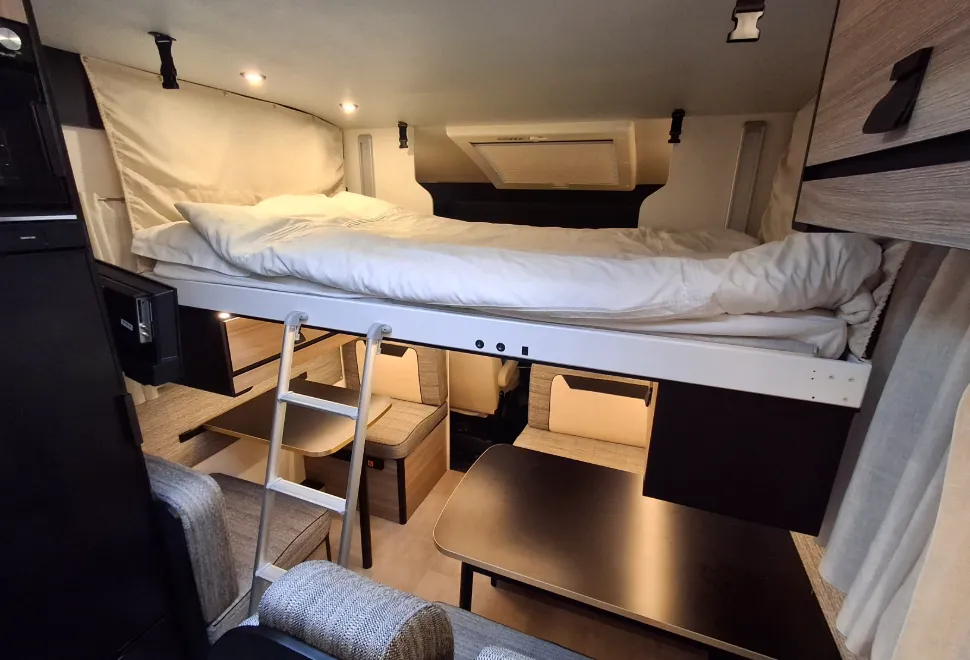
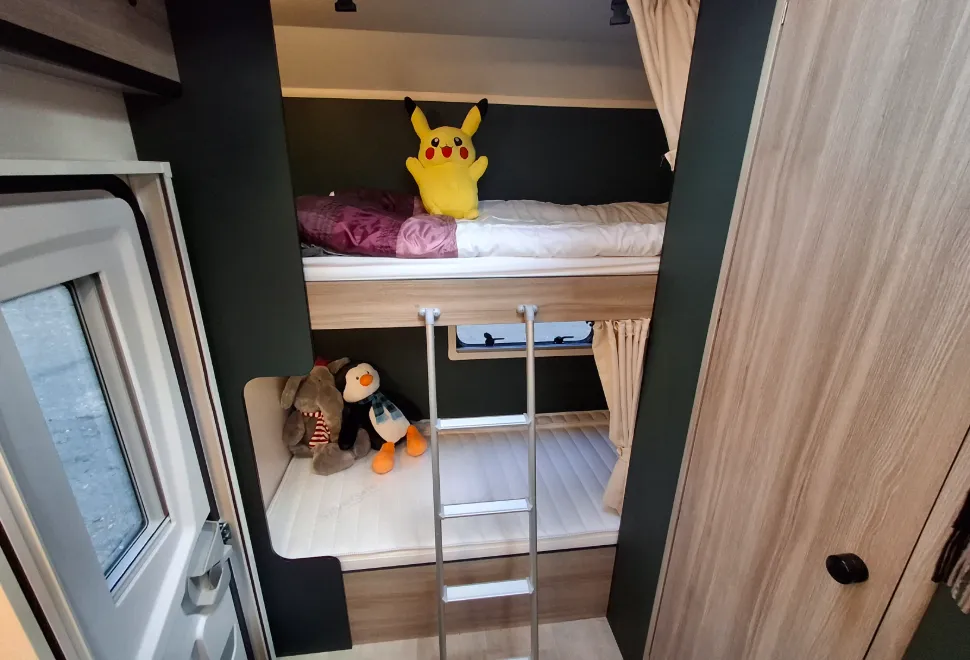
Well, the rear bunks will be bagged by the youngest members of your clan, no doubt, although older kids may fight over who goes where as only the upper bed has USBs. Both have a reading light and privacy curtain, while the lower bed has an opening window for ventilation. Down below, there’s more headroom, too (87cm versus 68cm) – it’s also a useful place to sit to take your boots off when you come in.
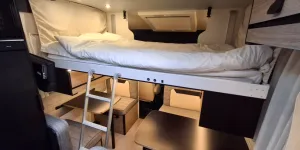
Parents will surely head straight for the drop-down double over the lounge. It’s not the widest bed (just 1.16m) and it does require a ladder for access but its hypoallergenic mattress and slatted base guarantee your comfort and pillows and duvet can be left in situ when the bed is stowed away. For a typical 2+2 family, that’s it – beds for four that can be left made up; no faffing around moving cushions.
Things become more complicated if you need berths five, six and seven. The larger dinette converts into a double bed, while the single diner becomes a bed for a child or small adult (it’s only 1.58m long).
In each case, you lower the table between the seats and remove the lower half of the table leg. Unusually, though, you don’t use the seat cushions as beds but, instead, there are separate cushions that are supplied in two large bags. You’ll have to carry these on the lower bunk bed while travelling as they are quite bulky and they do make for more long-winded bed-making but the positive aspect is that you get completely flat beds.
Do note, too, that while headroom below the drop-down bed is actually greater, in part, than for those sleeping above, it does reduce considerably beneath the cupboards attached to the underside of the upper berth – watch your head!
Pleated blinds in the habitation area and cab blinds are more features that you’ll be pleased to find in a £60k motorhome.
Dining for seven
You’re unlikely to be preparing gastronomic feasts in the Kilig but everything necessary is here to feed the whole family, starting with a tall 141-litre automatic energy selection fridge that has a separate bottle drawer below.
The galley itself isn’t huge but it includes two large cupboards, a good-size cutlery drawer, a waste bin, a sink with loose cover (to give you at least some preparation space) and a three-burner hob. There’s a single mains socket here and a couple of neat hooks for tea towels, etc, while the sink’s fancy pull-out tap could even be extended out of the window as an outside shower to clean the kids or the dog after a muddy walk.
All the lockers throughout the Kilig have positive locking buttons as well as smart leather tags – when parked up you can leave the cupboards unlocked and simply open them with the tags.
To suit UK tastes, Rimor also fits an oven (no grill) and it does so in the only place it could realistically go – above the fridge. That means you’ll need to be tall to check whether dinner has been cremated – it’s about 1.70m off the floor.
Alongside the fridge, the wardrobe is also tall, with a hanging height of 1.30m (and another useful cupboard below). Adjacent are coat hooks (matching the hooks in the kitchen) and a mirror.
Spacious bathroom
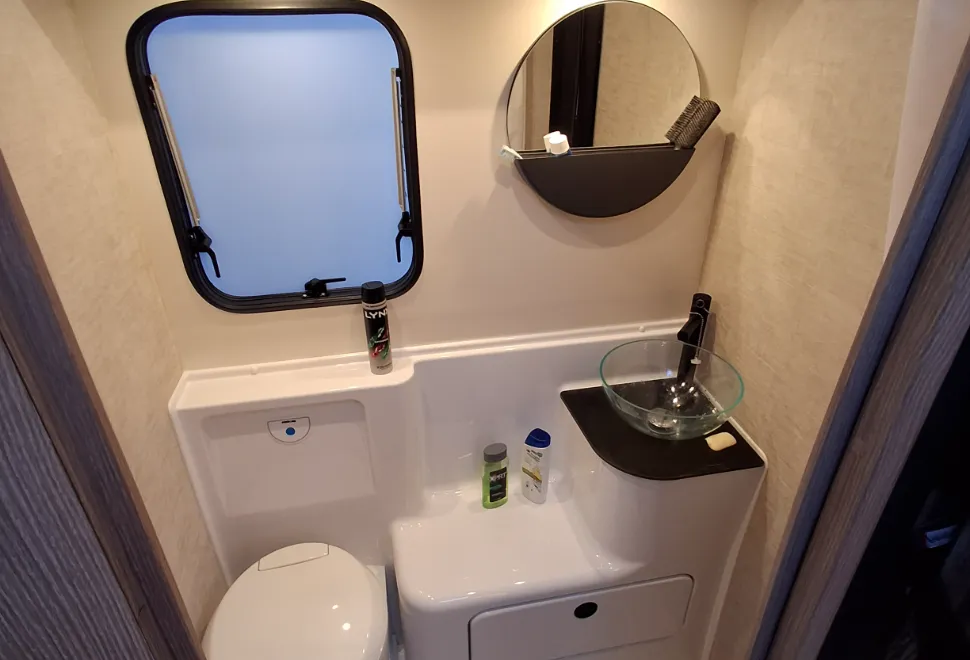
Next is the washroom, which immediately impresses with its spaciousness. No one will feel claustrophobic in here or lack legroom on the loo.
Again, there’s a dash of design panache, with the round wall mirror incorporating a slot for toothpaste, toothbrushes, etc. That’s not the only storage, of course, as there are plastic moulded lockers up top and at floor level. A tiny roof vent is supplemented by an opening window to extract whiffs and steam, and there’s one of those clear plastic ‘salad bowl’ washbasins (complete with on-trend matt black tap) that look lovely in the showroom, but less lovely once they’ve been splattered with soapy water…
I sighed a little at the sight of the dreaded shower curtain but then realised it was there simply to protect the door and not to wrap me up in a sort of soggy embrace. Actually, there’s loads of room to shower in here and the water drained away better than expected with just one small outlet in the tray. You could even sit a child on the flat surface alongside the basin to wash them down – very practical.
Of course, this isn’t a fully moulded compartment and there’s a wallpaper-style finish on the walls, so some maintenance may be required in years to come. For now, I’d just like the addition of a duckboard to reduce the mopping down (or wet socks) after someone has showered in here.

Browse motorhomes for sale
If you're in the market for a motorhome, you need to explore the huge range of motorhomes listed here on Out & About Live! Use the advanced search to filter by budget, berths, manufacturer and much more, then save your favourites to your profile.
Our Verdict
Few of us are likely to contemplate using the Kilig’s seven berths on a regular basis but this new model will work well for the more typical 2+2 family. It is surprisingly affordable – especially considering the spec and quality of finish – and even boasts a family-sized payload on a 3,500kg chassis. The height of the oven is an obvious downside but there’s little else to dislike.
Disadvantages


