
Benimar Tessoro T861 motorhome


Rachel Scholes Content Editor: Motorhomes
Rachel Scholes Content Editor: Motorhomes
Description
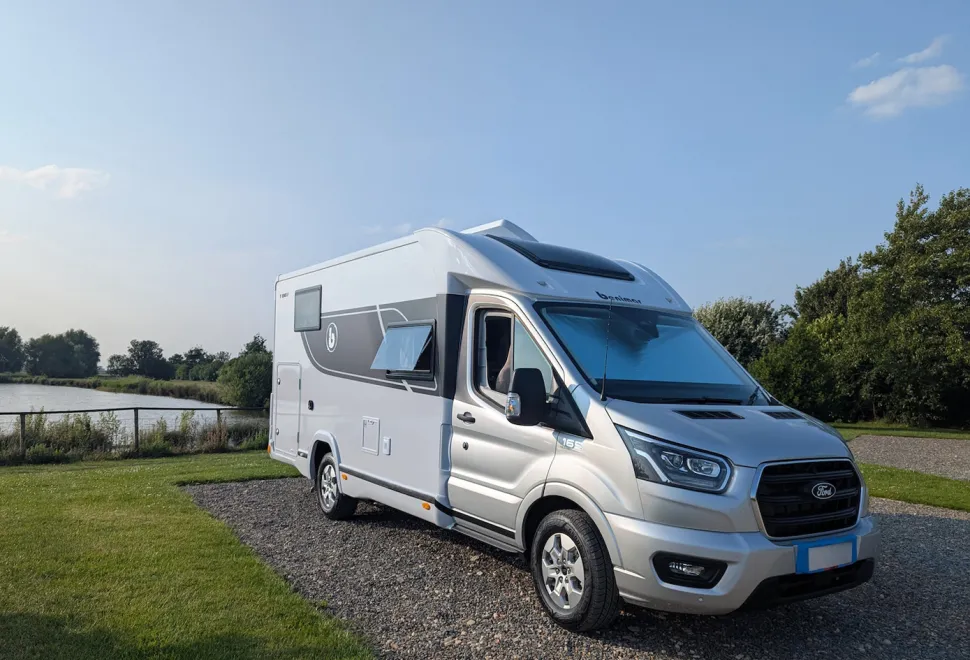
The Benimar Tessoro T861 is one of two models in the Tessoro range that's narrower than the norm. They are still Ford based and the layouts have been flipped for the UK, with the habitation door on the nearside.
Key Features
Full Review
Benimar is a Spanish brand and part of the Trigano Group, which also owns the Marquis dealer network. That’s why I was heading to Marquis Northampton to collect it.
I chose to head to a campsite close-ish to home because, if I forgot anything, then I could always nip back to get it. Sleeping bags, corkscrews and phone chargers have all been culprits in the past...
Whenever picking up a new motorhome we’d certainly either recommend staying close to the dealer for the first night, in case you have any questions, or do as I did and forget the scissors (why do you need scissors on a road test? Ed).
The Tessoro models are all built on the Ford Transit. Its sister Mileo and Primero models are Fiat Ducato-based. However, the three ranges each have a different look, prices and layouts. In the Ford models, there are conventional-width (2.30m) motorhomes – starting with a ‘4’ – and two narrower models introduced this year. This is the single bed T861, but you can also have a sub-6m T840 with a transverse double bed. Both are the expected floorplans for this type of motorhome.
What’s unusual here is that the habitation door is on the UK nearside. A close working relationship between Marquis and the factory means we get flipped layouts like this one, as well as (elsewhere in the range) UK exclusive designs with rear lounges and an enhanced specification.
Automatic for the people
So, UK-bound Benimars get more kit and that includes the base vehicle. As standard this model has the 165hp diesel engine, while the new eight-speed automatic gearbox is one of the few options available, priced at £2,500.
Many motorhomers prefer autos, because it’s one less thing to worry about when manoeuvring. This one coped admirably with hill starts, keeping up with traffic on dual carriageways and cruising down narrow country lanes.
There were a few noises from the rear, but these were mainly from the hob (pack it with a tea towel for travel), the sliding slatted washroom door and the odd rattle from the cab blinds. A fully loaded motorhome will also soften the ride and should lessen these noises, too.
I plugged in my phone and used the Google Maps on my device, but there is also a sat-nav built into the Ford SYNC4 system with the big screen. The intelligent cruise control was a boon on the dual carriageway.
Usefully there’s a USB-C socket (and a 12V one) in the dashtop pocket on the driver’s side, while the centre console has a second 12V socket and a USB-A port. There is a handy small pocket here, too, to rest your device when plugged in – it’s big enough for tablets.
In fact, the top of the dash has even more recesses for essential on-the-road gear – although don’t keep any choccies here in the sun!
The cab seats have twin armrests and can be set lower than in Fiat-based models, hence the reason people often say that the Fords are more car-like to drive. This is enhanced by the modern dashboard and solid plastics used.
The only downside is that the gear lever casing sticks out from the console. It would not be an issue for taller people who have the seat pushed back but, for me to navigate into the habitation area, I have to push the seat back slightly before getting up.
Being vertically challenged also has a further downside. The Ford’s twin-lens door mirrors are excellent, offering good views of each side and the lower one is particularly useful when parking or navigating corners and junctions. However, my view of the passenger side bottom mirror was partially blocked here by the fitted blinds. I had to stretch to see a little more.
Blinded by the light
The fitted blinds are easier than messing about with stick-on insulated screens that never seem to attach properly. The front screen is a roller blind type that pulls up from the base of the dash, while at the sides are concertina affairs. The windscreen blind does let in a little light but not enough to affect my sleep all the way back in the rear bedroom. The rest of the habitation side windows are fitted with cassette blinds. The roof fan in the bedroom may also help you sleep during warmer nights.
Comfy in the cab
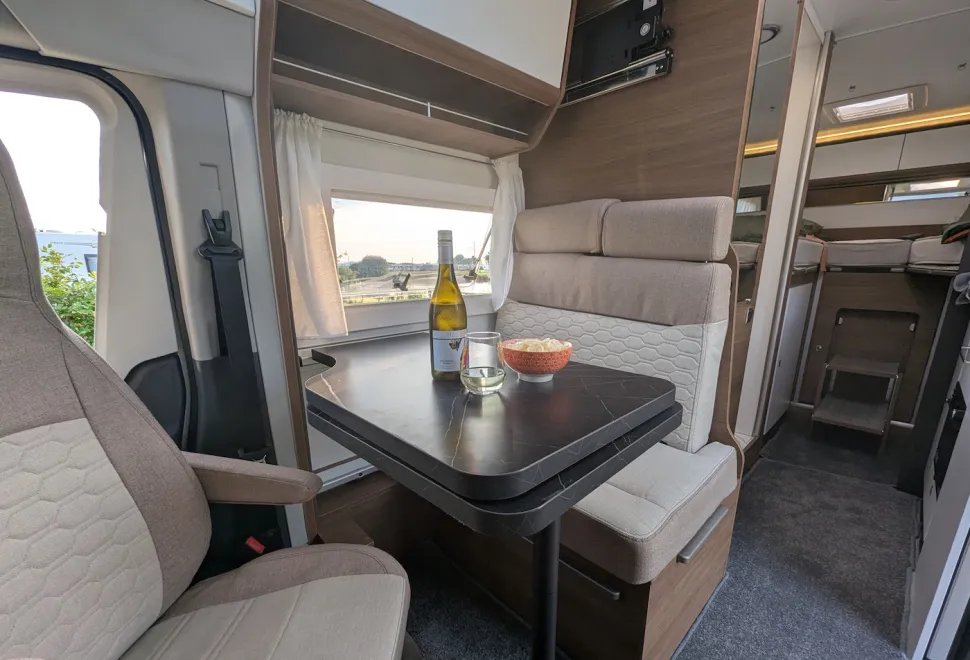
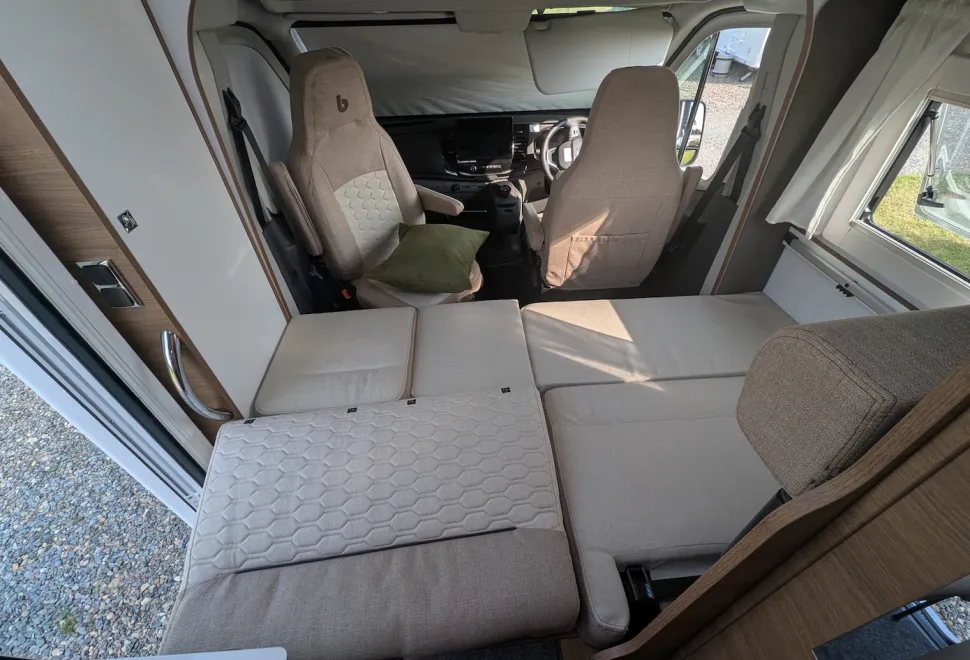
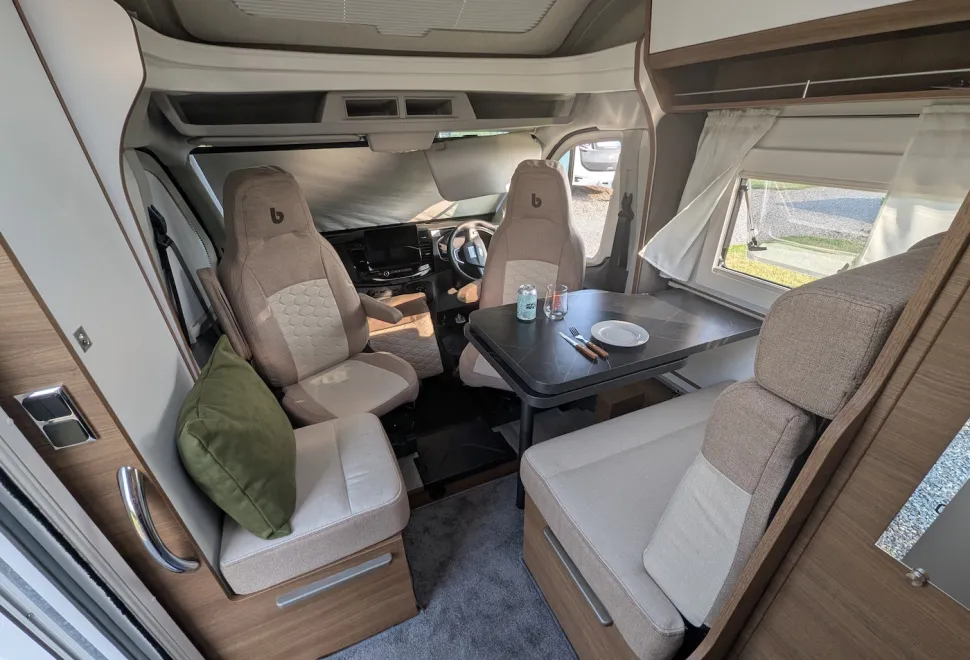
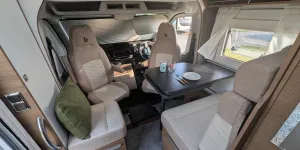
Once on site, the cab seats swivel and I found them the comfiest pews. The side seat is really a perch, as it is backed by a shallow wardrobe. This is a good use of space and ideal for coats, but you need to pack smaller hangers as my ones from home were too big. There’s only room for one or two thick winter coats, but you could fit in more lighter jackets in summer. No coat hooks are fitted elsewhere.
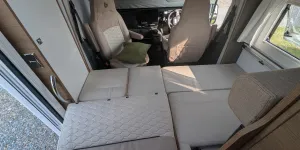
The forward-facing bench offers two further travel seats with three-point belts, both also with Isofix, although check if two car seats fit side by side if you plan to travel with two youngsters.
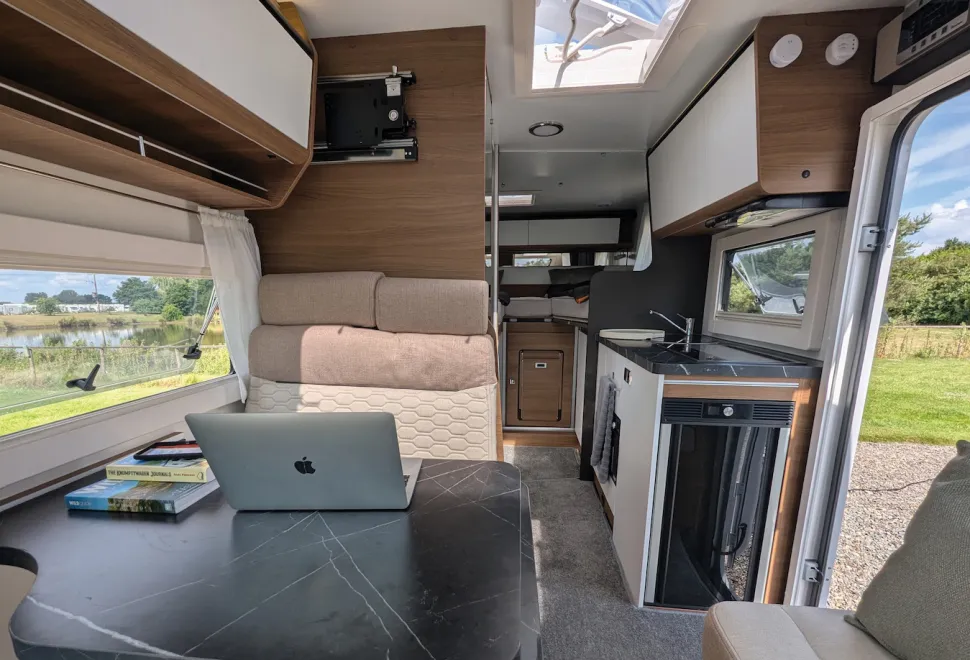
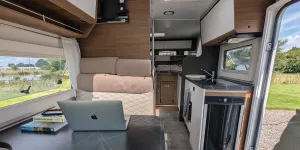
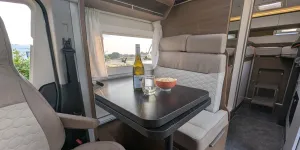
Also, if you plan to travel with rear passengers and the driver is tall, check the table position. I could just about squeeze in between the table leg and seat and, even though movement was a little restricted by the table, the raised cab floor plinth was a great footrest.
Under the bench are the water tank and pump; the cushion slides out with a hatch for access; useful if there’s problem or the water tank needs a clean.
Food is life
I’m a big foodie, so kitchens are very important in my book and I need to know my wine is going to stay cold and that I can pack in enough steak and prawns and maybe even a bag of salad.
The fridge here is a 70-litre Dometic compressor affair, meaning it runs on 12V power. It’s a dual opening model, so you can access it from the interior or from outside through the doorway. Switch it on and forget it – although if you are running off-grid, you’ll be making use of the solar panel to top up your leisure battery.
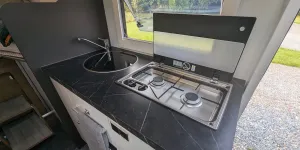
Kitchen storage is quite limited because of the low-level oven. There’s a locker below the oven and a cutlery drawer above, but the tall cupboard would be better as drawers or a larder-style unit. Three overhead lockers are useful, but the left-hand two both need the addition of shelves.
The right-hand cupboard does have a shelf, although a chunk of space is taken up by the extractor fan – unlike most domestic kitchens that have fancy-looking extractors which just recirculate air, this one actually extracts smelly cooking air to the outside.
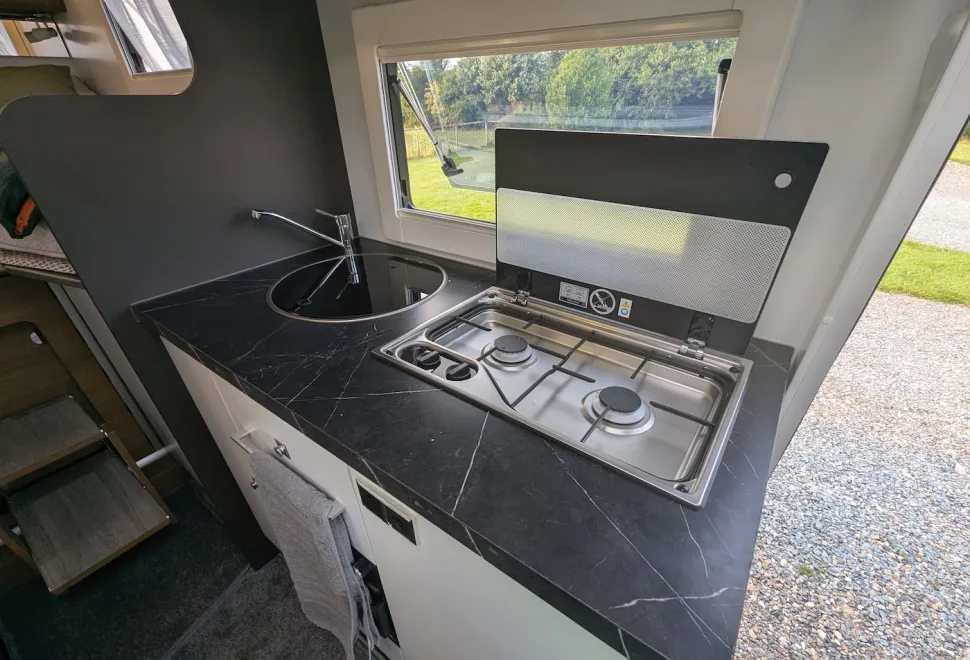
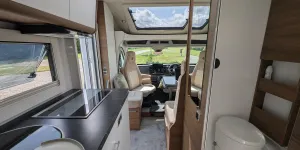
The two-burner hob fits a 16cm pan and a 22cm pan together and the cast iron pan stands certainly feel solid. Next to this is a good-size round-ish sink with mixer tap that’s tall enough to get a kettle underneath. The 230V socket is on the front, next to the cutlery drawer, so you’d probably be best using the slot-in worktop at the end to house the kettle. With the worktop in place you can still just about squeeze past in and out of the doorway.
Game of thrones
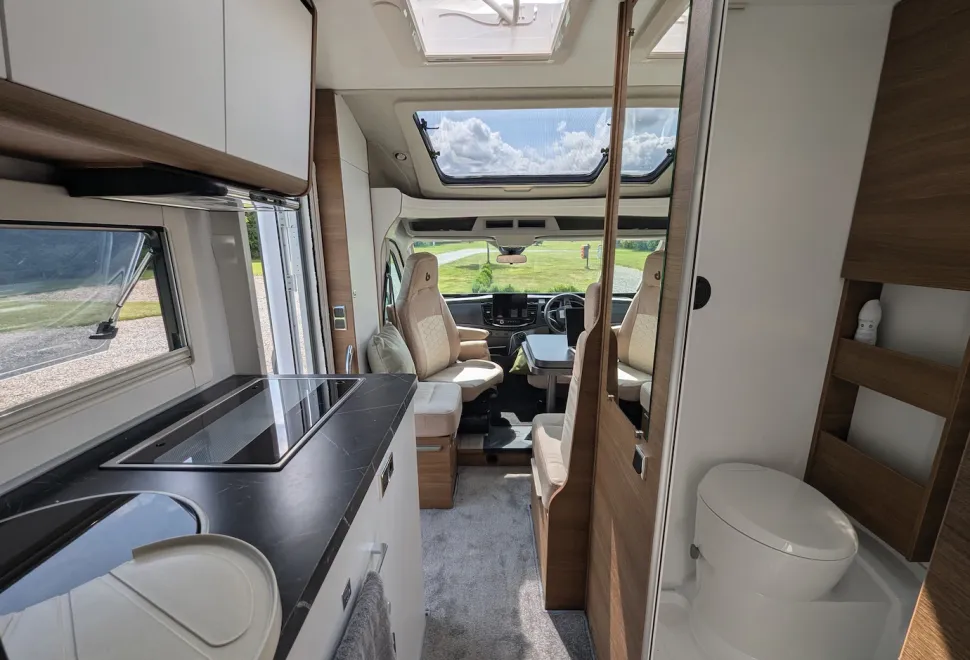
Did I mention my height? While headroom in washrooms and showers has never been an issue for me, the height of the toilet has. This one’s OK, but if sat fully back I’m resting on tiptoes.
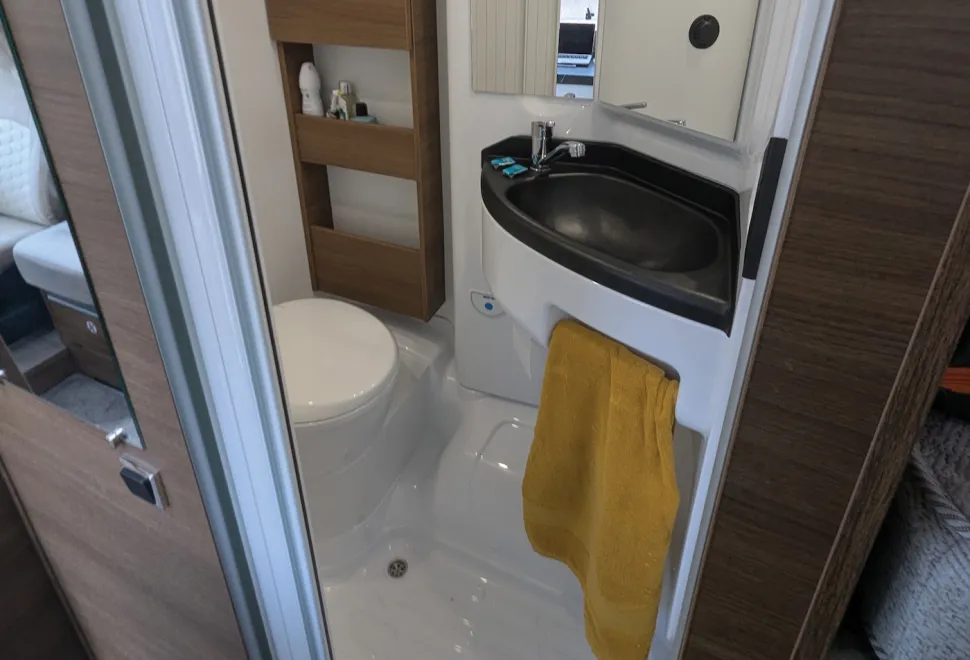
The basin is a moulded black unit, which might show water stains, with a small amount of surface for potions and the like. The twin mirrors are a good height for most.
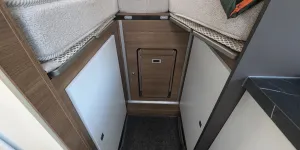
There is no window – I’m OK with this as the room has two good lights and a roof vent. The cupboard behind the toilet is for all your bits and pieces but the lips on the shelves are very shallow.
The shower has a swing wall and it covers the toilet pretty well. It also has lots of pockets on the rear for gels – three with decent retainers mean you could travel with stuff stored here.
Although there are no towel/coat hooks anywhere else, the back wall of the shower has a stylish B-for-Benimar-shaped hook for your towel. It is tucked away, so it didn’t get wet while I was using the shower, but it may depend on how splashy you are.
The water drained away through the twin drain holes pretty well, but I was obviously parked a little nose down as there was a small pool at the front end of the washroom. It actually looks like this shower tray was designed to accommodate a hole here, but there isn’t one.
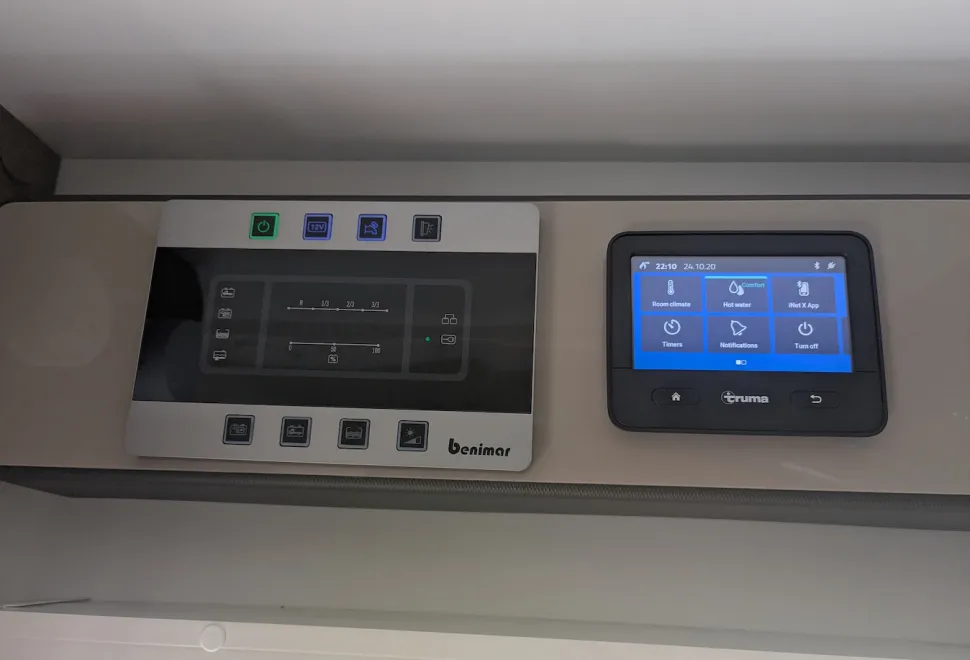
A heater outlet blows into the washroom but it’s not a closable one, so it might get a bit warm in here as it’s the closest vent to the heater itself. This is a Truma Combi 6 E, running off gas and/or electric.
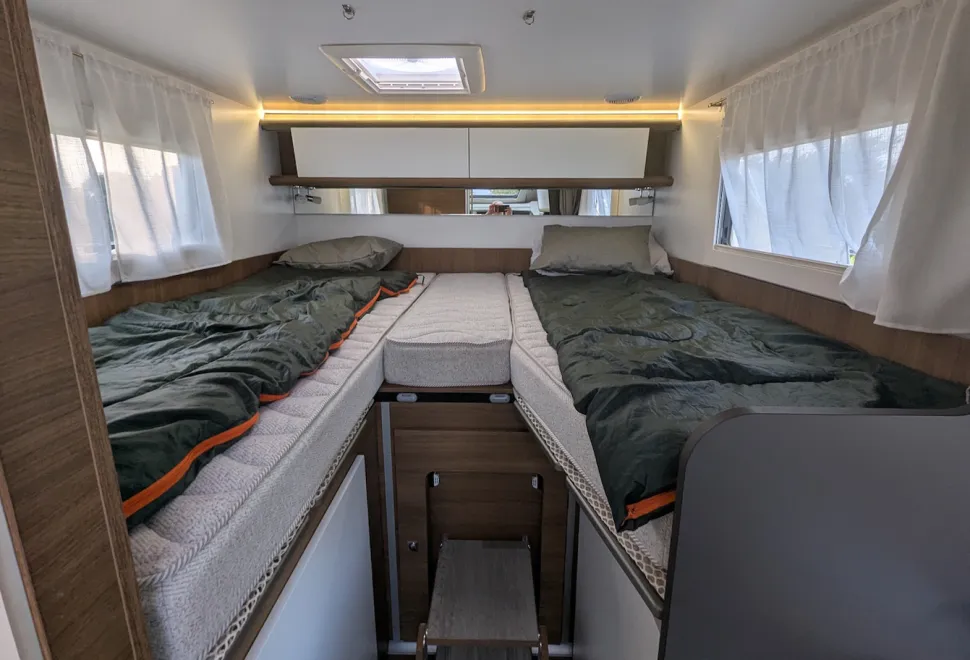
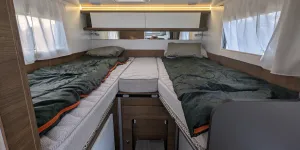
The rear part of the motorhome is taken up by the bedroom, where there’s ambient over-locker lighting as well as two spotlights and alcoves at each end that are perfect for your phone and reading glasses.
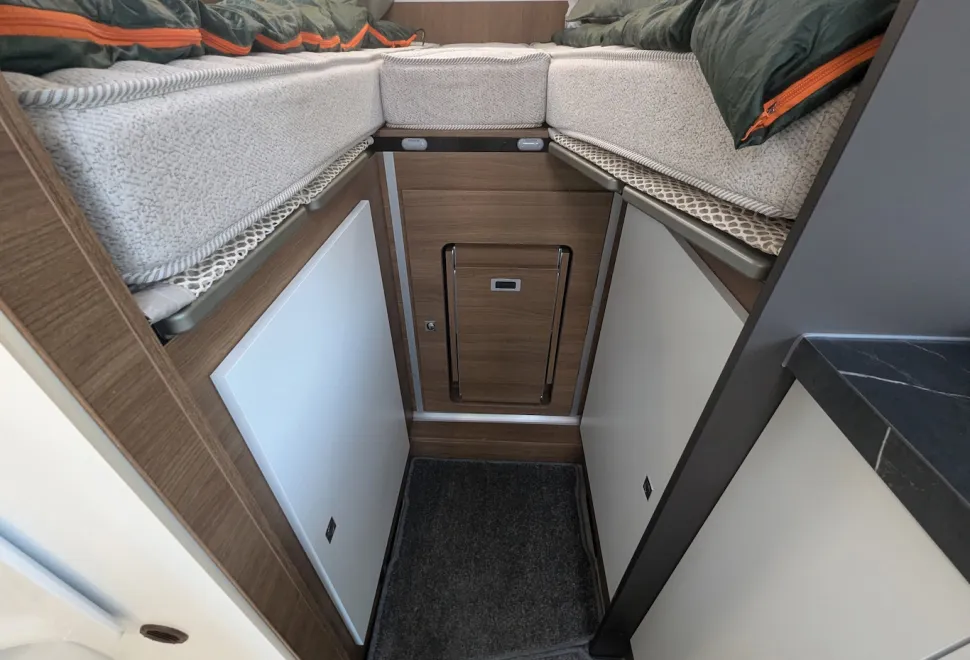
However, you won’t be able to sit up in bed due to those overhead lockers. There is further storage under the foot of each bed, too. Plus, a big space above the heater on the offside (for towels or jumpers) and a handy long hanging rail opposite that’s suited to shorter dresses and shirts, etc.
Steps fold down for access to the beds, or there’s a ladder instead for when the infill section is deployed, making a very spacious bed. The mattresses are firm, so I would get a topper for extra comfort.
A curtain slides across for privacy, but it’s only half height – a longer section would allow private changing without having to close all blinds. As it is, I had to get changed in the washroom.
There’s also a roof fan above the bed, which was a boon for my trip. While it can never replace air-conditioning, it does a good job of pushing warm air out during the day and pulling cold air in at night. Variable speeds include a slower mode for sleeping.
All the toys
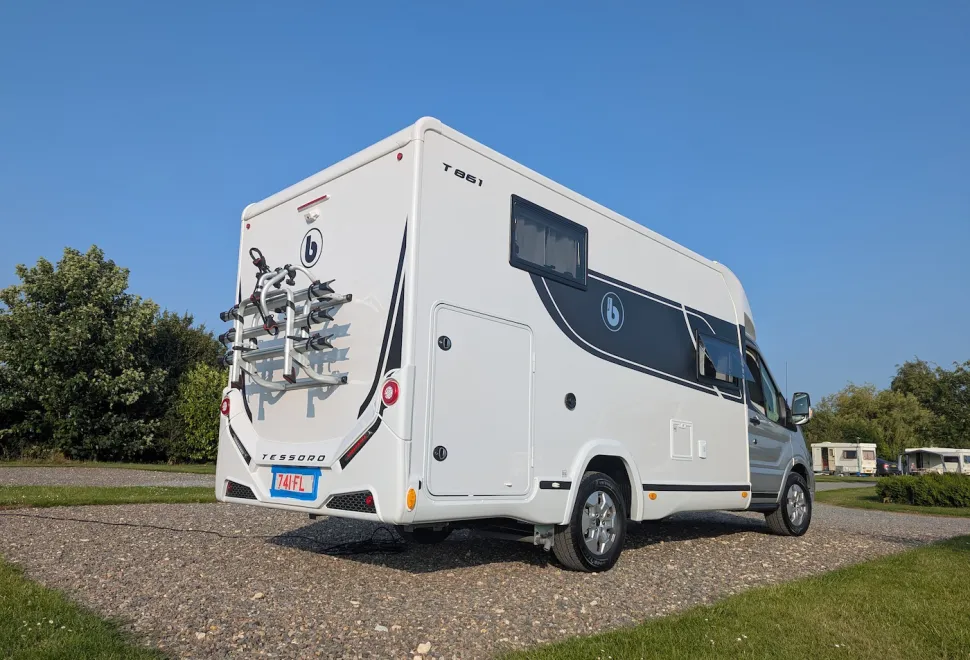
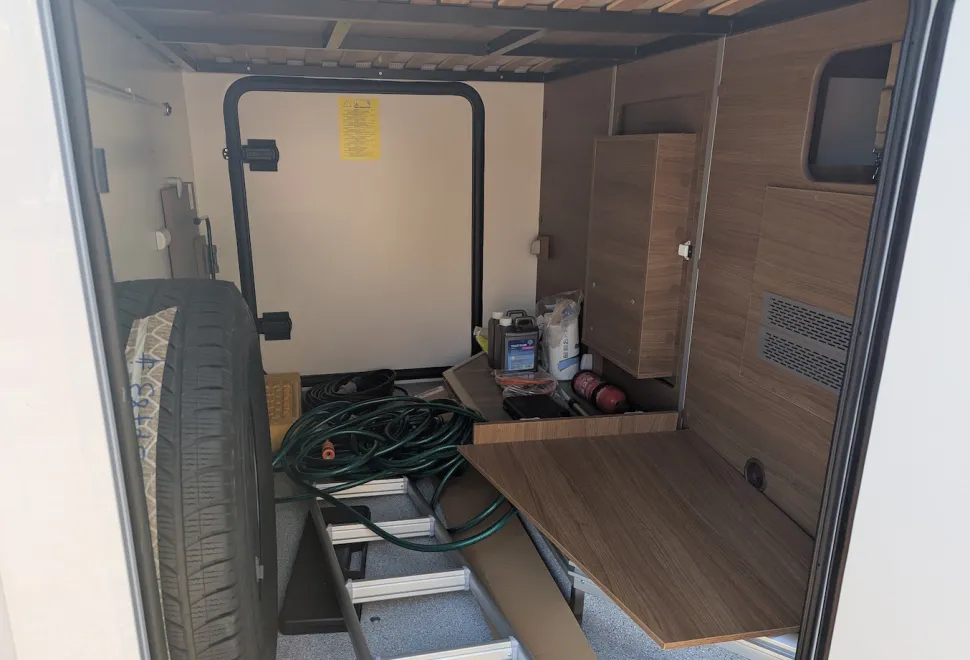
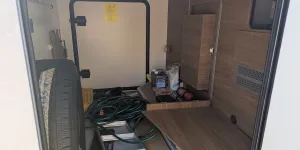
The garage is likely to also be one of the reasons you’ll choose this motorhome. With twin doors for ease of access, you’ll instantly notice the full-size spare wheel. You don’t need to worry so much about have a flat tyre in this model (unlike those with just a Fix ‘n’ Go kit) – just remember to check it every so often for condition as spares can age and perish just like a normal tyre, even when not in use.
There’s a light on the wall. It does a good job of illuminating the space; the switch is on the nearside.
On the right is dedicated storage for the extra wooden panels for the beds. Unfortunately, these are tucked over on the rear wall, away from the hatch through from the interior. If it’s raining and the garage is full of stuff, you’ll have to go outside to retrieve these, or pre-plan and keep them tucked on the inside wall. The rear steady winding handle is kept here on a handy bracket.
Steadies are useful if any night-time shuffling or movement rocks the motorhome, but this wasn’t really the case here, so it’s an individual thing if you use these or not.
The fire extinguisher is also located in the garage and you have access to the winter drain valve, while a panel can be unscrewed to get at the heater for servicing, etc.
There is also access to the shelf above the heater, that can also be reached from inside the motorhome. Tie-down points are attached to the plinth surrounding the interior access hatch. There’s a 225kg weight limit for the garage, which is a decent amount, too.
As an aside, the gas locker is able to accommodate a 13kg or a 6kg cylinder.

Join the Out & About Live family
Get the latest news and exclusive offers direct to your inbox
Discover your inner outdoors with Out & About Live. For over 20 years we have provided the very best advice to motorhomers, campervanners, caravanners and campers – whether you are looking for travel advice, the very best campsites, help with choosing a new ‘van, news, shows, what’s on and much more – it’s all on Out & About Live.
We would love to welcome you to the family so sign up to our FREE email newsletters so you don’t miss out any longer.
Our Verdict
If you’re looking for fixed single beds in a compact vehicle, this model is a good option. It drives well, the spec level is great (solar panel, oven, 165hp engine) and the layout makes the most of the space. Ideal for couples wanting a garage layout, it has a good payload, too. Downsides are the restricted space in the dinette and limited kitchen storage.
Disadvantages


