
A beginner's guide to caravanning... Part two
That’s the biggest and most important step, of course and it’s also the first step into a leisure lifestyle that can lead you into awnings and all manner of accessories.
It’s a lifestyle that has to be easy and comfortable. Easy? It is, when you have the knowledge to ensure you do everything in the right way. You need to know, for instance, how to load your caravan correctly, to achieve the best stability and balance in the interest of safety.
If you’re new to towing the best way to gain confidence and learn the “dos” and “don’ts” is to take a tow course. Both the Camping and Caravanning Club and the Caravan Club run tow courses. But if you tow before you’ve managed to take one of those courses, you might find our basic hints on these pages helpful.
Hitching up
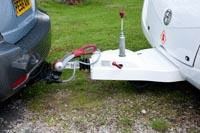
It’s the single most important aspect of towing. Best way: do everything in the same order each time. That way you’re unlikely to forget to do something – like releasing the caravan handbrake, for instance!Crucially, you need to know how to tell if the cup is securely on the towball. There are two types of hitch on new caravans, AL-KO (on the majority of caravans) and Winterhoff (on all Explorer Group caravans).
Most have hitch-head stabilisers which incorporate friction-pads that are pressed onto the coupling ball. That’s the device that dampens snaking and pitching movements of the caravan.
You can tell if you’ve not attached a Winterhoff with a hitch-head stabiliser correctly because, unless it’s secure, you can’t lower the lever to activate the stabiliser. In the case of AL-KO couplings, a small green stalk pops up when you’re correctly hitched.
Older caravans (and a few lower specification new models) may not have hitch-head stabilisers. And on older caravans there are different types of hitch from the standard ones we mention here; if in doubt, ask your dealer how to operate the one on the caravan you choose.
Towing
For an experienced driver, towing is not daunting, so long as you stick to some basic rules. Among them are: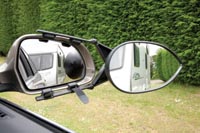 Speed: 60mph is your limit on motorways and dual carriageways; on single carriageway roads it’s 50mph.
There’s a vital aspect of speed to keep in mind. Slow down for descents. If you go too fast down a hill, the weight of the caravan pushing on the back of the car can cause instability and, in extreme cases, the dreaded snaking. It only takes a gust of wind caused by a lorry overtaking you to set up instability.
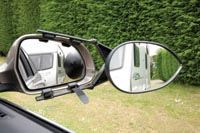
Cornering: The caravan will always take a tighter line than the car on corners. So, especially on tight corners in towns, watch the position of the caravan wheel in your door mirror. That way you’ll not climb the kerb.
Reversing: New caravanners often feel especially daunted by the prospect of this process. It’s actually quite simple. You turn the steering wheel in the opposite direction to that in which you want the caravan to go.
So, if you want the caravan’s back end to turn to the left, you effectively push it that way by turning the car to the right. How does it work? A right turn by the car exerts pressure on the right side of the towball, making the caravan turn left. Got it? Have practice and you’ll find it’s straightforward.
Single-axle caravans are harder to reverse accurately than twin-axle models. That’s because twin-axles respond slower and more accurately to the direction-force from the car, enabling you to place your caravan with greater precision. It feels counter intuitive at first but take some time and it will come naturally.
Our advice: Practice on a campsite with plenty of space where there’s no-one to watch and make you feel self-conscious!
Overtaking: At first, the length of car and caravan can be hard to judge when you’re overtaking. Best advice is: don’t overtake on single-carriageway roads unless you have no option. That’s when you encounter a slow-moving farm vehicle or cyclist, for example. The way to be sure the back of the caravan has passed the vehicle or cyclist you’re overtaking is to watch through the nearside door mirror, of course. Overtaking on motorways and dual carriageways is much easier – and most lorry drivers flash their headlamps to indicate to you that you’re safe to pull in. Take great care to overtake only on level or uphill sections of road; that way you can avoid going too fast on downhill gradients.
Read Part one of our beginners' guide by clicking here.
New to caravanning? Read our top caravan tips by clicking here.
- For more information, visit the Caravan homepage, or take a look at our Your First Caravan special edition.
- Read our extensive selection of caravan reviews.
- Take a look at our online buyer's guide.


