
Wheelhome Dashaway eRC campervan


Peter Vaughan Content Editor: Motorhomes
Peter Vaughan Content Editor: Motorhomes
Description
Tesla car turns into a campervan…
Key Features
Full Review
It’s fair to say that Stephen Wheeler, founder and owner of Wheelhome, doesn’t think like other campervan converters. He has never stuck with traditional layouts or even the obvious base vehicles. The company’s past repertoire includes the Millennium on a Ford Galaxy people-carrier and Vikestian on the Suzuki Wagon R – a shopping car measuring just 3.4m long. Both gained pop-tops and became proper campervans in Stephen’s workshop.
Most recently, Wheelhome has been converting the small Vauxhall Combo (sister vehicle to the Citroën Berlingo and Peugeot Partner). But not in van form, rather using the car derivative. Oh, and not petrol or diesel but the full EV version. The Vikenze III-e won the Best Campervan Innovation award in 2023.
It was while away in one of his own electric Vauxhall campervans in Iceland that Stephen came up with his latest idea. Seeing Tesla cars fitted with roof tents regularly parking up on the same campsites, he thought ‘I can do better than that’. And as an EV convert, he already owned a Tesla Model 3.
Back home, it didn’t take Stephen long to start drawing up plans for his Tesla campervan, building wooden bucks and then GRP moulds around his own car. Now, after six months of designing and building, the prototype is here and we met up with Stephen at Low Farm campsite at Folkingham in Lincolnshire. You’ll be able to see the Dashaway eRC for the first time at the Norfolk Motorhome and Campervan Show from 18 to 20 July.
What's a roof camper?
The Dashaway name has been used by Wheelhome previously on a tiny caravan – another break from convention. This time it’s gained a suffix – eRC. That’s e for electric and RC for roof camper.
But what exactly is a roof camper? Well, the whole point of the new Dashaway is that it’s more than just a roof tent. Stephen watched those Icelandic Tesla campers continually going up and down a ladder and thought ‘that’s no good’.
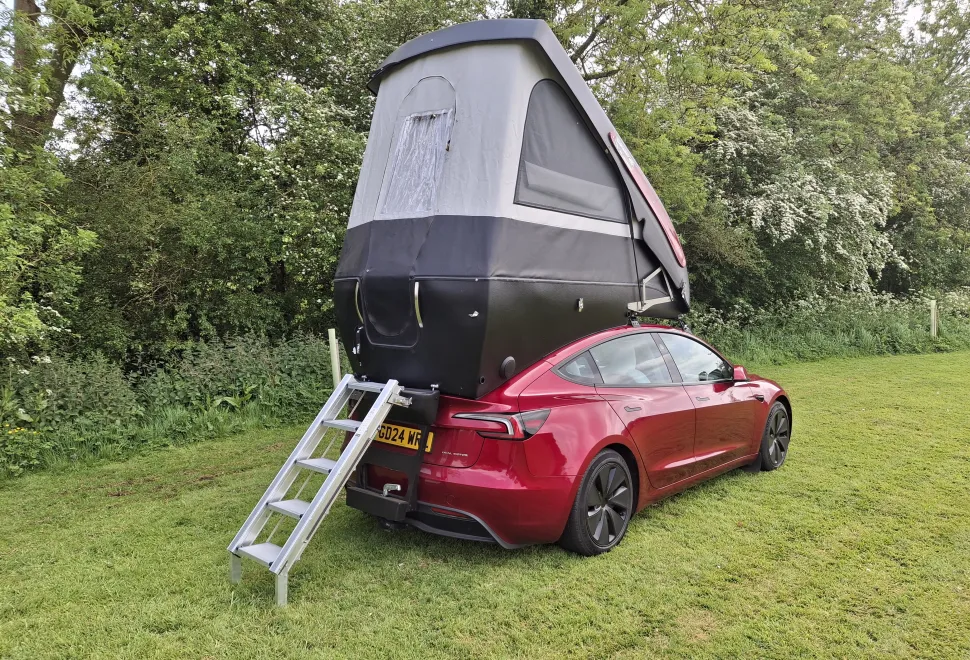
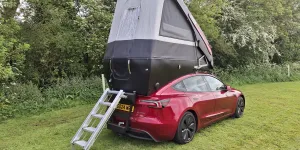
So, the unit here has a settee and a kitchen and even space for a loo, as well as the double bed. It has been designed specifically to fit the Tesla Model 3 (any version) but the car itself is not modified. No cutting holes for a pop-top this time, you just need to fit Tesla’s own roof rack and a towbar – cost is about £1,500.
The Dashaway is then added, but not permanently. It will be supplied with a frame that lifts it off the car and you then simply drive your Tesla out from underneath. You could even park the car under the camper on your drive if space is at a premium! Demounting your Dashaway should take less than half an hour.
Why a Tesla?
You can only fit the Dashaway to a Tesla Model 3; it has been designed to fit the contours and roofline of the car. Partly, that’s because Stephen already owned a Model 3 – he’s now on his third – but mostly because it’s a popular and widely available vehicle. To quote What Car magazine, “The Tesla Model 3 is good to drive, packed full of tech, fast and even reasonably practical. It’s also competitively priced and well equipped, and when you factor in its long range and Tesla's world-beating charging infrastructure, it's a brilliant choice.”
Launched in the UK in 2019, the Model 3 has been a huge success, with 17,245 sold new last year alone. It was the world’s best-selling EV from 2018 to 2020 and a million examples had already been sold by June 2021.
What that means is that there’s plenty of choice out there. A quick look on the Autotrader website showed 877 Model 3s for sale at the time of writing, with prices ranging from £10,450 for a high-mileage example up to £63k for a high-spec brand-new car. Stephen recommends the post-2021 facelifted version, prices for which start at under £20k.
So, choosing the Model 3 was, perhaps, the easy bit. Making the roof camper work and keeping it within the car’s weight allowances wasn’t so simple.
The Tesla towbar has a maximum noseweight of 100kg and the roof rack is rated at 75kg. Those figures were challenging, so the Dashaway doesn’t have a gel coat finish, instead opting for a protected two-pack polyester textured paint that saves around 8kg. The unit has thinner glass-fibre where it isn’t structural but is around 9mm where strength is required. And Stephen has had to forgo his usual electric elevating roof for a manual version (with gas struts) to keep the weight down. The finished camper weighs 150kg and keeps within the Model 3’s payload and rear axle limits.
In testing (2,200 miles so far), with and without the Dashaway fitted, Stephen reports that the camper reduces the car’s range by around 10% with the unit fitted, although this is expected to rise to nearer to 20% in less ideal (colder) conditions. Still, a realistic range of almost 300 miles is way better than other EV campers that we’ve seen so far. Just as importantly, driven sensibly you’ll not be aware that you’ve added the Dashaway – the Model 3 remains very quick and stable. The stares of those passing by are the only giveaway…
Two-seater
The roof camper sleeps two and, with it locked to the roof rack, the Model 3 becomes a two-seater car to stay within its weight capacity. That means the space in the rear footwells becomes storage for a 10-litre water carrier, a small compressor fridge (nine litres is standard but larger models will fit) and a power bank. The car’s boot lid is blocked by the camper body but you can still access the space by tipping the rear seats forward – and it’s a big space. Stephen carries two metre-long plastic storage boxes, so you can fit clothes and non-perishable food here. Payload is 168kg for a passenger and your clothes, food, etc.
The power bank is an essential part of the Dashaway. It incorporates an inverter, auxiliary battery, mains battery charger and a 12V charger. It charges when you’re hooked up to 230V on a campsite but also allows off-grid touring as it’s connected to the Tesla’s low-voltage battery (the one that powers the car’s lights, etc), rather than the high-voltage traction battery that drives the wheels.
Using the Tesla’s facility to ‘keep power accessory on’, Stephen estimates that you could cook three meals a day in the camper (all on electric, of course) and by 3pm the power bank would be replenished to 100% – without driving and without a hook-up. The Tesla’s low-voltage battery will be continually topped up from the high-voltage battery until the latter is down to 20%, so, as long as you arrive at your destination with it fairly full, long off-grid stays are simply not an issue. Only if you need to use the portable fan heater for warmth will you need to rely on a campsite mains supply.
When staying on a campsite you can select how many amps to draw from the site’s 230V supply – Stephen recommends 8A (not too greedy!), but you’ll need to check with the campsite owner or warden as different rules apply on different sites. So far, he has never been refused permission to charge the car on a campsite and, typically, you can add 120 to 130 miles of range on an overnight stop by charging the car in this way.
What's on board?
Once you’ve raised the roof (undo four locks and push up) and added the ladder (which locks into place), you’re ready to climb inside the Dashaway – and we think you’ll be amazed at what’s inside!
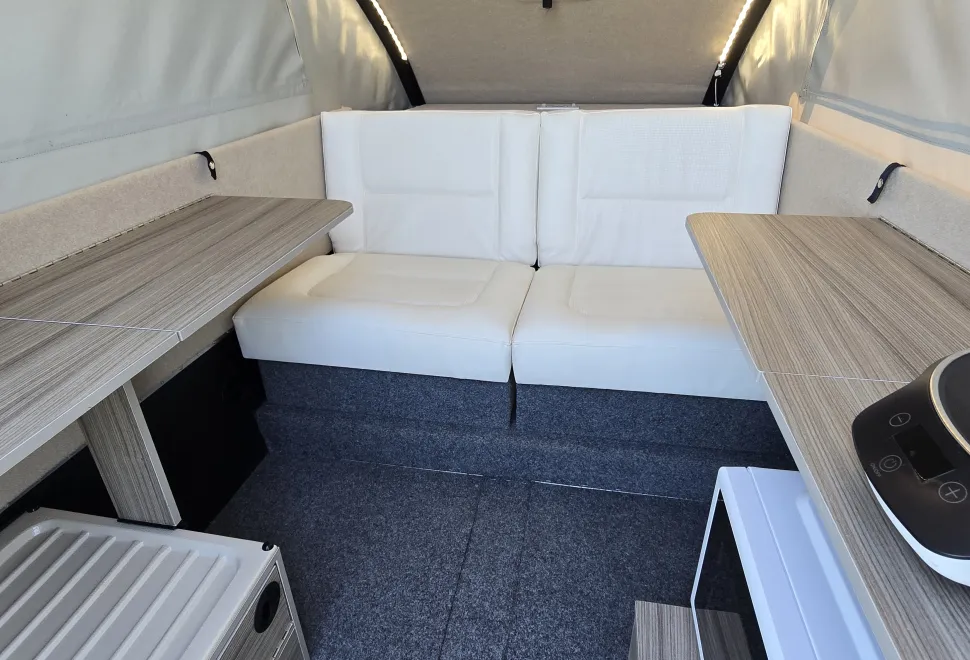
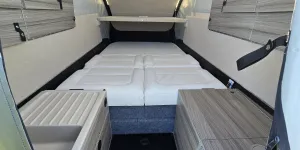
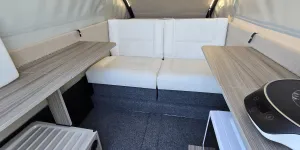
Unzip the door and there’s headroom just inside of 1.88m, then facing you is a settee – trimmed here in white to match the seats in the car, but more practical choices are available. On either side of the doorway are cabinets – necessarily simple but with a sink on the nearside and room for a Porta Potti on the offside.
The sofa has plenty of legroom to stretch out and is a generous two-seater. It then folds down into a flat 1.90m by 1.20m double bed with room at the foot for one person to stand to get undressed, or to use the loo.
As far as cooking is concerned, you can choose from any mains appliances up to 2,400W. A three-socket power tower is fitted and a folding shelf for your cooking kit to sit on. A microwave or electric oven and a Sterling single-ring induction hob are included with the Dashaway but, equally, you could carry an air fryer. The microwave/oven can travel on the floor of the Dashaway when it is all closed down.
On the opposite side, the portable water carrier sits on another fold-down shelf and feeds the sink by gravity – a bit basic but another essential weight-saving measure.
What does it cost?
Clearly, the Dashaway offers a lot more than a conventional roof tent. Inside, it’s more akin to a small campervan, although note that the sides are largely canvas (with large flyscreen panels for ventilation). Ready to go, complete with the demounting kit, cooking equipment, fridge, etc, it costs £23,400.
To that figure you’ll need to add a Tesla and the towbar and roof rack, so you could viably be on the road for approximately £45k.
Join the Out & About Live family
Get the latest news and exclusive offers direct to your inbox
Discover your inner outdoors with Out & About Live. For over 20 years we have provided the very best advice to motorhomers, campervanners, caravanners and campers – whether you are looking for travel advice, the very best campsites, help with choosing a new ‘van, news, shows, what’s on and much more – it’s all on Out & About Live.
We would love to welcome you to the family so sign up to our FREE email newsletters so you don’t miss out any longer.
Our Verdict
It’s hard to categorise the Dashaway eRC – not really a campervan, nor a roof tent, so the ‘roof camper’ description seems appropriate. It offers similar space and facilities to a small pop-top campervan, but, of course, is a completely different proposition to drive as it’s based on one of the world’s most successful electric cars.
Consider the price of the smallest caravans at £20k to £25k and the similar cost of converting a VW van into a camper and Wheelhome’s pricing seems fair. In fact, this might just prove to be the company’s cleverest design yet, as well as its most radical.
Disadvantages


