
Rolling Homes Columbus T7 campervan

Peter Vaughan Content Editor: Motorhomes
Peter Vaughan Content Editor: Motorhomes
Description
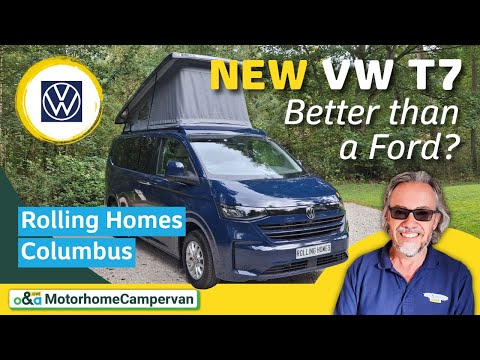
Campervans based on the new T7 VW Transporter are just starting to appear. One of the first is the latest Columbus from Shrewsbury-based Rolling Homes…
Key Features
Full Review
Volkswagen and camper are words that go together like fish and chips. The Transporter has been around for over 75 years and Westfalia introduced its Camping Box to turn a split-screen van into a camper as far back as 1951.
Ever since, Volkswagen campervans have been developing a loyal following, with specific VW events and clubs and every conceivable item of branded merchandise. Mugs, T-shirts, blankets, socks and much more allow devotees to show their passion, while VW camper drivers wave to each other on the road. The word ‘iconic’, for once, is not overplayed.
But now there’s a new Transporter – a seventh generation that VW seems oddly reluctant to refer to as a T7. Maybe that’s because the new van hides a secret that, in this internet age, is as well-kept as the fact that the Germans like beer. This, then, is a Transporter that’s not built in Germany – not that this seemed to harm the Polish-made Crafter. This time the story of its home goes far deeper, however, because the T7 is built in Turkey – at a Ford factory. And underneath some Volkswagen tinsel, the Transporter is virtually the same van as a Transit Custom. It even says FoMoCo (Ford Motor Company) on the glass…
Does that matter? After all, the Transit Custom is a fine vehicle in its current form and popular as a campervan base in its own right. It’s a much newer design than the outgoing T6.1, which can trace its roots back to the T5 (introduced in 2003), and with that comes all the latest tech – as well as a bit more internal space. Some VW fans might be horrified, but let’s take a more objective approach here…
The new VW Transporter
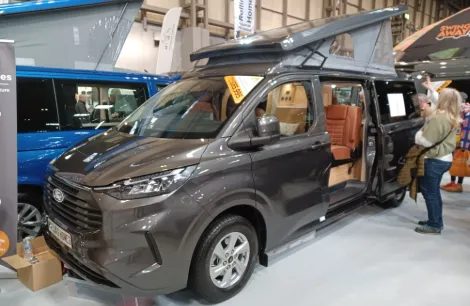
From the front, Volkswagen has done a brilliant job of concealing the Transporter’s ancestry – the whole nose (bonnet, grille, lights and bumper) is different and has a VW look about it. At the rear, there are changes, too, with more stylish chrome badging and a better integrated reversing camera. But putting a wig on your bald friend won’t stop you recognising him and, when you see the T7 side on, its Ford origins are obvious, especially in the shape of the rear side glass.
More importantly, the mechanicals come from Ford – a 2-litre diesel engine in 110, 150 or 170hp versions (nothing to match the old 204hp T6.1), mated to a six-speed manual or eight-speed automatic transmission (a Ford torque convertor gearbox, not the twin-clutch DSG). A hybrid version (petrol/electric, as in the Transit Custom) will follow in 2026.
All T7s are a little bigger – both wider and longer than their predecessors. As before, VW also offers a choice of gross vehicle weights, from 2,800kg to 3,200kg. Even on the lightest chassis, the Columbus has a 425kg payload.
Jump into the cab and there’s the same mix of ‘I’ve seen that in the Ford’ and ‘that feels like a VW’ as on the outside. Most obviously, the basic design with the raised central 13in infotainment screen (with Apple CarPlay, Android Auto, reversing camera, DAB+ radio) is inherited. However, the 12in digital dashboard display uses VW graphics and the Ford’s oddly squared off steering wheel is replaced by something properly round. There’s a slice of brushed aluminium across the fascia that hints at being more premium and an extra USB-C port (by the centre mirror) for a dashcam. On the safety front, the VW also boasts extra airbags, with these built into the seats and four more in the cab roof.
For the Transporter driver, the biggest advantage over the Transit Custom may be the seats, which feature tilting squabs with an extendable centre section (great for under-knee support) and electric lumbar adjustment. These additions aren’t found on the passenger seat but both chairs get twin armrests (it’s one per side in the Ford).
What we have here is also VW’s top-spec Transporter, which Rolling Homes will use for all the campers it builds for stock. Volkswagen offers Commerce, Commerce Plus and Commerce Pro equipment levels, with the last coming with front and rear parking sensors, heated cab seats, automatic air-conditioning, a heated windscreen, wireless phone charging, body-coloured bumpers and 16in Montreal alloy wheels (which look lost in the big arches).
The most important thing, though, is how it drives and – like the Ford – the VW is light and easy to pilot, with the 150hp engine giving plenty of go even on tight and hilly Welsh roads. It’s smooth and quiet and, for better or worse, has all the electronic nannying of modern vehicles. No one (even VW fans) is likely to be disappointed behind the wheel.
SCA pop-top
Rolling Homes adds a German SCA pop-top, which is a popular, premium choice for Ford and VW campervans. Folded down, it keeps overall height to 2.05m, so some height restrictions are passable, but it is not the neatest-looking lid. Here, it’s colour-keyed and there’s the option to add a solar panel.
When raised, it comes with a panoramic opening section with a huge flyscreen around the front three-quarters of the canvas – great in summer, not so great in the autumn when you want daylight without the fresh air. As we’ve said before, SCA seems to have southern Europe in mind more than the UK…
However, there are plus points to this roof, including the ‘halo’ LED strip light running around the circumference of the top and the excellent roof bed on Caraflex plastic springs. There are belt and braces catches to secure the top on each side and a trim panel to keep things tidy in the cab ceiling.
Our test ’van came in dark Indigo Blue, which is perhaps not the most flattering shade – brighter colours seem to suit the T7 best (or the red and white duo-tone we spotted in the Rolling Homes factory). The Columbus conversion also adds various subtle branding and graphics, including a black strip between the headlights that seems to give the van a bit more personality. The tinted side windows are fixed, except for a single slider (with flyscreen) on the offside. The mains hook-up is under the rear bumper.
All the approvals
Rolling Homes is one of just six companies listed as a Volkswagen Motorhome Qualified Converter, so this camper is also type approved and NCC (National Caravan Council) approved. Ticking those boxes is important with so many firms now converting VWs into campervans – to very varied standards.
Of course, the Columbus will be registered as a Motor Caravan, not a Van with Windows, but the most critical aspect is the seat installation. Like many converters, Rolling Homes uses the RIB rear bench/bed (here with twin Isofix points), but it’s the substantial framework underneath – developed by Rolling Homes in conjunction with Bespoke NI and crash-tested in a van bodyshell – that matters. It’s a two-part steel structure – one frame under the van and another mounted onto the floor – that ensures your passengers’ safety.
In the cab, early examples of the new Columbus have RIB swivel bases but factory swivels from VW will be fitted in future, now that they’re available.
Side kitchen layout
Rolling Homes has evolved its range around the new Transporter, so there are Shackleton, Columbus and Columbus S models with a side kitchen and the Livingstone with a rear galley and toilet. Both Columbus versions have the company’s trademark real oak furniture, but differ in the rear offside corner, where this non-S model has useful additional storage.
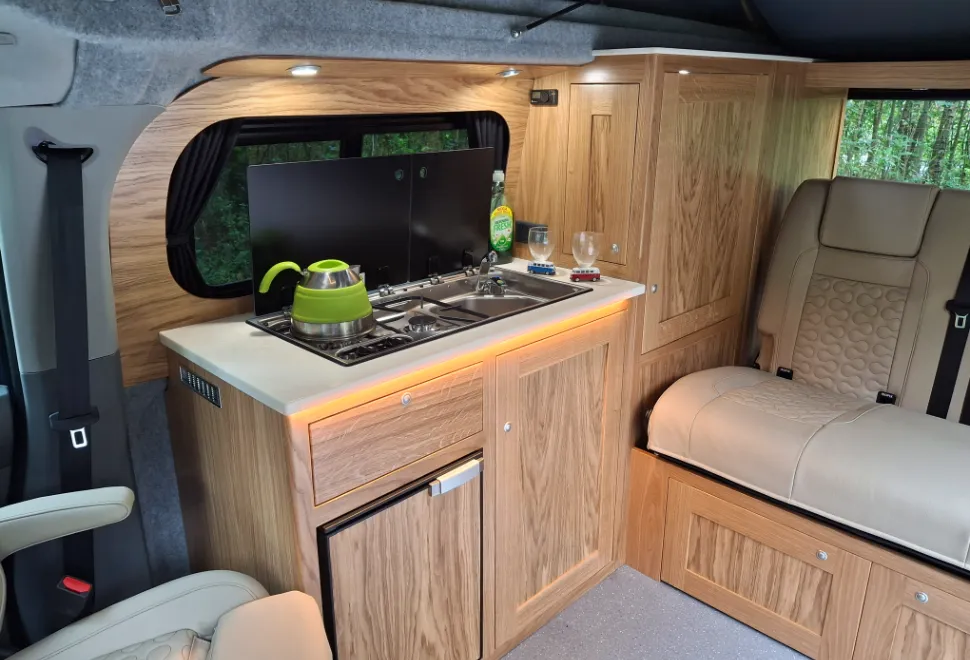
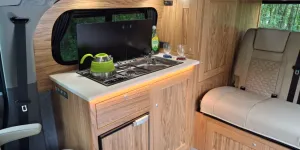
Of course, the side kitchen is the classic design for a camper of this size but there are many permutations of seat/bed width and number of seatbelts, as well as kitchen depth, design and fittings. Here, it’s a two-person rear seat and a generous kitchen but the defining aspect is the Rolling Homes cabinetwork with Corian worktops, while the woodwork extends not only to the superb, handcrafted galley but also the frames around the side windows.
Both front seats rotate easily – the kitchen finishes short of the cab’s B-pillar to allow this and to ensure that tall drivers are not restricted in their seat adjustment. Then, of course, there’s the RIB bench, which (as usual) has a nice shape but sits too high for all but the most giraffe-like of us to get their feet comfortably on the floor.
With that in mind, I preferred relaxing in the cab seats and dined from there, too. The table – a Loc8 Duo – stores neatly inside the sliding door and is free-standing, so can also be used al fresco. It just seems a shame that its grey top doesn’t match any of the interior décor.
Lighting is a mix of downlights all around the living area, plus an under-counter strip and illumination in the wardrobe. There’s plenty of light but on only two circuits – there are times, especially at night, when it would be useful to have some lamps switched individually.
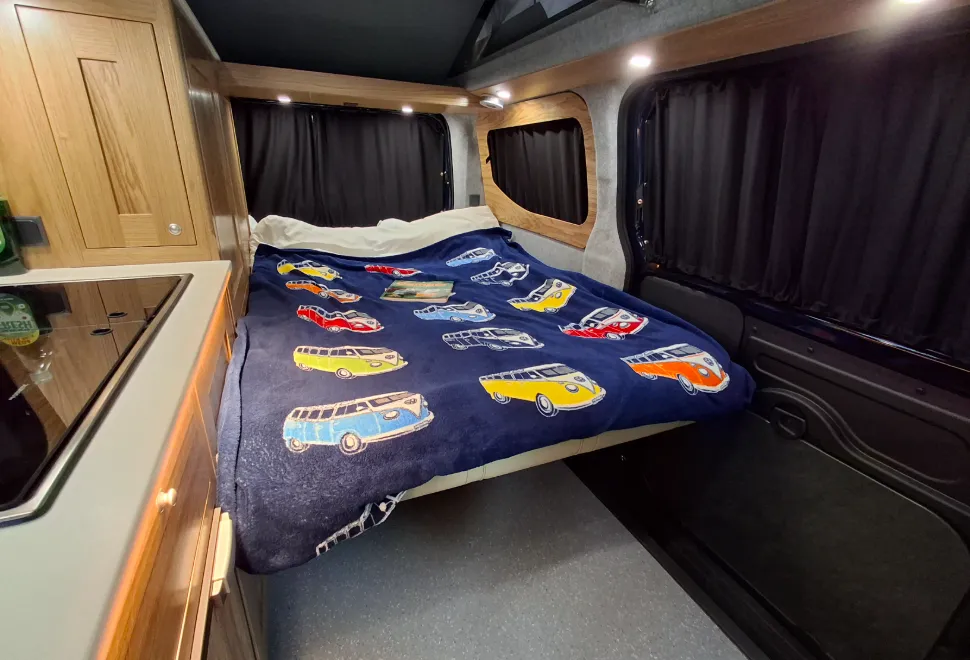
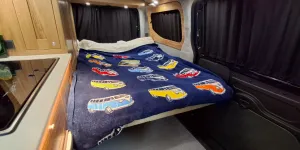
At bedtime, it’s easy to convert the RIB seat into a bed – the base flips over and the backrest folds flat, while the rearmost section of mattress can be tilted for a chaise longue effect – just mind your head on the shelf above. It’s a completely flat bed but very firm, so you’re sure to want a mattress topper. The bed measures 1.12m wide but there’s a more useful 1.22m between the cabinets and the side wall.
Night-time privacy is ensured with curtains that provide proper blackout (better than most blinds), with silver screens around the cab.
Real wood cabinets
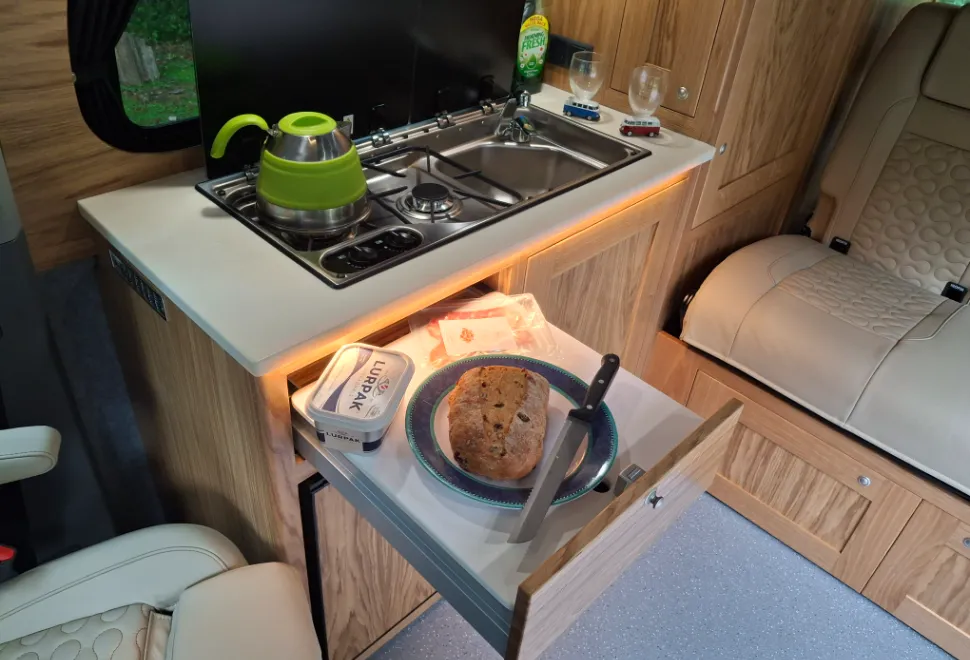
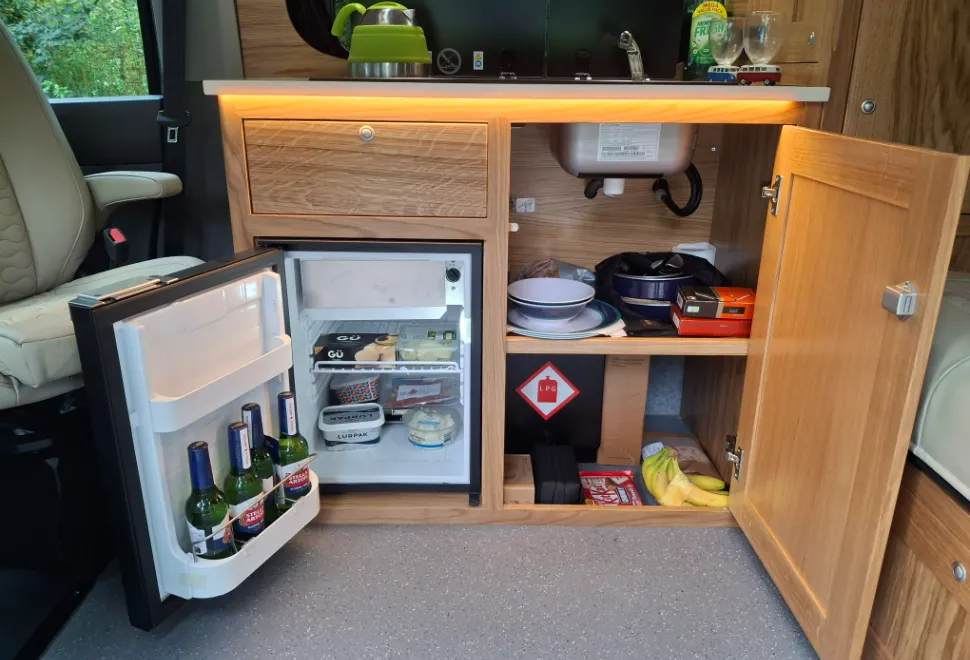
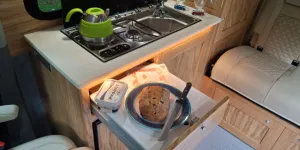
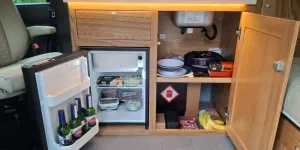
The oak furniture makes a statement here but it also includes the typical campervan fittings – a combination two-burner hob and sink unit from Dometic and a 50-litre front-loading compressor fridge from Vitrifrigo. The hob meets the latest regulations, so the gas is turned off automatically when the lid is lowered. The gas cylinder itself (a Campingaz 907) is housed in a steel box in the main kitchen cupboard.
That locker is a tall, deep, shelved space with lots of room for your pots and pans, crockery and non-perishable foods; although, arguably, drawers would give easier access. There is one drawer, for your cutlery, above the fridge and there’s a slab of Corian that sits on here to provide extra worktop – quite necessary when preparing a meal as there’s little other space with the cooker and sink lids raised.
That worktop is an option, as is the mug cupboard next to the sink – another neat touch. You won’t miss its intrusion into the wardrobe, which comes with a hanging rail and a drop right down to the floor – that’s 1.26m! In truth, you’ll probably keep your mains lead and the like at floor level here as this full-height unit is also accessible via the tailgate. The leisure battery (105Ah lithium) and fresh water (10-litre portable container) live in the base of the wardrobe, where you’ll also find shelves for your folded clothes, toiletries, towels, etc.
There’s more storage under the rear seat, with two doors in front – there’s room here to store a portable toilet. Or you can keep the loo in the boot, where there’s a good amount of space.
I always recommend that with this type of campervan, buyers look at the boot area before they get seduced by a fancy interior, as space here is vital if you’re going away for more than the occasional one-night stay. Typically, with the RIB seat, there’s useful space under the mattress for wellies, chairs, etc, while above you can keep your bedding, ready to simply unfurl at night. Or you can fold the mattress upright to carry tall loads, but the seat is fixed, so you can’t slide it forward to create more space.
Rolling Homes offers other campervan layouts, too
If a side kitchen layout isn't for you, maybe the Stanley model is more to your liking
Our Verdict
The T7 offers more interior space than its predecessor, plus the latest tech and just enough differences from its Ford cousin. With the Rolling Homes conversion you get the peace of mind of VW and NCC approval, plus a three-year warranty and Volkswagen’s five-year service package, while the Columbus’ design is conservative but the finish is classy.
Disadvantages


