
Landseer Tourneo Custom 2.0 campervan

Peter Vaughan Content Editor: Motorhomes
Peter Vaughan Content Editor: Motorhomes
Description
In just five years Landseer has built up a reputation for high-end pop-top campervans and its latest Ford Tourneo will soon be joined by bigger brothers…
Key Features
Full Review
Landseer Leisure – named after Edwin Landseer, the artist – started developing its first campervan just before Covid. It has since redesigned its pop-top conversion to suit the new-generation Ford and built up a growing network of dealers. Unusually for a firm of this size, it doesn’t sell direct, but the size of its former cotton mill factory in Preston and its future plans perhaps explain that.
At the NEC this October, it will have its own stand for the first time and the Custom 2.0 tested here will be joined by a more entry-level pop-top camper as well as larger campervans based on the bigger (six-metre) Transit and the MAN TGE. Up until now, Landseer has put all its eggs in the Tourneo Custom basket, offering this high-spec campervan (in short or longwheelbase forms) to those seeking a top-quality, gas-free campervan that can easily replace the family car.
The vehicle here is the first one built to 2026 spec, with additions including wireless phone charging in the cab and an extended range fuel tank. There are new optional extras, too, and ‘our’ Landseer had most of the boxes ticked, taking the price to a heady £89k.
It’s worth noting that, being based on a Tourneo (not a Transit), the Landseer is classified as an M1 passenger vehicle, rather than an N1 commercial, and it benefits from Ford’s Camper Assist roadside assistance package which offers a replacement vehicle for five days and up to five nights in a four-star hotel, should you be unlucky enough to need it.
All Landseers are currently IVA’d but the company expects to have full GB Type Approval in place next year. It already has National Caravan Council (NCC) approval and its campers are registered as motor caravans, not vans with windows. There’s a three-year (40,000-mile) conversion warranty, too.
Simply red
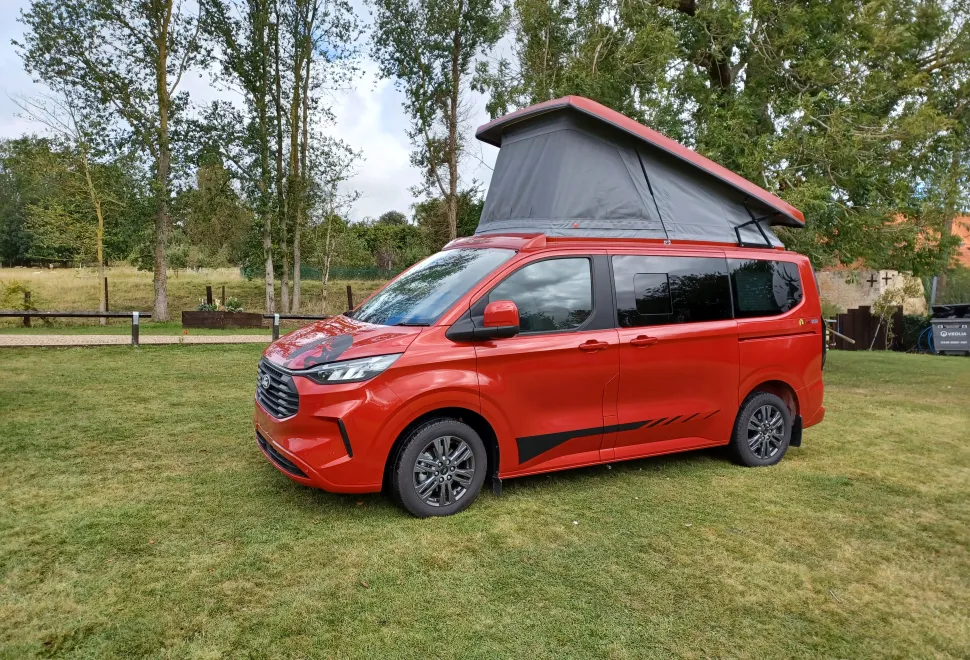
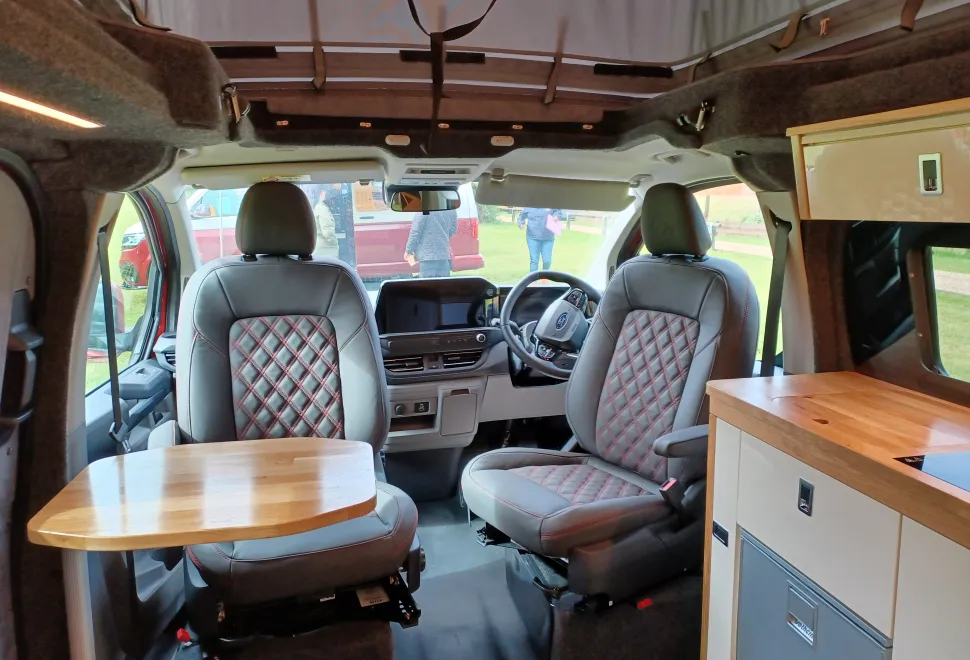
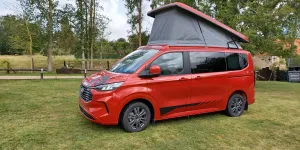
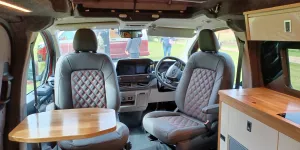
Artisan Red is one of six exterior colour choices for the Custom 2.0 and it certainly popped in the summer sunshine. With its dark tinted privacy glass and 17in Carbonised Grey alloy wheels, the Landseer looked premium and matched that inside as I settled into the Ash Grey leather seat with ‘Bentley-style’ red stitching.
With height and tilt adjustment, twin armrests, lumbar support and a tilting and extendable squab, the driver’s pew should allow all sizes of pilot to get the perfect position behind the reach/rake-adjustable wheel. Had it not been 29 degrees outside, I could also have enjoyed the three-stage bottom warmers...
You sit behind Ford’s oddly squared-off steering wheel, facing the latest in digital instrumentation, with a 13in touchscreen adjacent for sat-nav, music, phone and heating. Virtually everything is controlled via the SYNC4 display – not always the easiest when on the move but that seems to be the modern way!
What you can’t argue with is the way the Tourneo drives, although the latest Ford is wider than its predecessor and feels it in tight spaces.
Smooth and refined, with plenty of performance from the 170hp motor and imperceptible gearchanges through all eight ratios (standard spec is 150hp, six-speed manual), the Ford feels like a car, not a van. The ride is comfy, too, and there were absolutely no rattles from Landseer’s fittings, which speaks volumes for its attention to detail.
In the rear, you have room for three passengers (two with Isofix) and two additional, removable seats (£1,900 each) can be added to the floor rails to turn the camper into a seven-seater bus.
Check out the headroom, though, if you have lanky teenagers as anyone over six foot is likely to have their hair squashed against the underside of the roof bed. The surrounds for the blinds also restrict the view out through the tinted windows. For the driver, the height of the seat back means there is no through-view, so the digital rear view mirror (£1,150) might be worth considering.
That said, the Landseer comes with a reversing camera, front and rear parking sensors and twin-lens door mirrors. On the test campervan, these were powered folding mirrors as part of a new £1,530 Driver Assistance Package that also includes adaptive cruise control, the navigation centre and a Sensico steering wheel.
Features that come as standard are the stop/start, electronic stability control, lane assist, hill start assist, LED headlights, digital climate control, keyless entry, alarm and a choice of drive modes. Externally, the Landseer branding is the most obvious indication that this is a camper, with the colourkeyed SCA roof blending neatly when closed.
On the offside, you’ll also find flaps for the mains socket and fresh water filler. Both fresh and waste tanks are underslung, with 40 litres capacity each. The 2.6m Thule awning (with LED underlighting) is an £890 option.
Raising the roof
The German SCA pop-top is seen as a market-leading product and we’ve sampled it on a number of test vehicles. Here, it takes overall height to 2.10m, so some height-restricted car parks will still be OK – as long as you don’t opt for the 5G on-board WiFi system with its rooftop fin that adds about 5cm…
It’s easy enough to raise manually, after releasing belt ‘n’ braces twin latches on either side, giving over 2.30m headroom at the front of the camper. It’s also what’s called a panoramic roof with a huge, threesided flyscreened section in the front of the canvas.
That was much appreciated in the August heatwave, but had inclement weather arrived, it would have been zipped up, leaving just a small window on the offside to let in daylight.
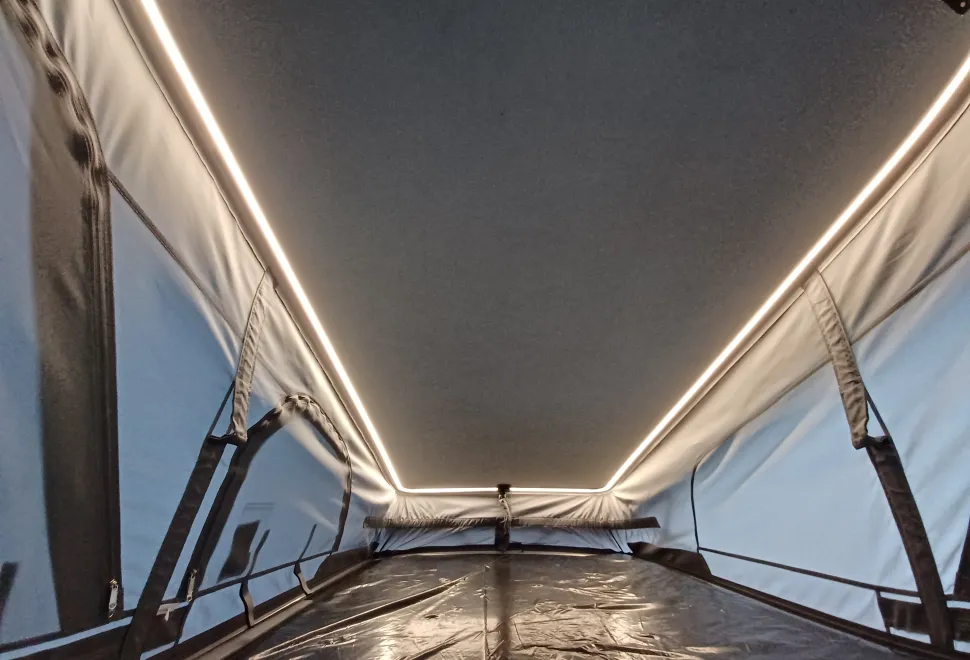
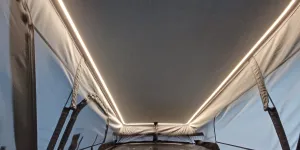
Other roofs offer a better mix of fresh air and light and Landseer has already moved to Reimo for the pop-tops on its LWB model. In the meantime, there’s no shortage of artificial lighting, with two long LED strips set into the base of the roof bed and a dimmable LED running right around the perimeter of the roof cap.
The best bit of the SCA roof, though, might be the roof bed. Measuring 1.98m by 1.20m, its 5cm-thick mattress sits on Caraflex plastic springs for superior comfort. A ladder is provided for adult access – kids will scramble up via the front seats! Two flexi-wand reading lights are fitted at the cab end, these also serving the swivelled chairs below.
Slide rules
Although Landseer joins the seemingly never-ending list of converters offering side kitchen layout pop-top campervans, it aims for the top of the market and first impressions are very promising when you slide back the side door.
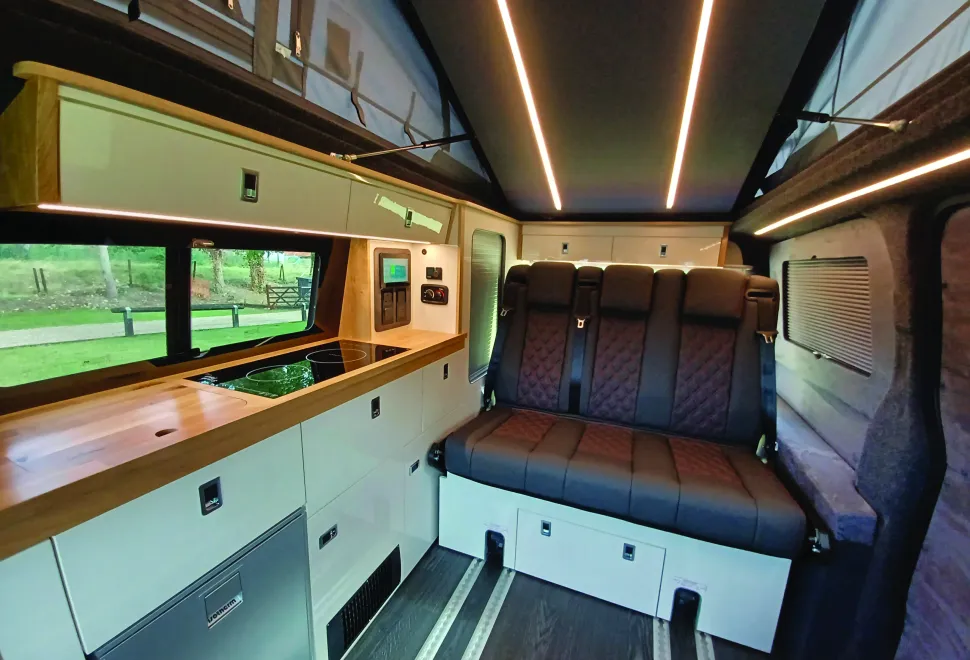
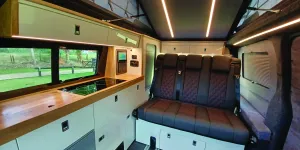
The swivel cab seats (which rotate without opening doors) and sliding rear bench look smart in the optional leather and, as the Schnierle settee can be locked anywhere along its floor tracking, that greatly increases the camper’s versatility. Meanwhile, facing you, the gloss cream cabinets (Highland Green Matte is a very attractive alternative) look well finished, topped with real oak worktops.
With the back seat pushed all the way forwards, the Tourneo returns to its load-lugging roots with a load bay over 1.70m long. Don’t go quite as far and you can have the kids conveniently close to the cab and still have huge space in the boot.
Or you can push the seat all the way back to the tailgate and enjoy maximum living and floor space inside, although then the boot area is reduced to zero (only really practical if you’ve decanted everything into a free-standing awning).
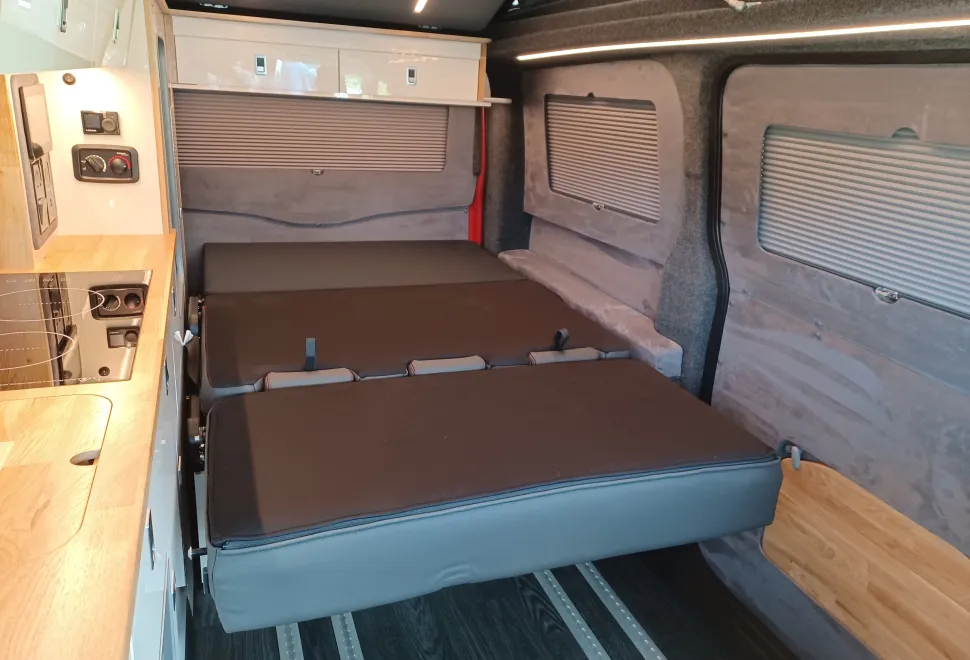
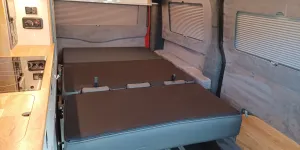
Usually when camping, you’ll have the seat in the position where it also makes the bed; in this mode there’s still a large boot area (above and below the rear mattress).
Above you can keep bedding, ready to unfurl at night, while below ‘our’ Landseer was supplied with a Brunner outdoor table and chairs as part of a new £479 option pack that also includes plates, a neat set of stackable pans and even a hob-top coffee pot.
Indoors, there are two tables – one on a cranked leg that’s perfect for the swivel passenger seat and a second free-standing one on a tripod base that’s far from ideal – small, tall and wobbly.
Unfortunately, with the rear section of mattress in the horizontal position, the tall cupboard alongside cannot be opened and one of the kitchen cupboards is also blocked. More practically, the shelved locker alongside the seat can always be accessed as it has a tambour door.
At night, the seat-to-bed transformation takes seconds if the bench is already in the right slot. The seat squab flips over and the backrest folds down, so you sleep on the reverse side of the seats. It’s a firm bed but completely flat and a mattress topper is available for £180 if you find it too hard (I didn’t).
The seat is 1.09m wide but an infill alongside takes bed width to a maximum of 1.28m. Folding the bed back into a seat takes a bit more effort as the backrest is quite heavy. Night-time privacy is by Vanshades blinds, with Reimo suckered-on thermal screens for the cab windows.
Side orders
Looks aside, the key difference with the Landseer kitchen is the absence of gas. Cooking is instead on a Sterling Power two-ring induction hob that’s as easy to use as the one at home. It does, however, require the right electrical backup if you’re not to be reliant on mains hook-ups, so a Clayton LPS II lithium power system is fitted.
As standard you get a 100Ah battery and 2,500W inverter, but here that was upgraded to 160Ah and 3,000W for an extra £840. It includes a jump-start feature for the vehicle battery and Landseer also fits a 240W solar panel on the roof as standard.
As a test of the off-grid capability, I eschewed the Caravan and Motorhome Club’s 230V hook-up post and relied on on-board power.
Arriving on the campsite in Southport with a full battery, I never saw power level drop below 40% on my two-night stay and, after the first full day’s wall-to-wall sunshine, the solar had me back to 100%.
Of course, I didn’t use the heating and cooking was simple fare for one but a certain amount of off-grid touring should be no problem at all – just don’t be too greedy turning on the AC power on the comprehensive control panel to run mains appliances.
The 12V system also powers the 42-litre compressor fridge. Above, the deep sink has a domestic-size outlet and a flush-fitting cover in matching oak to increase worktop space.
The sink was also supplied with hot water care of a Webasto Thermo Top diesel-fired blown-air heating and boiler unit. It’s a pricey (£1,445) option, especially as Landseer fits Webasto’s Air Top (also diesel but heating only) as standard. Going for the Thermo Top robs you of a kitchen drawer and raises the Porta Potti cupboard off the floor, above a heater outlet, making retrieval of the loo less convenient.
The galley also includes small top cupboards, both at the side and rear of the camper. In this spec there’s only one kitchen drawer, above the fridge, but there is a very useful slide-out store for tins and packets next to the fridge. Drop-down doors provide easy access to the main kitchen cupboards and all the storage is illuminated, which adds a premium touch.
The furniture also feels like a cut above the norm and there is virtually no paintwork on show inside the camper, although maybe less carpet trim would be better still.
Join the Out & About Live family
Get the latest news and exclusive offers direct to your inbox
Discover your inner outdoors with Out & About Live. For over 20 years we have provided the very best advice to motorhomers, campervanners, caravanners and campers – whether you are looking for travel advice, the very best campsites, help with choosing a new motorhome, news, shows, what’s on and much more – it’s all on Out & About Live.
We would love to welcome you to the family so sign up to our FREE email newsletters so you don’t miss out any longer.
Our Verdict
Landseer is a name that we’re sure to hear more of in the coming season. It has established itself with a high-quality pop-top camper sold through a dealer network and this Custom 2.0 has much to recommend it, using top-notch components from SCA, Schnierle and Clayton. With a gas-free and stylish design, it should be on your shopping list if you’re looking for a compact campervan.
Disadvantages


