
Carthago C-Tourer i 142
Image
Image
Image
Image
Image
Image
Image
Image
Image
Image
Image
Image






Key Features
Model Year
2012
Product Class
A-Class
Product Model Base
Fiat Ducato
Length (m)
6.85
Berths
4
Belted seats
5
Main Layout
Garage
Full Review
Before undertaking this evaluation, it seemed appropriate to consider exactly what it was being evaluating. Obviously, this C-Tourer’s practicality as a multi-berth motorhome needed to be affirmed, plus a stab at judging the appeal of this C-Tourer was essential, but another very important question presented itself.
But before posing that question, here’s an insight into the C-Tourer’s market placement: Carthago is a German manufacturer of motorhomes and that’s all it produces. Unlike many of the competitors, the firm doesn’t make touring caravans, static caravans, lodge homes, horseboxes or anything else...just motorhomes.
Carthago maintains that this tight focus means that it does one thing really well and that the loyalty of owners to the marque is proof of this. In the UK, Carthago established itself as maker of high-end A-class motorhomes, based originally on Mercedes-Benz (later, MAN) and Iveco chassis. The Liners are expensive, opulent and palatial.
For many, Carthago ownership would only ever be a dream. That was until the idea of broadening the marque’s appeal – offering a new range of low-profile and A-class coachbuilts. The majority of these were to be based upon a lighter-weight chassis (Fiat Ducato), and all were destined to have a more approachable price tag. Named Chic, the range hit the ground running and achieved significant sales in the UK and in mainland Europe, and is thought to be behind Carthago’s meteoric rise up to number-two motorhome producer in its home market of Germany.
The question
Recently the ‘Carthago for the masses’ philosophy was taken a stage further by the unveiling of a new range, monikered C-Tourer, which claims to offer high quality, but in a product aimed at what Carthago describes as the lower middle range. This claim is what prompted the important question: has this premium German motorhome manufacturer cheapened its product merely to boost sales during a recession, or does the new C-Tourer range genuinely offer premium build quality at a more affordable price? Let’s look at the evidence...
Accommodating
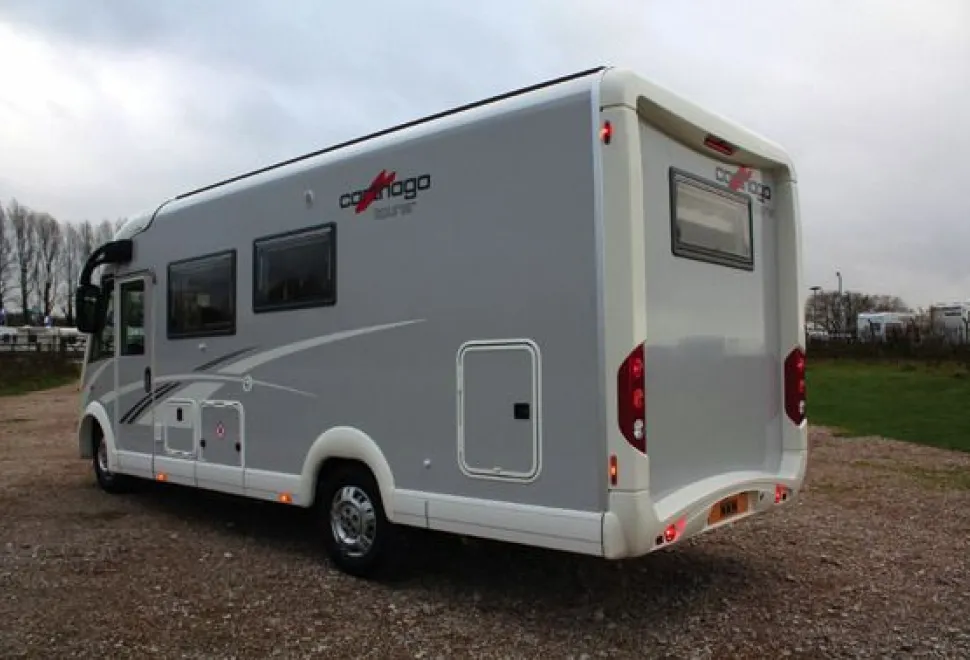
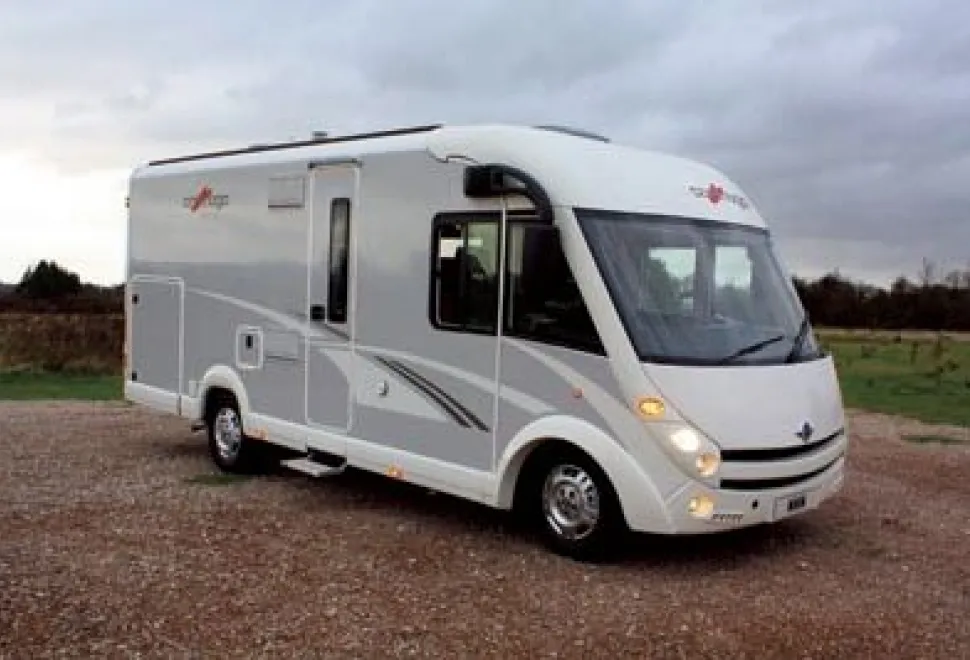
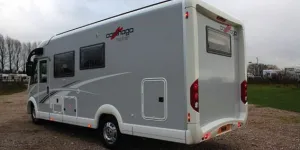
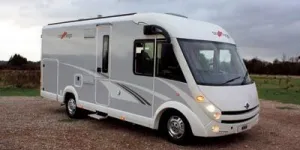
As in the majority of A-classes the interior felt much roomier than the reasonably modest overall length (6.85m/22ft 5.5in) might have suggested. The entrance door is centrally placed on the UK offside and once aboard, turn right for the forward lounge and left for the kitchen and washroom, which are ahead of the permanent high-level transverse bed at the far rear. A tried and tested layout and a popular one with purchasers who wish for a garage, but crucially, who are lithe enough for the ‘trapped’ partner to climb over the other during nocturnal visits to the loo.
On the road
Reduced price? Certainly in comparison with the Liners, but that doesn’t mean an inadequate chassis: the Ducato Heavy chassis-cowl continues to deliver, especially when it’s mated to the low-height, wide-track Fiat frame pulled along by the new 150bhp version of the 2.3-litre Multijet II motor. This Euro 5 lump is equipped with VGT (variable geometry turbocharger) and the very latest in multi-point fuel injection technology.
Comfort-Matic, Fiat’s top-tackle automated transmission is available as an extra-cost option, though on the test vehicle, manual cog-swapping was the order of the day. Not that this was in any way an effort or awkward, or indeed, anything but a delight. In fact, the driving environment fitted like a glove. In short, I just got in and headed for the open road, no faffing about with over-high seat squabs or spending ages trying to adjust the exterior mirrors in an attempt to gain a reasonable view rearwards.
Actually, as the driving experience was significantly better than in many rivals that looked identical on paper, I thought it worthwhile teasing out exactly how the pointy-heads at Carthago had achieved this. Success starts with a good view out through the curved – slightly wrap-around – windscreen, past commendably skinny A-pillars, and over the sloping dashboard top and low bottom edges to all cab windows. Genuinely panoramic rear view mirrors are assisted by a well-placed monitor for the reversing/rear vision camera. Aguti Roadline cab pews are the best seats in this particular house. Brilliantly sculpted to give effective lumbar support, and with just the right amount of resilience in the cushions, these are firmly supportive, but without that ‘perched on a park bench’ feeling.
Sitting
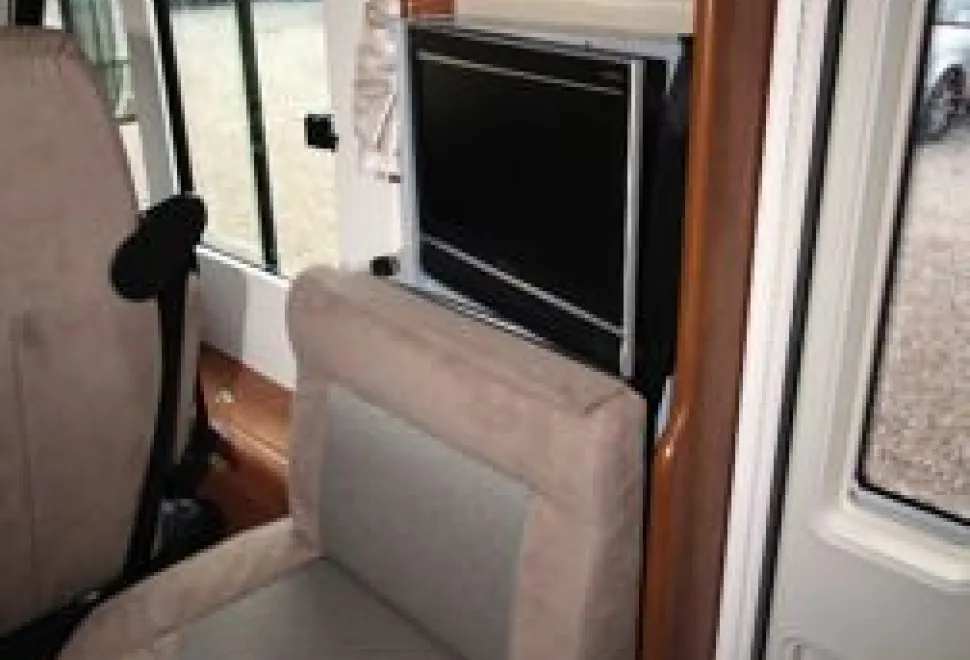
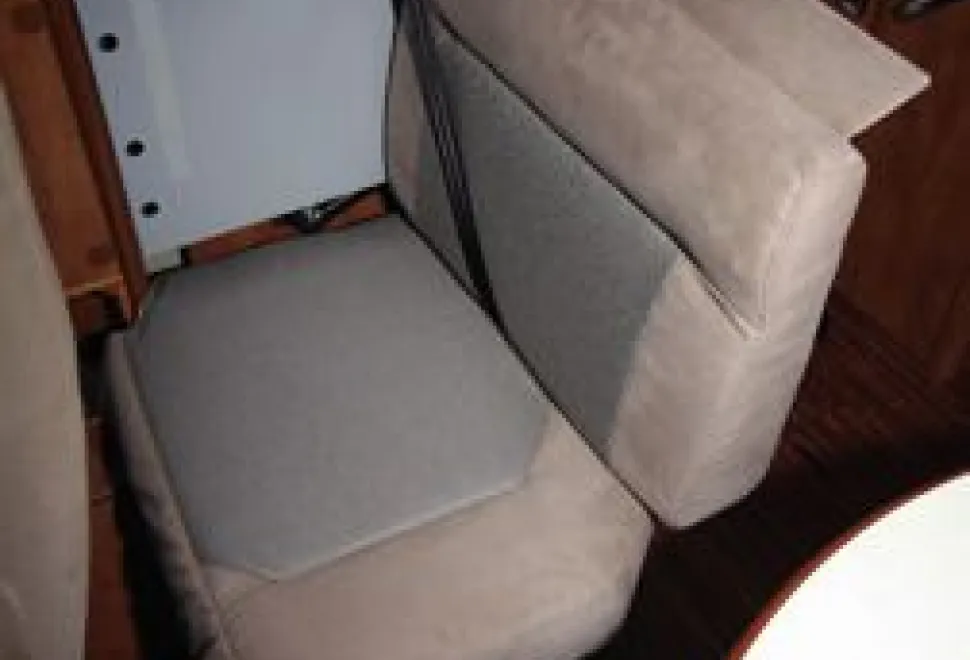
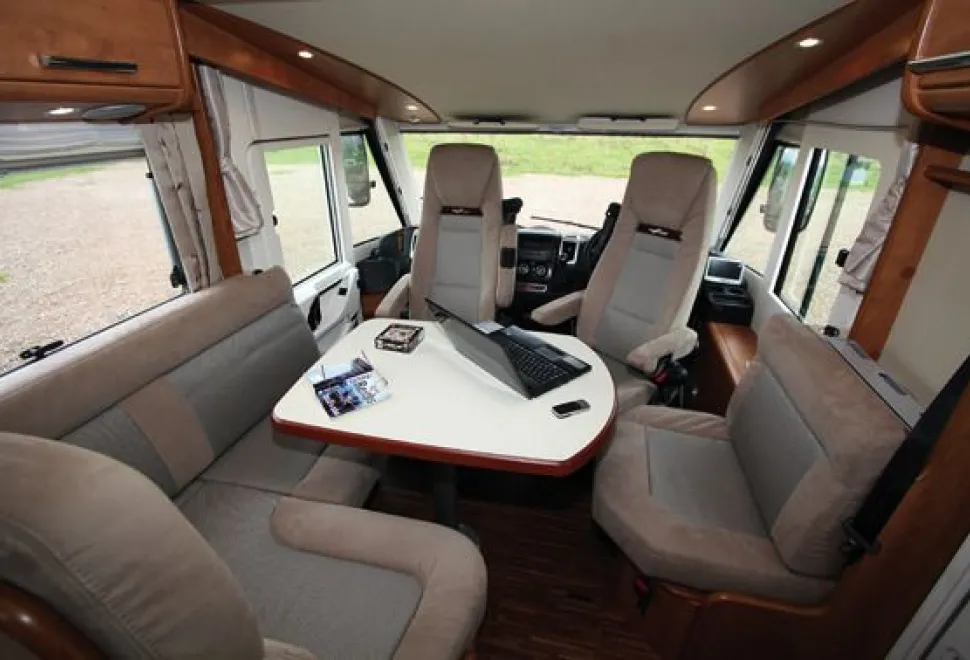
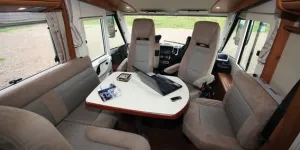
Good then, that the lounge makes full use of the cab seats when swivelled. Further backside parking is available via an L-shaped settee on the nearside and a single inward-facing seat opposite, along the offside wall. A chunk of the L-shaped settee squab is removable to accommodate the outer passenger’s legs when the forward-facing section is in double travel seat mode. The whole looked well-executed for safe passenger travel. But I am unsure about its counterpart across the aisle. Someone travelling in this seat will have no adjacent window to look out of, a squab that is only partially supported, no metal frame for the backrest, no anti-submarine squab and no head restraint. As this is a four berth ‘van that already has four travel seats, I wonder why this extra seat has been included.
That aside, the area functions well on site, both when dining and when lounging. A pillar-mounted table slides every which way and can be locked in just about any position you might wish it to be in. It’s almost rectangular in shape, but with one of the shorter sides curved to allow easier pass-by for those of us built for comfort rather than speed.
A slight downside to having so much glass in the living area is that there is a lot of glass in the living area! Whilst it’s a real benefit on dark gloomy days, it can seem like sitting in a greenhouse especially when the sun is blazing through the tour bus-sized windscreen. However, Carthago’s designers have applied themselves to this problem and come up with a clever solution of sublime simplicity. Most installations of electrically-operated front blinds can be partially lowered from the top to use as a sun blind when driving or on site. The problem is, or rather was, that they cannot the sun is low or for privacy plus natural light in the mornings. Huzzah! The ones in C-Tourer can be opened from the top or the bottom.
A 19-inch telly pops up from behind the single offside inward-facing seat. Both the TV and the mounting system (rather amusingly named the ‘Quick up’) are extra-cost options to the basic spec. As with many German motorhomes, the basic retail price is just that and doesn’t include a fair bit of kit that British manufacturers often provide as standard. To guide us through the (frankly baffling) number of available extras, upgrades and extras packs, Lowdham Leisureworld recommends that, as with the demonstrator, six individually-available extras and upgrades plus five option packs are added. Listen to Lowdhams, as this advice is sound and offers a considerable advantage over individual box-ticking on the options list: my back-of-an-envelope calculations suggested cost savings of around 35 per cent.
Cooking
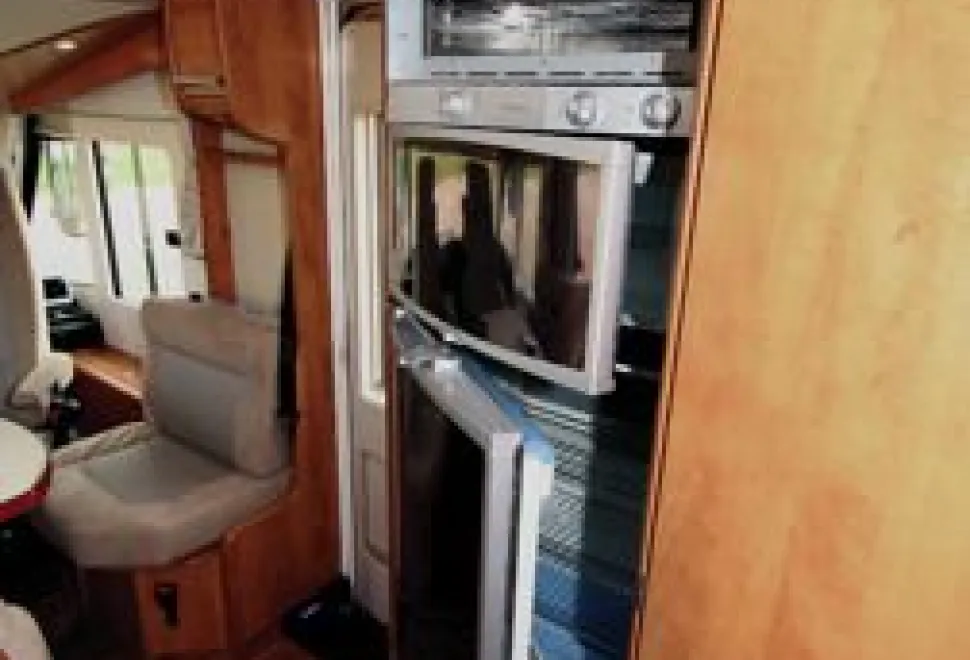
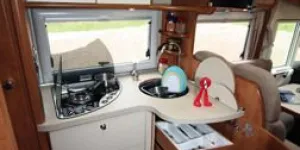
The C-Tourer’s galley is split either side of the central aisle with the controversial TEC tower fridge/oven unit on the offside and all the rest on the nearside. Controversial because almost inevitably this unit places the oven too high off the floor for most to use comfortably and safely, except for those in possession of contraband ‘Sarkozy’ shoe lifts. Mature reflection revealed that it needn’t have been so high if the tower had been mounted on the floor and not raised up – and no, it isn’t because a wheelarch is in the way!
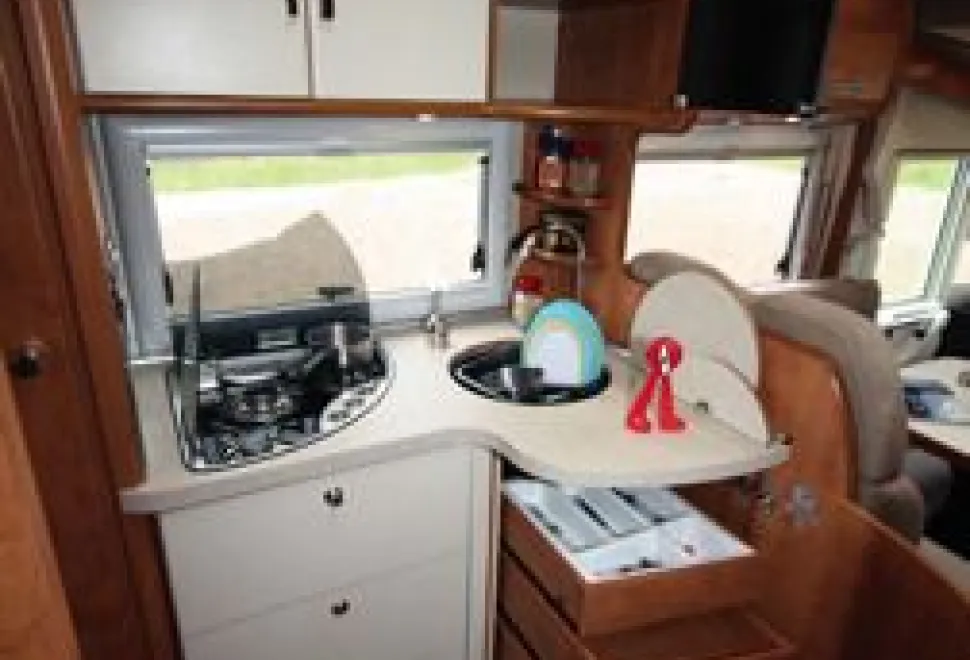
The rest of the kitchen is superb, and a pleasant place to create meals. Management and I feel you can’t have too many drawers in a kitchen, much preferring them to undivided cupboards, and to those other inefficient users of space – slide-out wire baskets. There are six deep drawers here, mounted on roller slides and just begging to be filled with stuff. Perfect! Task lighting, and 99 per cent of the artificial lighting throughout the interior, is by LEDs, so will draw far less current than conventional incandescent and halogen bulbs.
Convenience
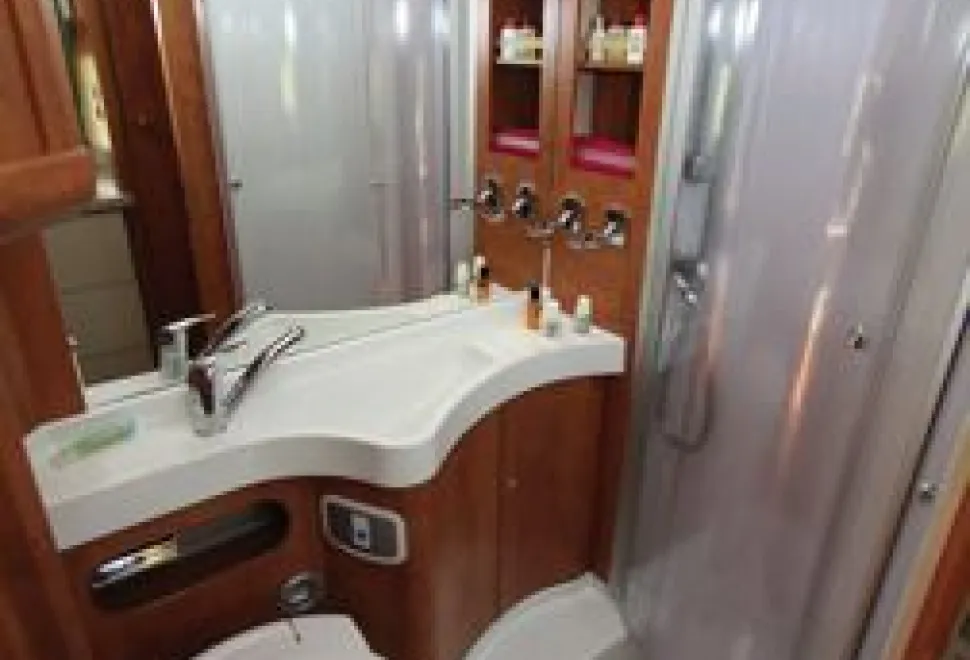
Well thought-out, well-finished, well-equipped and well...very convenient. On balance, and in this size of motorhome, we would rather have this type of open-plan washroom/showering area – with more elbow room around the washbasin and loo – than a separate walk-in shower cubicle. That said, with this arrangement, we would miss the usefulness ?of a separate cubicle as a drying area for wet coats and the like.
Sleeping
If you find you can’t sleep well in this C-Tourer then it’s likely to be your conscience troubling you rather than a problem over the comfort or sizes of the beds.
As mentioned previously, there is the usual issue over ‘trapping’ one partner against the wall that is a downside to all transverse beds. If this bothers you, there are others in this range that offer unimpeded access to their permanent beds, either as two singles or an island double.
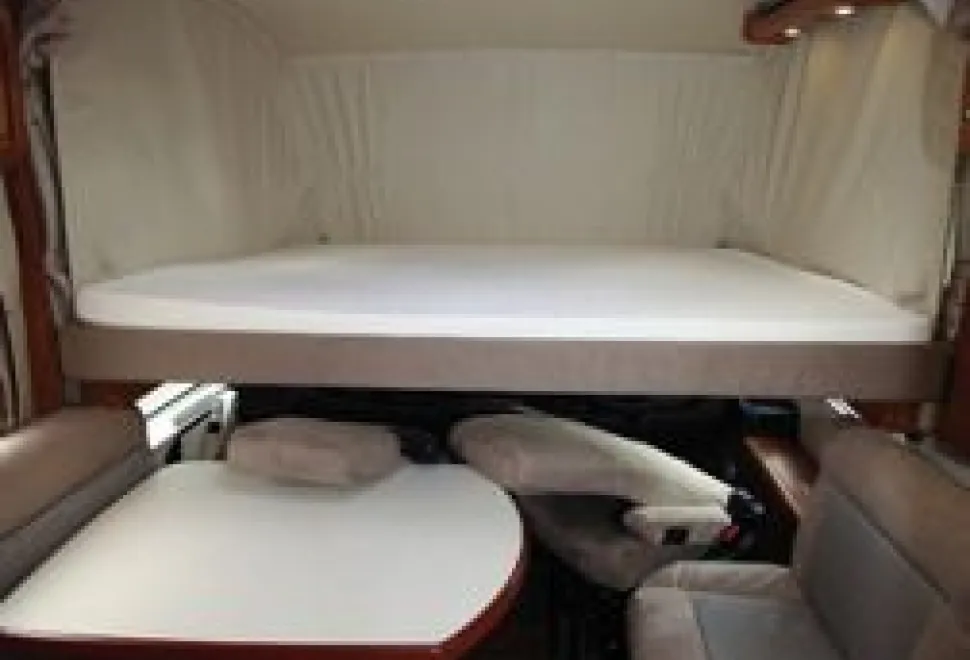
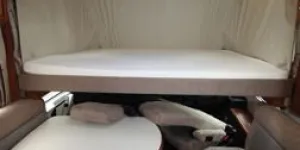
The A-class, in-cab, drop-down double lowers sufficiently for most folks to be able to hop up from the adjacent seats – much kinder to bare feet than aluminium access ladders. To enable the bed to drop down this low, the cab seatbacks have to be folded down, with quick-release mechanisms allowing this to be accomplished in a jiffy. Underneath the rear transverse double bed is a small supplementary wardrobe, curtained off from the main garage.
Storing
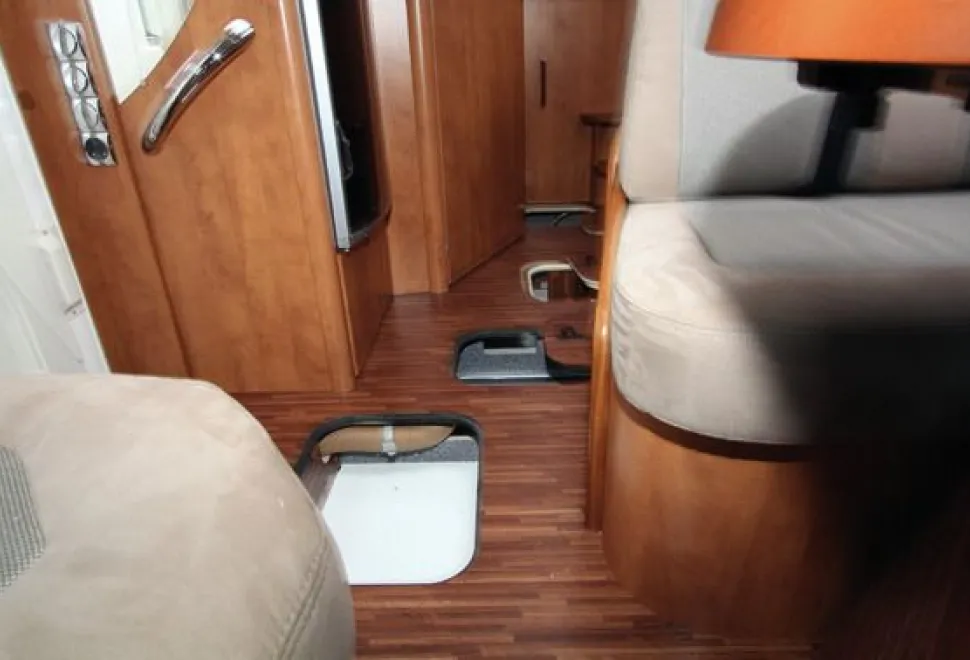
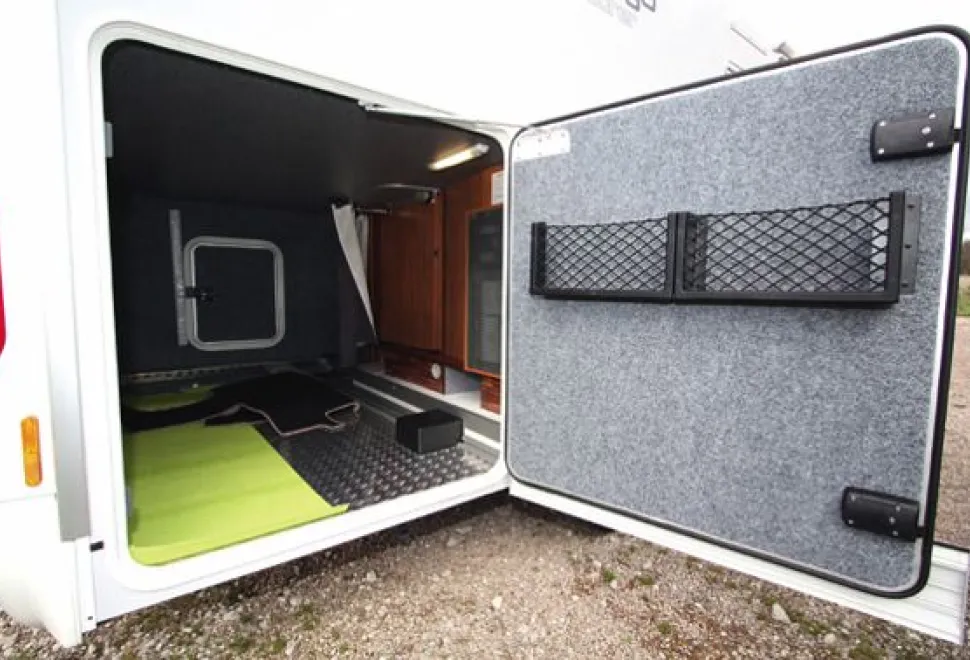
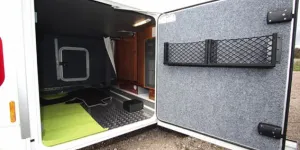
Lowdhams has sensibly specified some upgrades for the methods of stowage in the garage, addressing minor criticisms folk may have had. In addition, the double floor throughout the rest of the ‘van creates storage voids, separated from the salon, but protected from the elements. The estimated payload of 1,120kg shouldn’t be far out. Even with the worst case scenario, say it’s 10 per cent optimistic, there should be ample carrying capacity for everybody and anybody except, perhaps, gold bullion smugglers.
Any doubts, insist on a trip to a weighbridge, then do the sums before parting with your hard-earned.
Undressing
If you just read one section of this report make sure it’s this one. So far I’ve dealt with what you can see, not what lies beneath the surface, and which ?is equally important. Carthago’s Liner range gained an enviable reputation for the integrity of its body, and this was largely due to using both-sides aluminium-clad panels, employing a timberless superstructure and avoiding any thermal bridges.
Further, the thicker-than-many marine plywood lower floor is protected from the ravages of road and weather by a GRP cladding. All of the above makes the body much less likely to leak or suffer condensation damage than those that use softwood and wallboard in their construction. And should the worst occur, say unscheduled contact with overhanging branches or over-friendliness with a farm-site gatepost, the damage shouldn’t spread. The older a C-Tourer gets, the more apparent these advantages should become.
Conclusion
An interesting and welcome new range that will appeal to experienced motorcaravanners who have learnt that motorcaravan appeal is more than skin deep. Not perfect, but it delighted far more often than it disappointed.
The answer
Carthago may have ‘cheapened’ its product in order to boost sales during a recession, but the C-Tourer range genuinely offers premium build quality at a more affordable price. Congratulations are due, and thanks go to importer, Lowdham Leisureworld, for tempting us with these Teutonic treats.
To read the full motorhome review in PDF format exactly as it appeared in the March 2012 issue of MMM, click here.
But before posing that question, here’s an insight into the C-Tourer’s market placement: Carthago is a German manufacturer of motorhomes and that’s all it produces. Unlike many of the competitors, the firm doesn’t make touring caravans, static caravans, lodge homes, horseboxes or anything else...just motorhomes.
Carthago maintains that this tight focus means that it does one thing really well and that the loyalty of owners to the marque is proof of this. In the UK, Carthago established itself as maker of high-end A-class motorhomes, based originally on Mercedes-Benz (later, MAN) and Iveco chassis. The Liners are expensive, opulent and palatial.
For many, Carthago ownership would only ever be a dream. That was until the idea of broadening the marque’s appeal – offering a new range of low-profile and A-class coachbuilts. The majority of these were to be based upon a lighter-weight chassis (Fiat Ducato), and all were destined to have a more approachable price tag. Named Chic, the range hit the ground running and achieved significant sales in the UK and in mainland Europe, and is thought to be behind Carthago’s meteoric rise up to number-two motorhome producer in its home market of Germany.
The question
Recently the ‘Carthago for the masses’ philosophy was taken a stage further by the unveiling of a new range, monikered C-Tourer, which claims to offer high quality, but in a product aimed at what Carthago describes as the lower middle range. This claim is what prompted the important question: has this premium German motorhome manufacturer cheapened its product merely to boost sales during a recession, or does the new C-Tourer range genuinely offer premium build quality at a more affordable price? Let’s look at the evidence...
Accommodating
As in the majority of A-classes the interior felt much roomier than the reasonably modest overall length (6.85m/22ft 5.5in) might have suggested. The entrance door is centrally placed on the UK offside and once aboard, turn right for the forward lounge and left for the kitchen and washroom, which are ahead of the permanent high-level transverse bed at the far rear. A tried and tested layout and a popular one with purchasers who wish for a garage, but crucially, who are lithe enough for the ‘trapped’ partner to climb over the other during nocturnal visits to the loo.
On the road
Reduced price? Certainly in comparison with the Liners, but that doesn’t mean an inadequate chassis: the Ducato Heavy chassis-cowl continues to deliver, especially when it’s mated to the low-height, wide-track Fiat frame pulled along by the new 150bhp version of the 2.3-litre Multijet II motor. This Euro 5 lump is equipped with VGT (variable geometry turbocharger) and the very latest in multi-point fuel injection technology.
Comfort-Matic, Fiat’s top-tackle automated transmission is available as an extra-cost option, though on the test vehicle, manual cog-swapping was the order of the day. Not that this was in any way an effort or awkward, or indeed, anything but a delight. In fact, the driving environment fitted like a glove. In short, I just got in and headed for the open road, no faffing about with over-high seat squabs or spending ages trying to adjust the exterior mirrors in an attempt to gain a reasonable view rearwards.
Actually, as the driving experience was significantly better than in many rivals that looked identical on paper, I thought it worthwhile teasing out exactly how the pointy-heads at Carthago had achieved this. Success starts with a good view out through the curved – slightly wrap-around – windscreen, past commendably skinny A-pillars, and over the sloping dashboard top and low bottom edges to all cab windows. Genuinely panoramic rear view mirrors are assisted by a well-placed monitor for the reversing/rear vision camera. Aguti Roadline cab pews are the best seats in this particular house. Brilliantly sculpted to give effective lumbar support, and with just the right amount of resilience in the cushions, these are firmly supportive, but without that ‘perched on a park bench’ feeling.
Sitting
Good then, that the lounge makes full use of the cab seats when swivelled. Further backside parking is available via an L-shaped settee on the nearside and a single inward-facing seat opposite, along the offside wall. A chunk of the L-shaped settee squab is removable to accommodate the outer passenger’s legs when the forward-facing section is in double travel seat mode. The whole looked well-executed for safe passenger travel. But I am unsure about its counterpart across the aisle. Someone travelling in this seat will have no adjacent window to look out of, a squab that is only partially supported, no metal frame for the backrest, no anti-submarine squab and no head restraint. As this is a four berth ‘van that already has four travel seats, I wonder why this extra seat has been included.
That aside, the area functions well on site, both when dining and when lounging. A pillar-mounted table slides every which way and can be locked in just about any position you might wish it to be in. It’s almost rectangular in shape, but with one of the shorter sides curved to allow easier pass-by for those of us built for comfort rather than speed.
A slight downside to having so much glass in the living area is that there is a lot of glass in the living area! Whilst it’s a real benefit on dark gloomy days, it can seem like sitting in a greenhouse especially when the sun is blazing through the tour bus-sized windscreen. However, Carthago’s designers have applied themselves to this problem and come up with a clever solution of sublime simplicity. Most installations of electrically-operated front blinds can be partially lowered from the top to use as a sun blind when driving or on site. The problem is, or rather was, that they cannot the sun is low or for privacy plus natural light in the mornings. Huzzah! The ones in C-Tourer can be opened from the top or the bottom.
A 19-inch telly pops up from behind the single offside inward-facing seat. Both the TV and the mounting system (rather amusingly named the ‘Quick up’) are extra-cost options to the basic spec. As with many German motorhomes, the basic retail price is just that and doesn’t include a fair bit of kit that British manufacturers often provide as standard. To guide us through the (frankly baffling) number of available extras, upgrades and extras packs, Lowdham Leisureworld recommends that, as with the demonstrator, six individually-available extras and upgrades plus five option packs are added. Listen to Lowdhams, as this advice is sound and offers a considerable advantage over individual box-ticking on the options list: my back-of-an-envelope calculations suggested cost savings of around 35 per cent.
Cooking
The C-Tourer’s galley is split either side of the central aisle with the controversial TEC tower fridge/oven unit on the offside and all the rest on the nearside. Controversial because almost inevitably this unit places the oven too high off the floor for most to use comfortably and safely, except for those in possession of contraband ‘Sarkozy’ shoe lifts. Mature reflection revealed that it needn’t have been so high if the tower had been mounted on the floor and not raised up – and no, it isn’t because a wheelarch is in the way!
The rest of the kitchen is superb, and a pleasant place to create meals. Management and I feel you can’t have too many drawers in a kitchen, much preferring them to undivided cupboards, and to those other inefficient users of space – slide-out wire baskets. There are six deep drawers here, mounted on roller slides and just begging to be filled with stuff. Perfect! Task lighting, and 99 per cent of the artificial lighting throughout the interior, is by LEDs, so will draw far less current than conventional incandescent and halogen bulbs.
Convenience
Well thought-out, well-finished, well-equipped and well...very convenient. On balance, and in this size of motorhome, we would rather have this type of open-plan washroom/showering area – with more elbow room around the washbasin and loo – than a separate walk-in shower cubicle. That said, with this arrangement, we would miss the usefulness ?of a separate cubicle as a drying area for wet coats and the like.
Sleeping
If you find you can’t sleep well in this C-Tourer then it’s likely to be your conscience troubling you rather than a problem over the comfort or sizes of the beds.
As mentioned previously, there is the usual issue over ‘trapping’ one partner against the wall that is a downside to all transverse beds. If this bothers you, there are others in this range that offer unimpeded access to their permanent beds, either as two singles or an island double.
The A-class, in-cab, drop-down double lowers sufficiently for most folks to be able to hop up from the adjacent seats – much kinder to bare feet than aluminium access ladders. To enable the bed to drop down this low, the cab seatbacks have to be folded down, with quick-release mechanisms allowing this to be accomplished in a jiffy. Underneath the rear transverse double bed is a small supplementary wardrobe, curtained off from the main garage.
Storing
Lowdhams has sensibly specified some upgrades for the methods of stowage in the garage, addressing minor criticisms folk may have had. In addition, the double floor throughout the rest of the ‘van creates storage voids, separated from the salon, but protected from the elements. The estimated payload of 1,120kg shouldn’t be far out. Even with the worst case scenario, say it’s 10 per cent optimistic, there should be ample carrying capacity for everybody and anybody except, perhaps, gold bullion smugglers.
Any doubts, insist on a trip to a weighbridge, then do the sums before parting with your hard-earned.
Undressing
If you just read one section of this report make sure it’s this one. So far I’ve dealt with what you can see, not what lies beneath the surface, and which ?is equally important. Carthago’s Liner range gained an enviable reputation for the integrity of its body, and this was largely due to using both-sides aluminium-clad panels, employing a timberless superstructure and avoiding any thermal bridges.
Further, the thicker-than-many marine plywood lower floor is protected from the ravages of road and weather by a GRP cladding. All of the above makes the body much less likely to leak or suffer condensation damage than those that use softwood and wallboard in their construction. And should the worst occur, say unscheduled contact with overhanging branches or over-friendliness with a farm-site gatepost, the damage shouldn’t spread. The older a C-Tourer gets, the more apparent these advantages should become.
Conclusion
An interesting and welcome new range that will appeal to experienced motorcaravanners who have learnt that motorcaravan appeal is more than skin deep. Not perfect, but it delighted far more often than it disappointed.
The answer
Carthago may have ‘cheapened’ its product in order to boost sales during a recession, but the C-Tourer range genuinely offers premium build quality at a more affordable price. Congratulations are due, and thanks go to importer, Lowdham Leisureworld, for tempting us with these Teutonic treats.
To read the full motorhome review in PDF format exactly as it appeared in the March 2012 issue of MMM, click here.
Our Verdict
Although billed as Carthago’s budget range, this A-class is still priced at £62,315, with our test vehilce costing £74,850 so it’s hardly a budget vehicle. But it still delivers a premier top-of-the-line offering packed with Teutonic treats.
Advantages
High quality of construction throughout
Comfy Aguti captains chairs in cab
Smooth and stylish exterior
Carthago cache
Disadvantages
Oven mounted too high
Unnecessary fifth travel seat


